The 7 Crystal Systems
Cubic to triclinic — the seven geometric families that every crystal belongs to, and the everyday stones that show them off.
Crystal geometry · Structure
Every crystalline mineral belongs to one of seven crystal systems, defined by the symmetry of its internal atomic lattice: cubic, tetragonal, hexagonal, trigonal, orthorhombic, monoclinic and triclinic. The system determines a crystal’s natural shape, its angles, how it breaks (its cleavage) and often its durability. Fluorite and pyrite are cubic; quartz is trigonal; selenite is monoclinic; labradorite is triclinic. A handful of materials, such as opal and obsidian, have no ordered structure at all and are called amorphous.
Pick up a quartz point and a cube of pyrite and you are holding two different answers to the same question: how do a mineral’s atoms like to stack? The shape of a well-grown crystal is not decorative chance — it is the visible signature of an invisible pattern repeating billions of times inside the stone. Crystallographers sort those patterns into seven families, the crystal systems, and once you know them you start to read a crystal’s structure straight from its faces.
Here is a plain-language tour of all seven, each with familiar stones you may already own, plus the “eighth” category for materials that break the rules.
What is a crystal system?
A crystal system is a way of grouping crystals by the symmetry of their internal lattice — described using imaginary reference lines called crystallographic axes and the angles between them. Think of it as the geometric rulebook the atoms follow as they stack. Because the lattice repeats identically in every direction, it forces the crystal to grow with characteristic faces and fixed angles. Seven distinct rulebooks cover every crystalline mineral on Earth. (This is a companion to our guide on how crystals form, which explains where that growth happens.)
1. Cubic (isometric)
The most symmetrical system, built on three equal axes at right angles. Cubic minerals grow as cubes, octahedra and dodecahedra. Classic examples are fluorite (perfect cubes and octahedra), pyrite (its striated brassy cubes are unmistakable), garnet (rounded dodecahedra) and diamond. Because they are equally strong in all directions, cubic crystals often have no single easy break — though fluorite is a famous exception, splitting cleanly into octahedra.
2. Tetragonal
Like the cubic system stretched or squashed along one axis: three axes at right angles, but one longer or shorter than the other two. The result is four-sided prisms and pyramids. Zircon and rutile (the golden needles inside rutilated quartz) are tetragonal, as is the classic blue variety of apophyllite.
3 & 4. Hexagonal and trigonal
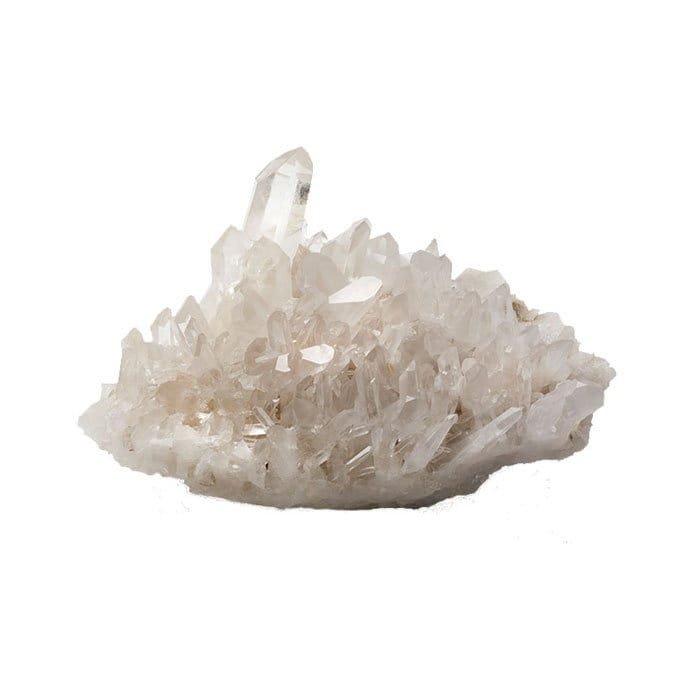
These closely related systems are built around a principal axis of six-fold (hexagonal) or three-fold (trigonal) symmetry, giving six-sided prisms and rhombohedra. This is one of the most important families for collectors. Quartz — and therefore amethyst, citrine and smoky quartz — is trigonal, which is why quartz points are six-sided. Beryl, the family of aquamarine and emerald, is hexagonal, as are tiger’s eye‘s parent quartz and calcite.
5. Orthorhombic
Three unequal axes, all still at right angles. Orthorhombic crystals tend to form rhombic prisms and tabletop shapes. Topaz, aragonite, peridot and the gem iolite (cordierite) belong here. Their unequal axes often give clear, directional cleavage.
6. Monoclinic
The largest system by number of minerals. Three unequal axes, with one pair meeting at an oblique (non-right) angle. Shapes are prismatic and often “leaning.” Key stones include selenite (gypsum), malachite, azurite, jadeite jade and the micas such as lepidolite — whose stacked-sheet structure lets them peel into thin flakes.
7. Triclinic
The least symmetrical system: three unequal axes, none at right angles. This lopsided geometry produces irregular-looking crystals — and some of the most beautiful optical effects. The feldspars live here, including labradorite (whose internal layering causes its blue flash), amazonite and moonstone, along with the blade-like crystals of kyanite, whose hardness even varies with direction.
The exception: amorphous materials
Not everything sold as a “crystal” has a crystal system at all. Amorphous materials have no long-range ordered lattice, so they belong to none of the seven. Obsidian is volcanic glass; opal is a hardened silica gel of packed micro-spheres; amber is fossilised resin. They can be gorgeous and are widely used, but strictly speaking they are not crystalline.
Crystal systems are a matter of mineralogy and physics, not medicine. In crystal healing, stones are used as a symbolic focus for reflection — a spiritual tradition, not a treatment. No crystal, of any system, treats, cures or prevents illness, and nothing here is intended to diagnose or treat any condition. Enjoy the geometry for its own sake, and see a qualified professional for any health concern.
Why the crystal system matters
This is more than trivia. A crystal’s system governs its cleavage — the directions in which it splits — which is why selenite peels into sheets while quartz fractures like glass. It influences durability and how a stone should be cut, and it explains striking optical effects such as labradorite’s flash and kyanite’s directional hardness. For anyone caring for a collection, structure also hints at fragility: sheet-like and soft monoclinic stones need gentler handling, a theme we cover in our guide to cleansing and charging crystals. Knowing the system even helps you spot fakes, since a moulded glass “crystal” shows none of the true faces and cleavage of the real mineral.
Learn to notice the shape, and every specimen starts telling you how it is built — from the humblest tumbled stone to a museum-grade point.
Well-formed natural specimens
If you’d like a crystal that shows its natural faces, Minerals Kingdom offers authenticated points, clusters and raw specimens across every crystal system.