Aragonite
A calcium carbonate that grows in glowing reddish-brown “sputnik” clusters — the same mineral that builds pearls and seashells, a soft and water-shy stone, and read in the crystal world as a grounding anchor for scattered energy.
Carbonate · Grounding & stability
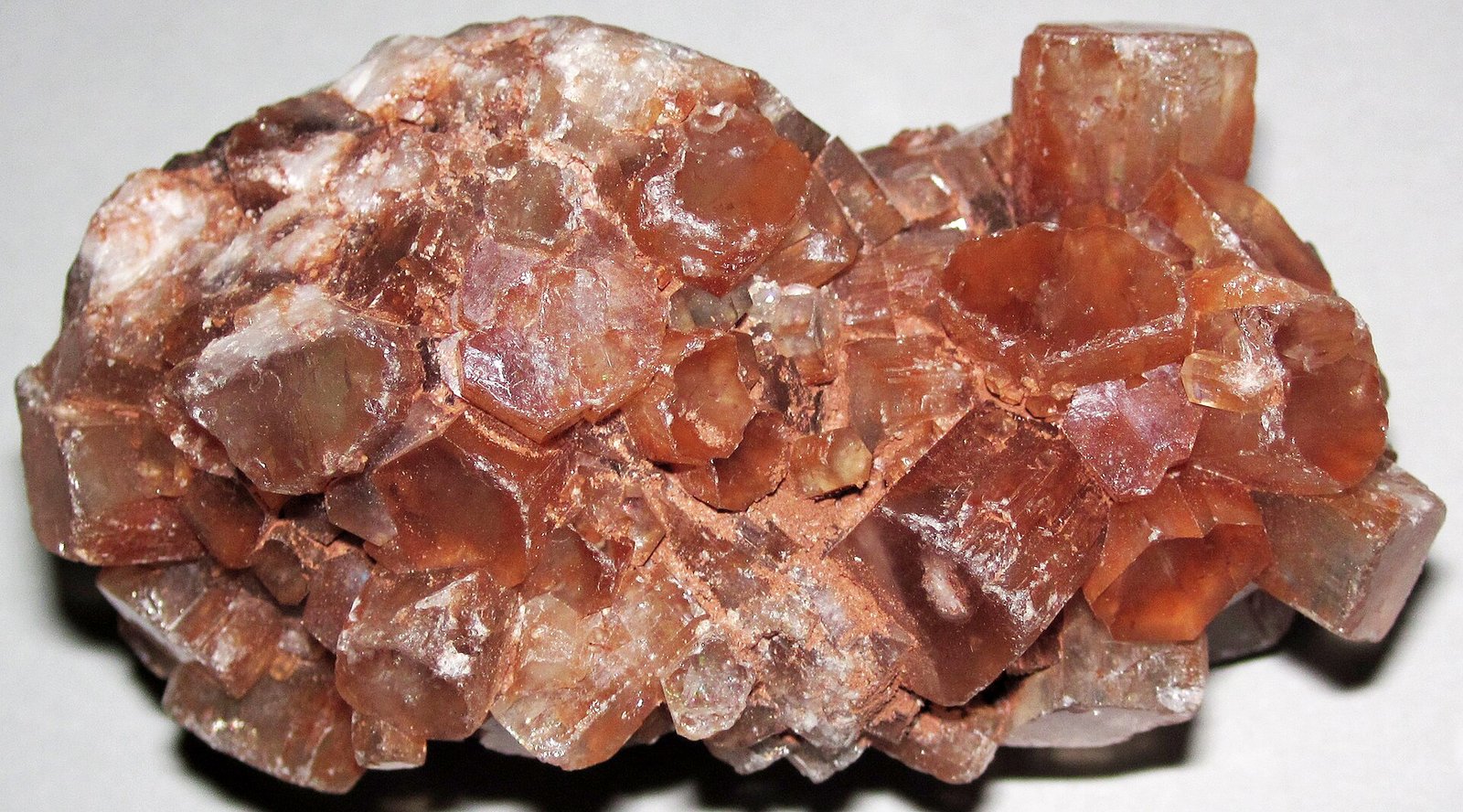
In short Aragonite is a calcium carbonate, CaCO3 — chemically identical to calcite, but with a different crystal structure, which makes the two polymorphs. Its most familiar form is the warm reddish-brown “sputnik” star cluster from Morocco, radiating spokes of stubby crystals. It is also the mineral of pearls, coral and mother-of-pearl, quietly built by living things. In the crystal tradition it is a root and earth-star stone of grounding, patience and stability. Because it is soft and reacts with acids, this guide treats care seriously — no soaking, no salt, and no vinegar anywhere near it.
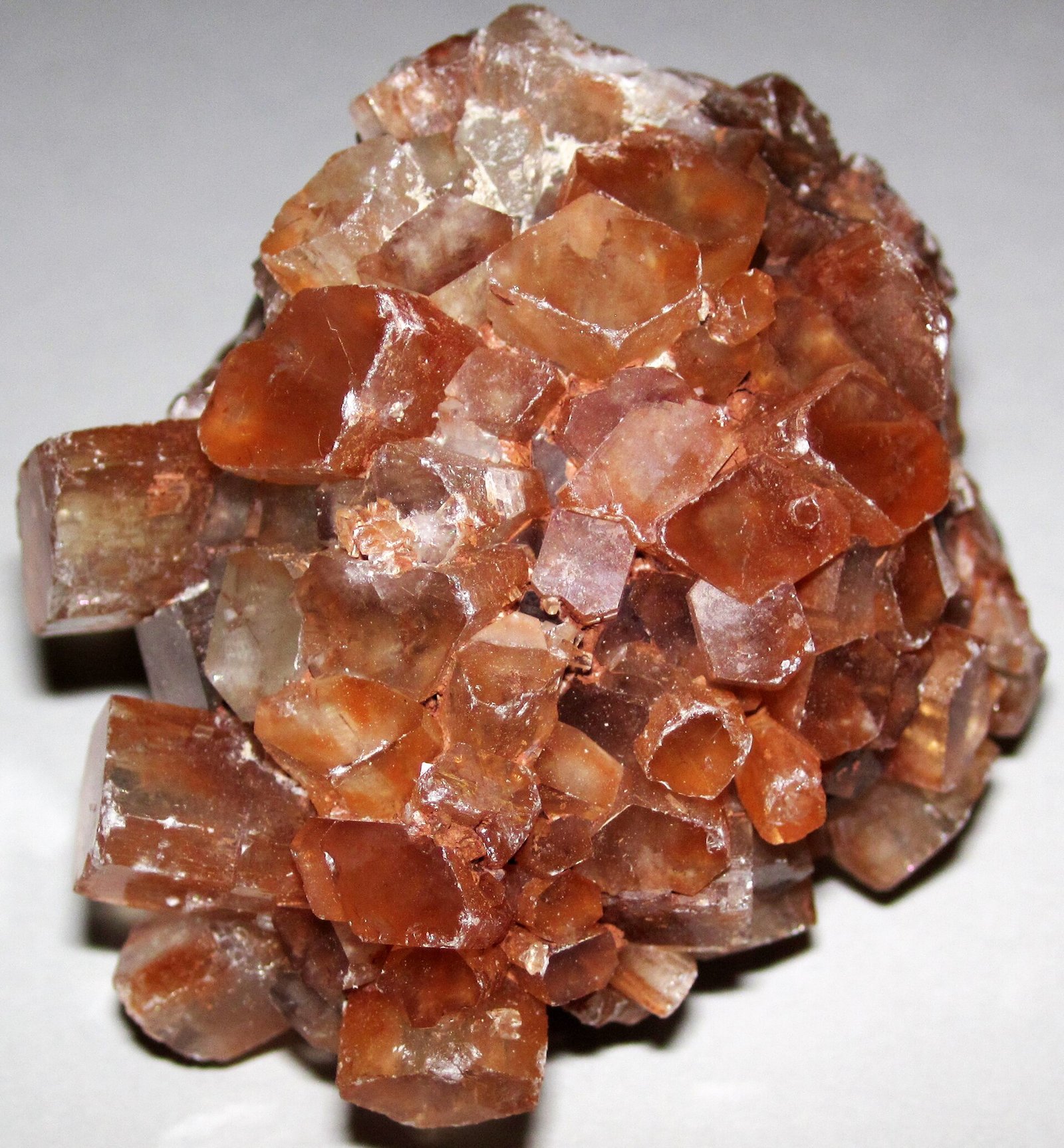
Aragonite is one of those minerals that looks designed: reddish-brown crystals radiating from a central point like a burst of fireworks or a tiny satellite, which is exactly why collectors nickname the Moroccan clusters “sputniks.” It is warm, earthy and unmistakably grounded-looking — and it is the same humble calcium carbonate that oysters use to build pearls.
This guide covers what aragonite actually is, where its name comes from, its surprising role in the living world, and why it and calcite are two faces of the same simple chemistry.
What is aragonite?
Aragonite is calcium carbonate, CaCO3. Unlike its more common twin calcite, it crystallises in the orthorhombic system, typically forming stubby prisms, needles and the radiating clusters it is famous for. It is a soft mineral, only 3.5 to 4 on the Mohs scale, easily scratched by a steel pin, and like all carbonates it fizzes in dilute acid — the reaction that also explains why vinegar, lemon juice and descaling products must never touch it.
Its colours are earthy and warm: the famous Moroccan material is reddish-brown to orange, tinted by iron, but aragonite also occurs white, yellow, and — as the sky-blue variety “blue aragonite” — a soft pastel blue. It forms in a striking variety of shapes, from the “sputnik” star clusters and coral-like flos ferri (“flower of iron”) to the banded, translucent layers of cave onyx-marble. It is a specimen and decorative stone rather than a hard-wearing gem.
Aragonite meaning & history
Aragonite takes its name from Molina de Aragón in Spain, near where it was formally described in 1797 (the town, not the wider region of Aragón, is the true source of the name). As a mineral it has been known and collected for centuries, but like charoite and other recently popularised stones it carries little in the way of ancient talismanic folklore.
Its metaphysical reputation is modern and drawn straight from its appearance: an earthy, iron-red mineral that grows in stable, radiating, firmly rooted-looking forms. The crystal tradition reads it as a grounding stone — an anchor for scattered energy, a symbol of patience and of being settled in the body and the present moment. Its association with the earth is so strong that some crystal writers call it a stone of the environment and of conservation, a reminder to slow down and tend what is around you.
The mineral of pearls & shells
Aragonite’s most extraordinary quality is that it is alive with biology. It is the calcium carbonate that molluscs choose to build much of the natural world’s hard beauty: the lustrous mother-of-pearl (nacre) lining a shell, the shimmering surface of a pearl, and the skeletons of reef-building corals are all aragonite, laid down atom by atom by living things. The same mineral that forms fiery clusters in a Moroccan mine is quietly secreted by an oyster to protect itself. For anyone drawn to aragonite as a grounding, earth-connected stone, that link to living, growing structures gives the symbolism an unusually literal root.
Calcite’s twin
Aragonite and calcite are polymorphs: two minerals with exactly the same chemistry, CaCO3, but different internal arrangements of the atoms. Calcite is trigonal and by far the more stable and common; aragonite is orthorhombic, denser, and forms under more specific conditions of pressure, temperature or biological control. Given enough geological time, aragonite tends to convert into calcite — which is why ancient shell and coral is usually calcite, while fresh aragonite is a younger, slightly restless mineral. It is a neat, tangible example of how the very same ingredients can build two different crystals, a theme explored in our guide to the seven crystal systems.
Aragonite healing properties
In the crystal tradition, aragonite is valued as a stone of grounding, patience and stability.
People typically turn to aragonite for:
- Grounding. A root and earth-star stone, read as anchoring scattered thoughts and energy back into the body.
- Patience and calm. Associated with slowing down, steadying the nerves and easing a sense of overwhelm.
- Focus and structure. Traditionally used to bring order and follow-through to busy, unfocused days.
- Earth connection. Linked to feeling settled, present and in tune with the natural world.
These are traditional and symbolic uses, not medical claims. There is no scientific evidence that any crystal treats, cures or prevents any illness, and aragonite has no proven effect on stress, focus or health. Nothing here is intended to diagnose, treat or prevent any condition; concerns about anxiety, concentration or wellbeing belong with a doctor.
Aragonite, the chakras & zodiac
Aragonite’s warm, earthy colour places it at the root chakra (Muladhara), the centre of grounding and stability, and the tradition often extends it below the body to the earth-star chakra, the point of connection to the planet itself. It shares that steadying, down-to-earth role with hematite, smoky quartz and red jasper, though its soft carbonate chemistry sets it apart from those harder stones. For the wider framework, see our guide to the seven chakras and their crystals.
By zodiac, aragonite is most often linked to Capricorn, read as a sign of patience, structure and grounded persistence.
How to use aragonite
- Keep it as a display specimen. Its softness makes a sputnik cluster far better suited to a shelf or desk than to being carried loose.
- Hold it briefly in meditation. At the base of the spine or in the hand, for its traditional links to grounding and calm.
- Place one in a busy room. A popular choice for a steadying presence in a workspace or family space.
- Set a small cluster on your desk as a reminder to slow down and focus during scattered days.
- Store it apart from harder stones, which will scratch its soft surface almost instantly.
How to cleanse & charge aragonite
- Use dry methods only. Smoke from sage or palo santo, sound, moonlight or a selenite plate never touch the stone with water.
- Never use water or salt. Aragonite is soft and, as a carbonate, is slowly attacked by water and dissolved by acids; salt will pit and scratch it. A dry, soft brush is all the dusting it needs.
- Keep all acids away. Vinegar, lemon juice and descaling products will visibly etch a carbonate.
- Moonlight over sun. A gentle overnight moon charge is safe; strong sunlight can fade the warmer colours over time.
- Handle gently. Its radiating spokes are brittle and snap easily, so cleanse it in place rather than tumbling it around.
Our general guide to cleansing and charging crystals covers each method in more detail, including which stones tolerate water and which — like this one — really do not.
Types & origins
- Sputnik / star clusters. The classic reddish-brown radiating clusters from Morocco, the form most people picture.
- Blue aragonite. A soft, pastel sky-blue variety, popular as tumbled stones for calm and communication.
- Flos ferri. Delicate, coral-like white sprays — the “flower of iron,” a prized and fragile collector form.
- Onyx-marble (cave onyx). Banded, translucent aragonite deposited in caves, carved for ornaments and bowls.
- Biogenic aragonite. Pearls, nacre and coral — aragonite built by living organisms rather than geology.
Fine aragonite comes chiefly from Morocco (the famous red star clusters), with notable material from Spain, Czechia (historic Bohemian localities), Namibia and the United States. It is inexpensive to moderately priced, chosen for the drama of its clusters and the warmth of its colour rather than for durability or rarity. Value is driven by the completeness and symmetry of the star clusters, colour and specimen size. Because it is soft, brittle and slowly changeable, aragonite is very much a specimen and decorative stone rather than an everyday gem.
Real vs fake
- Dyed “blue aragonite.” Some pale material is dyed to deepen the blue; look for colour pooling in cracks and an unnaturally even, vivid tone.
- Confusion with calcite. Its polymorph twin looks similar; aragonite tends to form radiating needles and stubby prisms, while calcite favours rhombs and blades — though a lab test is the only certain distinction.
- Reconstituted or resin pieces. Cheap tumbled “stones” made of powder and resin feel warm and light and lack real crystal structure.
- The softness & fizz tells. Real aragonite is easily marked by a steel pin and effervesces in a drop of dilute acid; a hard, unreactive “aragonite” is something else.
- The structure tell. Genuine sputnik clusters show real radiating crystals with natural irregularity; a perfectly uniform, moulded-looking “cluster” deserves suspicion.
The workable rule: trust the softness, the fizz and the natural crystal shape. Real aragonite is a soft carbonate that grows in irregular radiating clusters — for the wider method, see our guide to spotting dyed and imitation stones.
Genuine, correctly identified aragonite
If you’d like a piece of your own, Minerals Kingdom offers authenticated natural aragonite — genuine calcium-carbonate star clusters, correctly labelled and honestly described, not dyed or reconstituted material.
Aragonite pairs well with
Frequently asked questions
What is aragonite good for?
Traditionally, aragonite is used for grounding, patience, calm and focus — a root and earth-star stone. These are symbolic, traditional uses, not proven medical effects. No crystal treats illness, and aragonite has no demonstrated effect on stress or the body.
What is the difference between aragonite and calcite?
They are polymorphs — the same chemistry (calcium carbonate) with different crystal structures. Calcite is trigonal, more common and more stable; aragonite is orthorhombic and denser, and over long periods tends to convert into calcite. Aragonite typically forms radiating needle clusters, calcite forms rhombs and blades.
Can aragonite go in water?
No. It is soft and, as a carbonate, is slowly attacked by water and dissolved by acids, so soaking damages it — and salt will scratch and pit it. Cleanse it with smoke, sound, moonlight or selenite instead, and keep vinegar and lemon juice well away.
Is aragonite the same as the mineral in pearls?
Yes. Pearls, mother-of-pearl (nacre) and coral skeletons are all made largely of aragonite, laid down by living organisms. The same mineral that forms fiery star clusters in a Moroccan mine is quietly built by molluscs to make shells and pearls.
Is aragonite toxic?
No. Aragonite is calcium carbonate — the same compound as chalk and limestone — and is not toxic to handle. The cautions around it are practical, not chemical: it is soft, brittle and easily damaged by water and acids, so it should be kept dry and handled gently.
What crystals pair well with aragonite?
Other grounding stones suit it well — hematite for firm, immediate grounding, smoky quartz for releasing stress and staying present, and red jasper for patient stamina. Together they form a coherent root-and-earth grouping.
Image credits · Hero: aragonite from the Tazouta Mine, Middle Atlas Mountains, Morocco — photo James St. John, Wikimedia Commons (CC BY 2.0). Below: aragonite from Tazouta, Morocco — photo James St. John, Wikimedia Commons (CC BY 2.0).