
Hematite
The heavy, mirror-bright stone people reach for when they want to feel grounded, steady and protected.
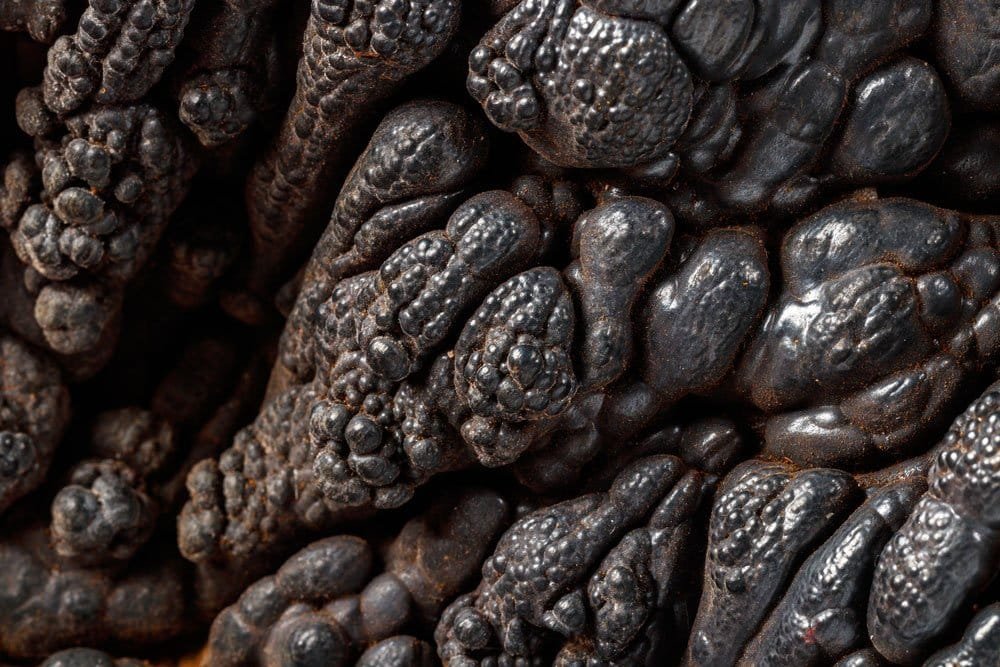
Iron oxide · Grounding stone
Hematite is an iron oxide with a striking metallic, mirror-like shine and a surprising weight in the hand. In the crystal tradition it’s a stone of grounding and protection — the one people reach for to feel steady, focused and back in their body. Its secret signature is a red streak: scratch it on rough porcelain and the heavy silver stone leaves a rusty-red line, the reason the Greeks named it after blood. It rusts if left wet, so it needs dry care. Below — what it means, how to use it, how to keep it, and how to spot synthetic “magnetic hematite”.
Pick up a piece of hematite and the first thing you notice is the weight — it feels far heavier than it looks. The second is the shine: a polished hematite is bright as a mirror. Together they make it one of the most distinctive stones in any collection, and the natural choice when the crystal tradition calls for something grounding. If black tourmaline is the protective bodyguard, hematite is the anchor.
This guide covers what hematite actually is, where its grounding reputation comes from, the ways people use it, how to keep an iron stone without rust, and — because you deserve the full picture — what’s tradition and what’s genuinely known. We’ll keep the lore and the facts clearly labelled.
What is hematite?
Hematite is iron oxide (Fe₂O₃) — the most important ore of iron on Earth, and the mineral that paints so much of the planet (and Mars) red. Polished, it’s a brilliant silvery grey-black with a metallic lustre; in raw form it can be grey, black or earthy red. It’s moderately hard at 5 to 6 on the Mohs scale, but what really sets it apart is its density: hematite is heavy, far heavier than a same-size quartz.
Its single most reliable identifier is the streak. Drag any hematite across unglazed porcelain and it leaves a rusty cherry-red mark, no matter how silver the stone looks. That blood-red streak is why the ancient Greeks named it from haima, “blood.” Most hematite on the market comes from Brazil, with historic material from England (Cumbria), and more from Canada and beyond.
One important caution for buyers: the shiny, strongly magnetic “hematite” sold as bracelets and “magnetic therapy” beads is almost always a man-made material called hematine. Natural hematite is, at most, very weakly magnetic — see the fake section below.
Hematite meaning & history
Hematite’s story is written in red. Prehistoric people ground it into red ochre for cave paintings and burials tens of thousands of years ago, making it one of humanity’s oldest pigments. Its blood-red streak linked it everywhere to life, courage and the body; Roman soldiers are said to have rubbed it on themselves before battle for strength and invulnerability, and it was carved into seals and mirrors across the ancient world.
That deep tie to blood, iron and the earth gave hematite its enduring meaning in the crystal tradition: a stone of grounding, strength and protection. Where airy stones lift you up, hematite is felt as pulling you down — in the good sense of being settled, embodied and hard to knock off balance.
Today people reach for hematite when they feel scattered, overstimulated or “in their head,” and want to come back to something solid. It’s the collection’s anchor stone.
Hematite healing properties
In the crystal tradition, hematite is valued for a tight cluster of steadying, strengthening qualities.
People typically turn to hematite for:
- Grounding. A heavy, anchoring presence when you feel scattered or overstimulated.
- Protection. A traditional shield stone, often paired with black tourmaline.
- Focus & willpower. A desk stone for concentration and follow-through.
- Courage & strength. A token for confidence before something demanding.
These are traditional and symbolic uses, not medical claims. Magnetic “hematite” bracelets are often marketed for pain, circulation or blood pressure — there is no reliable scientific evidence that magnetic jewellery treats any condition, and most such bracelets aren’t even real hematite. Enjoy hematite as a grounding ritual and a beautiful object; it is not a treatment, and nothing here is intended to diagnose or cure any condition.
Hematite, the chakras & zodiac
Hematite belongs to the root chakra (Muladhara) at the base of the spine — the centre of safety, stability and physical presence. Its weight and its iron content make it one of the most-recommended root-chakra stones, and a natural partner to red and black grounding crystals.
By zodiac, hematite is most often linked to Aries (for courage and drive) and Aquarius. It has no birthstone month, but as a stone of strength and focus it makes a thoughtful gift for anyone facing a big challenge or a fresh start.
How to use hematite
Hematite is a tactile, practical stone — much of its appeal is simply how grounding it feels to hold.
- Carry a pocket stone. A smooth tumbled piece is a reassuring weight for travel, crowds or anxious days.
- Hold it to settle. Cupping a heavy hematite in the palm is a quick way to feel “back in your body.”
- Keep it at your desk. A piece by your workspace is a traditional focus-and-willpower anchor.
- Wear it. A hematite necklace, ring or bracelet keeps its grounding weight close — just keep it dry (see care).
- Pair it for protection. Many keep hematite with black tourmaline by the door or bedside.
How to cleanse & charge hematite
Hematite is hard enough to handle daily, but it’s iron — so the golden rule is keep it dry. Choose water-free cleansing methods.
- Smoke. Incense, palo santo or sage is the safest, no-contact reset.
- Selenite. Rest it on a selenite plate overnight — dry and gentle.
- Sound. A singing bowl or bell cleanses without any moisture.
- Earth. Fittingly for a grounding stone, some bury it briefly in dry soil.
- Moonlight. A night under the moon charges it without water or harsh sun.
Avoid water and salt. Hematite can develop rust spots or a dull film if left wet or soaked in salt, and the surface shine is hard to recover. A quick wipe with a dry cloth keeps it mirror-bright. There’s no need to charge it in strong sun — its colour is stable, but moisture is its real enemy.
Types & relatives
Hematite appears in several forms and has a few close relations worth knowing:
- Polished hematite. The bright, mirror-silver tumbles and beads most people picture.
- Specular hematite. A sparkling, micaceous form with glittering plates (also called specularite).
- Red ochre / earthy hematite. The soft, dull-red pigment form used since prehistory.
- Hematoid quartz. Clear or smoky quartz with red-orange hematite inclusions — said to blend clarity with grounding.
- “Magnetic hematite” (hematine). A man-made magnetic substitute — useful to know, because it isn’t real hematite.
Most hematite on the market comes from Brazil, with historic English material and more from Canada, Italy and Morocco.
Is hematite rare or valuable?
Hematite is abundant and inexpensive — it’s an ore mined by the millions of tonnes, so as a crystal it’s one of the most affordable around. Tumbled stones, beads and palm stones cost very little, and even large polished pieces are budget-friendly. Its value is in its look and feel, not its rarity.
What small differences exist come down to polish and form: a flawless mirror finish, or a sparkling specular piece, is more desirable than a scratched or dull one. For most buyers the honest advice is simple — pick a well-polished piece that feels good in the hand, and don’t pay “therapy” premiums for magnetic bracelets that usually aren’t real hematite.
How to tell real hematite from fake
The big one here isn’t a dyed stone but a man-made magnetic substitute. Natural hematite also has a foolproof tell — its streak.
- Do the streak test. Real hematite leaves a rusty red-brown streak on unglazed porcelain, even though the stone looks silver. A black or grey streak means it isn’t true hematite.
- Be wary of strong magnets. Natural hematite is at most weakly magnetic. A bracelet whose beads snap firmly together is almost certainly synthetic hematine, not natural stone.
- Feel the weight. Genuine hematite is noticeably heavy for its size; light “hematite” beads may be coated plastic or glass.
- Check the shine honestly. Real polished hematite is bright but not perfectly flawless; an utterly uniform, plasticky mirror can be a coated imitation.
- Mind the name games. “Magnetic hematite,” “hematine” and “magnetite hematite” usually signal a manufactured material — fine to enjoy, but not natural hematite.
Genuine, ethically sourced hematite
If you’d like to start your own piece, Minerals Kingdom offers authenticated natural hematite — raw stones, tumbles and jewellery (not synthetic “magnetic” beads).