
Black Tourmaline
The dark, grounding stone people reach for when they want to feel protected and settled.
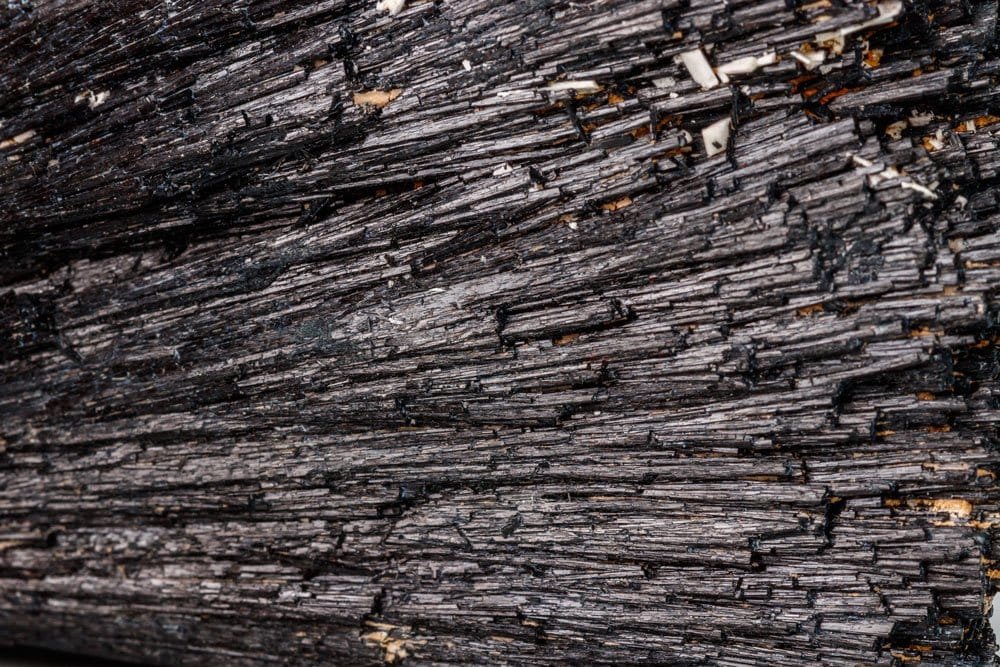
Schorl · Tourmaline family
Black tourmaline, known to mineralogists as schorl, is the crystal world’s classic stone of protection and grounding. It’s the one people keep by the front door, carry in a pocket on hard days, or set near a desk. Durable at 7–7.5 on the Mohs scale and very affordable, it’s an easy stone to live with. Below — what it means, how to use it, how to keep it, and how to spot a fake.
If amethyst is the crystal people reach for to calm down, black tourmaline is the one they reach for to feel safe. It has a long reputation as a protective, grounding stone — the quiet bodyguard of a crystal collection. It’s also genuinely useful to know about, because few stones are so easy to identify once you know what to look for.
This guide covers what black tourmaline actually is, where its protective reputation comes from, the ways people use it at home and on the move, how to keep it, and — because you deserve the full picture — what’s tradition and what’s genuinely known. We’ll keep the lore and the facts clearly labelled.
What is black tourmaline?
Black tourmaline is the most common member of the large and colourful tourmaline family. Its mineral name is schorl, and chemically it’s a complex sodium-iron aluminium borosilicate — the iron is what makes it a deep, opaque black. Tourmalines are famous for coming in almost every colour, from pink rubellite to green verdelite to the blue-green of Paraíba; schorl is the dark, iron-rich end of that spectrum.
Its most useful feature is visual. Black tourmaline grows in long, slender prisms marked by lengthwise striations — fine parallel grooves running along the crystal, like the ridges on a stick of celery. Snap a piece and the cross-section is often rounded-triangular. Those striations are the single best way to recognise a real specimen, and we’ll come back to them. On the Mohs scale schorl rates a hard 7 to 7.5, so it’s durable enough for everyday handling and easy to care for.
There’s also a genuinely strange property worth knowing: tourmaline is pyroelectric and piezoelectric. Heat it or put it under pressure and it develops a small static electric charge, with one end positive and the other negative. Eighteenth-century Dutch traders noticed their tourmalines pulling ash out of pipes and called the stone aschentrekker — “ash-puller.” It’s a real, measurable effect, and it’s the kernel of truth behind much of the stone’s protective folklore.
Black tourmaline meaning & history
The name tourmaline comes from the Sinhalese turamali, a term Sri Lankan traders used for the mixed parcels of colourful gemstones they sold. Schorl, the name for the black variety, is far older in Europe — it comes from a medieval German mining village where the stone was found near tin workings, and it appears in texts centuries before “tourmaline” entered the language.
Across many cultures, black stones have been worn as guardians, and tourmaline was no exception. Its odd electrical behaviour — attracting ash, dust and tiny scraps of paper — gave it an early reputation as a stone that could “pull” unwanted things away. Magicians and healers of earlier centuries are said to have used schorl as a shield against curses and ill intent. That image of a stone that draws off and deflects negativity is exactly the role it still plays in the modern crystal tradition.
Today black tourmaline is, above all, the protection stone: the one recommended for guarding a space, steadying the nerves, and staying grounded when life feels chaotic. It’s less about beauty than about reassurance — which is precisely why so many people keep a piece close.
Black tourmaline healing properties
In the crystal tradition, black tourmaline is valued for two closely related qualities: protection and grounding. It’s the stone most often suggested for creating a sense of a safe, settled space — whether that’s a home, a workspace, or simply your own state of mind on a stressful day.
People typically turn to black tourmaline for:
- Protection. A traditional shield against negativity, whether from places, situations or other people.
- Grounding. A heavy, steadying presence when you feel scattered or anxious.
- Calm under pressure. A pocket stone for difficult meetings, crowds or travel.
- A settled home. Often placed near the entrance to “hold the door” for a space.
These are traditional and symbolic uses, not medical claims. You’ll also see black tourmaline marketed as protection against EMF or Wi-Fi radiation — there is no scientific evidence that any crystal blocks or absorbs electromagnetic fields. Enjoy black tourmaline as a grounding ritual and a beautiful object; it is not a treatment, and nothing here is intended to diagnose or cure any condition.
Black tourmaline, the chakras, birthstone & zodiac
In chakra work, black tourmaline is tied to the root chakra (Muladhara) at the base of the spine — the centre associated with safety, stability and being grounded in the body. That’s a natural fit for a stone whose whole reputation is about feeling settled and protected.
Tourmaline as a whole is one of the October birthstones (alongside opal), so a black tourmaline makes a meaningful gift for an autumn birthday. It’s often linked to the zodiac sign Capricorn, the steady, grounded sign of the calendar — a fitting association for the family’s most down-to-earth member.
How to use black tourmaline
Black tourmaline is one of the most practical stones to work with, because most of its traditional uses are about placement.
- Keep it by the door. The classic placement — a piece near the entrance is said to “guard” the home’s threshold.
- Carry a pocket stone. A small tumbled piece is a tactile anchor for crowds, travel or tense days.
- Set it by your desk. Many people keep a piece near where they work, as a grounding focal point.
- Wear it. As a black tourmaline necklace or bracelet, it keeps its protective meaning close — and at hardness 7–7.5 it handles daily wear well.
- Grid your space. Some place a small piece in each corner of a room to “hold” the whole space.
How to cleanse & charge black tourmaline
Because black tourmaline is so associated with absorbing and deflecting, many people like to cleanse it often. It’s a hard, durable stone, which gives you plenty of options.
- Cool running water. A brief rinse is safe — schorl is hard and not water-soluble. Dry it well afterwards, as the iron content means you shouldn’t leave it soaking.
- Smoke. Pass it through incense, palo santo or sage smoke — a quick, no-contact reset.
- Selenite. Rest it on a selenite plate overnight; a popular pairing for a “self-cleansing” duo.
- Earth. Fittingly for a grounding stone, some bury it in soil overnight to reset it.
- Sound. A singing bowl or bell is a gentle option for jewellery and clusters.
Black tourmaline tolerates both moonlight and brief sunlight for charging — its colour won’t fade. Many people simply cleanse it once a week if it’s doing “heavy lifting” by the door, or whenever it feels right.
Types & relatives
“Black tourmaline” almost always means schorl, but it helps to see it within its colourful family:
- Schorl. The opaque black, iron-rich tourmaline — the protective stone of this guide.
- Dravite. A brown, magnesium-rich tourmaline, sometimes sold as a softer “grounding” alternative.
- Rubellite & verdelite. The pink and green gem tourmalines, prized in fine jewellery.
- Watermelon tourmaline. A single crystal zoned pink in the centre and green at the rim.
- Tourmalinated quartz. Clear quartz threaded with needles of black schorl — said to blend amplification with protection.
Most black tourmaline on the market comes from Brazil and several African countries, with notable material from Pakistan, Afghanistan and Madagascar.
Is black tourmaline rare or valuable?
As a mineral, schorl is abundant and inexpensive — which is exactly why it’s such a friendly stone to start with. A rough piece or tumbled stone costs very little, and even a substantial specimen for the home is well within reach. The tourmaline family contains some of the most valuable coloured gems in the world (the electric-blue Paraíba can rival fine sapphire), but black schorl is firmly the affordable, everyday end of the family.
Value, such as it is, comes down to crystal quality: well-formed prisms with crisp striations, good lustre and a clean shape are more desirable than crumbly, fractured pieces. For most buyers the honest advice is simple — pick a solid, attractive piece at a size that suits where it will live, and don’t overpay.
How to tell real black tourmaline from fake
Good news: black tourmaline is one of the easier stones to authenticate, because schorl has clear physical tells. Most “fakes” are really other black materials sold under the wrong name.
- Look for striations. Genuine schorl shows fine parallel grooves running the length of the crystal. Smooth, glassy, ungrooved black material is something else.
- Test the hardness (gently). At 7–7.5, real black tourmaline scratches glass. Black glass or dyed howlite will not.
- Check for bubbles & shine. A very glassy surface with tiny internal bubbles points to glass, not crystal.
- Try the ash test. Warm or vigorously rub a real piece and its pyroelectric charge will attract small bits of paper or ash — a genuinely diagnostic, if old-fashioned, trick.
- Mind the look-alikes. Obsidian (glassy, with curved fractures and no striations) and black onyx (banded, smooth) are often confused with tourmaline.
Genuine, ethically sourced black tourmaline
If you’d like to start your own piece, Minerals Kingdom offers authenticated natural black tourmaline — raw crystals, tumbled stones and jewellery.