Charoite
A swirling lilac silicate found in exactly one place on Earth — a single Siberian mountain — and sold as the great “stone of transformation.” Here is what is genuinely remarkable about it, and what is simply marketing.
Silicate · Transformation & calm
In short Charoite is a rare violet silicate mineral — a complex potassium-calcium inosilicate — famous for one genuinely extraordinary fact: it is found in only one place on the entire planet, the Murun massif in Sakha (Yakutia), Siberia. Recognised as a new mineral in 1978 and named after the nearby Chara River, it is prized for its unmistakable swirled, fibrous lilac pattern, often laced with white feldspar, black aegirine and honey-coloured tinaksite. In the crystal tradition it is a third-eye and crown stone of transformation, calm and spiritual insight — and, as this guide explains plainly, its genuine rarity is often stretched into claims of “power” that no stone can deliver.
Charoite is one of the few gemstones whose whole story can be told with a single sentence of geography: it comes from exactly one mountain, and nowhere else. That scarcity, combined with a marbled violet colour that looks almost painted, has made it one of the most recognisable — and most romanticised — stones in the modern crystal world.
This guide covers what charoite actually is, how a Siberian silicate became a global “stone of transformation,” an honest look at what its rarity does and does not mean, and the care a relatively soft, fibrous stone genuinely needs.
What is charoite?
Charoite is a rare silicate mineral — technically an inosilicate, a member of the same broad structural family as many chain silicates — with a complicated formula rich in potassium, calcium, sodium and barium. What matters for most people is not the chemistry but the look: charoite forms dense, swirling masses of interwoven violet fibres, so its polished surface seems to move like brushstrokes. That fibrous structure gives good material a soft, silky sheen called chatoyancy, a little like the shimmer of tiger’s eye but in shades of lilac and purple.
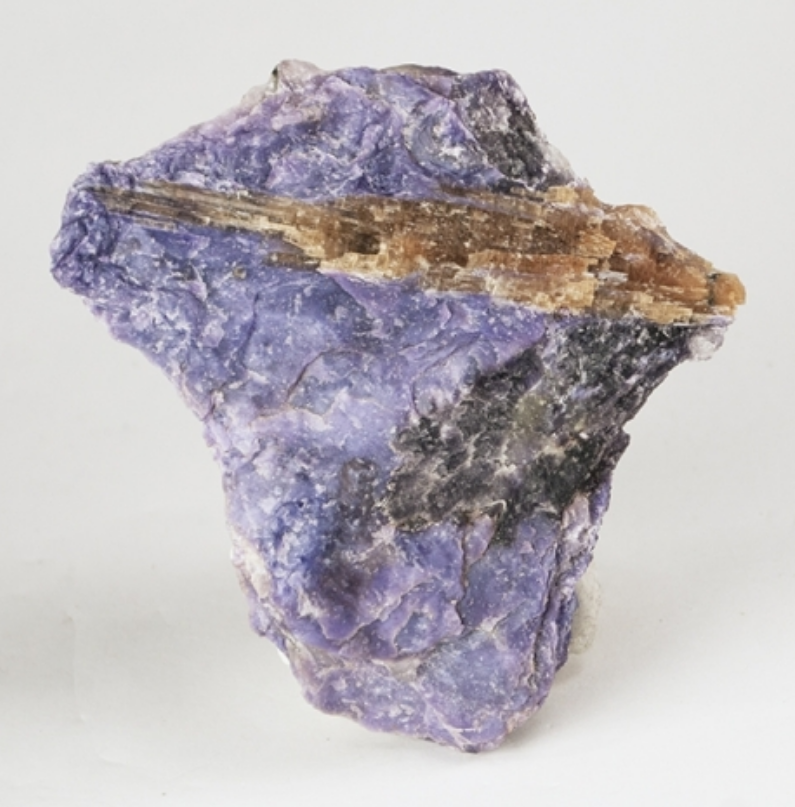
Its Mohs hardness is around 5 to 6, which places it in the middle of the scale — softer than quartz, roughly the hardness of apatite or a steel knife. In nature charoite rarely appears alone: it grows entangled with white potassium feldspar, jet-black needles of aegirine and orange-brown blades of tinaksite, and it is exactly this jumble of minerals that produces the distinctive marbled pattern collectors love. Truly single-coloured “pure” charoite is uncommon; most pieces are a genuine mineral mosaic.
Charoite meaning & history
Charoite is a very modern gemstone. Although Soviet geologists had encountered the strange purple rock in the Murun massif of Siberia decades earlier, it was only formally described and accepted as a distinct mineral species in 1978. Its name is usually linked to the nearby Chara River, though some sources also point to the old Russian word chary, meaning “charms” or “magic” — a fitting double meaning for a stone that looks almost enchanted.
Because it is such a recent discovery, charoite carries none of the classical folklore attached to older stones like amethyst or lapis lazuli. Its reputation has been built entirely within the last few decades, on two things: its striking colour and its extreme scarcity. Almost as soon as polished charoite reached the West, the crystal community adopted it as a premium “spiritual” stone, and its associations with transformation, the higher chakras and deep calm all date from that period rather than from ancient tradition.
The “rare and powerful” claim — honestly
Charoite is almost always sold with a version of the same pitch: it is one of the rarest stones on Earth, therefore it is unusually powerful. The first half of that sentence is genuinely true. Gem-quality charoite really does come from a single locality — the Murun massif — and when that deposit is eventually exhausted, no new source is expected. In that narrow, geological sense, charoite is one of the rarest decorative stones you can buy.
The second half does not follow. Rarity is a fact about supply, not about energy. A stone being hard to find tells you something about geology and price, and nothing at all about whether it can influence your mood, health or destiny. Enjoy charoite for what it honestly is — an unusual, beautiful silicate with a remarkable one-mountain origin story — but treat “rare, therefore powerful” as marketing rather than fact. It is also worth knowing that the same scarcity makes charoite a frequent target for imitation, so a suspiciously cheap “charoite” is often dyed stone rather than the real thing, a point we return to below.
Charoite healing properties
In the crystal tradition, charoite is valued above all as a stone of transformation, calm and spiritual insight.
People typically turn to charoite for:
- Transformation. Read as a companion for periods of deep change, letting go and personal growth.
- Calm under pressure. Associated with soothing worry, overthinking and a racing mind.
- Spiritual insight. A third-eye and crown stone, linked to intuition, dreams and meditation.
- Courage in the face of fear. Traditionally carried to steady nerves during difficult transitions.
These are traditional and symbolic uses, not medical claims. There is no scientific evidence that any crystal treats, cures or prevents any illness, and charoite is no exception. Nothing here is intended to diagnose, treat or prevent any condition; health, sleep and emotional concerns belong with a doctor or a qualified professional.
Charoite, the chakras & zodiac
Charoite’s deep violet places it firmly among the higher chakras: the third eye (Ajna), the centre of intuition and insight, and the crown (Sahasrara), associated with spiritual connection. It shares that upper-chakra territory with amethyst, sugilite and lepidolite, three other purple-to-lilac stones with calming, spiritual reputations. For the wider framework, see our guide to the seven chakras and their crystals.
By zodiac, charoite is most often linked to Scorpio and Sagittarius, read as signs of depth, change and the search for meaning.
How to use charoite
- Wear it as jewellery. Pendants, cabochon rings and beads show off its swirled pattern; a moderate-hardness stone, it suits everyday wear better than very soft minerals but still dislikes hard knocks.
- Hold it in meditation. At the brow or crown, for its traditional associations with calm and insight.
- Keep it by the bed. A popular choice for a restful, reflective bedside stone.
- Choose protective settings. Bezels help guard the edges of a fibrous stone that can chip.
- Store it separately. Harder stones such as quartz will scratch charoite if they share a pouch or drawer.
How to cleanse & charge charoite
- Water, briefly. A quick rinse and a soft-cloth dry is fine; avoid long soaking and hot or salty water, which can dull a polished surface over time.
- Moonlight. A gentle overnight charge suits it well; prolonged strong sun is best avoided, as it may fade the violet.
- Smoke. Sage, palo santo or incense — contact-free and low-risk.
- Selenite or sound. Safe, contact-free alternatives that never touch water.
- Never use ultrasonic or steam cleaners. Both are a real hazard for a fibrous, mid-hardness stone.
Types & origins
- Gem-grade charoite. Vivid, evenly swirled violet with strong chatoyancy — the most prized and most expensive material.
- Charoite with tinaksite. Lilac charoite threaded with honey-orange tinaksite blades, a much-loved collector combination.
- Charoite with aegirine. Purple material set with jet-black aegirine sprays, giving dramatic contrast.
- Feldspar-rich charoite. Paler, cloudier stone streaked with white — attractive but less intense.
- Cabochons and beads. The usual cut forms, chosen to display the fibrous swirl rather than for faceting.
Every scrap of genuine charoite comes from the same place: the Murun massif in Sakha (Yakutia), in eastern Siberia. There is no second deposit, which is what makes the stone both collectable and finite. Value is driven by colour saturation and the quality of the chatoyant swirl, with strongly patterned violet material commanding the highest prices; paler, greyer pieces are far more affordable. Because supply depends on a single, protected locality, good charoite is priced as a genuine collector’s stone rather than a bargain tumble.
Real vs fake
- Dyed imitations. Cheaper purple stones and even dyed marble are sometimes passed off as charoite; dye tends to sit unnaturally even, without the fibrous swirl, and can concentrate along cracks.
- Reconstituted or “purpurite” swaps. Pressed powder, plastic composites or unrelated purple minerals are occasionally mislabelled charoite; genuine charoite always shows an interwoven, directional fibre pattern.
- The pattern tell. Real charoite has a chatoyant, brushstroke-like swirl with visible white, black or orange inclusions. A flat, uniform “grape” purple with no movement is a warning sign.
- The price tell. Because true charoite is single-source and finite, very cheap “charoite” is one of the more reliable clues that a stone is dyed or fake.
The workable rule: trust the swirl. A stone with a living, fibrous violet pattern and honest mineral inclusions is very likely genuine charoite; a flat, evenly coloured purple sold suspiciously cheaply probably is not.
Genuine, correctly identified charoite
If you’d like a piece of your own, Minerals Kingdom offers authenticated natural charoite — genuine Siberian silicate, not dyed marble or pressed composite.
Charoite pairs well with
Frequently asked questions
What is charoite good for?
Traditionally, charoite is used for transformation, calm and spiritual insight — a third-eye and crown stone. These are symbolic, traditional uses, not proven medical effects. No crystal treats illness, and charoite has no demonstrated effect on health.
Where does charoite come from?
From exactly one place on Earth: the Murun massif in Sakha (Yakutia), Siberia. No other deposit is known, which is why genuine charoite is treated as a rare, finite collector’s stone.
Is charoite really that rare?
Yes, in a strict geological sense — it has a single source and cannot be found elsewhere. But rarity is a fact about supply and price, not evidence of any special power. Real charoite is scarce; that alone does not make it “stronger” than common stones.
How can I tell if charoite is real?
Genuine charoite shows a chatoyant, fibrous violet swirl, usually with white feldspar, black aegirine or orange tinaksite mixed in. A flat, uniform purple with no movement — especially if very cheap — is often dyed marble or a composite rather than true charoite.
Can charoite go in water?
A brief rinse is fine, but avoid long soaking, salt water and hot water, which can dull the polish of a mid-hardness stone over time. Dry methods such as moonlight, smoke or selenite are gentler options.
What crystals pair well with charoite?
Other higher-chakra stones sit naturally alongside it — amethyst for calm focus, sugilite for transformation and lepidolite for soothing rest. Together they make a coherent violet, third-eye and crown grouping.