
Lepidolite
The lilac mica that really does contain lithium — and the stone about which the internet tells its single most persistent lie.
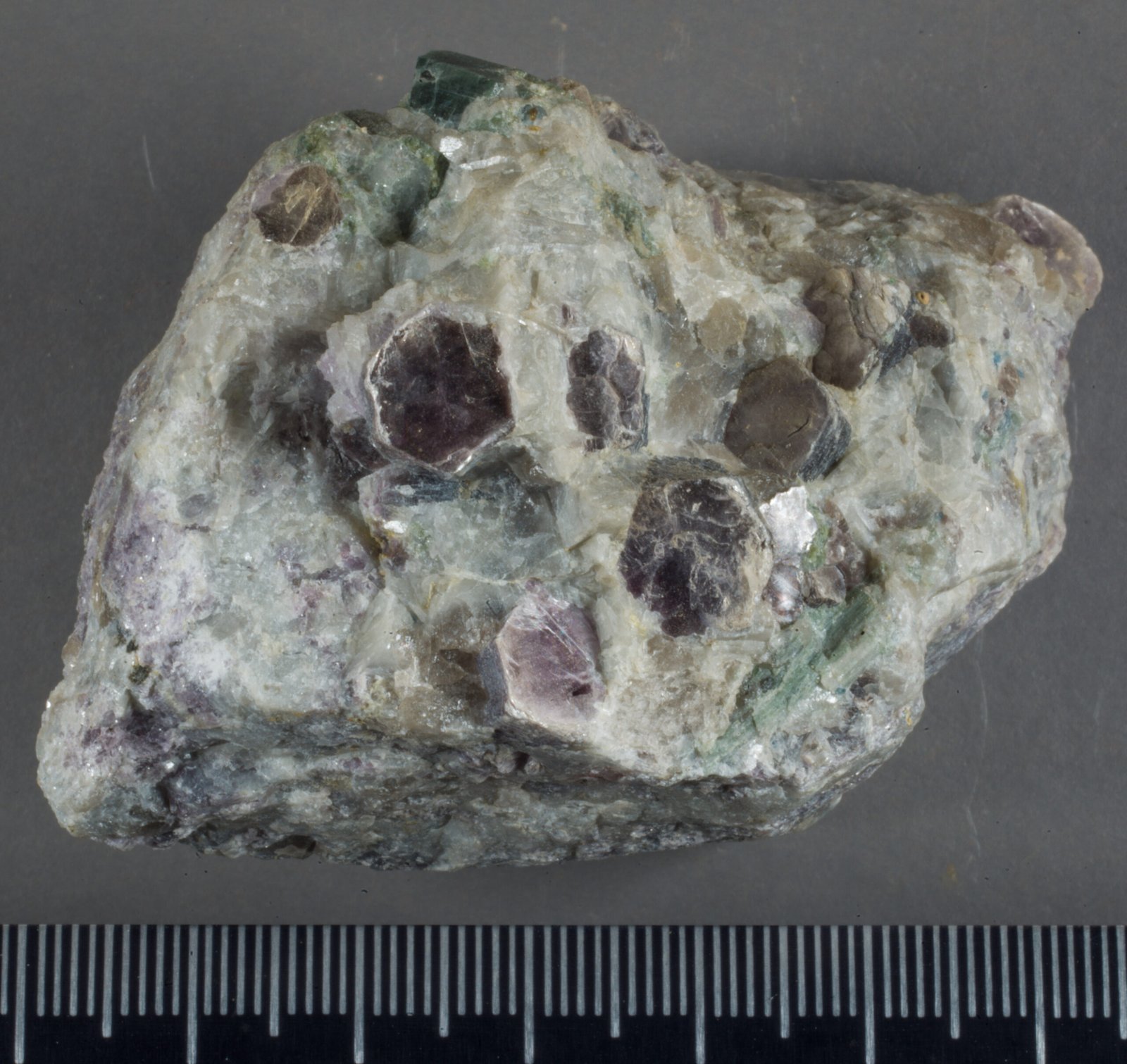
Lithium mica · The stone of transition
Lepidolite is a lithium-bearing mica — a phyllosilicate, formula K(Li,Al)₃(Al,Si)₄O₁₀(F,OH)₂ — and its lilac colour comes from traces of manganese, not from the lithium. In the crystal tradition it’s the stone of transition: calm, sleep and emotional balance. It is also the subject of a claim you will meet everywhere, and which is false: that its lithium content works like the medication lithium. It does not. The lithium is locked into the silicate lattice and is not absorbed by your body. Lepidolite is also very soft (2.5–3 Mohs) with perfect basal cleavage — it flakes, and it is unsuitable for rings. Below — the mineral, the tradition, the correction, and how to spot dyed fakes.
Lepidolite is a stone that peels. Slide a fingernail under the edge of a good specimen and it will part into sheets so thin they are transparent, stacked like the pages of a lilac book — which is exactly what mineralogists call them: books. Held to the light it goes from lavender to rose to a silvery, almost pearly grey, and the whole thing glitters, because you are looking at ten thousand tiny mirrors lying flat.
It is also the crystal most consistently misdescribed on the internet, and the reason is understandable: lepidolite genuinely contains lithium. That fact is true. Almost everything the wellness internet has built on top of it is not. This guide covers what lepidolite actually is, what the tradition says about it, and — plainly, in its own section — what the lithium does and does not do.
What is lepidolite?
Lepidolite is a lithium-bearing mica: a phyllosilicate, or sheet silicate, with the formula K(Li,Al)₃(Al,Si)₄O₁₀(F,OH)₂. Like all micas it is built from stacked layers — two sheets of silicon-oxygen tetrahedra sandwiching a layer of aluminium and lithium, with potassium ions holding one sandwich loosely to the next. Those weak potassium bonds are why mica splits so obligingly, and why lepidolite has perfect basal cleavage in one direction.
There is a mineralogical subtlety worth stating accurately. “Lepidolite” is not currently a valid single mineral species. Under the mica nomenclature adopted by the International Mineralogical Association, it is treated as a series name — a field term for material in the polylithionite–trilithionite series, whose members differ in the ratio of lithium to aluminium. It remains entirely legitimate as a collector’s and trade name; it simply is not one defined species, and you should be mildly suspicious of any source that gives lepidolite a single tidy formula without saying so.
Its lilac colour is not from lithium. It comes from trace manganese. This is worth knowing because the lithium-equals-purple assumption is the seed from which most of the misinformation grows.
Lepidolite forms in granite pegmatites — the coarse, slow-cooled veins where the leftover, element-enriched dregs of a granite melt finally crystallise. That is why it turns up alongside tourmaline, spodumene, beryl, topaz and amblygonite: pegmatites are where the rare, awkward elements go. It also occurs in high-temperature quartz veins and greisens.
It is a real lithium ore, and the most abundant lithium-bearing mineral there is. It is fair to be precise about its commercial standing: most of the world’s lithium today comes from spodumene and from brines, with lepidolite a secondary source — though Chinese producers have brought lepidolite back into large-scale processing in recent years. Its other claim is unambiguous: lepidolite is the principal ore of rubidium, and it is where rubidium was discovered. In 1861 Bunsen and Kirchhoff worked through 150 kilograms of lepidolite to obtain a few grams of rubidium salts.
Lepidolite meaning & history
The name comes from the Greek lepidos, scale — the scaly mica — and dates to 1792. Before that it was called lilalite, for the colour.
Lepidolite has no ancient lore. There is no Egyptian tradition, no classical mention, no medieval lapidary entry. Its meanings belong entirely to the twentieth-century crystal revival, and they crystallised around a single idea that has stuck: lepidolite as the “stone of transition”. The crystal it is given to someone who is between things — leaving a job, leaving a marriage, moving country, grieving, recovering, changing.
That reputation almost certainly has two roots. One is the lithium association, which arrived after lithium became a household word in psychiatry. The other is simply how the stone behaves: it is soft, it is lilac, it is layered, and it comes apart in your hands. It is difficult to think of a better object for a period of your life that is doing the same thing.
Lepidolite healing properties
In the crystal tradition, lepidolite is valued as a stone of calm, transition and emotional balance.
People typically turn to lepidolite for:
- Transition. Its signature use — periods of change, upheaval and endings.
- Calm. Kept for restlessness and a busy mind.
- Sleep. Traditionally placed under a pillow or on a bedside table.
- Emotional balance. Associated with steadiness through mood swings.
- Overthinking. A third-eye stone said to quiet mental circling.
These are traditional and symbolic uses, not medical claims. There is no scientific evidence that any crystal treats illness or “detoxifies” anything. Nor will any stone improve your finances.
Lepidolite needs one correction of its own, because the claim attached to it is unusually specific and unusually wrong. You will read that lepidolite calms anxiety “the way the medication lithium does”, or that it releases lithium into your body when you wear or hold it. Both are false. The lithium in lepidolite is chemically bound inside a silicate lattice — it is a structural part of the crystal, not a loose ingredient. Holding a stone, wearing it, sleeping beside it or placing it on your skin transfers no lithium into you whatsoever.
The comparison also misrepresents the medicine. Pharmaceutical lithium is a prescribed drug, given in carefully calculated doses, with a narrow therapeutic window and monitored by blood tests precisely because the gap between an effective dose and a toxic one is small. A rock is not a version of it, a milder form of it, or a substitute for it. Nobody should stop, reduce or alter prescribed psychiatric medication because of a crystal — that is a conversation for your doctor.
None of which is an argument against lepidolite. It is a genuinely lovely mineral with a real and interesting geology. It is simply not a pharmacy. Nothing here is intended to diagnose or cure any condition.
The lithium question, in plain terms
Since this is the thing people actually come to the page for, here it is set out directly.
Does lepidolite contain lithium? Yes. Genuinely, and in commercially useful quantity — typically a few per cent by weight as Li₂O. This part of the story is completely true, which is what makes the rest so persuasive.
Can that lithium get into you? No. Lithium in lepidolite occupies octahedral sites in a silicate framework, bonded to oxygen, fluorine and hydroxyl. Getting it out is an industrial process: ore is crushed, roasted at high temperature with reagents, leached with acid, and purified. That is what a lithium refinery is for. Skin contact does nothing of the kind. Nor does water in which a stone has been sitting.
Is it dangerous to handle, then? No. Lepidolite is safe to hold, carry and keep. The sensible precaution is about dust rather than lithium: like any silicate, you should not grind, cut or sand it without dust protection, and you should not make powders or elixirs from it. Wash your hands after handling flaky raw specimens, as you would with any mineral.
Lepidolite, the chakras & zodiac
Lepidolite is worked at the heart chakra (Anahata) for emotional steadiness, and at the third eye (Ajna) and crown (Sahasrara) for its quieting, mind-settling associations — the violet end of the spectrum is conventionally read upward.
By zodiac it’s most often associated with Libra, for balance, and Pisces, for emotional sensitivity. It has no birthstone month. It is, however, one of the most frequently given “going through something” gifts in the whole trade, which is a kind of role of its own.
How to use lepidolite
Most uses revolve around the end of one thing and the start of another.
- Keep one through a change. Its clearest and most honest use.
- Put it by the bed. The traditional sleep placement — bedside table rather than under the pillow, since it sheds flakes.
- Carry a tumble. Smooth, light and pleasant in the hand.
- Choose lepidolite-in-quartz for wear. A lepidolite pendant in a quartz matrix survives daily life far better than pure mica.
- Use it in meditation. Held, or rested on the chest.
- Never put it in a ring. At 2.5–3 Mohs it is softer than a copper coin. It will not survive a hand.
If calm and sleep are what you are after, it sits naturally alongside the other stones in our guide to crystals for anxiety and stress.
How to cleanse & charge lepidolite
This is a soft, layered, cleavable mineral, and it needs genuinely careful handling. Most of the standard advice you will read is wrong for lepidolite.
- Smoke. Sage, palo santo or incense — the safest method for this stone.
- Moonlight. A gentle overnight charge.
- Selenite. Rest it on a plate.
- Sound. A singing bowl, at a distance.
- Dry cloth. A soft brush or cloth is all the cleaning it needs.
Avoid water. Not because lepidolite dissolves — it does not — but because water works its way between the cleavage planes of a sheet silicate and lifts them apart, and because a great deal of the lepidolite sold as tumbles and towers is resin-stabilised to stop it flaking, and soaking degrades that. A quick wipe is fine. Soaking, gem elixirs and long rinses are not. Avoid salt entirely, dry or wet: salt crystals abrade a stone this soft and wedge into the layers. Never use ultrasonic or steam cleaners. Keep it out of prolonged strong sunlight, which can pale the lilac, and store it where harder stones cannot scratch it — which is nearly all of them.
Types & origins
- Lepidolite books. Stacked plates of pure mica — the classic specimen form, beautiful and extremely fragile.
- Lepidolite in quartz. Lilac mica suspended in or veining white quartz. Much tougher, and the sensible choice for jewellery.
- Tumbles and towers. Usually massive, fine-grained material, often resin-stabilised. Check for a plasticky lustre.
- Lepidolite with tourmaline. Pink or green elbaite set in lilac mica — a pegmatite classic from Brazil.
- Origins. Brazil (Minas Gerais, the best-known source), Madagascar, California and the Black Hills of South Dakota, the Tanco Mine in Manitoba, the Urals, and Varuträsk in northern Sweden — the locality of the specimen photographed above.
Is lepidolite rare or valuable?
Lepidolite is common and inexpensive. It is an abundant mineral in a well-understood setting, and tumbles cost very little.
Value belongs almost entirely to specimens rather than to the material: sharp, undamaged crystal books with good lilac colour, and above all pegmatite association pieces — lepidolite with a fine tourmaline crystal standing in it — which can be genuinely expensive and are collected as mineral specimens rather than as crystals. Gem-quality transparent lepidolite essentially does not exist in any wearable sense; it is far too soft and too cleavable to facet meaningfully.
The practical consequence of the softness is worth repeating, because it is what buyers most often get wrong. Perfect basal cleavage plus 2.5–3 on the Mohs scale means lepidolite scratches with a fingernail at the low end, flakes at the edges, and cannot be worn in a ring or a bracelet that meets desks and doorframes. Pendants and pocket stones, yes. Rings, no.
How to tell real lepidolite from fake
Lepidolite is cheap enough that outright forgery is rare — but dyeing and misnaming are common, because “lilac” sells.
- Look for the sparkle. Real lepidolite is made of countless tiny reflective mica plates. Turn it in the light and it should glitter and shift. Dyed stone is flatly matte.
- Look for layers. On raw material you should see the sheeted, splintery, book-like structure at the edges. It is unmistakable once you have seen it once.
- Check the hardness. Lepidolite is very soft. If your “lepidolite” resists a steel pin or a knife edge on an inconspicuous spot, it is not lepidolite.
- Beware dyed howlite and magnesite. The commonest substitution for any purple stone. Dyed howlite shows uniform colour with grey web veins, and no mica glitter at all.
- Beware dyed quartzite and “purple jade”. Flat, even colour, no layering, too hard.
- Acetone on a cotton bud. On a discreet spot. Colour on the cotton means dye.
- Beware “lithium quartz”. A different material entirely — quartz with pinkish inclusions — sold with the same lithium claims, which are equally untrue.
Genuine, ethically sourced lepidolite
If you’d like a piece of your own, Minerals Kingdom offers authenticated natural lepidolite — specimens, tumbles and lepidolite-in-quartz pendants.