
Ammonite
The coiled, chambered shell of an extinct sea creature, turned to stone over tens of millions of years — the “horn of Ammon” and the snakestone of legend — and read in the crystal world as a spiral emblem of change, growth and deep time.
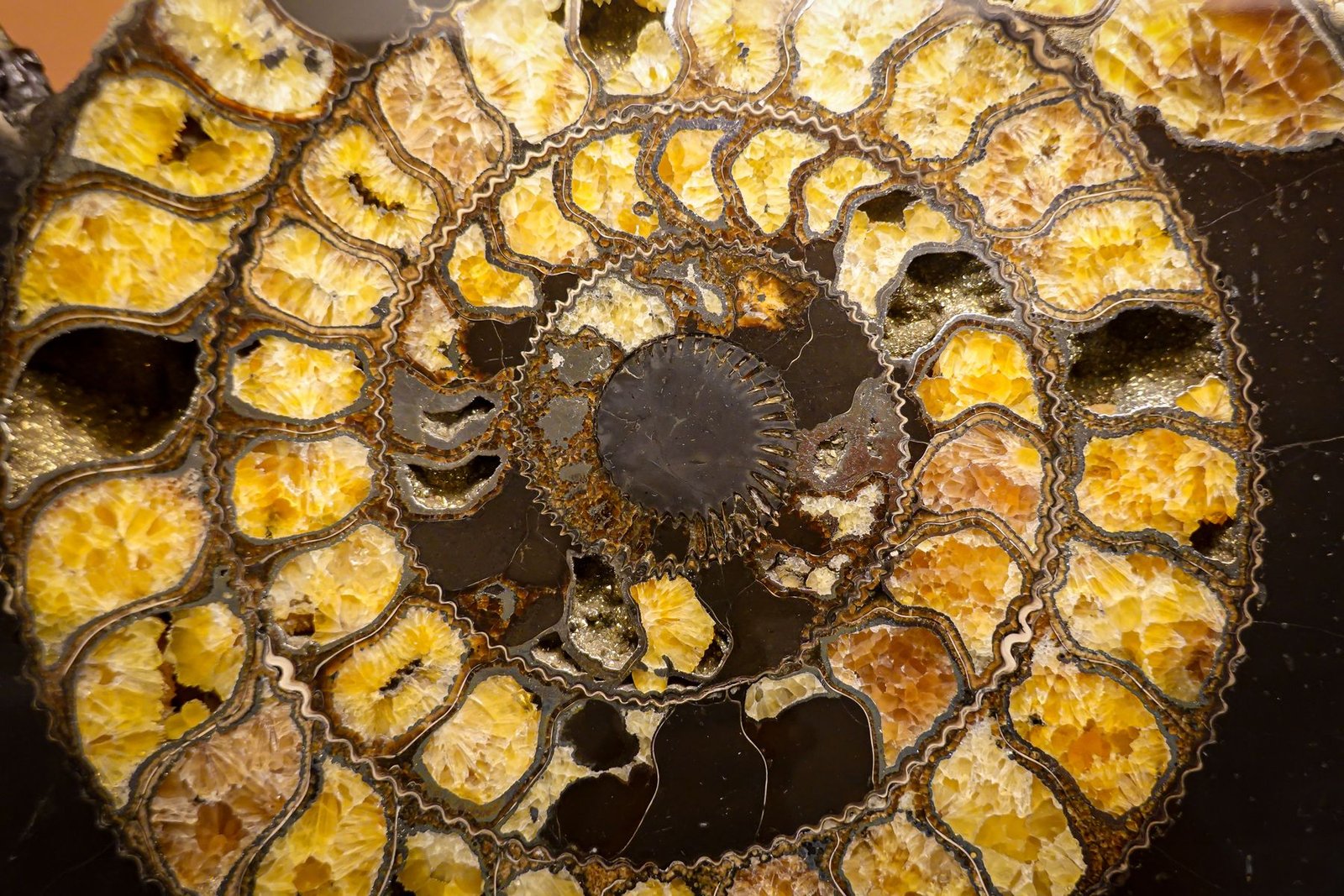
Fossil cephalopod · Change & deep time
In short An ammonite is not a crystal but a fossil: the shell of an extinct marine cephalopod, a distant relative of today’s octopus and squid. Ammonoids lived in the world’s oceans from roughly 450 million years ago until the end of the Cretaceous, about 66 million years ago. Their spiral shells were originally made of aragonite (CaCO3, orthorhombic); in the rock they are often replaced by calcite, pyrite or silica, and in Alberta a few keep their original nacre as the iridescent gem ammolite. Whatever the mineral, an ammonite is soft (about 3–4 Mohs). Named after the ram-horned god Ammon and long known in England as “snakestones,” it is read in the crystal tradition as a stone of transformation, steady growth, grounding and connection to ancestral time — symbolic uses, this guide explains, rather than medical ones.
Few objects hold as much time in the palm of a hand as an ammonite. Split one open and polish the face, and you see the inside of an animal that swam in a warm sea long before the first flowers bloomed — a near-perfect spiral of chambers, each one sealed off as the creature grew, now filled with crystal. It is no surprise that cultures across the world have treasured these stones as charms, relics and symbols.
This guide covers what an ammonite actually was, how a shell turns into stone, the myths that gave it the names “horn of Ammon” and “snakestone,” what the crystal tradition reads into its spiral, and how to tell a genuine fossil from the carved and cast copies sold in many markets.
What is an ammonite?
Ammonites were ocean-dwelling molluscs belonging to the cephalopods, the same class as the nautilus, octopus, squid and cuttlefish. Although their shells look like a nautilus, palaeontologists think they were more closely related to the coleoids — the octopus and squid group — and that they probably had eight arms, though no fossil arms have ever been found. The wider group, the Ammonoidea, appeared around 450 million years ago; the “true” ammonites flourished from the Jurassic onwards, and almost all vanished in the mass extinction 66 million years ago that also ended the non-avian dinosaurs.
The shell was a chambered buoyancy device. The animal lived in the last, open chamber; as it grew it moved forward and sealed the space behind it with a curved wall called a septum. A thin tube, the siphuncle, ran through the chambers so the animal could adjust gas and fluid and control its depth. Where each septum met the outer shell it left a wavy line, the suture, whose increasingly frilly, fern-like patterns are one of the most beautiful features of a polished specimen. Sizes ranged from a few millimetres to giants such as Parapuzosia seppenradensis, estimated at well over two metres across.
Because ammonites were abundant and evolved quickly, each species lived for a geologically short span. That makes them superb index fossils: geologists divide much of the Mesozoic rock record into “ammonite zones” and use them to date the layers they are found in.
Ammonite meaning & history
The name goes back to antiquity. Early Greeks and Romans compared the coiled shells to the curled horns of the god Jupiter Ammon, the Egyptian Amun shown with a ram’s head, and called them cornu Ammonis — “horns of Ammon.” Naturalists later turned that into the scientific name “ammonite.” In China they were likewise known as “horn stones.”
In England they were snakestones. At Whitby, legend says the seventh-century abbess St Hilda turned a plague of snakes to stone and cast them from the cliffs; a similar story attaches to St Keyna at Keynsham. Victorian dealers obligingly carved snake heads onto the fossils to match the tale, and three such “snakes” still appear on Whitby’s coat of arms. Elsewhere, Blackfoot people of the North American plains used ammonite fragments as buffalo stones in ceremonies for the bison hunt, and German farmers in the Harz mountains put “dragonstones” in milk pails for luck with their cows.
The most sacred ammonites of all are the shaligrams (saligrams) of Hindu tradition — black, ammonite-bearing concretions from the Gandaki river valley in Nepal, venerated as a natural form of Vishnu and kept in temples and homes. In the modern crystal world, ammonite has become a symbol of evolution, transformation and continuity, its spiral read as growth that keeps building on everything that came before.
How an ammonite becomes stone
When an ammonite died, its empty shell sank to the sea floor and was buried in mud or sand. Over millions of years, as that sediment hardened into rock, mineral-rich water percolated through it. What happened next decides the kind of specimen you hold today:
- Original aragonite. In rare, gentle conditions the shell keeps its original aragonite, sometimes with its mother-of-pearl nacre intact — the same material that forms a pearl. In Alberta this survives as ammolite.
- Calcite replacement and infill. Most often the unstable aragonite recrystallises to calcite, and the empty chambers fill with sparkling calcite crystals — the honey-gold chambers in the photograph above.
- Pyritisation. In oxygen-poor muds, sulphur-loving bacteria help pyrite replace the shell, giving brassy “golden” ammonites.
- Silica and other minerals. Quartz, chalcedony or iron minerals can also replace or fill the shell, much as silica replaces wood in petrified wood.
So the “mineral” of an ammonite depends on its history: aragonite belongs to the orthorhombic crystal system, calcite to the trigonal system and pyrite to the cubic system — see our guide to the seven crystal systems for what that means, and to how crystals form for the chemistry of growth from solution.
Ammonite healing properties
In the crystal tradition, ammonite is valued as a stone of transformation, growth and rootedness in time.
People typically turn to ammonite for:
- Change & transformation. A creature that survived hundreds of millions of years of change, it is read as a companion for life transitions and new chapters.
- Steady, spiral growth. Its chambers, each built on the last, are a natural emblem of progress made step by step rather than all at once.
- Grounding & perspective. Holding something tens of millions of years old is, for many people, a simple way to put everyday worries into proportion.
- Ancestry & continuity. Its long history as a sacred and protective object links it to memory, lineage and the wisdom of the past.
These are traditional and symbolic uses, not medical claims. There is no scientific evidence that any crystal or fossil treats, cures or prevents any illness, and ammonite has no proven effect on health, mood or energy. Crystals are not a substitute for medical care: nothing here is intended to diagnose, treat or prevent any condition, and health concerns belong with a qualified professional.
Ammonite, the chakras & zodiac
Ammonite’s earthy colours and its origin in ancient sea-floor rock tie it most often to the root chakra (Muladhara), the centre of grounding and security. Because its spiral is read as a symbol of evolving consciousness, some practitioners also place it at the crown chakra, and iridescent ammolite is sometimes associated with the whole chakra column for its play of colour. It shares its grounding, ancient-earth territory with petrified wood and amber. For the wider framework, see our guide to the seven chakras and their crystals.
Zodiac lists vary for fossils more than for most stones. Ammonite is often linked to Cancer, a water sign suited to a sea creature, and to Capricorn, the earth sign of patience and endurance.
How to use ammonite
- Display a polished pair. Split-and-polished halves show the chambers and sutures beautifully on a shelf, desk or altar.
- Hold one in meditation. Tracing the spiral with a fingertip, from the outer whorl to the centre, is a simple focusing practice.
- Wear it with care. Small ammonites and ammolite are set into pendants and earrings; at 3–4 Mohs they suit occasional wear better than everyday rings.
- Keep one as a reminder of perspective. Many people place an ammonite where they work as a quiet nod to deep time.
- Use it for teaching. Few objects introduce children to geology, evolution and extinction as vividly as a real fossil.
How to cleanse & charge ammonite
- Keep it dry. Calcite and aragonite are soft and slightly reactive; a soft dry brush or cloth is the safest clean.
- Never use salt, vinegar or acids, which etch carbonate shells and dull the polish.
- Protect pyritised ammonites from damp. Pyrite fossils can suffer “pyrite decay,” crumbling and turning powdery in humid air; store them dry.
- Smoke, sound, moonlight or selenite are gentle, contact-free methods suitable for any fossil.
- Avoid ultrasonic cleaners and heat, which can crack the chambers or lift ammolite layers.
Our general guide to cleansing and charging crystals covers each method in more detail, including which stones tolerate water and which do not.
Types & origins
- Madagascan ammonites. The classic split-and-polished pairs, often Cretaceous species around 100–110 million years old, with crystal-filled chambers and creamy to reddish shells.
- Moroccan ammonites & goniatites. Dark, polished Devonian goniatites — some of the earliest ammonoids — and Jurassic ammonites, often sold as plates and bowls.
- Ammolite. The iridescent nacre of Placenticeras ammonites from the Late Cretaceous Bearpaw Formation of Alberta, Canada, about 70–75 million years old.
- Pyritised ammonites. Brassy, golden fossils from Russia, England and elsewhere, prized by collectors.
- Jurassic Coast ammonites. The famous fossils of Lyme Regis and Charmouth in Dorset, England, where the cliffs still yield new specimens after every storm.
- Shaligrams. Ammonite-bearing black concretions from the Gandaki river in Nepal, treated as sacred objects rather than collector stones.
Polished ammonites from Madagascar and Morocco supply most of the decorative market and are relatively affordable. Value rises with size, completeness, crisp sutures, attractive crystal infill, and — for ammolite — the brightness and range of its colours.
Real vs fake
- Carved and composite fossils. Some Moroccan plates and “ammonites in matrix” are partly or wholly carved, or assembled from real fragments glued into a stone base. Repeated, identical spirals and perfectly smooth matrix are warning signs.
- Resin and plaster casts. Moulded copies feel lighter and warmer, may show bubbles, and look the same on every specimen in a tray.
- Painted sutures. Real suture lines are part of the stone and run through the polish; painted ones sit on the surface and may wear off.
- Ammolite assemblies. Because the colour layer is thin, most ammolite is sold as doublets or triplets with a backing and clear cap. These are legitimate when disclosed — the issue is only honest labelling.
The workable rule: buy from sellers who name the locality and age, and expect natural variation from piece to piece. For the wider method, see our guide to spotting dyed and imitation stones.
Genuine, natural ammonite fossils
If you’d like a piece of your own, Minerals Kingdom offers authenticated natural ammonites — real fossils rather than casts, with origin honestly described.
Ammonite pairs well with
Frequently asked questions
What is ammonite good for?
Traditionally, ammonite is used as a symbol of transformation, steady growth, grounding and connection to the past. These are symbolic, traditional uses, not proven medical effects. No crystal or fossil treats illness, and ammonite is not a substitute for medical care.
Is ammonite a crystal or a fossil?
It is a fossil: the shell of an extinct marine cephalopod. Its substance is mineral, though — usually aragonite or calcite, sometimes pyrite or silica — and its chambers are often lined with real calcite crystals.
How old are ammonites?
Ammonoids lived from roughly 450 million years ago until about 66 million years ago. Most polished ammonites on sale are Jurassic or Cretaceous, typically between about 70 and 200 million years old; Moroccan goniatites are older, from the Devonian.
What is the difference between ammonite and ammolite?
Ammonite is the fossil animal. Ammolite is a gem made from the iridescent aragonite nacre of certain ammonite shells, mainly Placenticeras from the Bearpaw Formation in Alberta, Canada.
Can ammonite go in water?
It is best kept dry. Carbonate shells are soft and react with acids and salt, and pyritised ammonites can decay in damp conditions. Use a soft dry brush, or contact-free methods such as smoke, sound or selenite.
What crystals pair well with ammonite?
Other stones of deep time suit it well — petrified wood for patience and grounding, aragonite as the mineral of its own shell, and amber as a fellow organic fossil. Together they make a coherent “ancient earth” grouping.
Image credits · Hero and buy-box: polished ammonite with calcite-filled chambers — Photo: Magda Ehlers / Pexels (Pexels License).
Sources · Natural History Museum: What is an ammonite? · Natural History Museum: Snakestones — ammonites in myth, magic and science · GIA, Gems & Gemology (2001): Ammolite from Alberta · British Geological Survey: Ammonites.