
Pyrite
The metallic-gold “fool’s gold” of abundance and willpower — a bright, confident stone for money, drive and protection.
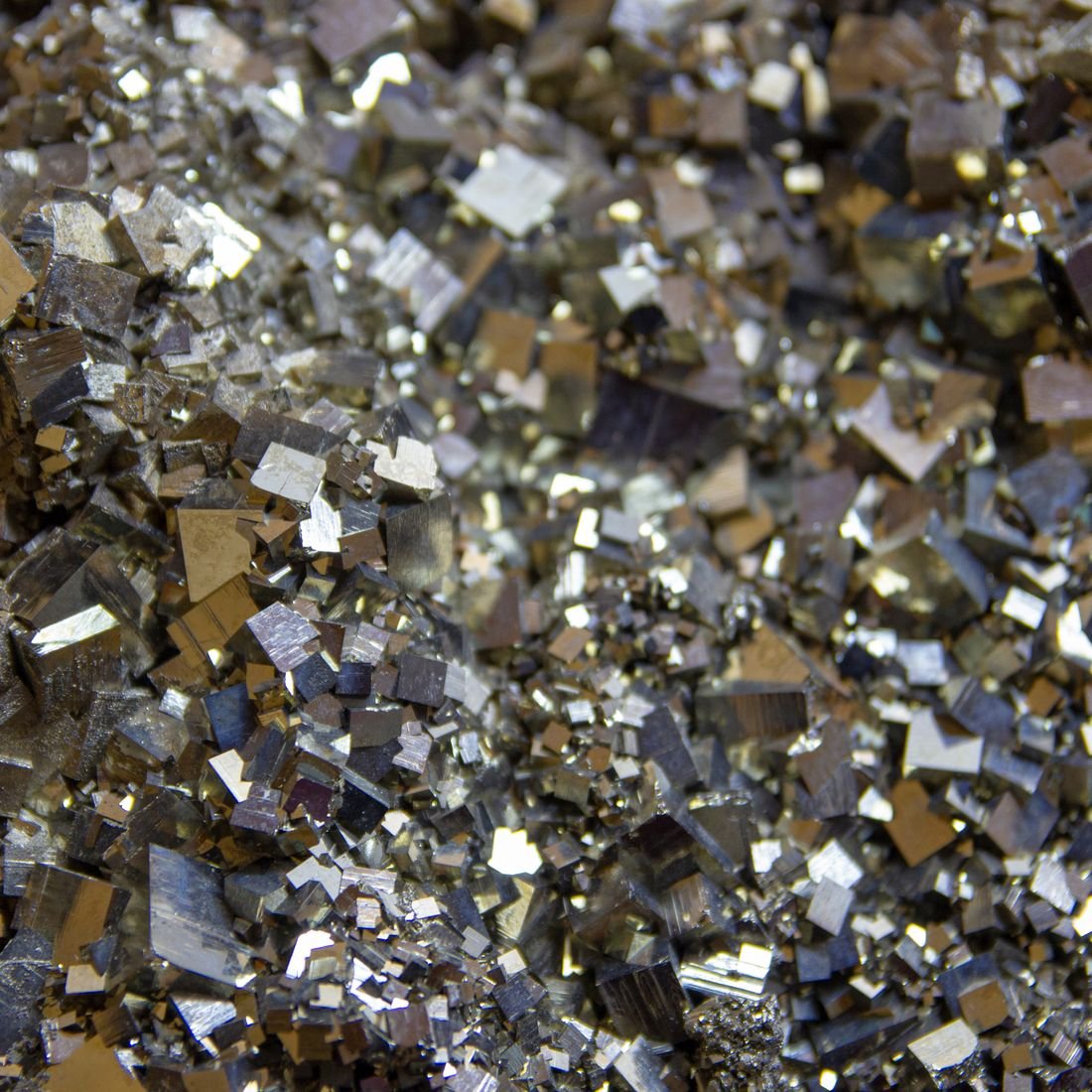
Iron sulfide · The abundance stone
Pyrite is iron sulfide (FeS₂), the brassy, metallic-gold mineral nicknamed “fool’s gold” for the miners it once tricked. In the crystal tradition it’s the “abundance stone,” reached for to attract money and opportunity, fire up willpower and confidence, and act as a protective shield — a solar-plexus stone for personal power. Its one quirk: it must be kept dry, since water makes iron sulfide rust and crumble. Below — meaning, how to use it, how to care for a water-shy stone, and how to tell it from real gold and glass.
Few minerals look as boldly wealthy as pyrite. Brassy, mirror-bright and often growing in perfect little cubes, it gleams like a fistful of gold — which is exactly why prospectors kept mistaking it for the real thing. The crystal tradition leans right into that shine, treating pyrite as the great stone of abundance, drive and self-belief. It’s the crystal people keep by the till, on the desk or in the money corner, as a bright nudge toward confidence and prosperity.
This guide covers what pyrite actually is, where its golden reputation comes from, how people use it, how to keep a stone that hates water, and how to tell it from gold and glass.
What is pyrite?
Pyrite is iron sulfide, FeS₂ — a sulfide mineral with a pale brass-yellow colour and a bright metallic lustre. It famously crystallises into near-perfect cubes and pyritohedra, and its name comes from the Greek pyr, “fire,” because it sparks when struck against steel. It’s moderately hard, 6 to 6.5 on the Mohs scale, but brittle.
Its one weakness is moisture: over time, damp air and water make pyrite oxidise — it can dull, rust, and even crumble (collectors call this “pyrite decay” or “pyrite disease”). So it’s a stone to keep dry and away from water. Fine pyrite comes from Spain (the famous cubes of Navajún), Peru and Italy.
Pyrite meaning & history
Pyrite has fascinated people for millennia. Ancient civilisations used polished pyrite as mirrors, struck it to make fire, and the Incas prized large polished slabs. Its enduring nickname, “fool’s gold,” was earned in the gold rushes, when its shine repeatedly fooled hopeful prospectors — even as pyrite itself sometimes signals real gold nearby.
In the modern crystal tradition, that golden gleam made pyrite the “abundance stone”: a talisman for wealth, ambition and manifestation, and a shield against negativity. Its solid cubic form and metallic strength also cast it as a stone of willpower and protection — grounded confidence with a golden glow.
Pyrite healing properties
In the crystal tradition, pyrite is valued as a stone of abundance, willpower and protection.
People typically turn to pyrite for:
- Abundance. The classic “money stone” for prosperity and opportunity.
- Willpower & drive. Said to boost confidence, ambition and follow-through.
- Protection. A shielding stone that “deflects” negativity.
- Focus at work. A motivating desk stone for productivity.
These are traditional and symbolic uses, not medical or financial claims. No crystal will improve your bank balance, and there is no scientific evidence that any stone treats illness or attracts money. Enjoy pyrite as a motivating symbol and a striking object on your desk; it is not a treatment or an investment strategy, and nothing here is intended to diagnose or cure any condition.
Pyrite, the chakras & zodiac
Pyrite is linked above all to the solar plexus chakra (Manipura), just above the navel — the centre of confidence, willpower and personal power. Its bright gold is felt as warming and empowering, a spark for self-belief and action. Its grounded, metallic solidity also gives it a protective, stabilising quality.
By zodiac it’s most often associated with Leo, whose confidence and shine it mirrors. It has no birthstone month, but it’s a bold, encouraging gift for anyone launching a project, business or new chapter.
How to use pyrite
Most uses revolve around confidence, drive and attracting abundance.
- Keep it on your desk. The classic stone for work, ambition and productivity.
- Place it in the “money corner.” By the till, safe or wealth area of the home.
- Hold it before a big push. A confidence anchor before a pitch or interview.
- Wear it as jewellery. A pyrite piece keeps its bold, golden energy with you (keep metal settings dry).
- Grid it for protection. A shielding stone at the edges of a room or space.
- Keep it dry. Away from water, damp and humid bathrooms.
How to cleanse & charge pyrite
Pyrite is the classic “never wet” crystal — water is its enemy.
- Smoke. Sage, palo santo or incense — safe and dry.
- Selenite. Rest it on a selenite plate overnight.
- Sound. A singing bowl for small pieces.
- Moonlight or brief sun. A dry charge on a windowsill.
- Dry salt bed (not salt water). Nestle it in a bowl of dry rice or salt, not submerged.
Never use water, salt water, or long soaking — iron sulfide rusts and can disintegrate. Keep pyrite in a dry spot, away from humidity, and it will keep its shine for years. Cleanse it whenever it has felt “heavy” or after a stressful, draining stretch.
Types & forms
Pyrite shows up in some spectacular natural forms:
- Pyrite cubes. Near-perfect natural cubes, famously from Navajún, Spain.
- Pyrite suns (dollars). Flat radiating discs formed in shale.
- Druzy pyrite. Sparkling crusts of tiny crystals, often on slate.
- Rainbow pyrite. An iridescent variety — though much “rainbow” material on sale is treated or another mineral.
Is pyrite rare or valuable?
Pyrite is abundant and affordable — clusters, cubes and small specimens cost little, which is part of its appeal. Value rises for large, sharp natural cubes (fine Spanish cube clusters are prized), striking pyrite suns and well-formed collector specimens. It is not a stone people buy as an investment, and its lovely shine belies a modest price.
Quality comes down to crystal form, brightness and the absence of rust or decay. Because it can oxidise, the freshest, driest-stored specimens hold their gleam best.
How to tell real pyrite from gold (and glass)
Pyrite is nature’s own “fake gold,” but it’s easy to tell from the real thing — and from imitations of pyrite itself.
- Vs real gold. Pyrite is hard and brittle (it scratches glass and shatters); gold is soft and malleable. Pyrite leaves a greenish-black streak on unglazed tile; gold leaves a yellow streak. Gold is far heavier.
- Look for cubes. Sharp cubic crystals and striated faces are a hallmark of natural pyrite.
- Beware “rainbow” hype. Intensely iridescent “rainbow pyrite” is often coated quartz or treated chalcopyrite, not natural pyrite.
- Watch for glass or resin. Round bubbles and a warm, light feel point to imitation rather than metallic mineral.
- Check for rust. A flaking, powdery, sulphur-smelling piece is oxidising pyrite (or unstable marcasite) — store it dry.
Genuine, ethically sourced pyrite
If you’d like a piece of your own, Minerals Kingdom offers authenticated natural pyrite — cubes, clusters and specimens.