
How Crystals Form
From molten rock to mineral-rich water, this is the real geology behind every crystal on your shelf — and why nature builds them into such flawless shapes.
Crystallisation · How minerals grow
A crystal forms when atoms lock into a repeating, orderly pattern as a mineral solidifies. This happens in three main ways: from cooling magma deep underground, from mineral-rich water depositing crystals in cavities and veins, and from vapour or intense heat and pressure in metamorphic rock. The single biggest factor in how large and well-formed a crystal grows is time — the slower and more undisturbed the growth, the bigger and cleaner the crystal. That is why a hand-sized quartz point can represent thousands of years of quiet, patient growth.
Every crystal you own is a small feat of geology. Long before it reached a shop shelf, its atoms arranged themselves — one layer at a time — into a pattern so orderly that it produces flat faces, sharp edges and geometric points entirely on its own. No one carves a raw quartz point into shape; it grows that way. Understanding how crystals form turns a pretty stone into something genuinely remarkable: a record of the conditions, chemistry and time that made it.
This guide walks through what a crystal actually is, the three great settings in which crystals grow, and why they take the shapes they do.
What is a crystal, really?
A crystal is a solid in which the atoms are arranged in a highly ordered, repeating three-dimensional pattern called a crystal lattice. That internal order is the defining feature — not the outward beauty. When a mineral has room and time to grow, the lattice expresses itself as flat faces and regular angles, giving the well-formed crystals we prize. When it is crowded, it still has the same internal order but a rougher outward form.
This is why obsidian is technically not a crystal: it is volcanic glass that cooled too fast for any lattice to organise, so it has no ordered structure at all. The same chemistry, cooled slowly, would have grown quartz and feldspar crystals instead. Speed, in other words, is everything.
Crystals from magma (igneous)
The first great crystal factory is molten rock. As magma cools, the elements dissolved in it begin to bond and solidify, and different minerals crystallise at different temperatures. Cooled slowly, deep underground, magma can grow large, clean crystals over very long periods — this is how much clear quartz, feldspar and mica form inside granite.
The most spectacular igneous crystals come from pegmatites: pockets of especially water-rich, slow-cooling magma where crystals can reach enormous size. Many gem minerals — beryl (the family that gives us aquamarine), tourmaline and topaz — grow in pegmatites. The lesson repeats: the slower the cooling, the bigger and better the crystal.
Crystals from water (hydrothermal & evaporite)
The second setting is water carrying dissolved minerals. When that water moves through cracks and cavities in rock and then cools, drops in pressure, or evaporates, it can no longer hold its dissolved load, and crystals precipitate out onto the surrounding rock.
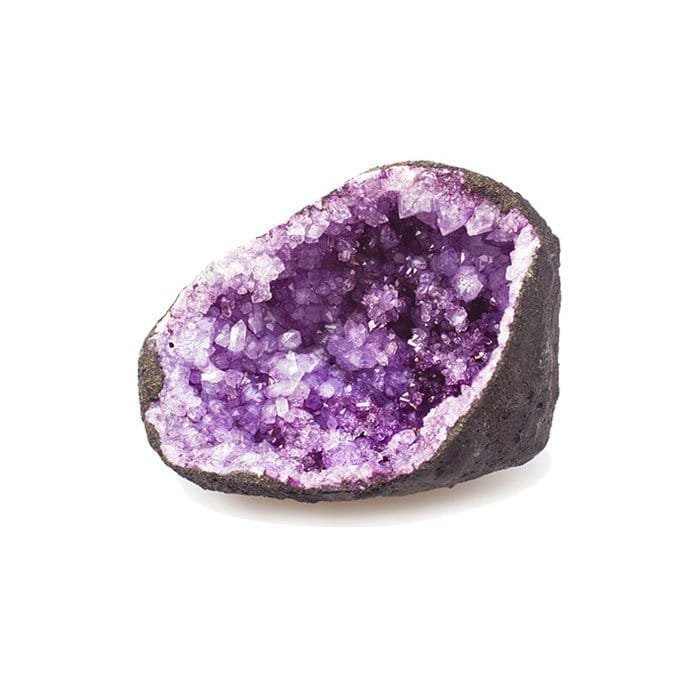
This is the story behind geodes — hollow rock cavities lined with inward-growing crystals. The classic amethyst geode forms when silica-rich water slowly deposits layer after layer of quartz inside a gas bubble in volcanic rock, tinted violet by traces of iron and natural radiation. The amethyst pictured above grew exactly this way.
A gentler version of the same process gives us evaporite minerals. When mineral-rich water evaporates, it leaves its dissolved content behind as crystals: this is how selenite (a form of gypsum) and halite (rock salt) form. It also explains why these stones are water-soluble and should never be soaked — you can literally dissolve them back the way they came.
Crystals from heat, pressure & vapour (metamorphic)
The third route needs no melting and no open water. When existing rock is subjected to intense heat and pressure deep in the Earth, its minerals can recrystallise in the solid state, reorganising into new crystals. Garnet, kyanite and much gem-quality mineral growth happens this way, in metamorphic rock. Some crystals also grow directly from vapour, as hot mineral-laden gases cool and deposit solids — the way sulphur crystals form around volcanic vents.
Why crystals take geometric shapes
The flat faces and sharp angles of a crystal are the outward signature of its internal lattice. Because the atoms stack in the same repeating pattern in every direction, the crystal grows fastest and most regularly along particular axes, producing the flat planes and fixed angles characteristic of each mineral. Quartz reliably forms six-sided prisms; fluorite and pyrite famously form cubes and octahedra. These consistent geometries are grouped into the crystal systems — explored in our companion guide to the seven crystal systems. Size, meanwhile, comes down to space and time: undisturbed growth over long periods builds large, clean crystals, while crowding produces small or intergrown ones.
This guide describes the geology of crystals — the genuine science of how they grow. In the separate crystal-healing tradition, stones are used as a symbolic focus for reflection and relaxation. Those uses are traditional and spiritual, not medical: there is no scientific evidence that any crystal treats, cures or prevents illness, and nothing here is intended to diagnose or treat any condition. Enjoy crystals both for the remarkable natural objects they are and, if you wish, as a mindful ritual — but see a qualified professional for any health concern.
Why this matters for how you use crystals
Knowing how a crystal formed is quietly practical. It tells you which stones are soft or water-soluble and need gentle care, why some colours fade in sunlight, and why no two natural specimens are identical. It also helps you spot imitations: a “crystal” with no internal order and tell-tale bubbles is probably glass. If you go on to use crystals in the healing tradition, that same knowledge makes the practice richer — you are holding a real fragment of deep time. For where to begin, see our guides to the seven chakras and their crystals and to caring for your stones.
However you relate to them, the origin story is the same: patient chemistry, the right conditions, and time. A crystal is order made visible — and that is worth appreciating whether it sits in a display case or on a meditation cushion.
Genuine, naturally grown specimens
If you’d like a naturally formed piece of your own, Minerals Kingdom offers authenticated natural crystals — geodes, points and raw specimens straight from the ground.