Herkimer Diamond
Not a diamond at all but a naturally faceted, water-clear quartz crystal pointed at both ends — grown inside half-billion-year-old rock in upstate New York — and treasured in the crystal world as the bright “attunement stone” of clarity, dreams and amplified intention.
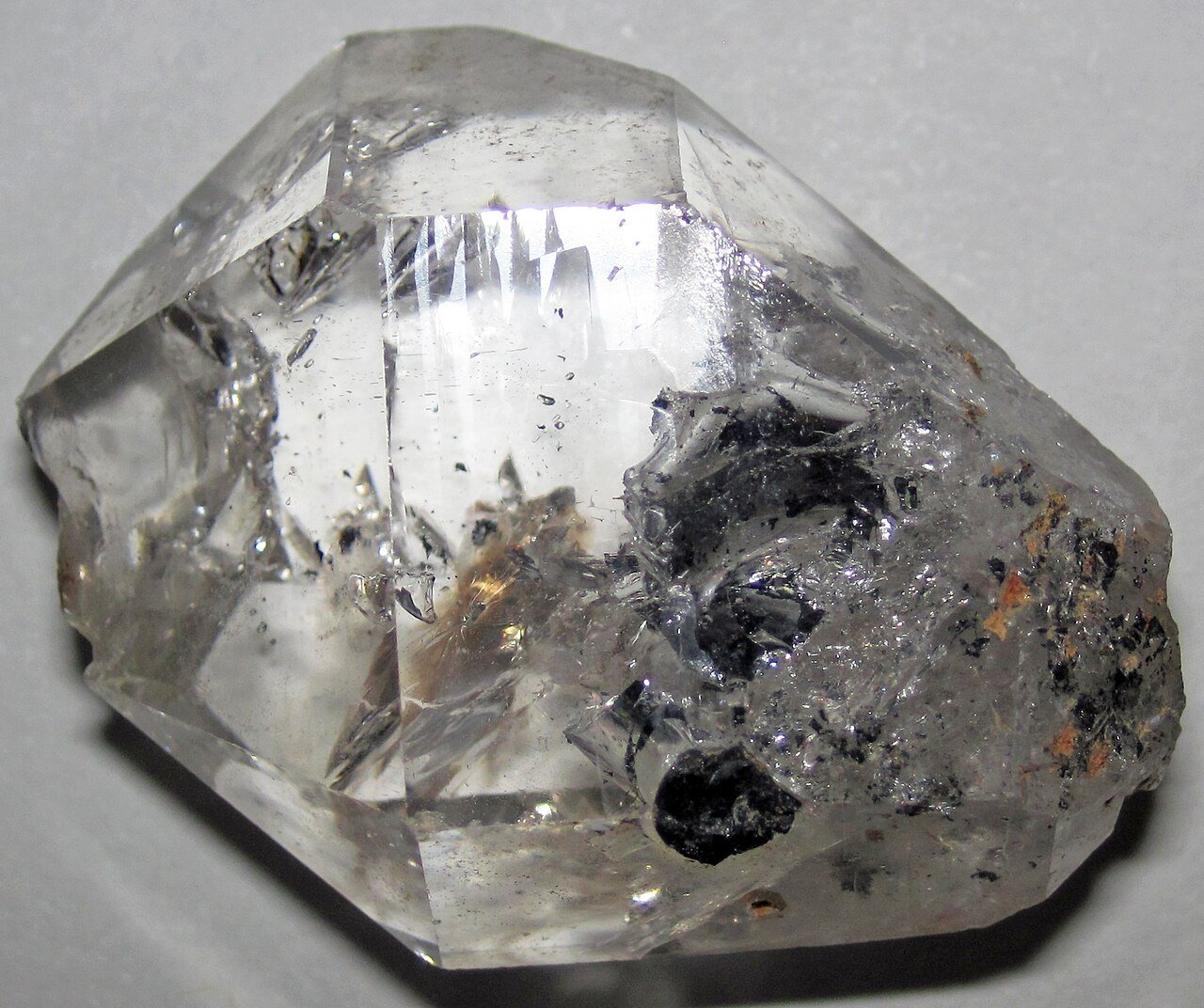 Double-terminated quartz · Clarity & dreams
In short A Herkimer diamond is a naturally double-terminated quartz crystal (SiO2, trigonal system, 7 on the Mohs scale) found in the Late Cambrian dolostone of Herkimer County and the Mohawk River Valley, New York. It grows free-floating inside small cavities in the rock, so instead of being attached at one end it develops a perfect point at both ends — 18 natural facets — with exceptional, glassy clarity straight out of the ground. The “diamond” is a nineteenth-century nickname, not a mineral identity. The crystal tradition reads it as a high-vibration stone of clarity, attunement, vivid dreams and amplified intention — symbolic uses, this guide explains, rather than medical ones.
Pick up a true Herkimer diamond and the first surprise is that nobody has cut it. Those bright, mirror-flat faces and the sharp points at either end are exactly as nature made them, grown slowly in a pocket of ancient seabed rock and released, centuries later, by a miner’s hammer. Few crystals come out of the ground looking this finished — which is why a little quartz from upstate New York borrowed the name of the most famous gem in the world.
This guide covers what a Herkimer diamond really is, how it forms, why the name is a nickname, what the crystal tradition says about it, how to care for it, and how to tell a genuine New York stone from the “Herkimer-type” quartz and glass that fills so many shop trays. If you are new to quartz in general, our profile of clear quartz is the natural companion to this page.
What is a Herkimer diamond?
A Herkimer diamond is quartz — silicon dioxide, SiO2 — the same mineral as ordinary rock crystal. What sets it apart is its habit and its address. Herkimer diamonds are doubly terminated: each crystal has a six-sided prism capped by a pointed termination at both ends, giving 18 natural faces (six prism faces and two sets of six rhombohedral faces). The prism is usually short and stubby, so many look like tiny, glittering double pyramids.
Like all quartz, it belongs to the trigonal crystal system, measures 7 on the Mohs scale, has no cleavage and breaks with a conchoidal fracture, and has a specific gravity of about 2.65. Its clarity is often exceptional, though many crystals carry small inclusions: black specks of a solid hydrocarbon (often described as anthraxolite), tiny pockets of salt water, petroleum or carbon dioxide — some with a moving gas bubble, called enhydros — and occasional smoky or golden zones. You can read more about how quartz builds its six-sided architecture in our guide to the seven crystal systems.
Herkimer diamond meaning & history
The name comes from Herkimer County, New York, where the crystals weather out of the dolostone of the Mohawk Valley. Workmen cutting into that rock in the late eighteenth century found them in large numbers, and the first well-known finds, near Middleville and Little Falls, also earned them the local names “Middleville diamonds” and “Little Falls diamonds.” Their brilliance and natural facets earned them the nickname “diamonds” — a name that stuck, even though they are nothing of the kind. Today several fee-to-dig mines around Middleville and St. Johnsville let visitors split the rock and find crystals for themselves.
In the modern crystal world, the Herkimer diamond is best known as the “attunement stone” — said in that tradition to help a person tune in to themselves, to other people and to their surroundings. Its clarity and double points also made it a symbol of purity, focus and energy that flows in two directions, and it is often described as one of the most “high-vibration” forms of quartz.
How Herkimer diamonds form
The host rock is the Little Falls Formation (long known as the Little Falls Dolostone), a magnesium-rich carbonate rock laid down as sediment in a warm, shallow sea during the Late Cambrian, roughly 500 million years ago. Over time, small cavities called vugs opened in the rock. Much later — geologists generally place it in the Carboniferous — silica-bearing fluids seeped through, and in the stillness of those pockets quartz crystallised slowly, without a surface to anchor to — which is exactly why points grew at both ends.
The dark hydrocarbon inclusions are traces of organic matter, mobilised as hydrocarbons and caught up while the crystals grew. Because the crystals sit loose or lightly attached inside the vugs, they can be released from the rock whole, faces intact. For the broader story of how slow growth in open space produces sharp, well-formed crystals, see our explainer on how crystals form.
Herkimer diamond healing properties
In the crystal tradition, the Herkimer diamond is valued as a stone of clarity, attunement and amplification.
People typically turn to Herkimer diamonds for:
- Clarity & focus. Its water-clear body is read as an emblem of a clear mind, honest perception and sharp, uncluttered thinking.
- Dreams & dream recall. One of its best-known associations — many people keep one by the bed or under the pillow for vivid, memorable dreams.
- Attunement. Said in the tradition to help you “tune in” — to your intuition, to a meditation, or to the people and places around you.
- Amplifying intentions & other stones. Like clear quartz, it is described as a magnifier, often placed in grids or beside other crystals to “boost” them.
These are traditional and symbolic uses, not medical claims. There is no scientific evidence that any crystal treats, cures or prevents any illness, and Herkimer diamonds have no proven effect on health, sleep, dreams or energy. Crystals are not a substitute for medical care: nothing here is intended to diagnose, treat or prevent any condition, and health concerns belong with a qualified professional.
Herkimer diamond, the chakras & zodiac
Its colourless clarity links the Herkimer diamond most closely to the crown chakra (Sahasrara), the centre associated with awareness and spiritual connection, and its dream associations tie it to the third eye (Ajna). Like other clear quartz, it is also read as a “universal” stone that can be used on any chakra. It shares this bright, high-crown territory with selenite, apophyllite and amethyst. For the wider framework, see our guide to the seven chakras and their crystals.
By zodiac, the Herkimer diamond is most often linked to Sagittarius, the sign of exploration and insight.
How to use a Herkimer diamond
- Keep one by the bed. The classic use — on the nightstand or under the pillow, paired with a dream journal.
- Hold it in meditation. Small enough to rest in the palm or on the brow during quiet, focused practice.
- Wear it as jewellery. At 7 Mohs it is hard enough for pendants and earrings; wire-wrapped and bezel-set points are popular, as the natural faces need no cutting.
- Add it to a crystal grid. Placed at the centre or between stones, where its double points are read as linking and amplifying the layout.
- Set an intention with it. Many people “program” a Herkimer diamond with a focused intention — our guide to how to program a crystal walks through the process.
How to cleanse & charge a Herkimer diamond
- Water is fine. As hard, non-porous quartz, it tolerates a rinse in lukewarm water and a soft cloth; pat it dry.
- Go easy on the sun. Brief morning light is fine, but strong sunlight through a sharp crystal can focus heat — keep it away from fabrics and wood on a windowsill.
- Smoke, sound, moonlight or selenite are all gentle, contact-free options.
- Avoid sudden temperature changes and ultrasonic cleaners, which can open fractures — especially in crystals with fluid inclusions.
- Store points apart so their sharp terminations do not chip against each other.
Our general guide to cleansing and charging crystals covers each method in more detail, including which stones tolerate water and which do not.
Types & origins
- Water-clear Herkimers. The classic, inclusion-free crystals — the most prized for jewellery and display.
- Included Herkimers. Crystals with black hydrocarbon specks, smoky zones or golden hydrocarbon — loved by collectors for their character.
- Enhydro Herkimers. Crystals with a fluid pocket and a bubble that moves when the stone is tilted; rare and sought after.
- Clusters & twins. Two or more double-terminated crystals grown together, sometimes called “soulmate” or twin Herkimers.
- Matrix pieces. Crystals still seated in grey dolostone, showing how they formed in their vugs.
Strictly speaking, a Herkimer diamond comes only from Herkimer County and the surrounding Mohawk Valley in New York. Similar double-terminated, high-clarity quartz is mined in Pakistan (Balochistan), Mexico, Afghanistan and China; it is real quartz, but should be sold as “Herkimer-type” or double-terminated quartz, not as Herkimer diamond. Value depends on clarity, size, sharpness of the faces and genuine New York provenance.
Real vs fake
- Glass imitations. Moulded or cut glass is common; it is softer than quartz, may show bubbles or swirl marks, and feels less cool to the touch.
- Cut and polished quartz. A real Herkimer’s faces are natural. Tiny polishing lines, rounded edges or perfectly identical facets suggest the stone was shaped by a lapidary.
- Misleading origin. The most frequent problem is honesty of name — Pakistani or Chinese double-terminated quartz labelled “Herkimer diamond.” Ask where it was mined.
- The “diamond” word. It is a trade nickname. A seller should never imply a Herkimer is a real diamond or price it like one.
The workable rule: look for natural faces, a stated New York origin and a quartz-level hardness before paying Herkimer prices. For the wider method, see our guide to spotting dyed and imitation stones.
Genuine, correctly sourced Herkimer diamonds
If you’d like a piece of your own, Minerals Kingdom offers authenticated natural double-terminated quartz — with Herkimer diamonds from New York clearly distinguished from Herkimer-type quartz, and honestly described.
Herkimer diamond pairs well with
Frequently asked questions
Is a Herkimer diamond a real diamond?
No. A Herkimer diamond is quartz (silicon dioxide), not diamond (pure carbon). It earned the nickname for its natural brilliance and faceted shape. At 7 on the Mohs scale it is hard, but far softer than diamond at 10, and it is priced accordingly.
What is a Herkimer diamond good for?
Traditionally, it is used for clarity, attunement, vivid dreams and amplifying intentions or other crystals. These are symbolic, traditional uses, not proven medical effects. No crystal treats illness, and Herkimer diamonds are not a substitute for medical care.
Where do Herkimer diamonds come from?
True Herkimer diamonds come from the Late Cambrian dolostone of Herkimer County and the Mohawk Valley in New York, USA. Similar double-terminated quartz from Pakistan, Mexico, Afghanistan or China is real quartz but should be called “Herkimer-type.”
Can Herkimer diamonds go in water?
Yes. As hard, non-porous quartz, they tolerate a brief rinse in lukewarm water. Avoid sudden temperature changes and ultrasonic cleaners, and don’t leave them in strong direct sunlight, where a clear crystal can focus heat.
How can I tell if a Herkimer diamond is real?
Look for natural, mirror-flat faces with no polishing lines, two genuine terminations, quartz hardness (it scratches glass) and often small natural inclusions. Ask the seller for the mine or county of origin — New York provenance is what makes it a Herkimer.
Is a Herkimer diamond the same as clear quartz?
Mineralogically, yes — both are quartz. A Herkimer diamond is a specific, naturally double-terminated, high-clarity variety from New York, so it is a special kind of clear quartz rather than a different mineral.
Sources · Mindat — Quartz · Mindat — Herkimer County, New York · Wikipedia — Herkimer diamond.
Image credits · Hero and buy-box: Herkimer diamond quartz from near Herkimer, New York — photo James St. John, via Wikimedia Commons (CC BY 2.0).