
Apophyllite
A glassy, pearly sheet silicate that grows as sparkling pyramids and blocky prisms inside the gas bubbles of ancient Indian lava — and is cherished in the crystal world as a bright, clear stone of meditation, insight and spiritual connection.
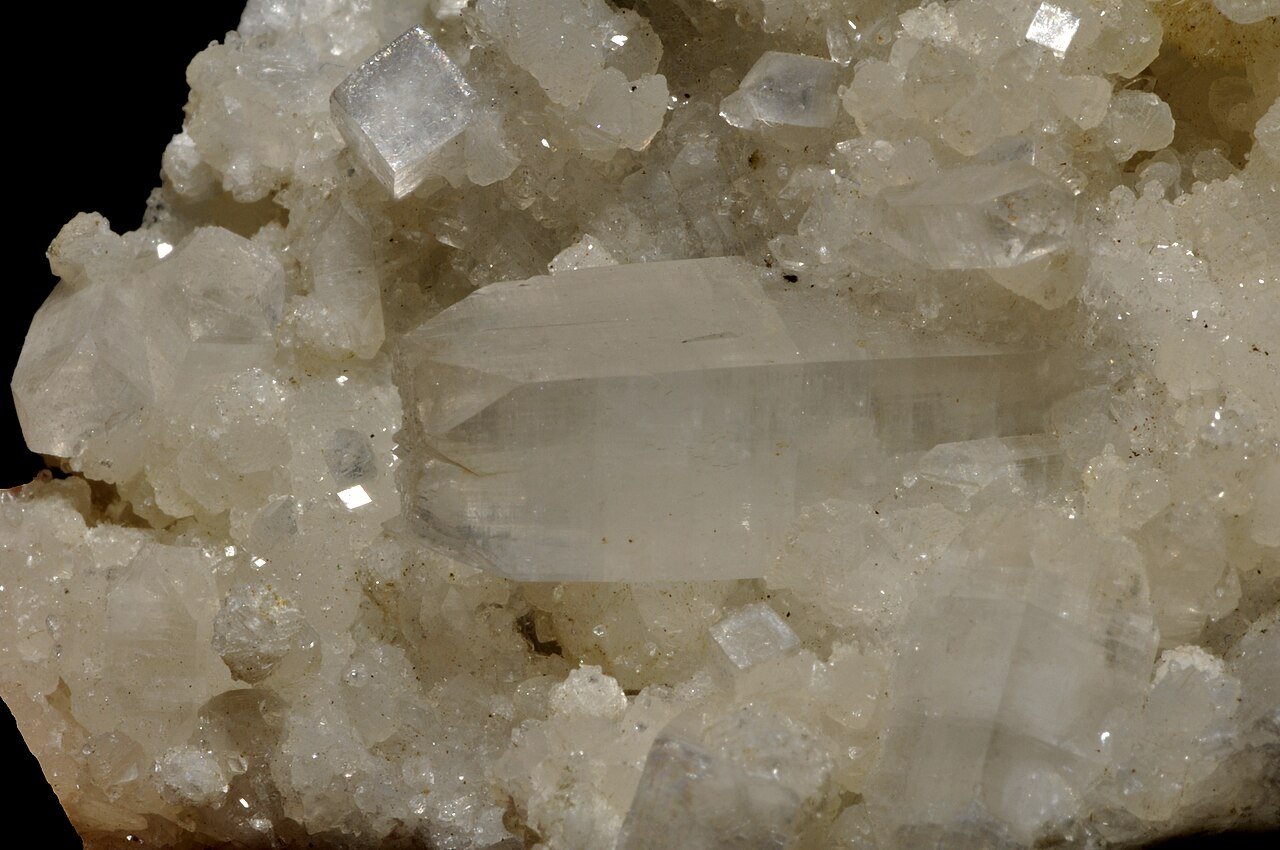
Apophyllite group · Clarity & insight
In short Apophyllite is not a single mineral but a small group of hydrated sheet silicates — chiefly fluorapophyllite-(K), with the formula KCa4Si8O20(F,OH)·8H2O, and its close cousin hydroxyapophyllite-(K). It crystallises in the tetragonal system, forming square-sectioned prisms and sharp, mirror-bright pyramids, most famously in the basalt cavities of India’s Deccan Traps, where it grows alongside stilbite and other zeolites. It has a perfect cleavage with a pearly sheen and sits at only 4.5–5 on the Mohs scale, so it needs gentle handling. The crystal tradition reads it as a third-eye and crown stone of meditation, clarity, honesty and spiritual connection — symbolic uses, this guide explains, rather than medical ones.
Apophyllite looks almost too perfect to be natural. Its crystals rise in crisp, four-sided pyramids and blocky little towers, so clear and glassy they seem cut by hand, and their flat tops catch the light with a soft, mother-of-pearl shimmer. Hidden for millions of years inside the gas bubbles of cooled lava, it has become one of the best-loved specimens in modern crystal collections — affordable, sparkling and endlessly photogenic.
This guide covers what apophyllite actually is, how it grows inside volcanic rock, where its curious name comes from, the meanings the crystal tradition gives it, and the practical care a medium-soft, perfectly cleaving mineral needs if it is to keep its shine.
What is apophyllite?
Apophyllite is the name of a mineral group rather than a single species. Since the International Mineralogical Association tidied up its nomenclature, the members are known as fluorapophyllite-(K), hydroxyapophyllite-(K) and the rarer fluorapophyllite-(Na). They differ only in whether fluorine or hydroxyl dominates one site in the structure, and whether potassium or sodium fills another; by eye they are practically indistinguishable, so dealers and collectors simply say “apophyllite.” Most material on the market is fluorapophyllite-(K).
Structurally, apophyllite is a phyllosilicate — a sheet silicate. Its silicon and oxygen atoms link into flat layers of four- and eight-membered rings, held together by calcium, potassium and a generous amount of water locked into the crystal. That layered architecture explains its two most distinctive traits: a perfect basal cleavage, so it splits cleanly into thin flakes parallel to its flat top, and the pearly lustre that shines on that cleavage face, while the sides are bright and glassy (vitreous).
Fluorapophyllite-(K) crystallises in the tetragonal system, which is why its prisms have a square cross-section and its pyramids four matching faces. Combinations of prism and pyramid can look almost cubic or octahedral, which sometimes leads beginners to mistake it for fluorite. It has a hardness of 4.5–5 Mohs and a low density of about 2.3–2.4. To see where the tetragonal system fits among the others, explore our guide to the seven crystal systems.
Apophyllite meaning & history
The name was given in 1806 by the French mineralogist René Just Haüy, often called the father of crystallography. He built it from the Greek apo, “off” or “away,” and phyllon, “leaf,” because the mineral flakes apart into leaf-like layers when heated. As the crystal warms, it loses its structural water and exfoliates along its perfect cleavage — a property that once served as a simple field test.
Apophyllite has no long lineage in ancient amulets or royal regalia; it entered the wider imagination much more recently, as the huge basalt quarries of western India began yielding spectacular clusters in the twentieth century. In the modern crystal world it quickly earned a reputation as a “high-vibration” stone of light and clarity. Its transparent pyramids are read as natural lenses, and practitioners describe it as a bridge between everyday awareness and meditative or spiritual states — a stone of honesty, insight and inner stillness.
Born in lava bubbles
Most of the world’s apophyllite comes from the Deccan Traps, a vast pile of flood basalts that poured out over western India around 66 million years ago. As each lava flow cooled, gas bubbles were frozen into the rock, leaving countless hollow cavities called vesicles and larger pockets known as geodes. Over long periods, warm, mineral-rich groundwater seeped through the basalt, slowly altering the volcanic glass and depositing new crystals inside those empty spaces.
Apophyllite is one of the classic products of that process, growing in company with the zeolite minerals — peach-coloured stilbite, heulandite, needle-like scolecite and mesolite — together with calcite, quartz, chalcedony and green prehnite. Although it is often sold among the zeolites and shares their habitat and water-rich chemistry, apophyllite is technically a sheet silicate, not a zeolite. The famous Indian localities include quarries around Pune (Poona), Nashik, Jalgaon and Aurangabad, where the rock is broken for roads and dams and the crystal pockets are recovered by local collectors. For the broader story of how minerals grow from fluids, see our guide to how crystals form.
Apophyllite healing properties
In the crystal tradition, apophyllite is valued as a stone of clarity, meditation and spiritual connection.
People typically turn to apophyllite for:
- Meditation & stillness. Its signature association — a clear pyramid placed in front of you or held in the hand is read as helping the mind settle and focus.
- Clarity & insight. Linked to seeing situations honestly, cutting through confusion and noticing what has been overlooked.
- Spiritual connection. Often described as a “bridge” stone, used in practices aimed at intuition, dreamwork and a sense of connection to something larger.
- Calm & release of tension (green apophyllite). The green variety is associated with the heart, emotional ease and a gentle, refreshing calm.
These are traditional and symbolic uses, not medical claims. There is no scientific evidence that any crystal treats, cures or prevents any illness, and apophyllite has no proven effect on health, mood or the mind. Nothing here is intended to diagnose, treat or prevent any condition; health concerns, including anxiety or sleep problems, belong with a qualified healthcare professional.
Apophyllite, the chakras & zodiac
Clear and white apophyllite is most often linked to the crown chakra (Sahasrara) and the third eye (Ajna), the centres traditionally associated with awareness, intuition and spiritual perspective — natural territory for a transparent stone so tied to meditation. Green apophyllite is additionally read as a heart chakra stone. It shares its clear, high-chakra role with clear quartz, selenite and celestite. For the wider framework, see our guide to the seven chakras and their crystals.
By zodiac, apophyllite is most commonly associated with Gemini and Libra, air signs whose traditional themes of thought, communication and balance echo the stone’s reputation for clarity.
How to use apophyllite
- Keep a cluster where you meditate. Its sparkle makes it a natural focal point for a few quiet minutes of breathing or reflection.
- Use a single pyramid as a gazing point. Apophyllite “pyramids” are natural crystal tips; many people place one at eye level during meditation.
- Set it beside the bed. A popular choice for those who keep a dream journal or like a calm, clear object nearby at night.
- Combine it with an intention practice. If you work with intentions, our guide to programming a crystal walks through a simple method.
- Display it rather than wear it. Its softness and perfect cleavage make apophyllite a poor choice for rings or bracelets; it is far happier on a shelf or altar.
How to cleanse & charge apophyllite
- Keep water brief and cool. A quick rinse in lukewarm water and a gentle pat dry is fine for most pieces, but never leave clusters soaking — matrix and companion zeolites can weaken.
- Avoid heat completely. Apophyllite holds water in its structure and can cloud, crack or flake when heated — no hot water, radiators or steam.
- Never use salt, acids or ultrasonic cleaners, which can etch the surface or split crystals along their cleavage.
- Smoke, sound, moonlight or a selenite plate are ideal dry, contact-free methods.
- Dust with a soft brush. Clusters collect dust between crystals; a clean make-up brush lifts it without chipping the delicate tips.
Our general guide to cleansing and charging crystals covers each method in more detail, including which stones tolerate water and which do not.
Types & origins
- Clear or white apophyllite. The classic form — glassy, colourless pyramids and blocks, often on a matrix of quartz or chalcedony.
- Green apophyllite. Mint to apple-green crystals, especially from the Pune district of India; the colour is attributed to traces of vanadium.
- Apophyllite with stilbite. Clear crystals perched on peach “bow-tie” stilbite — one of the most recognisable Indian combinations.
- Apophyllite pyramids. Single natural terminations broken or trimmed from clusters, sold as meditation points.
- Pink apophyllite. A rare, delicate pink to peach colour, most famously from the silver mines of Guanajuato, Mexico.
India dominates the market, but fine apophyllite also comes from Brazil, Mexico, Iceland, the United States (notably the basalt quarries of New Jersey), Canada (Nova Scotia) and historic mines in Germany such as St. Andreasberg. Because Indian quarries produce it in abundance, good clusters remain inexpensive; value rises with transparency, sharp undamaged tips, attractive companions and the rarer green and pink colours.
Real vs fake
- Glass imitations. Moulded glass “pyramids” may show bubbles, rounded edges and identical shapes; natural apophyllite has slight irregularities and growth lines.
- Confusion with quartz. Quartz grows as six-sided prisms and is harder (7 Mohs); apophyllite has square cross-sections, a four-sided pyramid and a pearly top face.
- Glued and repaired clusters. Because tips break easily along cleavage, broken crystals are sometimes glued back; look for shiny lines of resin at the base of crystals.
- Dyed or coated pieces. Occasionally colourless material is dyed or given an iridescent coating; natural green colour is soft and even inside the crystal, not concentrated in cracks.
The workable rule: look for square sections, a pearly flat top and natural irregularity — and be wary of uniform, perfectly identical “pyramids.” For the wider method, see our guide to spotting dyed and imitation stones.
Genuine, natural apophyllite clusters
If you’d like a piece of your own, Minerals Kingdom offers authenticated natural apophyllite — clearly described, with locality and companions honestly labelled.
Apophyllite pairs well with
Frequently asked questions
What is apophyllite good for?
Traditionally, apophyllite is used for meditation, clarity, honesty and spiritual connection — a third-eye and crown stone. These are symbolic, traditional uses, not proven medical effects. No crystal treats illness, and apophyllite has no demonstrated effect on health or the mind.
Is apophyllite a zeolite?
Not strictly. Apophyllite grows in the same basalt cavities as zeolites such as stilbite and is often sold alongside them, but mineralogically it is a sheet silicate (phyllosilicate) with a different structure.
Can apophyllite go in water?
A brief rinse in cool or lukewarm water is generally fine, but avoid soaking, salt water, hot water and ultrasonic cleaners. Apophyllite holds water in its structure and can cloud or flake if heated. Dry methods like smoke, sound or moonlight are safest.
Is green apophyllite natural?
Yes — natural green apophyllite comes mainly from the Pune area of India, and its colour is attributed to traces of vanadium. Its green is soft and even within the crystal; colour pooled in cracks suggests dye.
Are apophyllite pyramids cut or natural?
Genuine apophyllite pyramids are natural crystal terminations, usually broken from larger clusters and sometimes trimmed at the base so they stand upright. The four pyramid faces themselves grow that way in nature.
What crystals pair well with apophyllite?
Clear, light stones suit it well — clear quartz for focus, selenite for calm, celestite for serenity — and green prehnite, which grows alongside it in the same Indian basalts, makes a natural companion.
Sources · Mindat.org, “Fluorapophyllite-(K)” and “Apophyllite Group”; Anthony et al., Handbook of Mineralogy (Mineralogical Society of America); Burke, “Tidying up mineral names: an IMA report on revalidation and renaming,” Mineralogical Record (2008); Hatert et al., “CNMNC guidelines for the use of suffixes and prefixes in mineral nomenclature,” European Journal of Mineralogy (2013).
Image credits · Hero and buy-box: white apophyllite cluster from India — photo Géry Parent, via Wikimedia Commons (public domain).