Prehnite
The soft green stone with a milky glow — the crystal of unconditional love, and the first mineral ever named after a person.
Calcium aluminium silicate · The healer’s stone
Prehnite is a calcium aluminium silicate that grows in pale green botryoidal crusts with a soft, milky glow — often studded with black needles of epidote. In the crystal tradition it’s the stone of unconditional love and the healer’s healing, a heart-chakra crystal said to restore those who care for others. It’s hard enough to wear (6–6.5 Mohs) and reasonably water-tolerant. It was, in 1788, the first mineral ever named after a person. Below — meaning, how to use it, how to keep it, and how to tell it from jade.
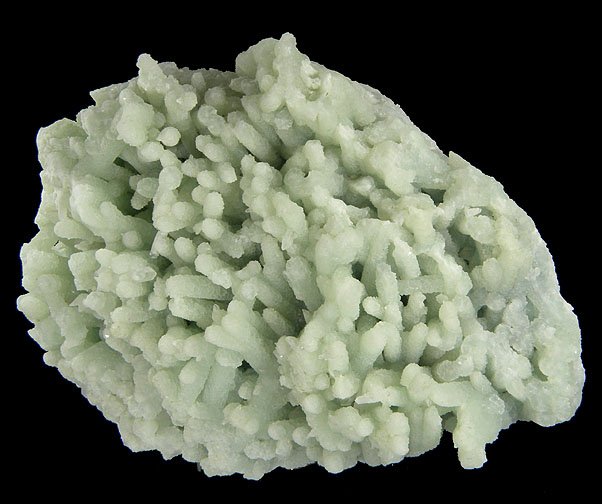
Prehnite does not sparkle. It glows — a soft, waxy, faintly translucent green, like light through a grape skin, or a jade carving lit from behind. When it grows over black epidote needles the effect is genuinely strange: dark spears frozen inside a pale mist. Collectors call it the stone that looks like it is holding its breath.
This guide covers what prehnite actually is, the odd distinction it holds in the history of mineralogy, where its healing reputation comes from, how people use it, and how to tell it from the jade it is so often mistaken for.
What is prehnite?
Prehnite is a calcium aluminium silicate hydroxide, forming in cavities in volcanic rock, often alongside zeolites, epidote and calcite. Its typical habit is botryoidal — a bubbly, grape-like crust — with a fibrous internal structure that scatters light and produces the characteristic milky sheen.
It sits at 6 to 6.5 on the Mohs scale: hard enough for pendants and rings worn with care. It is somewhat brittle and has one direction of good cleavage.
Fine material comes from Mali (the yellow-green “grape” specimens), Australia, South Africa, Scotland and New Jersey. Geologists know it well for a different reason: prehnite-pumpellyite facies is a named metamorphic grade. Its presence tells you what a rock has been through.
Prehnite meaning & history
Prehnite holds a genuine footnote in scientific history. Described in 1788 and named for Colonel Hendrik von Prehn, a Dutch military commander who brought specimens back from the Cape of Good Hope, it was the first mineral in the world to be named after a person. Every mineral name ending in “-ite” after a surname follows from that precedent.
It has no ancient lore. Its meanings arrived in the twentieth-century crystal revival, where it acquired an unusually specific reputation: the stone of unconditional love, and — the phrase used everywhere — the crystal that “heals the healer.” It is the stone recommended to nurses, therapists, carers and anyone who empties themselves into other people.
Where that came from is hard to trace. It is a modern attribution, like most on this site. But it is a kind one, and the people it is aimed at deserve a stone.
Prehnite healing properties
In the crystal tradition, prehnite is valued as a stone of unconditional love, calm and renewal.
People typically turn to prehnite for:
- Healing the healer. Its signature use — for carers and therapists.
- Unconditional love. A heart-chakra stone for acceptance.
- Calm. Said to quiet worry and restlessness.
- Decluttering. Oddly, a stone associated with letting go of things.
These are traditional and symbolic uses, not medical claims. Prehnite is sold as a stone for burnout, for the kidneys and for the connective tissue. There is no scientific evidence that any crystal treats illness. Burnout is real, serious and has real remedies — rest, boundaries, sometimes professional help. If you are a carer running on empty, a stone is a nice gesture and a poor substitute for support. Nothing here is intended to diagnose or cure any condition.
Prehnite, the chakras & zodiac
Prehnite works at the heart chakra (Anahata) and, through its yellower material, the solar plexus (Manipura) — the tradition reads this pairing as compassion joined to the will to act on it.
By zodiac it’s most often associated with Libra. It has no birthstone month, but it is a thoughtful gift for someone in a caring profession.
How to use prehnite
Most uses revolve around restoring the person who does the restoring.
- Keep it where you work. On a therapist’s shelf, a nurse’s windowsill.
- Hold it after a hard day. The stone’s most characteristic use.
- Wear it over the heart. A prehnite pendant — hard enough for daily wear.
- Use it in meditation. Rested on the chest.
- Keep one where you tidy. For the decluttering association, if it amuses you.
- Give it to a carer. Its clearest purpose.
How to cleanse & charge prehnite
Prehnite is one of the more forgiving green stones.
- Water. A brief cool rinse is safe; avoid long soaks.
- Moonlight. A gentle overnight charge.
- Smoke. Sage, palo santo or incense.
- Selenite. Rest it on a plate.
- Earth. Briefly buried, for its green, grounded association.
Avoid prolonged strong sunlight, which can pale the green; avoid ultrasonic and steam cleaners, since prehnite is brittle and cleaves; avoid acids. Cleanse it after emotionally draining stretches — which, given what it is for, will be often.
Types & inclusions
- Prehnite with epidote. Black needles inside pale green — the classic collector piece.
- Grape prehnite. Yellow-green botryoidal clusters from Mali.
- Cat’s-eye prehnite. Fibrous material cut to show a moving line of light.
- Prehnite with tourmaline. Fine black rutile-like needles suspended in green.
Is prehnite rare or valuable?
Prehnite is affordable. Tumbles and small cabochons cost little. Value rises for translucent, evenly coloured material, for well-formed botryoidal specimens, and above all for prehnite with sharp epidote inclusions, which collectors pursue seriously. Cat’s-eye material commands a premium.
Quality comes down to translucency and colour evenness. Chalky, opaque prehnite is common and cheap; the glowing translucent green is what people pay for.
How to tell real prehnite from fake
Prehnite is rarely faked. It is more often mistaken — or used to mislead.
- Vs jade. The main confusion. Prehnite is softer (6–6.5 vs jadeite’s 6.5–7) and, crucially, much less tough: jade is famously unbreakable, prehnite chips. Prehnite’s botryoidal habit is unmistakable in rough form.
- “Grape jade”. A trade name for prehnite. Not jade.
- Vs green fluorite. Fluorite is far softer (4) and shows cubic cleavage.
- Vs dyed quartzite. Uniform colour, no internal glow, no fibrous sheen.
- Look for the sheen. Real prehnite has a soft, waxy, slightly milky internal glow from its fibrous structure. Glass and resin look flat.
Genuine, ethically sourced prehnite
If you’d like a piece of your own, Minerals Kingdom offers authenticated natural prehnite — specimens, tumbles and pendants.