Celestite
The pale sky-blue geode crystal of serenity — the angel stone, whose colour fades in the light that reveals it.
Strontium sulfate · The angel stone
Celestite — also called celestine — is strontium sulfate (SrSO₄), famous for geodes lined with pale blue crystals like a piece of frozen sky. In the crystal tradition it’s the “angel stone” of serenity, dreams and quiet contact with something larger. It’s soft (3–3.5 Mohs), brittle, slightly water-soluble, and its blue fades irreversibly in sunlight. Its heavier density is the easiest way to tell it from blue calcite. Below — meaning, how to use it, how to keep a fragile stone alive, and how to spot a dyed geode.
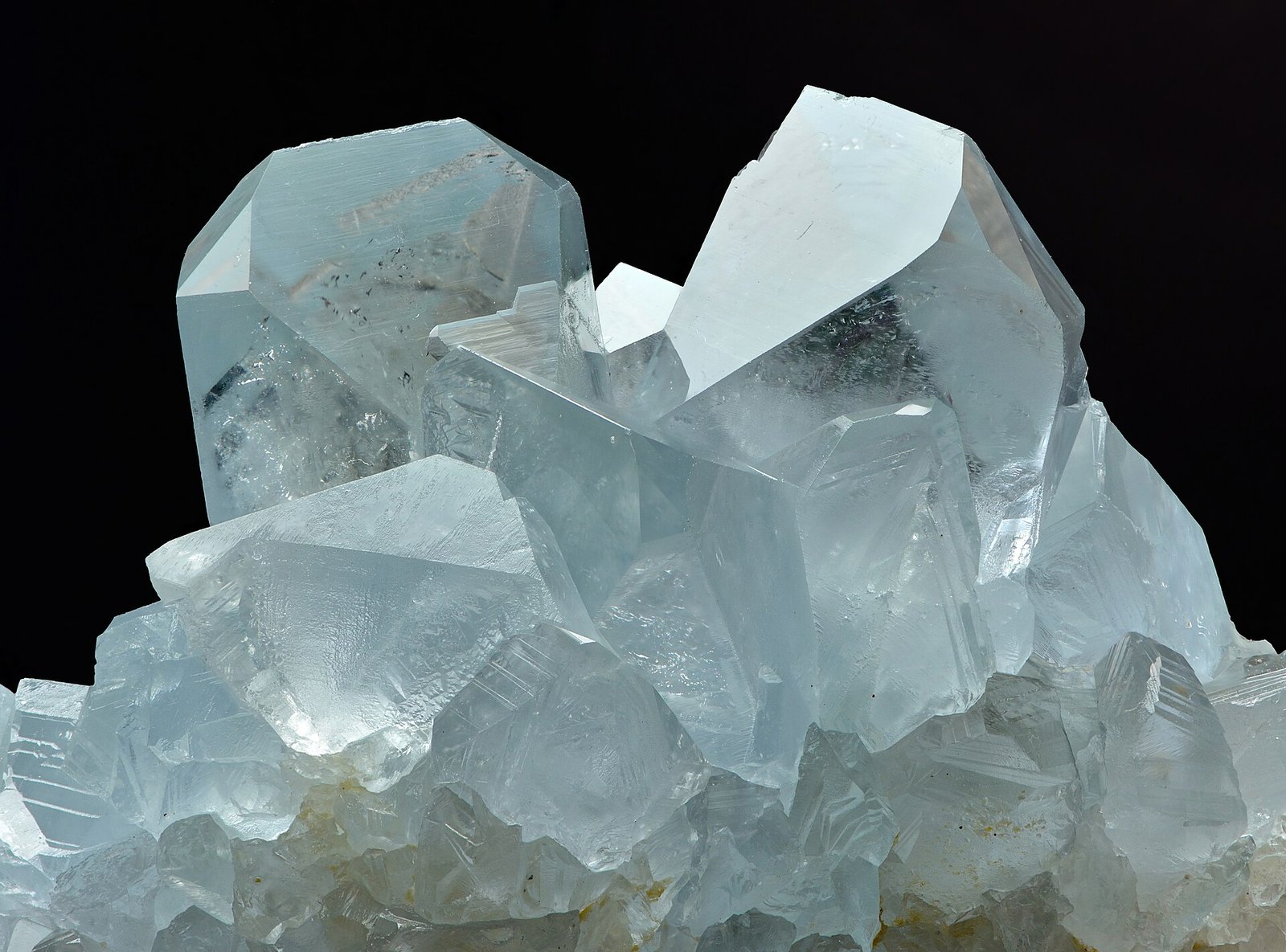
Open a celestite geode and the effect is unreasonable: a cave of pale blue crystals, glassy and faintly luminous, growing inward like frost. The colour is so faint it barely commits, and the name — from the Latin caelestis, heavenly — was given for exactly that reason. It is a stone that photographs badly and looks extraordinary in the hand.
This guide covers what celestite actually is, where its angelic reputation comes from, how people use it, why sunlight is its slow enemy, and how to tell it from the calcite it is so often confused with.
What is celestite?
Celestite is strontium sulfate, SrSO₄, the principal ore of strontium. It forms in sedimentary rocks — often in geodes within limestone and dolomite — where strontium-rich fluids crystallise out over long periods.
The most spectacular material comes from Madagascar (the Sakoany deposit), from Put-in-Bay, Ohio, where a single geode is large enough to walk inside, and from Poland and Tunisia. The strontium in road flares and in the old red of cathode-ray tubes came, ultimately, from stone like this.
Three properties shape everything: it is soft (3–3.5 Mohs), it is brittle with good cleavage, and it is slightly soluble. It is also noticeably dense for a pale mineral — about 1.5 times heavier than calcite of the same size, which turns out to be the most useful thing you can know about it.
Celestite meaning & history
Celestite was named in 1799 by Abraham Gottlob Werner. It has, like most nineteenth-century mineral discoveries, no ancient lore whatsoever. Nobody carried it in antiquity; nobody wrote about it.
Its entire spiritual reputation is a twentieth-century construction, and a transparently visual one: the colour of the sky, in a crystal that grows inside a hollow stone, naturally attracted the language of heaven and angels. From the 1980s onward it became the “angel stone” — a crystal for serenity, for meditation, for dreams, and for those who feel they are being watched over.
We say this without condescension. That the meaning is modern does not make holding one less pleasant. It simply means the meaning came from us, not from the rock.
Celestite healing properties
In the crystal tradition, celestite is valued as a stone of serenity, dreams and calm connection.
People typically turn to celestite for:
- Serenity. The classic use — a geode kept in a room for calm.
- Sleep and dreams. Placed near the bed for restful nights.
- Meditation. A crown-chakra stone for stillness.
- Grief. Reached for by people seeking comfort after loss.
These are traditional and symbolic uses, not medical claims. Celestite is often sold for anxiety, insomnia and grief. There is no scientific evidence that any crystal treats illness, improves sleep or eases bereavement. Grief and persistent insomnia deserve real support — from people, from a doctor, from a therapist. Enjoy celestite as an extraordinary natural object and a focus for quiet; nothing here is intended to diagnose or cure any condition.
Celestite, the chakras & zodiac
Celestite is read at the throat chakra (Vishuddha) and, above all, the crown (Sahasrara) — the centre associated with stillness and connection. Unlike most throat stones it is not about speaking; it is about listening.
By zodiac it’s most often associated with Gemini. It has no birthstone month.
How to use celestite
Most uses revolve around calm and quiet.
- Keep a geode in a room. The commonest use — a presence, not a tool.
- Place it by the bed. For rest and dream recall.
- Use it in meditation. Held or simply looked at.
- Keep it out of the sun. Non-negotiable. See below.
- Keep it out of the bathroom. Damp will dull it.
- Handle it by the matrix. Never by the crystal tips, which snap.
How to cleanse & charge celestite
Soft, brittle, soluble, light-sensitive. Celestite is the most demanding stone on this site.
- Smoke. Sage, palo santo or incense — the safest option by far.
- Moonlight. A gentle overnight charge, indoors.
- Selenite. Rest a small piece on a plate.
- Sound. A singing bowl, from a distance.
- Soft dry brush. For dust in the crystal points.
Never put celestite in water, salt water or an ultrasonic cleaner — it is slightly soluble and it cleaves. And never charge it in the sun: the blue is caused by lattice defects that sunlight destroys permanently. A celestite left on a bright windowsill will be white within a season, and no amount of moonlight will bring it back. This is the single most common way people ruin one.
Types & forms
- Geodes. The classic — hollow nodules lined with blue crystals.
- Clusters. Free-standing groups of tabular crystals.
- Single crystals. Sharp, tabular, sometimes gem-clear.
- White or colourless celestite. Perfectly natural; not everything is blue.
Is celestite rare or valuable?
Small geodes and clusters are affordable. Value climbs with size, colour saturation, crystal clarity and undamaged tips — and because the crystals are so easily chipped, an intact large geode is genuinely uncommon.
Because the blue fades, the freshest, best-stored specimens hold their value. A pale, chalky-looking geode has usually been sitting in a shop window.
How to tell real celestite from fake
The confusion is with blue calcite; the deception is dye.
- Weigh it. The decisive test. Celestite is about 1.5 times denser than calcite. Hold one of each and the difference is obvious.
- Vs blue calcite. Calcite fizzes in dilute acid; celestite does not. Calcite is lighter and has rhombohedral cleavage.
- Dyed geodes. A vivid, electric blue is dye. Natural celestite blue is pale and slightly grey, never saturated.
- Look at the base. Dye pools between crystals and in the matrix.
- Beware “never fades” claims. Any seller who tells you celestite is lightfast is either uninformed or selling dyed material.
Genuine, ethically sourced celestite
If you’d like a piece of your own, Minerals Kingdom offers authenticated natural celestite — geodes, clusters and specimens, with care advice.