
Angelite
The soft powder-blue “angel stone” — a trade name for blue anhydrite from Peru that is genuinely soft and, unusually, will slowly turn back to gypsum in water. We explain it honestly, and separate it from celestite.
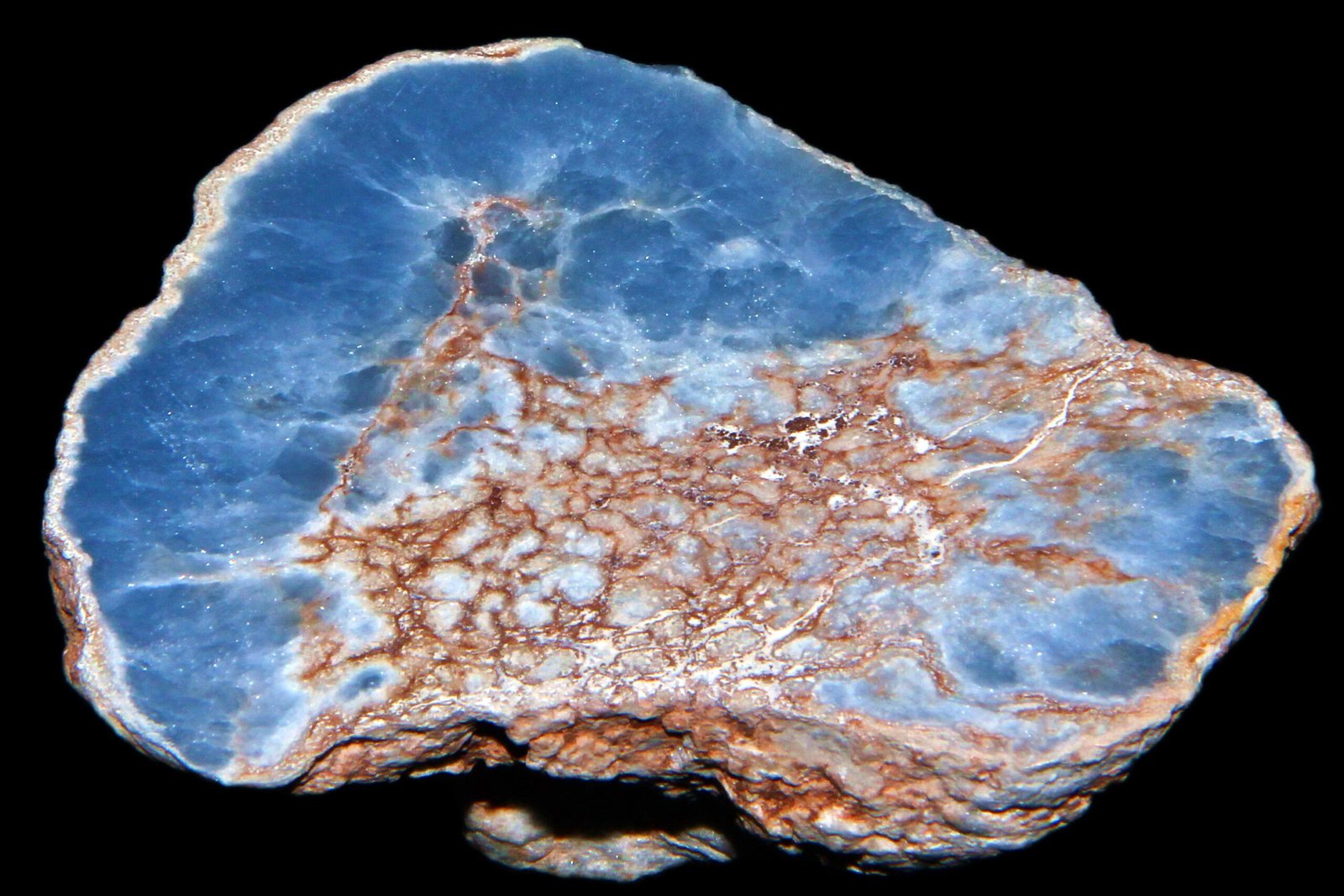
Anhydrite · Calm & communication
In short Angelite is a trade name, not a mineral name: it is a pale blue variety of anhydrite — anhydrous calcium sulfate, CaSO₄ — found chiefly in Peru. Two facts matter more than any other for owning it. First, it is genuinely soft at about 3–3.5 on the Mohs scale, so it scratches easily. Second, and unusually, anhydrite slowly absorbs water and converts back into gypsum — meaning prolonged soaking can literally degrade the stone. In the crystal tradition its serene blue makes it a stone of calm, communication and “angelic” connection. It is easily confused with celestite, a different mineral — we separate the two below.
Angelite is one of the gentlest-looking stones in any collection — a soft, matte powder-blue with the quiet, chalky calm of a clear morning sky. It is also one of the more quietly misunderstood, because the pretty name is a marketing label rather than a mineral species, and because the stone has two genuinely unusual physical traits that its serene appearance rather hides: it is soft, and it is water-sensitive in a way almost no other popular crystal is.
This guide covers what angelite actually is, where its name comes from, the crucial difference between it and celestite, and the two care points — softness and water — that genuinely set it apart.
What is angelite?
Angelite is a pale blue, semi-transparent to opaque variety of anhydrite, whose chemistry is anhydrous calcium sulfate (CaSO₄) — “anhydrous” meaning “without water.” Almost all of the gem-quality blue material sold as angelite comes from a single region in Peru, which is why the trade name is so tightly tied to that source. It usually occurs as compact, massive lumps rather than showy crystals, and it is carved into tumbled stones, spheres, palm stones and small angel figures.
Its Mohs hardness is only about 3 to 3.5 — softer than a fingernail-plus, easily scratched by a coin or a harder stone — so it is a decorative and meditative stone rather than a hard-wearing gem. And it has one property that genuinely sets it apart from nearly every other crystal in this encyclopedia: anhydrite is the dehydrated form of gypsum, and given enough water it will slowly reabsorb it and revert to soft, crumbly gypsum. That is not folklore; it is straightforward mineralogy, and it is the reason angelite should be kept away from water.
Angelite meaning & history
Angelite has no ancient lore, and honesty demands saying so: the blue Peruvian anhydrite reached the crystal market only in the late twentieth century, and the name “angelite” is a modern coinage chosen for its marketable association with angels and serenity rather than any historical tradition. Anhydrite itself was named in 1804 by the mineralogist A. G. Werner, from the Greek for “without water,” precisely to contrast it with water-bearing gypsum.
Its meaning in the modern crystal tradition is built entirely on its colour and its name. The gentle sky-blue was read as a stone of peace, calm communication and connection with the “angelic” or higher self, and it became popular in meditation and energy-work circles as a soothing, quieting stone. That reading is symbolic and recent, not a survival from antiquity.
Angelite vs celestite
Angelite is constantly confused with celestite (also called celestine), and it is easy to see why: both are soft, both are a serene pale blue, and both are marketed as calming, “angelic” or high-vibration stones. But they are genuinely different minerals. Angelite is anhydrite — calcium sulfate (CaSO₄), usually opaque and massive with a chalky, matte look. Celestite is celestine — strontium sulfate (SrSO₄), most familiar as glassy, translucent pale-blue crystals lining geodes. If you are looking at sparkling blue crystal points in a hollow rock, that is celestite; if you are holding an opaque, matte, powder-blue tumbled stone or carving, that is almost certainly angelite. Knowing which you own also tells you how to care for it, since their chemistry differs.
Angelite healing properties
In the crystal tradition, angelite is valued as a stone of calm, gentle communication and connection.
People typically turn to angelite for:
- Calm and peace. The signature association — a soothing, quieting stone for stress and overwhelm.
- Communication. A throat-chakra stone, read as supporting gentle, compassionate speech.
- “Angelic” connection. Popular in meditation for a felt sense of guidance or higher perspective.
- Emotional soothing. Associated with comfort during grief or anxiety.
These are traditional and symbolic uses, not medical claims. There is no scientific evidence that any crystal treats, cures or prevents any illness, and nothing here is intended to diagnose, treat or prevent any condition. Enjoy angelite as a beautiful, calming object; anxiety, grief and health concerns belong with a doctor or qualified therapist.
Angelite, the chakras & zodiac
Angelite’s soft blue places it at the throat chakra (Vishuddha), the centre of communication and truthful, gentle speech, with its calming, meditative quality often extended to the third eye (Ajna) and crown for connection and insight. It shares this serene-blue territory with celestite and blue lace agate. For the wider framework, see our guide to the seven chakras and their crystals.
By zodiac, angelite is most often linked to Aquarius, read as a stone of humanitarian calm and clear communication.
How to use angelite
- Hold it in meditation. At the throat or in the palm, for its traditional associations with calm and connection — its most natural use.
- Keep it as a bedside or desk stone. A soft, soothing presence for a quiet space.
- Wear it as protected jewellery. Pendants suit it far better than rings; at Mohs 3–3.5 it scratches very easily.
- Choose a carved angel or sphere. Its softness makes it ideal for carving, which is why so much angelite is shaped this way.
- Keep it dry. Display and store it away from damp — this is the one stone where water is a genuine, physical risk.
How to cleanse & charge angelite
- Never use water. This is the key rule: anhydrite absorbs water and slowly reverts to gypsum, so soaking or even prolonged damp can pit, cloud or crumble the stone.
- Smoke. Sage, palo santo or incense — contact-free and completely safe.
- Selenite or sound. Resting angelite on a selenite plate or using a singing bowl are ideal dry methods.
- Moonlight. A gentle overnight charge suits its soft, lunar character; avoid prolonged strong sun.
- Dry salt, not brine. If you use salt, keep the stone in dry salt and never in salt water.
Types & origins
- Peruvian angelite. The classic and almost exclusive source of gem-quality blue anhydrite — soft, matte and powder-blue.
- Tumbled stones and palm stones. The most common form, valued for a smooth, calming feel.
- Carved angels and spheres. Angelite’s softness makes it a favourite carving material.
- Banded material. Some pieces show pale white or grey banding from associated gypsum or calcite.
- General anhydrite. Anhydrite occurs worldwide in evaporite and salt deposits, but only the blue Peruvian material is usually sold as “angelite.”
Angelite is inexpensive and valued for its colour and soothing feel rather than any rarity or durability. Value is driven mainly by an even, attractive powder-blue tone and clean carving or polishing, rather than by scarcity. Because it is soft and water-sensitive, it is bought as a meditative and decorative stone, never as a hard-wearing gem or an investment.
Real vs fake
- Dyed howlite or magnesite. White stones dyed pale blue can imitate angelite’s colour; genuine, undyed howlite has its own guide on this site. Dye often concentrates unnaturally in veins.
- Celestite mislabelled as angelite. Not a fake so much as a mix-up — glassy, translucent blue crystals are celestite (strontium sulfate), not massive angelite (calcium sulfate).
- Blue glass or resin. Harder, cooler and often bubble-flecked; they lack angelite’s soft, chalky, matte surface.
- The softness tell. Real angelite is very soft — it can be marked by a coin or a steel pin — and has a distinctive dry, matte, almost porcelain feel rather than a glassy shine.
The workable rule: soft, matte and powder-blue is angelite; glassy blue crystal points are celestite. And whatever the label, a genuine angelite should never be soaked to “test” it — water is exactly what damages it.
Genuine, correctly identified angelite
If you’d like a piece of your own, Minerals Kingdom offers authenticated natural angelite — genuine blue anhydrite, not dyed howlite or mislabelled celestite.
Angelite pairs well with
Frequently asked questions
What is angelite good for?
Traditionally, angelite is used for calm, gentle communication and a sense of “angelic” connection — a soothing throat-chakra stone. These are symbolic, traditional uses, not proven medical effects. No crystal treats illness.
Can angelite go in water?
No — this is the single most important rule for it. Angelite is anhydrite (anhydrous calcium sulfate), and anhydrite slowly absorbs water and reverts to soft gypsum. Soaking or prolonged damp can pit, cloud or crumble the stone, so cleanse it with smoke, sound or selenite instead.
What is the difference between angelite and celestite?
They are different minerals that look similar. Angelite is anhydrite (calcium sulfate, CaSO₄), usually opaque, matte and massive; celestite is celestine (strontium sulfate, SrSO₄), most familiar as glassy, translucent blue crystals in geodes. Both are soft and both are marketed as calming “angel” stones, which is why they are so often confused.
Is angelite a real mineral?
“Angelite” is a trade name rather than an official mineral name, but the stone itself is real: it is a pale blue variety of the mineral anhydrite, found mainly in Peru. So the material is genuine even though the pretty name is a modern marketing coinage.
Is angelite durable enough for a ring?
Not really. At Mohs 3–3.5 it is genuinely soft and scratches very easily, and it is also water-sensitive. Pendants, palm stones and carvings suit it far better than rings, and it should be kept dry and stored away from harder stones.
How can I tell if angelite is real?
Genuine angelite is soft, opaque and powder-blue with a dry, matte, almost porcelain feel — it can be marked by a coin. Glassy, translucent blue crystals are celestite instead, and a hard, bubble-flecked “angelite” is likely glass or resin. Avoid the temptation to soak it as a test, since water is what damages the real stone.