Opal
The October birthstone that isn’t a crystal at all — a mineraloid full of water, whose colours come from physics rather than pigment.
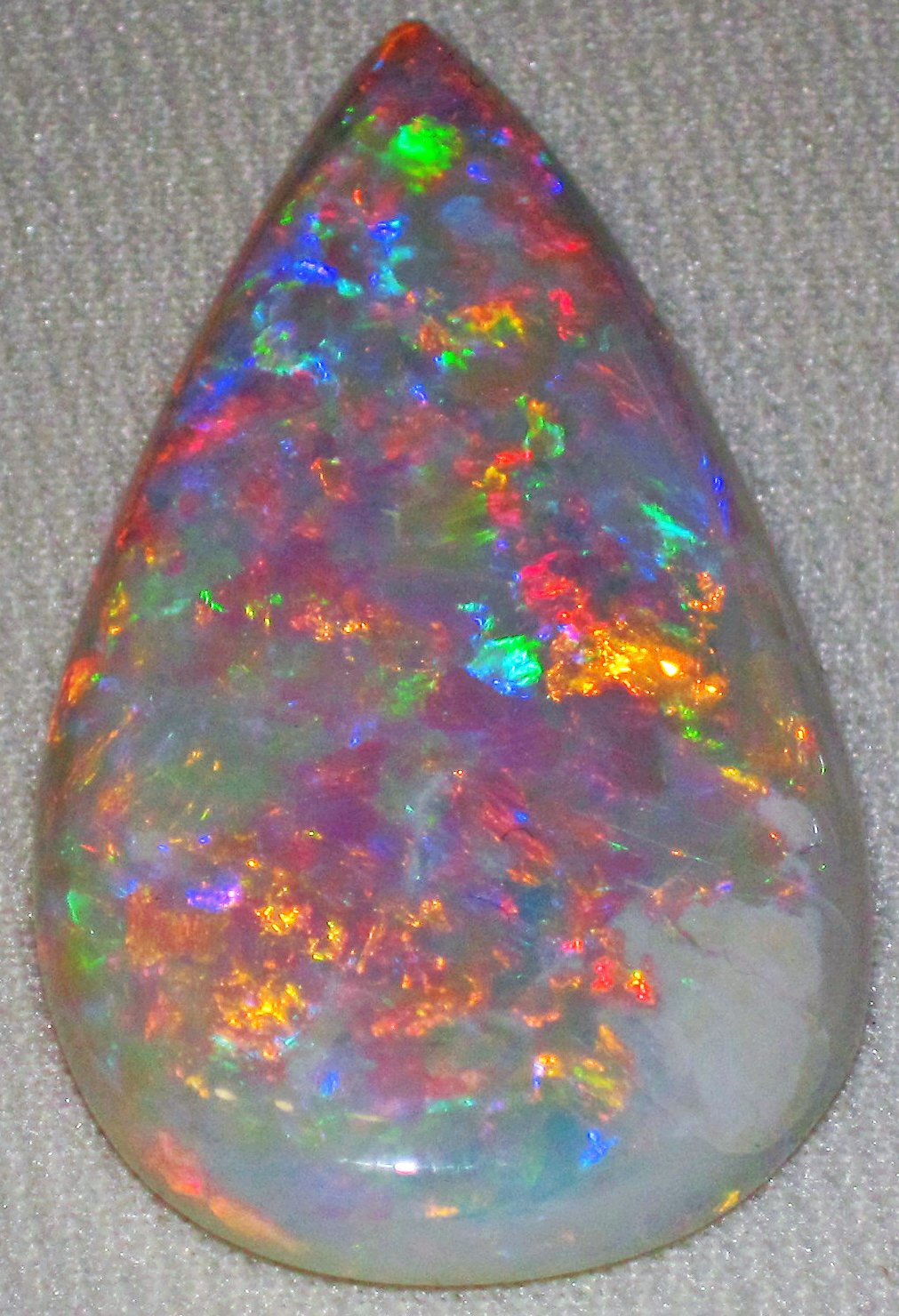
Hydrated silica · Play-of-colour
Opal is not a crystal. It is a mineraloid — amorphous hydrated silica, with no crystal lattice at all — and it contains water, typically around six to ten per cent by weight. Its famous play-of-colour is not pigment but diffraction, light bending around a regular three-dimensional array of microscopic silica spheres. It is the October birthstone, a traditional stone of creativity and emotional expression, and it is delicate: no ultrasonic cleaner, no steam, no thermal shock. And the old superstition that opals are unlucky has a traceable, datable, entirely human origin — which we get into below, including how solidly that story actually holds up.
Opal is the odd one out on this site. Almost every stone we profile is a crystal — atoms locked into a repeating lattice, growing in predictable geometry. Opal has none of that. It is a mineraloid: silica that never organised itself, holding water in its structure, arranged instead into billions of tiny spheres stacked like oranges in a crate. And it is precisely that stacking, not any pigment, that produces the flashes of green and blue and red that made opal famous.
This guide covers what opal actually is, the physics behind its colours, the water problem that makes it the most misunderstood stone in the jeweller’s case, the doublets and triplets and glass sold alongside it, and the strange, well-documented moment in 1829 when opal acquired a reputation for bad luck.
What is opal?
Opal is hydrated amorphous silica, written SiO₂·nH₂O. The n in that formula is the honest part: the water content is variable. It generally falls between about three and twenty-one per cent by weight, though most gem opal sits in the narrower band of roughly six to ten per cent. That water is not a contaminant. It is part of what opal is — and, as we’ll see, part of what makes it fragile.
Because it lacks a crystal lattice, opal is properly called a mineraloid rather than a mineral. It has no cleavage planes, no crystal faces, no habit. It fills cavities and cracks, replaces wood and shell and bone, and hardens into shapes dictated entirely by whatever space it happened to occupy. Its hardness is modest, roughly 5 to 6.5 on the Mohs scale — softer than quartz, and soft enough that everyday grit will scratch it.
The single most important distinction in the whole subject is this one:
- Precious opal shows play-of-colour — the shifting internal flashes. This is the material people mean when they say “opal”.
- Common opal, often called potch in the trade, shows none. It may be a perfectly pleasant milky, honey or pink stone, but it has no play-of-colour, and it is worth a small fraction of the price.
Potch is not fake opal. It is genuine opal that simply lacks the internal structure needed for diffraction. Most opal mined anywhere in the world is potch.
Why opal shows colour
This is the part worth understanding properly, because it explains everything else about the stone.
Under an electron microscope, precious opal turns out to be built from silica spheres of remarkably uniform size, packed into a regular three-dimensional array. Light entering the stone is diffracted by that array — bent and split, the way it is by a diffraction grating or by the pits on a CD. The colours you see are not pigments and not reflections. They are interference effects, produced by the geometry of the packing.
Which colour you get depends on how big the spheres are. Smaller spheres diffract shorter wavelengths and produce blues and violets. Larger spheres are needed to produce greens, then oranges, and finally reds. The spheres must be both large enough and uniform enough across a meaningful volume of the stone — and that is a much harder condition to satisfy at the red end.
This is the whole explanation for opal’s price structure. Blue and violet play-of-colour is the commonest; red is the rarest and most expensive. A stone showing strong red fire across its face is showing you that nature managed, over a very long time, to stack unusually large spheres with unusual regularity. Common opal has no such ordered array — its silica spheres are irregular in size or disordered in packing, so no diffraction occurs, and no colour appears.
Two terms cause endless confusion here, and both are worth nailing down:
- Play-of-colour is the diffraction effect described above. It is what makes an opal precious.
- Fire opal does not mean an opal with fire. It refers to body colour — a transparent to translucent orange, yellow or red opal, largely from Mexico. Most fire opal has no play-of-colour whatsoever. Some does, and that material is prized, but the name describes the orange body, not the flashes.
People routinely ask for “fire opal” when they mean a stone with strong red play-of-colour. Those are two entirely different things, and the mismatch causes real disappointment.
Opal meaning & history
For most of recorded history, opal was considered extremely lucky — and unusually prestigious. Because it contained flashes of every other gem’s colour, classical writers treated it as containing the virtues of all gems at once. Pliny the Elder wrote about it admiringly. It was associated with hope, with truth, and with prophetic sight; the name itself descends through Latin opalus from a Sanskrit root for stone.
And then, sometime in the nineteenth century, opal became unlucky.
The Walter Scott story — and how solidly it holds up
The standard account runs like this. In 1829, Sir Walter Scott published Anne of Geierstein. In it, the Lady Hermione wears an opal clasp in her hair that flashes and dims with her moods. Holy water falls on it; the opal loses its fire; she collapses, and shortly afterwards is found reduced to ash. Scott’s novel was enormously popular, and the story goes that opal sales across Europe collapsed in its wake, with the trade taking decades to recover.
It is a wonderful story, and the site’s usual rule applies: we should say honestly how well it is actually evidenced. Not as well as its constant repetition suggests.
Two problems are worth stating plainly. The first is that Scott does not appear to have meant it that way. Hermione’s opal is an enchanted object tied to her supernatural nature; the narrative logic would have worked identically with a diamond or a ruby. Nothing in the text presents opal as a generally unlucky stone.
The second is more telling. In 1875 — less than fifty years after publication, well within living memory — Sir Henry Ponsonby wrote to Notes and Queries asking where the opal superstition came from. He received several replies offering several different explanations, and none of them mentioned Anne of Geierstein. If Scott’s novel had single-handedly wrecked the European opal market a generation earlier, it is strange that nobody informed enough to answer a query in Notes and Queries thought to say so.
The honest reading is that the superstition consolidated gradually across the middle of the nineteenth century, drawing on several currents — including opal’s genuine physical delicacy, which meant stones did sometimes crack or dull in wear — and that Scott’s novel was later adopted as a tidy origin story rather than being demonstrably the cause. The causal link, in short, is asserted far more often than it is demonstrated.
What remains true, and is worth holding onto, is that this is a superstition with a datable, traceable, entirely human history. Nobody found opal unlucky for the first three thousand years it was worn. A reputation was manufactured, somewhere in the nineteenth century, by people — and then, in the twentieth, largely dismantled again, not least by Australia becoming the world’s great opal producer and having every commercial reason to say so.
Opal healing properties
In the crystal tradition, opal is valued as a stone of creativity, emotional expression and amplification.
People typically turn to opal for:
- Creativity. The classic association — imagination, originality, artistic work.
- Emotional expression. Said to help bring buried feeling to the surface where it can be looked at.
- Amplification. Traditionally described as intensifying whatever state you bring to it — which is why older texts advise against wearing it when you are already agitated.
- Spontaneity. Associated with playfulness and with breaking out of rigid habit.
These are traditional and symbolic uses, not medical claims. Opal is sometimes marketed for eyesight, hormonal balance or fertility — presumably because it holds water and comes in many colours, which is not a mechanism. There is no scientific evidence that any crystal treats, cures or prevents any illness, and none that opal affects mood, creativity or emotion by any physical means. Enjoy opal as one of the most optically remarkable natural objects there is; nothing here is intended to diagnose, treat or cure any condition, and nothing here should replace medical advice.
Opal, the chakras & zodiac
Because opal comes in so many body colours, the tradition assigns it by variety rather than as a single stone. White and crystal opal are usually placed at the crown chakra (Sahasrara), for their light and their association with clarity and inspiration. Fire opal, with its orange body, is placed at the sacral chakra (Svadhisthana), the traditional seat of creativity and appetite. Black opal is often read as a grounding counterweight to both. If you’d like the wider framework, see our guide to the seven chakras and their crystals.
By zodiac, opal is associated with Libra and Scorpio — the two signs that bracket October. It is the October birthstone, sharing the month with tourmaline, and the traditional gem of a fourteenth wedding anniversary.
How to use opal
Most uses revolve around expression and imagination — and all of them are constrained by the fact that this is a soft, water-bearing stone.
- Wear it for creative work. The traditional application: a pendant or earrings while writing, drawing or making.
- Keep it as a desk stone. Turning an opal in the light is a genuinely absorbing few seconds, which is not nothing.
- Choose pendants and earrings over rings. At 5–6.5 Mohs, a ring-mounted opal takes knocks that a pendant never will. If you do wear an opal ring, take it off for washing up, gardening and the gym.
- Use it in meditation. Held at the crown, or at the sacral chakra for fire opal.
- Give it in October. A birthstone gift with an unusually good story attached — including the debunking of the unlucky one.
- Keep it away from dry heat. Not on a sunny windowsill, not in a hot car, not in a bank vault for years without thought. Opal can dry out.
- Buy from a seller who discloses. Solid, doublet, triplet, hydrophane, treated — all legitimate, all things you should be told. See real vs fake below.
How to cleanse & charge opal
Opal needs more care than almost any other popular stone, and the reasons are physical rather than mystical.
- Water — with real caveats. A quick rinse in cool water with mild soap is fine for solid opal. It is not fine for doublets and triplets, where soaking dissolves the cement and lifts the layers. And it behaves oddly with hydrophane opal (see below).
- Never use an ultrasonic cleaner. The vibration will crack opal. Jewellers treat this as an absolute rule.
- Never use steam. Heat plus moisture is the worst combination you can inflict on it.
- Avoid thermal shock. No hot water after cold, no radiators, no leaving it in a car in summer. Sudden temperature change is a leading cause of cracking.
- Avoid prolonged dry heat. Opal holds water; bake it and that water leaves. Storing an opal in a very dry environment for long periods is a known risk.
- Moonlight. A gentle overnight charge, and the one traditional method that carries no risk at all.
- Smoke. Sage, palo santo or incense — pass it through, don’t hold it in the heat.
- Selenite or sound. Rest it on a selenite plate, or use a singing bowl. Both are contact-free.
Crazing and hydrophane — the two things to understand
Crazing is the fine network of cracks that can develop in opal, rather like the crackle glaze on old pottery. It is generally attributed to drying out or to thermal shock, and once it has happened it cannot be reversed. Some opal from some deposits is more prone to it than others. This is the single best argument for buying opal from a seller who knows their material and stands behind it.
Hydrophane opal is a distinct and fascinating category — much of the Ethiopian Welo material is hydrophane. It is porous, and it absorbs water. Drop a hydrophane opal in a glass of water and it will often turn noticeably transparent within minutes, its play-of-colour fading or vanishing entirely. Left to dry, it usually returns to its original appearance. This is normal and not damage in itself.
But porosity cuts both ways. A hydrophane opal will just as readily absorb oils, dyes, perfume, hand cream and sweat — and those do not evaporate out. Staining is permanent. This is why hydrophane opal should never be worn while cooking, moisturising or swimming in chlorinated water, and why some sellers deliberately dye hydrophane material to imitate black opal. If a stone is hydrophane, the seller should say so.
Types & origins
Australia has long dominated world opal production, and for most of the twentieth century supplied the overwhelming majority of the world’s precious opal. Its fields remain the benchmark for quality. Since the 2000s, however, Ethiopian material has arrived in enormous quantity, and by volume the Ethiopian supply now rivals — by some accounts in the trade, exceeds — what comes out of Australia. Both statements can be true at once: Australia still sets the standard at the top of the market.
- Black opal — Lightning Ridge, New South Wales. The most valuable opal in the world. A dark body tone makes the play-of-colour blaze against it, the way fireworks read better against a night sky.
- White and light opal — Coober Pedy, South Australia. The classic milky opal with pastel fire, from Australia’s most famous opal town — much of which is built underground to escape the heat.
- Boulder opal — Queensland. Opal formed in seams within ironstone, and cut with the dark host rock left attached as a natural backing. Solid and genuine, not a doublet.
- Ethiopian Welo opal. On the market in quantity since the 2000s. Often bright, often affordable, frequently hydrophane — which is the crucial thing to know before you buy.
- Mexican fire opal. Transparent orange to red body colour, often faceted rather than cut as a cabochon. Usually without play-of-colour.
- Opalised fossils. Wood, shell and occasionally bone in which opal has replaced the original material. Scientifically interesting and sometimes spectacular.
- Common opal / potch. No play-of-colour. Includes pink Peruvian opal and honey-coloured material. Pretty, inexpensive, genuine.
Is opal rare or valuable?
Opal has one of the widest price ranges of any gem — from a few pounds to figures competing with fine diamond — and the variables are unusually legible once you know them.
Value is driven by body tone (dark bodies are worth far more than light), the colours present (red is the rarest and most valuable, blue the commonest), brightness of the flash, the pattern of the colour play, and whether the stone is solid rather than assembled. Fine black opal from Lightning Ridge with strong red fire sits at the top of the market.
At the other end, common opal, potch and pale Ethiopian material are genuinely inexpensive. A disclosed triplet can give you a striking look for very little money, which is a legitimate thing to want. The problem is never that these exist; it is only ever when they are sold as something they aren’t.
One practical note: because opal is soft and can craze, it is not a good speculative investment for a non-specialist. Buy it because you want to look at it.
Real vs fake — doublets, triplets, synthetic and opalite
More sits between “real” and “fake” with opal than with almost any other stone, and most of it is perfectly honest when disclosed.
- Doublets. A thin slice of genuine precious opal cemented to a dark backing — usually potch, ironstone or black glass. The dark base does for the opal what a black body tone does naturally: it makes the colour sing. The opal is real. The stone is assembled.
- Triplets. The same sandwich, plus a clear quartz or glass cap on top, which protects the wafer and magnifies the colour. Triplets look dramatic and cost very little. The opal layer in a triplet can be extremely thin.
- How to spot them. Look at the stone edge-on, from the side, ideally out of its setting. A doublet shows one flat, straight join line; a triplet shows two. Solid opal has no such line — its colour runs through the body of the stone in a way that follows no ruler. A domed top with a perfectly flat, sharply defined base is another warning sign.
- Never soak a doublet or triplet. Water attacks the cement, the layers separate, and moisture gets trapped between them, producing a grey fogged look that cannot be undone. Wipe them; do not submerge them.
- Synthetic opal (Gilson and similar). Laboratory-grown opal, made by settling silica spheres in an ordered array — genuinely the same effect by the same mechanism. It is often identifiable by an unnaturally regular, columnar or “snakeskin” colour pattern, and colour patches that look too orderly. It is a legitimate product and must be sold as synthetic.
- Imitation opal. Plastic and glass imitations exist, including “opal glass” and resin composites. Under magnification they show bubbles, swirl lines or a flat, painted-on iridescence rather than true depth.
- “Opalite” is not opal. This one matters, because the name does the deceiving. Opalite is manufactured glass — usually a milky, bluish, faintly glowing man-made material. It contains no opal, it is not a mineral, it is not natural, and it has no play-of-colour, only a soft bluish sheen from light scattering. It is sold in enormous quantities under a name chosen to sound like opal. Nothing wrong with liking it; a great deal wrong with paying opal prices for it.
- Dyed and smoke-treated opal. Porous hydrophane can be dyed or smoke-treated to darken the body and imitate black opal. Both treatments should be disclosed; unnaturally uniform darkness with colour that seems to sit near the surface is a reason to ask questions.
The workable rule with opal is simply this: ask what it is, in writing. Solid, doublet, triplet, synthetic, treated, hydrophane. A good seller answers all six without hesitating.
Genuine, ethically sourced opal
If you’d like a piece of your own, Minerals Kingdom offers authenticated natural opal — rough pieces, tumbles and jewellery, with the type of material stated.