Amazonite
The calming blue-green stone people reach for to soothe the nerves and speak their truth with courage.
Feldspar · Soothing stone
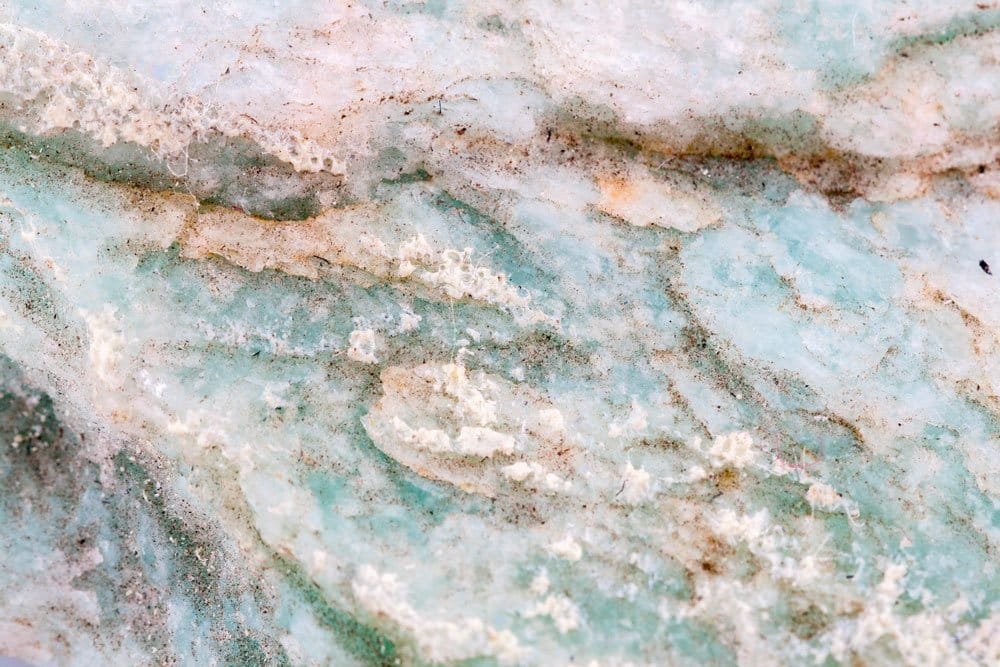
Amazonite is the soft blue-green variety of microcline feldspar, often streaked with white. In the crystal tradition it’s the “stone of courage and truth” — a soothing crystal that calms the nerves while helping you speak honestly, which is why it bridges the throat and heart chakras. It’s reasonably hard (6–6.5 Mohs) but has cleavage, so it dislikes knocks. Below — what it means, how to use it, how to keep it, and how to tell real amazonite from dyed howlite.
Amazonite has one of the most calming colours in the mineral world — a soft turquoise-green flecked with white, like sea glass or a tropical shallows. The crystal tradition matches that look to its meaning: a soothing stone that quiets anxious chatter while giving you the courage to say what you really think. It’s the gentle diplomat of a collection, equal parts calm and conviction.
This guide covers what amazonite actually is, where its name and reputation come from, the ways people use it, how to keep it, and — because you deserve the full picture — what’s tradition and what’s genuinely known. We’ll keep the lore and the facts clearly labelled.
What is amazonite?
Amazonite is a green-to-blue-green variety of microcline, a potassium feldspar — the same broad mineral family as moonstone and labradorite. Its distinctive colour was long a puzzle; it’s now understood to come from traces of lead (and water) in the crystal structure, not copper as once thought. The white streaks and grid-like patterning come from albite feldspar intergrown with it.
It rates 6 to 6.5 on the Mohs scale — harder than glass, but with two directions of cleavage that make it prone to chipping if knocked, like all feldspars. The colour ranges from pale mint to a deep, almost teal blue-green; an even, saturated colour with crisp white streaks is the most prized. Today most amazonite comes from Brazil, Madagascar, Russia and the USA (Colorado).
The name is a geographical near-miss: it’s named after the Amazon River, though no amazonite has ever been found there. The green stones that inspired the name were probably other minerals traded in the region — a quirk worth knowing, but it has nothing to do with authenticity.
Amazonite meaning & history
Amazonite has been used ornamentally for thousands of years. It appears in Ancient Egyptian jewellery and was carved into beads and amulets — a scarab of amazonite was found among Tutankhamun’s treasures — and it shows up in Mesopotamian and pre-Columbian artefacts. Its watery blue-green linked it across cultures to renewal, water and life.
A popular modern legend ties it to the Amazon warrior women, casting it as a “stone of courage.” Whether or not the history holds, the association has stuck, and it captures the stone’s dual character perfectly: amazonite is felt as both calming and emboldening — soothing enough to settle anxiety, steady enough to help you stand your ground.
Today people reach for amazonite when they want to take the heat out of a worry, find balance after conflict, or gather the calm confidence to speak honestly. It’s the crystal of the level-headed truth-teller.
Amazonite healing properties
In the crystal tradition, amazonite is valued for a balance of soothing and strengthening qualities centred on the voice and the emotions.
People typically turn to amazonite for:
- Calm. A soothing stone for anxious, overthinking moments.
- Courage & truth. The classic “stone of courage” for speaking honestly.
- Clear communication. A throat-chakra stone for difficult conversations.
- Emotional balance. A steadying presence after stress or conflict.
These are traditional and symbolic uses, not medical claims. Amazonite is sometimes marketed as protection against EMF or as a physical remedy — there is no scientific evidence that any crystal blocks electromagnetic fields or treats illness. Enjoy amazonite as a calming ritual and a beautiful object; it is not a treatment, and nothing here is intended to diagnose or cure any condition.
Amazonite, the chakras & zodiac
Amazonite bridges two centres: the throat chakra (Vishuddha), for communication and honest expression, and the heart chakra (Anahata), for emotional balance and compassion. That throat-and-heart pairing is exactly why it’s described as helping you speak your truth kindly — feeling, then voicing.
By zodiac, amazonite is most often associated with Virgo, the thoughtful communicator of the calendar. It has no birthstone month, but its calming colour makes it a popular gift for anyone going through a stressful time or learning to set boundaries.
How to use amazonite
Amazonite is an easy, gentle stone to work with — most of its uses revolve around calm and communication.
- Wear it at the throat. An amazonite necklace keeps its communication meaning close for talks and presentations — a calming anchor before you speak.
- Carry a pocket stone. A smooth tumble is a soothing anchor for anxious days.
- Hold it before a hard conversation. The classic “courage to speak” use.
- Keep it by your bed. Its calming colour suits a restful, low-stress bedside.
- Place it at your desk. A piece nearby for level-headed decisions and steady focus.
How to cleanse & charge amazonite
Amazonite is reasonably hard but has cleavage and can fade, so favour gentle methods.
- Smoke. Incense, palo santo or sage is a safe, no-contact reset.
- Selenite. Rest it on a selenite plate overnight.
- Moonlight. A night under the full moon charges it gently.
- Sound. A singing bowl or bell suits beads and jewellery.
- Brief cool water. A quick rinse is fine; dry it promptly and don’t soak it.
Avoid salt water (it can attack feldspar over time), long soaking, and prolonged strong sun, which may slowly soften the blue-green colour. For charging, moonlight or a quartz cluster is the safe habit. Cleanse it whenever it has been “absorbing” a lot of stress.
Types & relatives
Amazonite sits within the big feldspar family, alongside some famous cousins:
- Amazonite. The blue-green microcline of this guide — the calming “courage” stone.
- Moonstone. A feldspar with a floating blue sheen (adularescence).
- Labradorite. A feldspar famous for its flashing play of colour.
- Sunstone. A feldspar with glittering copper-coloured inclusions.
- Amazonite with smoky quartz. A popular natural combo (classic from Colorado), pairing calm with grounding.
Most amazonite on the market comes from Brazil, Madagascar and Russia, with prized crystals from Colorado, USA.
Is amazonite rare or valuable?
Amazonite is affordable and widely available — tumbled stones, beads and palm stones cost little. The exceptions are fine crystallised specimens, especially the sharp blue-green crystals from Colorado (often grouped with smoky quartz), which are collector pieces and can be valuable. For everyday use, it’s firmly a budget-friendly stone.
Quality comes down to colour and pattern: a deep, even blue-green with crisp white streaks and a good polish is more desirable than a pale, washed-out piece. As with many coloured stones, beware colour that looks too perfect and uniform, which can signal dyeing. For most buyers, choose a colour you love at a sensible size.
How to tell real amazonite from fake
Amazonite is most often imitated by dyed howlite or magnesite, and occasionally by dyed quartz or glass. Its natural patterning is the best guide.
- Look at the pattern. Real amazonite shows uneven colour with natural white albite streaks and a faint grid-like sheen. A flat, uniform turquoise colour can mean dyed howlite.
- Test the hardness. At 6–6.5 amazonite scratches glass; dyed howlite (3–3.5) is much softer and won’t.
- The acetone test. Rub a hidden spot with acetone — if colour transfers to the cotton, it’s dyed.
- Watch for bubbles. Internal air bubbles and a glassy feel point to glass, not feldspar.
- Don’t confuse it with turquoise or amazon “jade”. Amazonite is its own feldspar; names blending it with turquoise or jade are marketing, not species.
Genuine, ethically sourced amazonite
If you’d like to start your own piece, Minerals Kingdom offers authenticated natural amazonite — raw stones, tumbles and jewellery.