
Malachite
The boldly banded green stone people reach for when life is changing — a crystal of transformation, the heart, and fierce protection.
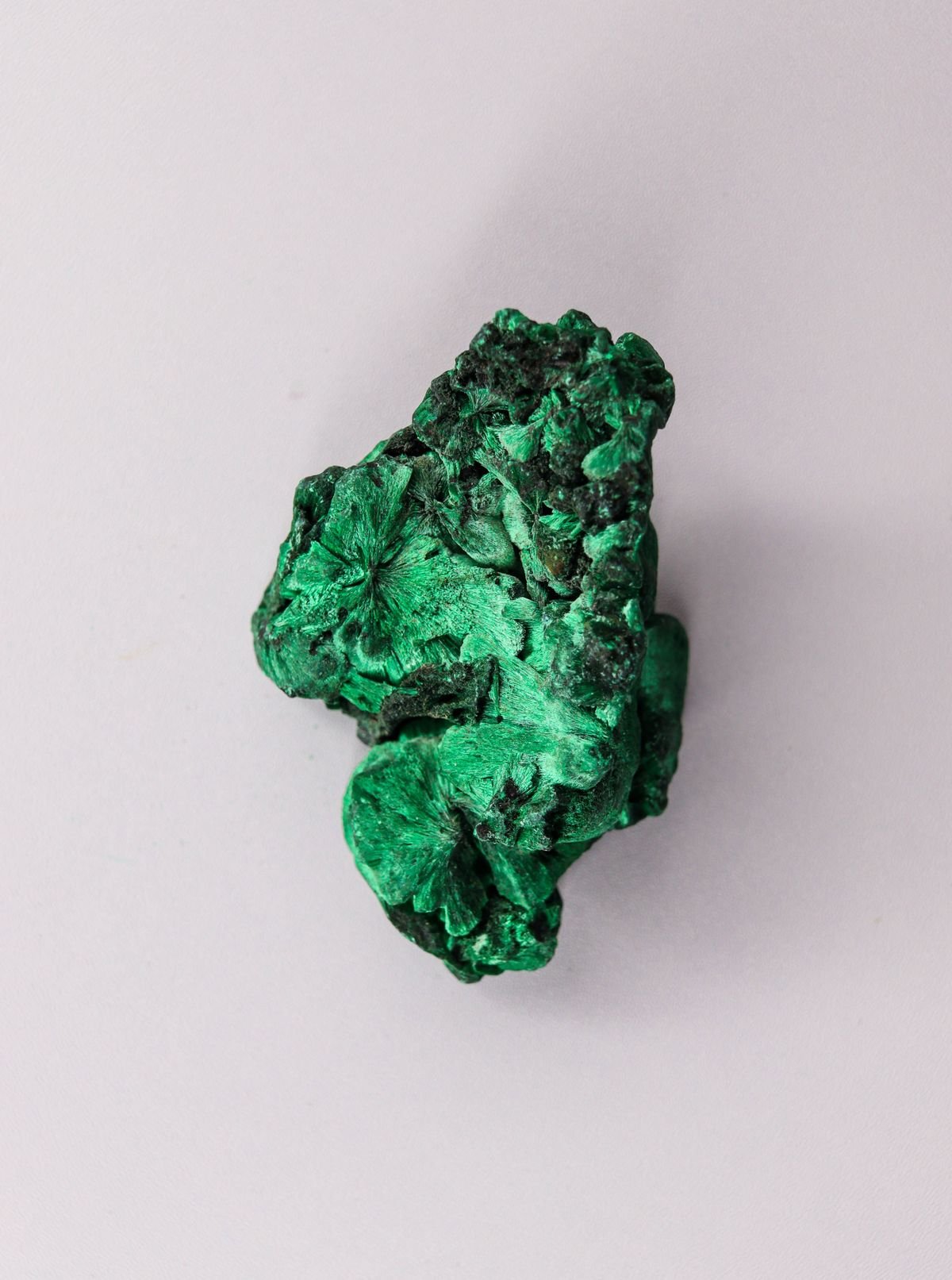
Copper carbonate · Stone of change
Malachite is a copper carbonate famous for its swirling, concentric green bands. In the crystal tradition it’s the “stone of transformation” — a heart-chakra crystal linked to change, emotional healing and strong protection. It’s soft (3.5–4 Mohs) and, importantly, a copper mineral: its dust is toxic to inhale and it should never be used to make crystal water. Used as a polished, sealed stone it’s perfectly safe to handle. Below — meaning, how to use it safely, and how to spot reconstituted fakes.
Few stones look as alive as malachite. Its bands of green — from near-black forest to bright spring — loop in rings and eyes and waves, as if the stone were still moving. Little wonder the crystal tradition made it the stone of transformation: the one people reach for when something in life is ending, changing or asking to be released. It’s bold, beautiful and a little fierce — and, as you’ll see, it asks to be handled with a bit of knowledge.
This guide covers what malachite is, where its reputation comes from, how people use it, how to keep it — and an honest, important note on safety, clearly separated from the lore.
What is malachite?
Malachite is a copper carbonate hydroxide, Cu₂CO₃(OH)₂ — a secondary mineral that forms where copper deposits weather near the surface. It very often grows side by side with azurite, its deep-blue counterpart, which slowly alters into malachite over geological time. Its hypnotic banding comes from layer upon layer of green crystals deposited in rounded, botryoidal masses; slice through them and you get the famous concentric rings. The green is the copper itself. You’ll find it described in detail at Britannica.
It is soft — just 3.5 to 4 on the Mohs scale — so it scratches and chips easily and is usually sold polished. Because it’s a copper mineral, its dust is toxic if inhaled, and contact with water or acids can release copper, which is why raw malachite must never be made into “gem water.” Sealed, polished pieces are safe to wear and hold; the cautions are about dust and soaking, not normal handling. Most malachite today comes from the Democratic Republic of Congo and Zambia, with historic sources in Russia.
Malachite meaning & history
Malachite has adorned humanity for millennia. The Ancient Egyptians ground it for green eye paint and jewellery and linked it to the goddess Hathor; they mined it in the Sinai as early as 4000 BC. In Russia, vast malachite deposits in the Urals were carved into columns, vases and the dazzling Malachite Room of the Winter Palace. Across medieval Europe it was a protective talisman, especially for children, and an amulet against the evil eye — a band that resembled an eye was thought to watch over the wearer.
From all this grew its modern reputation as the stone of transformation and protection: a crystal for moving through change, guarding your energy, and clearing away what no longer serves. It’s often called a “midwife stone” for its association with new beginnings and letting go.
Malachite healing properties
In the crystal tradition, malachite is one of the most intense stones — valued for transformation and the heart rather than gentle calm.
People typically turn to malachite for:
- Transformation. The classic stone for navigating change and new chapters.
- Emotional healing. A heart stone said to draw out old patterns and pain.
- Protection. A long-standing guardian stone for energy and boundaries.
- Courage to change. Support for breaking habits and stepping forward.
These uses are traditional and symbolic, not medical claims; no crystal treats illness. Malachite also needs a genuine safety word, because it is a copper mineral: its dust is toxic if inhaled (don’t sand, grind or carve it without protection), and it should never be used to make crystal-infused water or elixirs, as copper can leach into the liquid. Buy it polished and sealed, keep it out of water, wash your hands after handling rough pieces, and you can enjoy it safely.
Malachite, the chakras & zodiac
Malachite is primarily a heart chakra (Anahata) stone — its green tied to emotional healing, compassion and release — and is sometimes linked to the solar plexus for willpower and confidence. That heart-and-will pairing fits its character: feeling deeply, then finding the courage to act.
By zodiac it’s most often associated with Capricorn and Scorpio, both signs tied to depth and transformation. It has no birthstone month, but its bold look and “change” symbolism make it a meaningful gift for someone starting over.
How to use malachite
Most uses revolve around change, the heart and protection — always with polished, sealed pieces.
- Wear it as jewellery. A polished malachite necklace, pendant or ring keeps its meaning close — sealed settings protect the soft stone through the day.
- Carry a tumbled stone. A smooth piece in the pocket for days of change.
- Hold it in reflection. Use it when working through an ending or a decision.
- Place it in the home. A specimen on a shelf as a protective, grounding presence.
- Keep it dry. Never add it to bathwater or drinking water — admire it, don’t infuse it.
How to cleanse & charge malachite
Because malachite is soft and water-sensitive, the golden rule is no water, no salt.
- Smoke. Sage, palo santo or incense — the safest, no-contact method.
- Selenite. Rest it on a selenite plate overnight.
- Sound. A singing bowl or bell suits beads and jewellery.
- Moonlight. A gentle charge under the full moon.
- On a quartz cluster. A dry, gentle way to recharge it.
Avoid water and salt (they can damage the surface and release copper), and prolonged strong sun. Cleanse it often if you use it through periods of intense change, when the tradition says it’s “working hardest.”
Is malachite rare or valuable?
Polished malachite is affordable and widely available — tumbles, beads and small carvings cost little. Value rises with the quality of the banding: tight, high-contrast concentric rings and “eyes” are the most prized, and large fine specimens or stalactite slices can be collector pieces. Top-quality material from the Congo commands real prices among collectors.
Quality is all about the pattern and polish: bold, well-defined bands beat muddy, flat green. Because malachite is so often reconstituted (see below), buying from a seller who is clear about whether a piece is solid natural stone matters more here than with most crystals.
How to tell real malachite from fake
Malachite is widely imitated, most often by reconstituted stone (real malachite powder bound in resin) and by dyed or printed imitations.
- Study the bands. Natural malachite has irregular, organic concentric rings of varied green. Repeating, too-perfect or oddly geometric patterns suggest reconstituted or printed fakes.
- Check the weight and feel. Real malachite is dense and cool; light, warm, plasticky pieces are imitations.
- Look for a seam. Reconstituted pieces can show resin lines or air bubbles.
- Mind the price. A huge, flawless, cheap “malachite” sphere is very likely reconstituted.
- Hardness. It’s soft (3.5–4), so it won’t scratch glass — but don’t scratch-test a polished piece you want to keep.
Genuine, ethically sourced malachite
If you’d like a piece of your own, Minerals Kingdom offers authenticated natural malachite — polished stones, tumbles and specimens.