
Azurite
The deep blue copper carbonate that painted the skies of medieval altarpieces — a soft, water-shy mineral that slowly turns green, and is read in the crystal world as a stone of insight. Handled honestly, copper chemistry included.
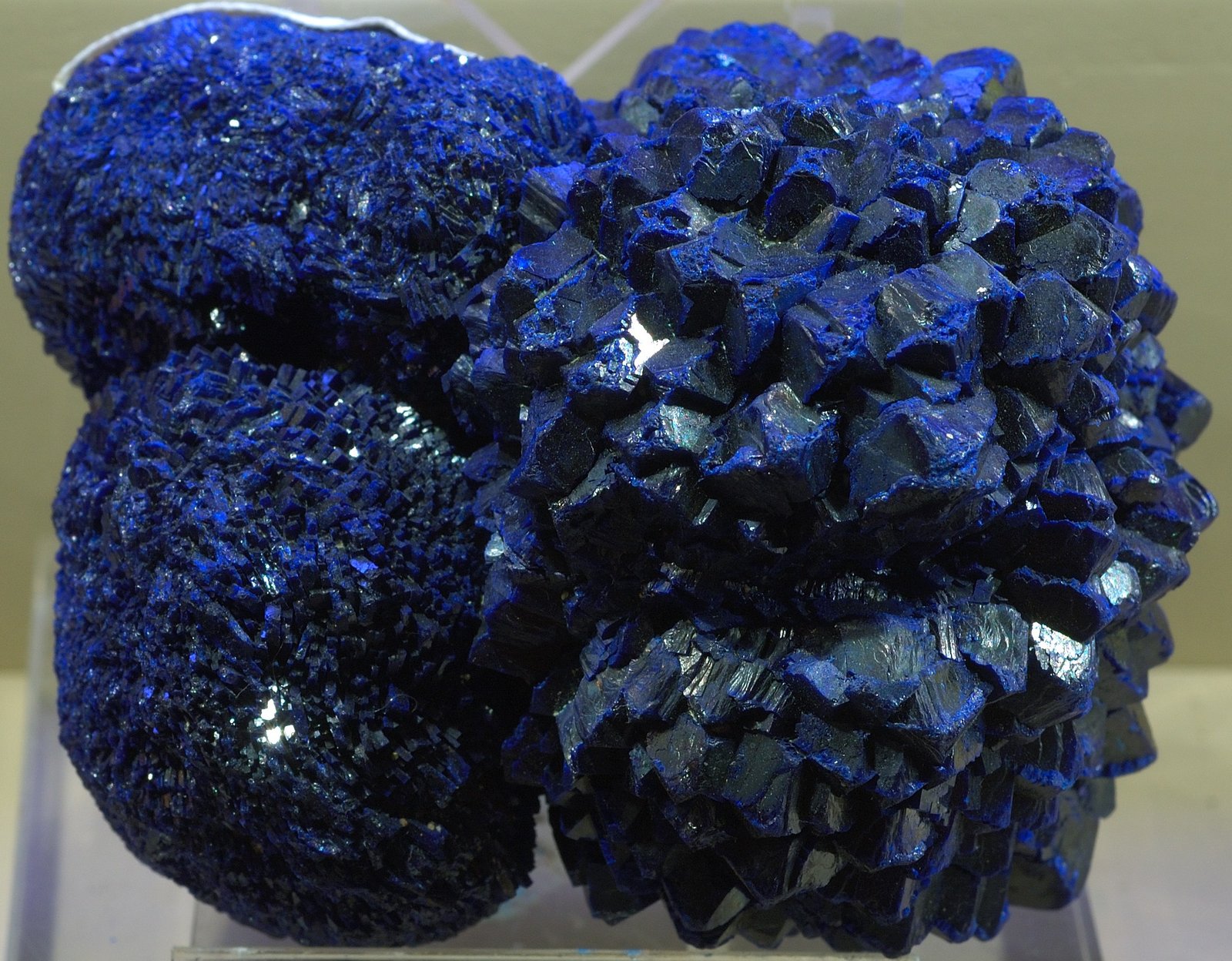
Copper carbonate · Insight & the third eye
In short Azurite is a basic copper carbonate, Cu3(CO3)2(OH)2, and the deep-blue sibling of malachite — the two form together wherever copper ore weathers, which is why so many specimens are blue and green at once. It was Europe’s most important blue pigment before ultramarine became affordable, and it has one genuinely strange habit: over centuries it slowly alters into green malachite, which is why some medieval skies have quietly turned olive. In the crystal tradition it is a third-eye stone of insight, clarity and study. Because it is a soft copper mineral, this guide treats care as seriously as symbolism — no elixirs, no soaking, and no grinding its dust.
Azurite is the most saturated natural blue most people will ever hold: a dark, ink-deep, almost violet blue that seems to swallow light rather than reflect it. Crush it and the powder is brilliant; leave it on a sunny windowsill for a few decades and it will begin, very slowly, to turn green. Few minerals are so beautiful and so quietly unstable at the same time.
This guide covers what azurite actually is, how it painted half the skies of the late Middle Ages, why those skies changed colour, and the care a soft copper mineral genuinely needs.
What is azurite?
Azurite is a basic copper carbonate, formula Cu3(CO3)2(OH)2. It is a secondary mineral, meaning it does not crystallise from magma but forms later, near the surface, where carbon-dioxide-rich water attacks the copper ore below. That is why azurite is a prospector’s signpost: where the ground shows blue, copper is usually not far away.
It crystallises in the monoclinic system, and its best specimens are blocky, glassy, wedge-shaped crystals; more often it turns up as crusts, rosettes and rounded botryoidal masses. Its blue is the deepest of any common carbonate, and its pale blue streak — the colour of the powder it leaves on unglazed porcelain — is a classic identification test. Like all carbonates it fizzes in dilute acid, a reaction that also explains why vinegar and household cleaners should never come near it.
At 3.5 to 4 on the Mohs scale it is soft — comfortably scratched by a coin or a steel pin — and it is brittle with a perfect cleavage in one direction, so it chips readily. Its density is high for its size, and it is almost always sold as a specimen or a cabochon rather than as a hard-wearing gemstone.
Azurite meaning & history
The name comes, unsurprisingly, from the Persian lazhward by way of the Old French azur — the same root that gave us “azure” and, confusingly, part of the story of lapis lazuli. Pliny the Elder knew a blue copper mineral he called caeruleum, and azurite has been mined, ground and traded around the Mediterranean and in China for well over two thousand years.
Its metaphysical reputation is largely modern, and it is worth saying so plainly: azurite carries no great body of classical folklore in the way turquoise or lapis do. Twentieth-century crystal writers, most influentially Edgar Cayce, attached it to intuition, mental clarity and the “inner eye,” and the association stuck because the colour fits — a dark, contemplative, midnight blue that the tradition naturally reads as a stone of the mind rather than the body.
The pigment that turned green
Before synthetic pigments, painters who needed blue had two realistic choices: ultramarine, ground from lapis lazuli and literally worth more than gold, or azurite, which was merely expensive. Azurite therefore did most of the work. Under names like azzurro della magna and “Bice,” it coloured manuscript initials, altarpiece robes and vast stretches of medieval and Renaissance sky.
It came with a catch. Azurite is metastable: given time, warmth and moisture it converts into malachite, its green cousin, atom by atom. Some paintings that left the workshop with clear blue heavens now show them in dusty green, and conservators can point to figures whose blue draperies have quietly changed hue over five centuries. In mineral specimens the same process produces pseudomorphs — green malachite that has kept the exact blocky shape of the azurite crystal it replaced — which are among the most sought-after pieces a collector can own.
The copper question — honestly
Azurite is a copper mineral, and copper compounds are toxic if swallowed or inhaled. That does not make a specimen on a shelf hazardous — holding a solid azurite crystal is low-risk — but it does mean a handful of rules are worth keeping.
- Never make elixirs or “gem water.” Do not soak azurite in water you intend to drink, and never leave it in a water bottle. This is the single most important rule.
- Don’t sand, grind, carve or polish it at home. Copper carbonate dust should not be inhaled; leave shaping to workshops with proper extraction.
- Wash your hands after handling, especially before eating and especially with rough or powdery specimens.
- Keep it away from children and pets, who may put things in their mouths.
- Keep acids away from it. Vinegar, lemon juice and descaling products will visibly attack a carbonate.
Follow those and azurite is a perfectly reasonable stone to own and enjoy. Ignore them — by brewing its “elixir,” for example — and you are needlessly ingesting copper. Let its blue work on you visually and symbolically, not chemically.
Azurite healing properties
In the crystal tradition, azurite is valued as a stone of insight, mental clarity and concentration.
People typically turn to azurite for:
- Clear thinking. A third-eye stone, read as cutting through mental fog and indecision.
- Study and focus. Traditionally kept on a desk during exams, research or demanding intellectual work.
- Intuition. Associated with inner guidance and paying attention to what you already sense.
- Honest self-reflection. Linked to looking squarely at a situation rather than around it.
These are traditional and symbolic uses, not medical claims. There is no scientific evidence that any crystal treats, cures or prevents any illness, and azurite has no proven effect on the mind, memory or health. Remember too that it is a copper mineral: never take it internally in any form, and never drink water it has been soaked in. Nothing here is intended to diagnose, treat or prevent any condition; concerns about concentration, memory or wellbeing belong with a doctor.
Azurite, the chakras & zodiac
Azurite’s deep indigo places it at the third eye chakra (Ajna), the centre of insight and perception, extending down to the throat chakra (Vishuddha) of clear expression. It shares that contemplative blue territory with lapis lazuli and sodalite, though its copper chemistry and softness set it firmly apart from those harder silicates. For the wider framework, see our guide to the seven chakras and their crystals.
By zodiac, azurite is most often linked to Sagittarius and Aquarius, read as signs of enquiry and independent thinking.
How to use azurite
- Keep it as a display specimen. Its softness and copper content make it far better suited to a shelf than to daily wear.
- Place it on a desk or study table. The most popular use, for its traditional links to clarity and concentration.
- Hold it briefly in meditation. At the brow, for its third-eye associations — then wash your hands afterwards.
- Choose sealed or bezelled settings if you have it made into jewellery, and keep it off damp skin.
- Store it in the dark, dry and cool. Prolonged strong light, heat and humidity all encourage the slow drift towards green.
How to cleanse & charge azurite
- Use dry methods only. Smoke from sage or palo santo, sound, moonlight or a selenite plate never touch the stone with water.
- Never use water or salt. Soaking a soft copper carbonate risks both the specimen and, if you drink that water, you; a dry soft brush is all the dusting it needs.
- Moonlight over sun. A gentle overnight moon charge is safe; strong sunlight can fade and destabilise the blue.
- Handle gently. Its perfect cleavage means it chips easily, so cleanse it in place rather than tumbling it about.
- Never use ultrasonic or steam cleaners, which would wreck a soft mineral and disperse fine copper-bearing particles.
Our general guide to cleansing and charging crystals covers each of these methods in more detail, including which stones tolerate water and which — like this one — really do not.
Types & origins
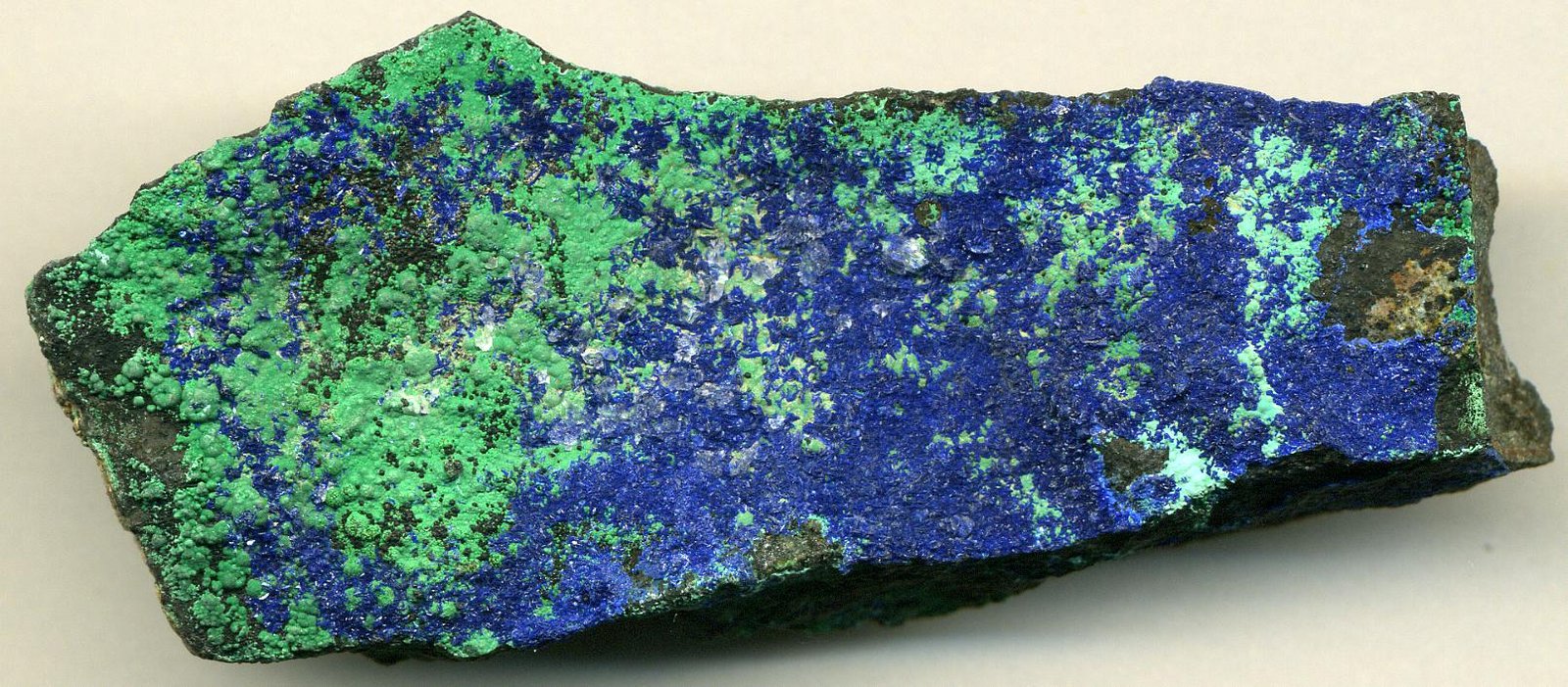
- Azurite-malachite. Blue and green intergrown in one specimen — the most familiar form, sold polished as “azurmalachite.”
- Crystallised azurite. Sharp, glassy blue crystals on matrix; the classic Moroccan and Namibian collector material.
- Azurite “suns” or roses. Flat, radiating discs formed in sandstone, most famously from Malbunka in Australia.
- Botryoidal crusts. Rounded, velvety blue coatings on copper ore, often paired with green malachite.
- Malachite pseudomorphs after azurite. Green crystals in azurite’s blocky shape — a mineralogical curiosity and a collector’s prize.
Fine azurite comes chiefly from Morocco (notably Touissit) and Namibia (Tsumeb), with excellent material also from Arizona in the United States, from China and from Mexico. It is inexpensive to moderately priced as small crusts, while sharp, deeply coloured crystals on matrix reach genuine collector prices. Value is driven by colour saturation, crystal sharpness and lustre, and by how attractively the blue sits against its matrix or its malachite. Because it is soft, brittle and slowly changeable, azurite is very much a specimen and cabochon stone rather than an everyday gem.
Real vs fake
- Dyed howlite or magnesite. White porous stones dyed deep blue are sold as azurite; look for dye pooling in the veins and an even, flat colour with no crystal structure.
- “Reconstituted” blue blocks. Powder-and-resin composites are common in cheap beads — they feel warm and light, and often show a suspiciously uniform blue.
- Confusion with lapis lazuli and sodalite. Both are harder silicates: azurite is much softer, effervesces in acid and leaves a pale blue streak, while lapis is usually flecked with gold pyrite.
- The softness tell. At Mohs 3.5–4, azurite is easily marked by a steel pin on an inconspicuous spot; a “blue crystal” that shrugs off a coin is something harder.
- The green tell. Genuine azurite very often carries at least a trace of green malachite. Perfectly uniform blue with no green whatsoever, at a bargain price, deserves suspicion.
The workable rule: trust the softness and the company it keeps. Real azurite is a soft, dense, ink-blue mineral that usually arrives with a little green somewhere — for the wider method, see our guide to spotting dyed and imitation stones.
Genuine, correctly identified azurite
If you’d like a piece of your own, Minerals Kingdom offers authenticated natural azurite — genuine copper-carbonate specimens, correctly labelled and honestly described, not dyed howlite or resin composite.
Azurite pairs well with
Frequently asked questions
What is azurite good for?
Traditionally, azurite is used for insight, mental clarity, study and intuition — a third-eye stone. These are symbolic, traditional uses, not proven medical effects. No crystal treats illness, and azurite has no demonstrated effect on the mind or body.
Is azurite toxic?
Azurite is a copper carbonate, and copper compounds are toxic if swallowed or inhaled. Owning and handling a solid specimen is low-risk, but never make elixirs from it, never grind or sand it, wash your hands after handling, and keep it away from children and pets.
Can azurite go in water?
No. It is soft, it reacts with acids, and it is a copper mineral, so soaking damages the stone and contaminates the water — and that water must never be drunk. Cleanse it with smoke, sound, moonlight or selenite instead.
Why does azurite turn green?
Azurite is metastable: over long periods, with moisture and warmth, it converts into malachite, which is green. The same process turned some medieval blue skies olive and produces malachite pseudomorphs that keep azurite’s original crystal shape. Storing a specimen cool, dry and out of strong light slows it down.
What is the difference between azurite and lapis lazuli?
They are unrelated. Azurite is a soft copper carbonate that fizzes in acid and leaves a pale blue streak; lapis lazuli is a much harder blue rock built around lazurite, usually flecked with golden pyrite and white calcite. Azurite is also more likely to show green malachite alongside the blue.
What crystals pair well with azurite?
Malachite is the natural partner, since the two grow together and share the same copper chemistry. Chrysocolla suits it for a softer blue-green pairing, and lapis lazuli makes a durable companion for the same third-eye and clear-communication associations.
Image credits · Hero: azurite from the Shilu Copper Mine, Guangdong, China — photo Eric Hunt, Wikimedia Commons (CC BY-SA). Below: malachite and azurite — photo James St. John, Wikimedia Commons (CC BY 2.0).