Sodalite
The deep-blue stone of the calm, clear mind — reached for to speak your truth, think straight and trust your intuition.
Sodium aluminium silicate · The logic stone
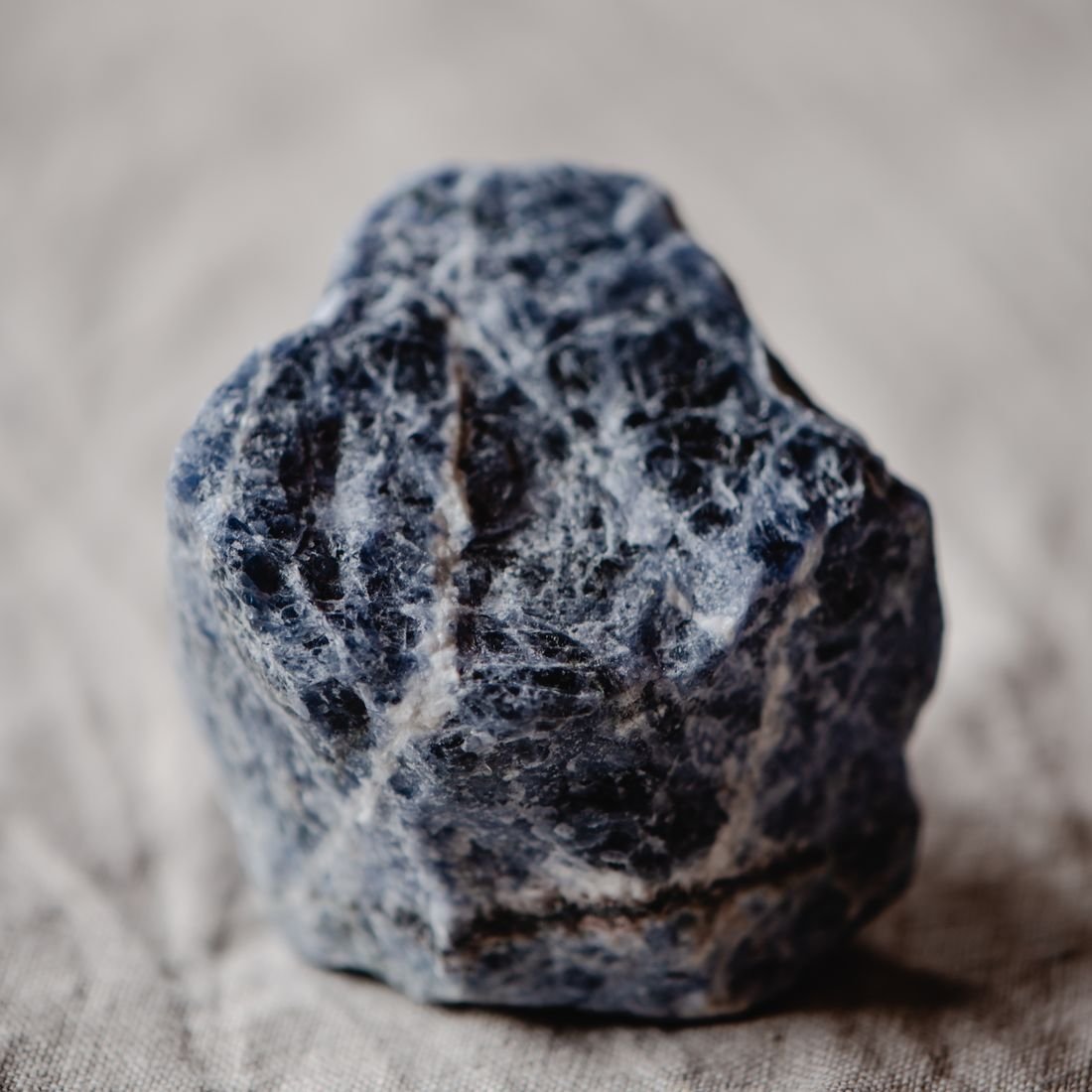
Sodalite is a royal-blue mineral streaked with white calcite veins, a member of the feldspathoid group (Na₄Al₃Si₃O₁₂Cl). In the crystal tradition it’s the “logic stone” and a stone of the throat chakra — reached for to speak honestly, order the mind and steady the emotions, which is why it’s a favourite for students, writers and anyone who freezes when they have to speak up. It’s often mistaken for lapis lazuli, but sodalite has white veins, not gold pyrite flecks. Fairly durable at 5.5–6 Mohs, it still prefers gentle care. Below — meaning, how to use it, how to keep it, and how to tell it from lapis.
Some crystals are all sparkle; sodalite is all depth. A cool, ink-blue stone marbled with rivers of white, it looks like a night sky or a deep sea — and the crystal tradition treats it that way, as a stone for the thinking, truth-telling part of us. It’s the crystal people reach for when their head is noisy, when they need to say a hard thing calmly, or when logic and intuition need to work together. Beautiful, affordable and grounding, it’s an easy stone to love.
This guide covers what sodalite actually is, where its reputation comes from, how people use it, how to keep it, and — crucially — how to tell it apart from the lapis lazuli it’s so often confused with.
What is sodalite?
Sodalite is a sodium aluminium silicate chloride (Na₄Al₃Si₃O₁₂Cl), a rock-forming mineral of the feldspathoid group. Its signature is a rich royal to navy blue, veined and patched with white calcite, though it also occurs in grey, green, yellow and pink. A rarer variety, hackmanite, is famously tenebrescent — it changes colour with light exposure.
It sits at 5.5 to 6 on the Mohs scale — harder and more durable than fluorite or selenite, but still softer than quartz, so it can scratch and chip. Most sodalite on the market comes from Brazil, Canada (the historic Bancroft, Ontario deposits) and Namibia. Because its blue so resembles lapis lazuli, the two are constantly mixed up — the key difference is below.
Sodalite meaning & history
Sodalite was only formally described in 1811, from Greenland, and its name simply means “sodium stone.” It shot to decorative fame when large deposits were found in Ontario, Canada, around 1900 — so much so that it was nicknamed “Princess Blue” after Princess Patricia, who admired it on a royal visit, and it was shipped to Britain to panel grand interiors.
In the modern crystal tradition, sodalite became the “logic stone” and the writer’s and student’s crystal: a stone for clear thinking, rational analysis and honest self-expression. Its deep, orderly blue made it a natural symbol for a calm, truthful mind — the union of head and heart, logic and intuition.
Sodalite healing properties
In the crystal tradition, sodalite is valued as a stone of the mind and the voice — clarity, truth and calm communication.
People typically turn to sodalite for:
- Communication. The classic stone for speaking up honestly and calmly.
- Mental clarity. Said to bring order, logic and rational focus.
- Intuition. A bridge between clear thinking and inner knowing.
- Emotional calm. A steadying stone for anxiety and self-doubt.
These are traditional and symbolic uses, not medical claims. Sodalite is sometimes sold as a remedy for throat problems, metabolism or the immune system — there is no scientific evidence that any crystal treats illness. Enjoy sodalite as a calming, focusing ritual and a beautiful object; it is not a treatment, and nothing here is intended to diagnose or cure any condition.
Sodalite, the chakras & zodiac
Sodalite is linked above all to the throat chakra (Vishuddha), the centre of truth and expression — which is why it’s the crystal for finding your voice. It also reaches up to the third eye (Ajna) for insight and intuition, making it a bridge between what we think and what we say. Its blue is felt as cooling and quieting, settling an anxious, overactive mind.
By zodiac it’s most often associated with Sagittarius, whose search for truth and meaning it’s said to support. It has no birthstone month, but it’s a thoughtful gift for anyone who writes, teaches, speaks — or wishes they found it easier to.
How to use sodalite
Most uses revolve around clear thinking and honest, calm communication.
- Keep it on your desk. The classic study and writing stone for focus and logic.
- Hold it before speaking. A grounding anchor before a talk, meeting or hard conversation.
- Carry a tumbled stone. A pocket piece for anxious, self-doubting days.
- Wear it at the throat. A sodalite pendant sits over the throat chakra, keeping its calm, truthful presence with you through the day.
- Use it in meditation. At the throat or third eye, for clarity and honest reflection.
- Place it by your bed. A quieting stone for a restless, overthinking mind.
How to cleanse & charge sodalite
Sodalite is reasonably tough but contains soft calcite veins, so favour gentle methods.
- Smoke. Sage, palo santo or incense — safe and no-contact.
- Selenite. Rest it on a selenite plate overnight.
- Moonlight. A gentle full-moon charge.
- Sound. A singing bowl suits beads and small pieces.
- Brief cool water. A quick rinse is fine; dry it at once and don’t soak it.
Avoid salt water and long soaking (the calcite content dislikes it), harsh chemicals, and prolonged strong sun. Moonlight or a quartz cluster is the safe way to recharge it. Cleanse it whenever your thoughts have felt especially loud or tangled.
Types & colours
Sodalite is mostly known in blue, but it has a few notable faces:
- Blue sodalite. The classic royal-blue-and-white stone.
- Hackmanite. A tenebrescent variety that shifts colour with light — pink to grey and back.
- “Sunset sodalite.” A trade name for pieces with warm yellow and pink zones.
- Sodalite granite (blue granite). A speckled ornamental rock rich in sodalite, used for tiles and countertops.
Is sodalite rare or valuable?
Sodalite is affordable and widely available — tumbles, towers, spheres and beads cost little, which is part of its appeal as an everyday stone. Value rises with deep, even colour, attractive white veining and translucency, and with rarer material like fine hackmanite, which collectors prize for its colour change. For most people it’s a budget-friendly stone with a luxurious, deep-sea look.
Quality comes down to the richness of the blue, the balance of the white veining, and a good polish. Note, too, that hard blue dumortierite and its blue-quartz are sometimes confused with sodalite. Because its blue resembles pricier lapis lazuli, make sure you know which one you’re buying (next section).
Sodalite vs lapis lazuli
Sodalite’s most common “impostor” issue isn’t fakery but confusion with lapis lazuli — they look alike but differ in a few tell-tale ways.
- White vs gold. Sodalite shows white calcite veins; lapis is defined by gold pyrite flecks. This is the quickest test.
- Even vs speckled. Sodalite’s blue is smoother and more uniform; lapis is a richer, more mottled ultramarine.
- Mineral vs rock. Sodalite is a single mineral; lapis is a rock made of several minerals (lazurite, calcite, pyrite).
- Watch for glass. As with any blue stone, round air bubbles and smooth, paint-like colour point to dyed glass rather than natural stone.
- Price check. Very cheap “lapis” with white veins and no gold is usually sodalite; genuine lapis costs more.
Genuine, ethically sourced sodalite
If you’d like a piece of your own, Minerals Kingdom offers authenticated natural sodalite — tumbles, towers, spheres and pendants.