Lapis Lazuli
The deep-blue stone of kings and scholars — reached for when you want clarity, truth and inner vision.
Lazurite · Wisdom stone
Lapis lazuli is a deep-blue rock — a mix of blue lazurite, golden pyrite flecks and white calcite — treasured for over 6,000 years. In the crystal tradition it’s the stone of wisdom, truth and inner vision, tied to the third eye and throat chakras: clear thinking and honest, confident expression. It’s softer than quartz (5–5.5 Mohs) and a little porous, so it needs gentler care. Below — what it means, how to use it, how to keep it safely, and how to tell real lapis from dyed jasper.
Few stones carry as much history as lapis lazuli. Ground into the priceless pigment ultramarine, set into the mask of Tutankhamun, worn by scholars as a token of truth — it has been the colour of wisdom and royalty for millennia. In the modern crystal tradition it keeps that role: the stone you reach for to think clearly, speak honestly and trust your own inner vision.
This guide covers what lapis lazuli actually is, where its reputation comes from, the ways people use it, how to keep this softer stone safely, and — because you deserve the full picture — what’s tradition and what’s genuinely known. We’ll keep the lore and the facts clearly labelled.
What is lapis lazuli?
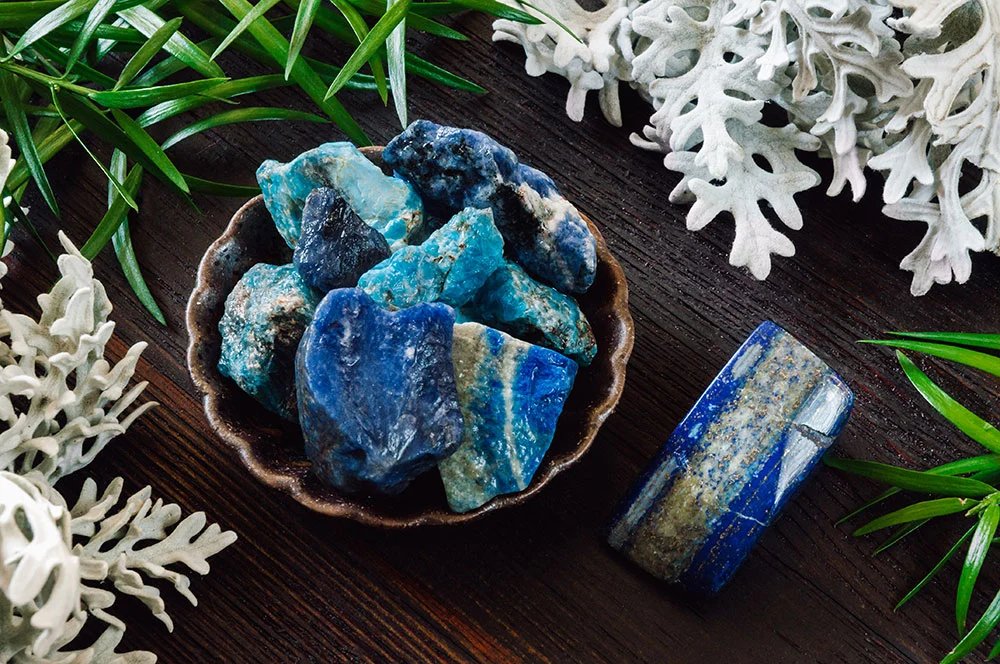
Lapis lazuli isn’t a single mineral but a rock made of several. Its deep blue comes from lazurite; the golden glints are pyrite (“fool’s gold”); and the white veins are calcite. The finest lapis is an intense, even ultramarine blue with a scatter of fine gold pyrite and little visible calcite. That trio of blue, gold and white is the stone’s unmistakable signature.
It’s a relatively soft, slightly porous stone — 5 to 5.5 on the Mohs scale — which matters for care: it doesn’t love long soaks, salt, or harsh sun. The most celebrated source is the Sar-e-Sang mines of Afghanistan, worked for over six thousand years and still producing the world’s best material, with more from Chile and Russia.
The name says it all: lapis is Latin for “stone,” and lazuli traces back through Persian lāzhward to the very word for “blue” and for the sky. Our words azure and ultramarine are its linguistic descendants.
Lapis lazuli meaning & history
For most of recorded history, lapis was a stone of royalty and the sacred. The Egyptians carved it into amulets and inlaid it into funerary masks, believing its starry blue echoed the heavens. Ground to powder, it became ultramarine — the most expensive pigment in the world, reserved by Renaissance painters for the robes of the Virgin Mary. Sumerian, Persian and Roman cultures all prized it as a mark of status and truth.
That long association with sky, heaven and honesty gave lapis its enduring meaning in the crystal tradition: a stone of wisdom, truth and inner sight. It was worn by judges and scholars as a symbol of integrity, and it remains the classic stone for clear thinking and speaking one’s truth.
Today people reach for lapis when they want mental clarity, honest self-expression, or a sense of connection to something larger — the calm authority of a stone that has meant “wisdom” for six thousand years.
Lapis lazuli healing properties
In the crystal tradition, lapis lazuli is valued for qualities of mind and voice — clarity, truth and confident expression.
People typically turn to lapis lazuli for:
- Clear thinking. A study-and-focus stone, traditionally linked to wisdom and learning.
- Speaking your truth. A throat-chakra stone for honest, confident expression.
- Inner vision. A third-eye stone for intuition, reflection and insight.
- Calm authority. A steadying presence for leadership, decisions and self-belief.
These are traditional and symbolic uses, not medical claims. Lapis is sometimes marketed as a remedy for physical conditions — there is no scientific evidence for that. Enjoy it as a focusing ritual and a beautiful object; it is not a treatment, and nothing here is intended to diagnose or cure any condition. (One practical caution: don’t make “gem water” by soaking lapis — see care below.)
Lapis lazuli, the chakras & zodiac
Lapis works mainly with the upper energy centres: the third eye chakra (Ajna), linked to intuition and insight, and the throat chakra (Vishuddha), linked to communication and truth. That pairing — see clearly, then speak clearly — is the heart of its reputation.
By zodiac, lapis is most associated with Sagittarius, the seeker and truth-teller of the calendar, and it’s sometimes given as a traditional September stone. Its regal blue makes it a meaningful gift for graduations, new roles and anyone stepping into their voice.
How to use lapis lazuli
Lapis is wonderful to work with, as long as you respect that it’s softer than quartz.
- Keep it on your desk. A piece where you study or write is the classic clarity-and-focus placement.
- Wear it at the throat. A lapis lazuli necklace at the throat keeps its truth-and-voice meaning close — a quiet anchor for honest conversations.
- Hold it in meditation. Rest a tumbled stone on the brow or in the hand for reflective, third-eye practice.
- Place it by your bed. Some keep lapis nearby for vivid, insightful dreaming.
- Carry it for a big conversation. A pocket stone before an interview, talk or honest discussion.
How to cleanse & charge lapis lazuli
Because lapis is soft and porous, this is the one area where it needs more care than a quartz. Stick to the dry, gentle methods.
- Smoke. Incense, palo santo or sage is the safest reset — no water, no contact.
- Selenite. Rest it on a selenite plate overnight; gentle and water-free.
- Sound. A singing bowl or bell cleanses without touching the stone.
- Moonlight. A night under the full moon charges it without the risks of sun or water.
- Dry cloth. Wipe it with a soft, slightly damp cloth and dry at once — never soak it.
Avoid long water baths, salt and prolonged direct sun: water and salt can dull the surface and attack the calcite and pyrite, and strong sun can fade the blue over time. Treat lapis like the precious old stone it is, and it will keep its colour for a lifetime.
Quality & relatives
With lapis, “quality” is really about the balance of its three ingredients:
- Top-grade lapis. Deep, even ultramarine blue with a fine scatter of gold pyrite and little calcite.
- Denim lapis. A paler, more affordable blue with more white calcite — pretty, but lower grade.
- Too much pyrite. Heavy gold or grey patches lower the value; a little is prized, a lot is not.
- Sodalite. A close blue relative, but more uniform and usually without pyrite — often confused with lapis.
- Azurite. Another deep-blue copper mineral, softer and unrelated, sometimes mistaken for it.
- Tanzanite. The rare blue-violet tanzanite is a very different mineral, but a natural companion at the third eye and throat.
- Sapphire. The blue gem variety of corundum — historically confused with lapis and the aristocrat of blue stones, profiled in our sapphire guide.
Most fine lapis still comes from Afghanistan, with paler material from Chile and Russia.
Is lapis lazuli rare or valuable?
Lapis sits in the middle ground: more valuable than everyday quartz stones, but far from a precious gem. Tumbled stones and beads are affordable, while a piece of top-grade, deep-blue Afghan lapis with fine pyrite and minimal calcite commands a real premium — that’s the material that was once worth more than gold as a pigment.
Value comes down to colour and purity: an intense, even blue with just a hint of gold is the ideal. Pale, chalky or heavily veined pieces are common and cheap. For most buyers the honest advice is to choose the best blue you can comfortably afford, and to check it’s natural rather than dyed.
How to tell real lapis lazuli from fake
Lapis is widely imitated, most often by dyed jasper or howlite (“Swiss lapis”) and by reconstituted or glass pieces. The natural trio of blue, gold and white is your best guide.
- Look for real pyrite. Genuine lapis usually shows metallic gold pyrite flecks with irregular shapes, set into the stone. Painted-on gold dots or no pyrite at all is a warning sign.
- Look for calcite. A little natural white veining is normal and reassuring. A flawless, uniform blue with no variation can mean dye.
- The acetone test. Rub a hidden spot with acetone (nail polish remover): if blue comes off on the cotton, it’s dyed.
- Mind the price. A large, deep-blue “lapis” for a few coins is almost certainly dyed jasper.
- Watch for glass. Internal bubbles and an even, glassy blue point to glass or reconstituted material, not natural rock.
Genuine, ethically sourced lapis lazuli
If you’d like to start your own piece, Minerals Kingdom offers authenticated natural lapis lazuli — raw stones, tumbles and jewellery, with origin declared.