
Tanzanite
The blue-violet gem variety of zoisite, found in one small patch of hills in Tanzania and nowhere else on earth — a stone that shifts colour as you turn it, almost always coaxed to blue by heat, and read in the crystal world as a stone of insight and transformation.
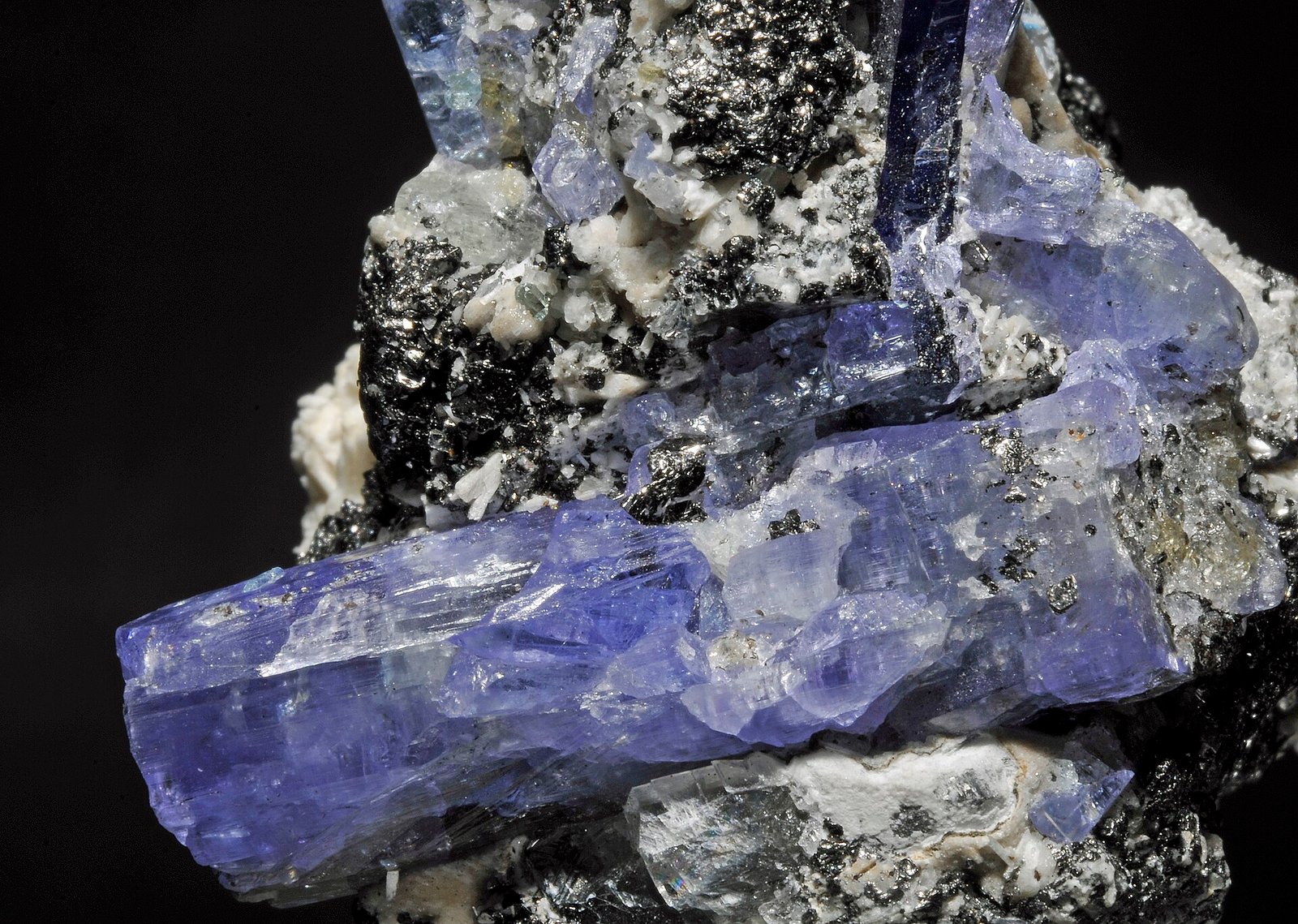
Gem zoisite · Insight & transformation
In short Tanzanite is the blue-violet gem variety of zoisite, a calcium aluminium silicate, and one of the rarest gems in commercial use: it comes from a single small deposit in the Merelani Hills of northern Tanzania, and from nowhere else in the world. Discovered only in 1967 and named by Tiffany & Co., it is famously trichroic — showing blue, violet and burgundy depending on the angle — and almost all tanzanite is heat-treated, which turns naturally brownish crystals a clean blue. In the crystal tradition it is a third-eye, throat and crown stone of insight, calm communication and transformation. It is moderately soft and brittle, so it needs gentle handling.
Tanzanite is a young stone with an old-looking beauty: a deep, velvety blue shot through with violet, sometimes flashing burgundy as it catches the light. It was unknown to science until the late 1960s, and everything the world will ever have comes from a few square kilometres of ground near Mount Kilimanjaro. That combination of extreme rarity and striking colour has made it one of the most sought-after gems of the modern era.
This guide covers what tanzanite actually is, how it was discovered and named, why it comes from only one place on earth, and an honest look at the heat treatment nearly every stone has undergone.
What is tanzanite?
Tanzanite is the blue-to-violet gem variety of zoisite, a calcium aluminium sorosilicate with the formula Ca2Al3(SiO4)3(OH). Its colour comes from a trace of vanadium. Zoisite itself is a common rock-forming mineral in dull greys, greens and browns; only in this one deposit does it occur in transparent, richly coloured crystals fit for cutting.
Its most remarkable optical property is pleochroism — in fact strong trichroism. A single tanzanite crystal shows three different colours down its three crystal axes: blue, violet and a reddish burgundy. Cutters orient the finished gem to bring out the most blue, but the violet is never far away, giving tanzanite its characteristic shifting depth. It crystallises in the orthorhombic system, is 6 to 7 on the Mohs scale, and has one direction of perfect cleavage that makes it brittle and vulnerable to knocks — the reason it is treated as a careful, special-occasion gem rather than an everyday one.
Tanzanite meaning & history
Tanzanite’s story begins in 1967, when blue crystals were found in the Merelani Hills near Arusha, in the shadow of Mount Kilimanjaro. Local accounts credit a Maasai herder who noticed the stones after a lightning-sparked grass fire had heated the ground — a fire that, fittingly, did naturally what jewellers now do deliberately. The gem was identified as a blue variety of zoisite, but “blue zoisite” sounded too close to “suicide” for comfortable marketing, so Tiffany & Co. renamed it tanzanite after its country of origin and launched it to the world in 1968.
Because it is so new, tanzanite carries no ancient folklore. Its metaphysical reputation was built entirely in the modern crystal world, drawn straight from its colour: a deep indigo-violet that the tradition naturally reads as a stone of the higher mind — insight, intuition and spiritual awareness. That it appears to transform from brown to blue, and shifts hue as you turn it, only reinforced its reputation as a stone of change and perception.
The one-source stone
Almost no other gem is so tied to a single place. Every natural tanzanite on earth comes from the Merelani Hills, a deposit only a few kilometres across in the Manyara Region of northern Tanzania. Geologists often point out that this makes it, by some estimates, a thousand times rarer than diamond — and because the deposit is finite, tanzanite is one of the few gems with a genuinely foreseeable end to supply. That scarcity is central to both its market value and its mystique: to own tanzanite is to own a piece of one small hillside in East Africa.
The heat-treatment question — honestly
Tanzanite is safe to own, wear and handle — it is non-toxic and chemically stable. The honesty it asks for is about heat treatment.
- Nearly all tanzanite is heated. Most rough comes out of the ground brownish or khaki; gentle heating to around 500–600 °C converts it to the clean blue-violet everyone recognises.
- The treatment is stable and permanent, and it is so nearly universal that it is simply assumed unless a stone is specifically sold as rare untreated material.
- Naturally blue tanzanite exists but is unusual, and untreated stones with a laboratory report command a premium.
- It changes nothing about authenticity. A heated tanzanite is still entirely natural tanzanite — the heat only finishes what the earth started.
In short, assume your tanzanite has been heated, and buy it as the naturally occurring, gently finished gem it is. There is nothing to hide here — only something worth understanding.
Tanzanite healing properties
In the crystal tradition, tanzanite is valued as a stone of insight, calm communication and transformation.
People typically turn to tanzanite for:
- Insight and intuition. A third-eye stone, read as sharpening perception and inner guidance.
- Calm, honest expression. Linked through the throat chakra to speaking clearly and truthfully.
- Transformation. Associated with periods of change, and with turning difficulty into understanding.
- Spiritual awareness. Traditionally used in meditation to quiet the mind and lift attention.
These are traditional and symbolic uses, not medical claims. There is no scientific evidence that any crystal treats, cures or prevents any illness, and tanzanite has no proven effect on the mind or health. Nothing here is intended to diagnose, treat or prevent any condition; concerns about mood, focus or wellbeing belong with a doctor.
Tanzanite, the chakras & zodiac
Tanzanite’s indigo-violet spans the upper chakras: the throat chakra (Vishuddha) of clear expression, the third eye (Ajna) of insight, and the crown (Sahasrara) of spiritual connection. It shares that contemplative blue-violet ground with iolite, lapis lazuli and violet amethyst, though its rarity and trichroic depth set it apart. For the wider framework, see our guide to the seven chakras and their crystals.
By zodiac, tanzanite is most often linked to Gemini and Sagittarius, read as signs of curiosity, communication and the search for meaning.
How to use tanzanite
- Wear it for special occasions rather than daily. Its brittleness and cleavage make earrings and pendants safer than everyday rings.
- Hold it in meditation. At the brow or throat, for its traditional links to insight and clear expression.
- Keep a small tumbled stone as a touchstone, stored away from harder crystals that would scratch it.
- Protect it from knocks and sudden temperature changes, both of which a brittle, cleaved stone dislikes.
- Set rings in protective mounts — bezels or halos — if you do wear tanzanite on the hand.
How to cleanse & charge tanzanite
- Prefer dry methods. Smoke, sound, moonlight or a selenite plate are all gentle and completely safe.
- Only brief, lukewarm water if you must. Avoid soaking, hot water and sudden temperature changes, which can shock a cleaved stone.
- Never use ultrasonic or steam cleaners. These are the classic way tanzanite gets cracked; vibration and heat find its cleavage instantly.
- Moonlight over sun. A gentle overnight moon charge is ideal, and avoids any risk of thermal stress.
- Handle it over a soft surface, since a single sharp knock can chip or cleave the stone.
Our general guide to cleansing and charging crystals covers each method in more detail, including which delicate stones — like this one — really need the gentle approach.
Types & origins
- Blue tanzanite. The most prized — a deep, slightly violet sapphire-blue, the classic heated gem colour.
- Violet tanzanite. More purple-leaning stones, often a little more affordable and equally beautiful.
- Bicolour and “fancy” tanzanite. Stones cut to show the interplay of blue and violet, or unusual natural hues.
- Untreated (natural colour) tanzanite. Rare stones naturally blue without heating, sold with documentation at a premium.
- Green and other zoisite. Related gem zoisite in green or the pink manganese variety thulite — cousins rather than tanzanite proper.
Every tanzanite comes from the Merelani Hills of Tanzania; there is no second source. Value is driven above all by colour — deep, saturated blue-violet being the most prized — along with clarity, cut and size, with larger fine stones rising steeply in price. Because the deposit is small and finite, tanzanite is widely expected to become scarcer over time, which forms a large part of its appeal.
Real vs fake
- Synthetic forsterite and glass. Lab-made blue-violet materials and coloured glass are sold as tanzanite; glass often shows bubbles and lacks tanzanite’s distinct colour shift.
- Coated or “coated quartz” imitations. Cheap stones with a thin blue-violet coating mimic the colour but wear at the facet edges.
- Confusion with iolite and sapphire. Iolite is a cheaper blue-violet look-alike but shows a different, greyer pleochroism; sapphire is far harder and lacks the violet flash.
- The pleochroism tell. Genuine tanzanite visibly changes between blue and violet as you rotate it — a strong, distinctive shift that most imitations cannot reproduce.
- The rarity tell. Tanzanite is genuinely rare; a very large, very cheap “tanzanite” deserves suspicion and, ideally, a laboratory report.
The workable rule: look for the true blue-to-violet colour change, and for anything costly, ask for documentation. For the wider method, see our guide to spotting dyed and imitation stones.
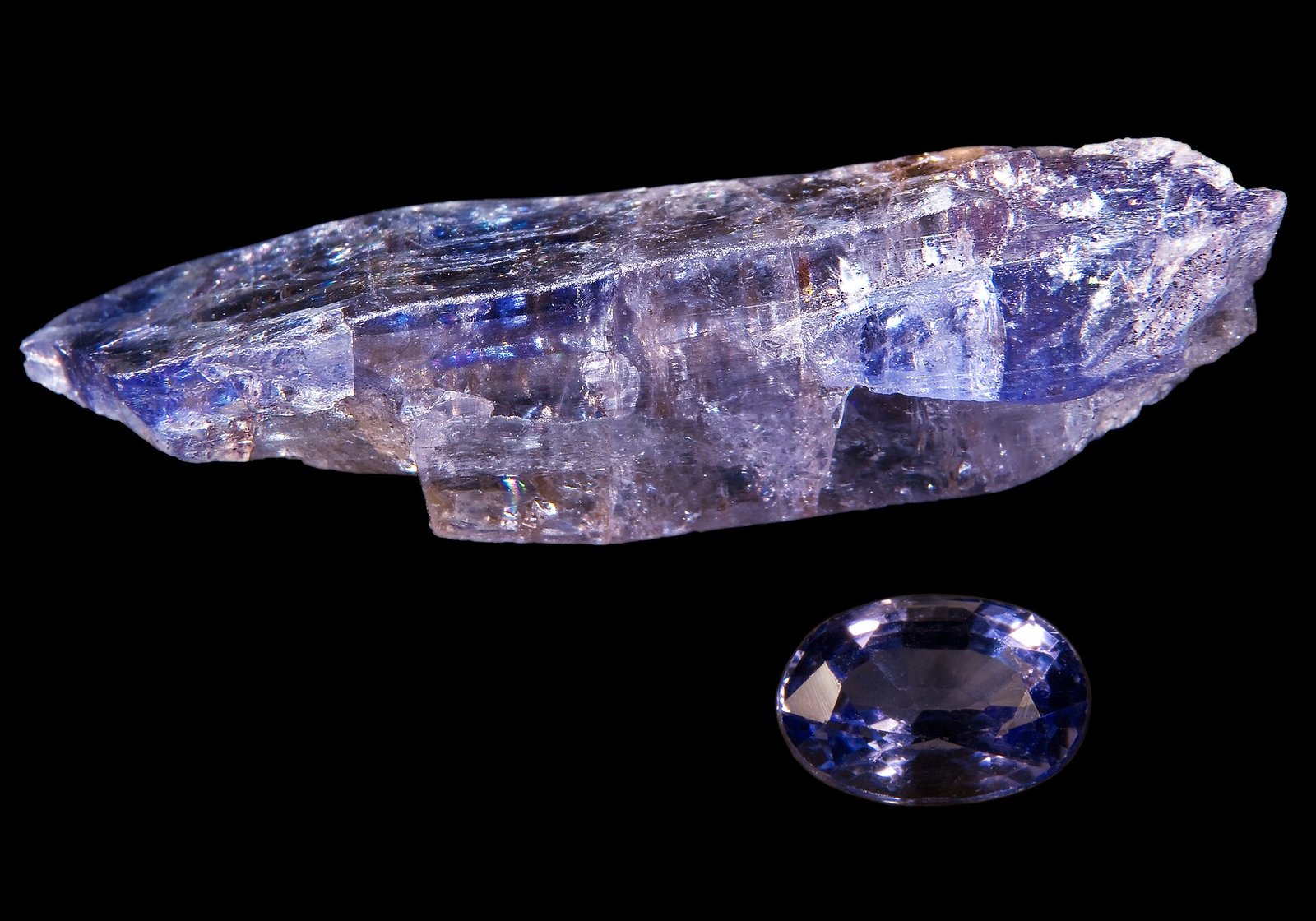
Genuine, correctly identified tanzanite
If you’d like a piece of your own, Minerals Kingdom offers authenticated natural tanzanite — genuine gem zoisite from Tanzania, correctly labelled and honestly described, not coated quartz or glass.
Tanzanite pairs well with
Frequently asked questions
What is tanzanite good for?
Traditionally, tanzanite is used for insight, intuition, calm communication and transformation — a third-eye, throat and crown stone. These are symbolic, traditional uses, not proven medical effects. No crystal treats illness, and tanzanite has no demonstrated effect on the mind or body.
Where does tanzanite come from?
From a single deposit: the Merelani Hills near Arusha in northern Tanzania, in the shadow of Mount Kilimanjaro. It is found nowhere else on earth, which is a large part of why it is considered so rare.
Is tanzanite heat-treated?
Almost always. Most tanzanite rough is brownish and is gently heated to bring out its blue-violet colour. The treatment is stable, permanent and essentially universal, and it does not make the stone any less natural. Rare untreated stones are sold with documentation at a premium.
Can tanzanite go in water?
Brief contact with lukewarm water is tolerable, but tanzanite is brittle with perfect cleavage, so avoid soaking, hot water and sudden temperature changes — and never use ultrasonic or steam cleaners. Dry methods such as smoke, moonlight, sound or selenite are safest.
What is the difference between tanzanite and iolite?
Both are blue-violet and pleochroic, but they are unrelated minerals. Tanzanite is a rare gem zoisite from one place in Tanzania; iolite (gem cordierite) is far more common and affordable, with a greyer, more subdued colour shift. Iolite is often sold as a budget tanzanite alternative.
What crystals pair well with tanzanite?
Other upper-chakra blue and violet stones suit it well — iolite for vision and perception, lapis lazuli for clear communication, and amethyst for calm spiritual focus.
Image credits · Hero: tanzanite crystal with graphite and laumontite — photo Parent Géry, Wikimedia Commons (CC BY-SA 3.0). Below: faceted tanzanite — photo Didier Descouens, Wikimedia Commons (CC BY 3.0).