Chrysocolla
The turquoise-green copper stone of gentle strength — the goddess stone of expression, and a mineral that dissolves in water.
Copper silicate · The goddess stone
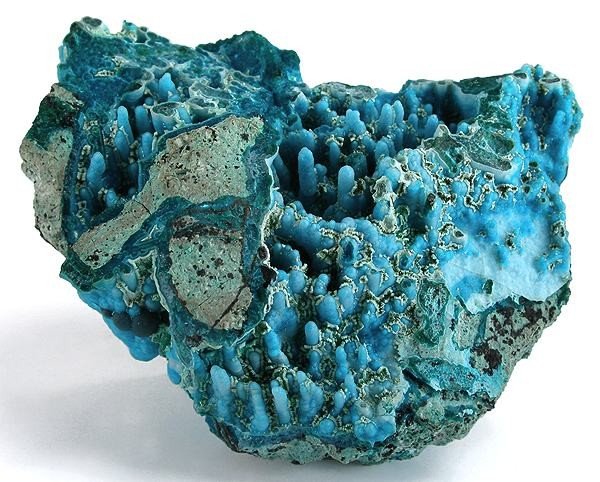
Chrysocolla is a hydrated copper silicate, blue-green and often intergrown with malachite, turquoise and quartz. In the crystal tradition it’s the “goddess stone” of calm expression, gentle strength and truth spoken kindly. It is very soft (2–4 Mohs), porous, and genuinely damaged by water — a fact almost never mentioned when it is sold. Most jewellery-grade material is chrysocolla in chalcedony, which is hard and safe. Below — meaning, how to use it, how to keep it, and why the two versions behave completely differently.
Chrysocolla is the colour of a shallow tropical sea, and it forms where copper ore has weathered — which means it almost never comes alone. Slice a piece open and you may find malachite green, azurite blue, black shadows of tenorite and the pale glassiness of quartz, all in the same stone. That mixing is what makes it beautiful. It is also what makes “chrysocolla” one of the loosest words in the crystal trade.
This guide covers what chrysocolla actually is, where the goddess association comes from, how people use it, why water is its enemy, and how to know which kind you are holding.
What is chrysocolla?
Chrysocolla is a hydrated copper phyllosilicate, formed in the oxidised upper zones of copper deposits. Copper gives it the blue-green; the exact hue shifts with water content and with whatever else is in the mix.
Pure chrysocolla is very soft — 2 to 4 on the Mohs scale — porous, and structurally fragile. It cannot be faceted and barely takes a polish. What jewellers actually cut is chrysocolla in chalcedony, where the copper mineral has been permeated by silica: this is hard (around 6–7), stable, and often sold as gem silica or chrysocolla chalcedony. It is one of the more valuable chalcedonies in the world.
The name is ancient and slightly absurd: from the Greek chrysos (gold) and kolla (glue), because a similar green mineral was used as a flux for soldering gold. Theophrastus used the word in the fourth century BC — but almost certainly for a different material.
Chrysocolla meaning & history
Copper minerals have been worked since the Bronze Age, and chrysocolla appears in Egyptian, Israelite and Andean contexts. There is a well-worn claim that Cleopatra wore chrysocolla and that it calmed her temper. It is repeated everywhere and rests on nothing but repetition — no ancient source says it. We include it because you will read it elsewhere, and you should know it is not history.
In the modern crystal tradition, chrysocolla became the “goddess stone”: a crystal of feminine strength, wise speech and calm authority — a stone for saying difficult things without hardening. Its blend of throat blue and heart green is read as the union of truth and compassion, which is an elegant reading whatever one makes of it.
Chrysocolla healing properties
In the crystal tradition, chrysocolla is valued as a stone of calm expression, gentle strength and emotional balance.
People typically turn to chrysocolla for:
- Speaking with compassion. The classic use — truth without cruelty.
- Calm authority. Carried by teachers, mediators, people who must hold a room.
- Emotional balance. Associated with steadiness through change.
- Feminine strength. The “goddess stone” of the modern tradition.
These are traditional and symbolic uses, not medical claims. Chrysocolla is sometimes sold for the throat, the thyroid or for hormonal balance, and it is occasionally recommended for elixirs. Please do not: it is a copper mineral and may contain associated toxic minerals, and copper compounds should not be ingested. There is no scientific evidence that any crystal treats illness. Never make a drinking elixir with chrysocolla, malachite, azurite or any copper stone. Nothing here is intended to diagnose or cure any condition.
Chrysocolla, the chakras & zodiac
Chrysocolla straddles the throat chakra (Vishuddha) and the heart chakra (Anahata) — which is precisely why the tradition assigns it kind speech rather than mere speech. Its blue is expression; its green is compassion.
By zodiac it’s associated with Taurus, Gemini and Virgo. It has no birthstone month.
How to use chrysocolla
Most uses revolve around speaking well and staying steady.
- Hold it before speaking. Especially when the thing you must say is hard.
- Keep it on a desk or lectern. A steadying presence.
- Wear the chalcedony form. A chrysocolla pendant — but check it is silicified, or it will wear away.
- Use it in meditation. At the throat, for compassionate honesty.
- Keep soft pieces displayed, not carried. They abrade in a pocket.
- Never make an elixir. Copper mineral. See the note above.
How to cleanse & charge chrysocolla
Soft, porous, copper-bearing: this is a dry-care stone.
- Smoke. Sage, palo santo or incense — the safest option.
- Moonlight. A gentle overnight charge.
- Selenite. Rest it on a plate.
- Sound. A singing bowl, for small pieces.
- Dry cloth. Wipe gently, do not scrub.
Never soak soft chrysocolla: water penetrates the pores and can leach copper, dulling and degrading the stone. Avoid salt entirely, avoid acids, avoid ultrasonic cleaners, and keep it out of strong sun, which can fade the green. Silicified chrysocolla chalcedony tolerates a brief rinse; pure chrysocolla does not.
Types & blends
- Gem silica. Chrysocolla in translucent chalcedony — the finest and priciest form.
- Chrysocolla with malachite. Green swirls in blue-green; from the DR Congo.
- Eilat stone. A mix of chrysocolla, malachite and turquoise from the Israeli desert.
- Sonora sunrise / sunset. Chrysocolla with red cuprite, from Mexico.
- Shattuckite and ajoite blends. Deep blue relatives, often sold together.
Is chrysocolla rare or valuable?
Soft massive chrysocolla is inexpensive. Specimens and rough cost little.
But gem silica — translucent chrysocolla chalcedony, especially the fine material from Arizona’s Ray Mine — is a serious gemstone, and the most valuable chalcedony there is. Good cabochons run to hundreds or thousands. The word “chrysocolla” on a label tells you very little about price until you know which of these two you are being sold.
How to tell real chrysocolla from fake
Fakery here is mostly about hardening and substitution.
- Test the hardness. Pure chrysocolla is scratched by a fingernail or a coin. If your “chrysocolla” scratches glass, it is silicified — which is good, but is a different material and a different price.
- Stabilised material. Much soft chrysocolla is resin-impregnated so it can be cut. Legitimate, but should be disclosed. A hot needle near a discreet spot will smell of plastic.
- Vs dyed howlite or magnesite. Uniform colour, grey web veins, very soft.
- Vs turquoise. Turquoise is harder and has a different matrix; chrysocolla is more green, more variable, and often merges into quartz.
- Look for the merge. Genuine chrysocolla blends gradually into its neighbouring minerals. A hard boundary suggests a composite.
Genuine, ethically sourced chrysocolla
If you’d like a piece of your own, Minerals Kingdom offers authenticated natural chrysocolla — specimens, cabochons and pendants, with the form stated.