Turquoise
One of the oldest gemstones worked by humans — and, today, one of the most treated and most imitated. Here is how to read the spectrum.
Phosphate · The sky stone
Turquoise is a hydrated copper aluminium phosphate, and the single most important thing to understand about it is that it is porous. That porosity explains everything else: why most turquoise on the market is stabilised with resin (a legitimate, disclosed practice), why it absorbs oils and perfume, why it can change colour on the wrist, and why it must never go near an ultrasonic or steam cleaner. It is also the classic target for imitation — above all dyed howlite. In the crystal tradition it is a stone of protection, especially for travellers, and of clear speech. Below: the full treatment spectrum, explained without moralising, and how to tell the fakes.
Turquoise is one of a small handful of stones humans have valued continuously for more than six thousand years. Egyptian expeditions were cutting it out of the Sinai in the third millennium BC. Persian craftsmen were setting it in the twelfth century. It has been carved, traded and inherited across three continents. And yet, walk into a market today and the odds are strongly against the blue stone in front of you being what a buyer of 1850 would have recognised as turquoise.
That is not a scandal. It is a consequence of the mineral’s own nature, and the honest version of the story is more interesting than the outraged one. This guide explains what turquoise is, why it behaves the way it does, the full spectrum from untreated to outright fake, and how to look after a stone that is genuinely fragile.
What is turquoise?
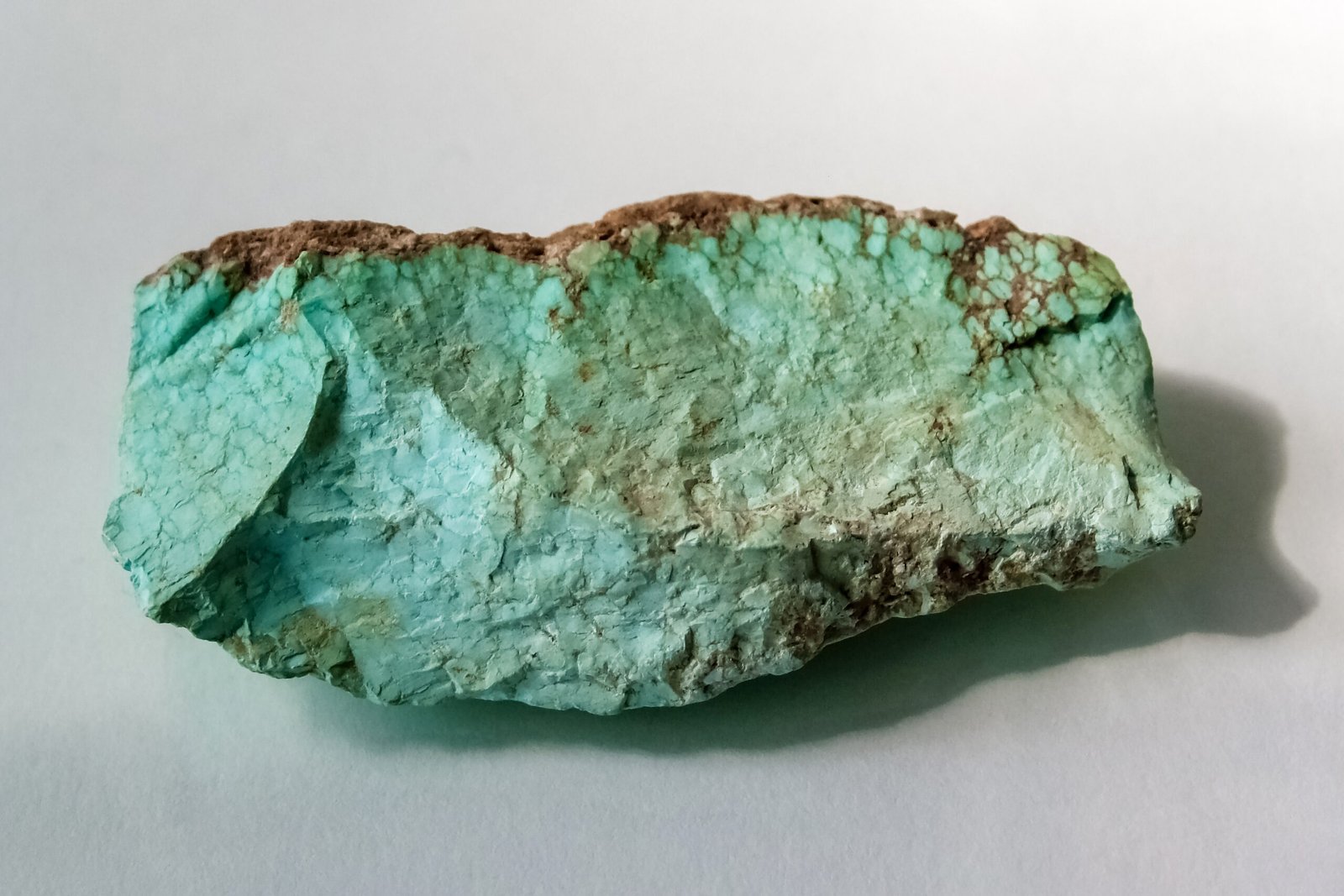
Turquoise is a hydrated phosphate of copper and aluminium — formula CuAl₆(PO₄)₄(OH)₈·4H₂O. The copper gives the blue; iron substituting for aluminium pushes the colour towards green. That is why turquoise runs a continuous range from pure sky blue to olive green, and why a single nodule can do both.
It forms near the surface, in arid regions, where acidic copper-bearing water percolates through aluminium-rich rock. Nearly all of it is cryptocrystalline — a dense mass of microscopic crystals rather than single visible ones. Well-formed turquoise crystals exist but are a mineralogical curiosity, not something you will ever be offered in a shop.
Its hardness sits at 5 to 6 on the Mohs scale — softer than quartz, meaning ordinary dust will scratch it over time. But hardness is not the headline. Porosity is. Because turquoise is an aggregate rather than a solid crystal, it is riddled with microscopic pore space. Finer, denser material from the best deposits is relatively tight; most turquoise is not. Porous material absorbs liquids, is chalky and weak, and cannot survive being cut and set without help.
Almost everything a buyer needs to know about turquoise follows from that single fact.
Turquoise meaning & history
The name reaches us through French — pierre turquoise, “Turkish stone” — not because it came from Turkey but because Persian material reached Europe through Turkish trade routes.
The Egyptians mined it in the Sinai from the Early Dynastic period, most famously at Serabit el-Khadim, where the mining camps sat beside a long-lived temple to Hathor, known there as the mistress of turquoise. State expeditions of several hundred men travelled there in the cooler months. Turquoise appears in Egyptian inlay, amulets and funerary goods throughout the dynastic period.
In Persia, the deposits near Nishapur in Khorasan have been worked for well over a thousand years and produced the intense, even sky blue that became the international benchmark — the colour still called “Persian blue” in the trade. Turquoise was set in Persian and later Mughal metalwork, arms and architecture, and carried a strong protective reputation, particularly for riders and travellers.
In the American Southwest, turquoise has a deep and continuing history. Ancestral Puebloan people mined and worked it extensively; excavations at Chaco Canyon have recovered enormous quantities of turquoise beads, pendants and mosaic inlay, and the sites sat within long-distance exchange networks. Turquoise remains culturally important today to the Diné (Navajo), the Zuni and other Pueblo nations, and the silver-and-turquoise jewellery traditions of those nations — each with its own distinct styles and techniques — are living artistic and cultural heritage, not a historical curiosity.
A word of care here. Turquoise carries specific ceremonial and cultural meanings within those nations. Those meanings belong to them, and are not ours to summarise, market or repackage as features of a consumer product. What can be said plainly and respectfully is that the stone is significant, that the jewellery traditions are living ones, and that anyone buying Native American turquoise work should buy authenticated pieces from the artists or from dealers who name them.
In the modern Western crystal tradition, turquoise is above all a stone of protection in movement — the amulet you carry when you go somewhere — and of honest, clear speech.
Turquoise healing properties
In the crystal tradition, turquoise is valued for protection, communication and calm.
People typically turn to turquoise for:
- Protection when travelling. Its oldest and most consistent association, from Persian horsemen to modern travel charms.
- Clear speech. A throat-chakra stone, used for saying difficult things plainly.
- Calm. Associated with steadiness rather than stimulation.
- Friendship and reconciliation. Traditionally given rather than bought for oneself.
These are traditional and symbolic uses, not medical claims. Turquoise is often sold as a stone for the throat, the immune system or “detoxification”. There is no scientific evidence that any crystal treats, prevents or cures any illness, and no crystal detoxifies anything. Nor will a stone keep you safe on a journey. Enjoy turquoise as one of the oldest and most beautiful gems in human use, and as an object with real history behind it; nothing on this page is intended to diagnose or treat any condition. If something is wrong, see a doctor.
Turquoise, the chakras & zodiac
Turquoise belongs to the throat chakra (Vishuddha) — the classic blue-stone placement, associated with speech, expression and honesty. Some practitioners also read it at the third eye for its calming quality, but the throat is its home.
By zodiac it is linked to Sagittarius — fitting, for a traveller’s stone — and secondarily to Scorpio and Pisces. It is one of the traditional December birthstones, alongside blue topaz, tanzanite and zircon.
How to use turquoise
Most traditional uses involve carrying it rather than displaying it.
- Carry it when you travel. The oldest use there is — a pocket stone or a pendant.
- Wear it at the throat. Before a conversation you have been putting off.
- Give it as a gift. Tradition holds that turquoise works best when received.
- Keep it in a workspace. For steadiness on scattered days.
- Choose a pendant over a ring. At 5–6 Mohs, a ring stone takes daily abuse; a pendant does not.
- Put it on last. After perfume, lotion, hairspray and makeup — never before.
How to cleanse & charge turquoise
This is the section that matters most, because a great deal of common crystal-care advice will actively ruin turquoise.
- Dry cloth. A soft, dry or barely damp cloth is the safest routine clean, and usually all that is needed.
- Warm soapy water, briefly. Acceptable for a stubborn mark: a quick wipe, then dry immediately. Never soak.
- Moonlight. A gentle overnight charge, indoors, away from a hot windowsill.
- Smoke. Sage, palo santo or incense — keep it away from actual heat.
- Selenite. Rest it on a plate. Dry, passive, harmless.
- Sound. A singing bowl, if that is your practice.
Now the emphatic part. Never soak turquoise in water. Porous material draws water in, and prolonged wetting can dull the surface, lift the polish, discolour the stone or weaken any stabilising resin. Never use salt or salt water — abrasive, and it will work into the pores. Never use an ultrasonic or steam cleaner; GIA is explicit that turquoise must not go in either, and jewellers treat it as one of the automatic exclusions. Keep it away from heat, direct sunlight and solvents, all of which damage both the mineral and any treatment it has received. And keep it away from household cleaners, perfume, cosmetics and metal polish, which it will absorb.
The blunt version: turquoise likes to be kept dry, cool, dark and boring.
Types & origins
Turquoise is one of the few gems where the mine name is a meaningful part of the description, because each deposit produces a characteristic colour and matrix. A few names a buyer will meet — and it is worth knowing which are still producing, because several famous ones are not.
- Sleeping Beauty (Arizona). Famous for pure, even sky blue with almost no matrix. The mine stopped producing turquoise in 2012, when the operation turned to copper. Everything sold today is from old stock, and prices reflect that.
- Kingman (Arizona). Mined at Turquoise Mountain near Kingman and still in production — the best-known active American source, worked by Colbaugh Processing. Ranges from strong blue with black or brown matrix to greener material.
- Bisbee (Arizona). “Bisbee Blue” — a deep, saturated blue with reddish-brown matrix, recovered as a by-product of copper mining at the Lavender Pit. No longer produced; the market is old stock and, inevitably, misattribution.
- Persian / Nishapur (Iran). The historic benchmark for even, matrix-free sky blue. The Nishapur district is still worked, though the finest historic pockets are long exhausted, and “Persian” is now widely used as a colour description rather than a statement of origin.
- Chinese turquoise (chiefly Hubei). The volume source for much of the world market today, in a wide range of qualities, and the material behind a large share of stabilised and reconstituted product.
Is turquoise rare or valuable?
Turquoise spans an enormous price range, and the drivers are simple: colour, hardness, matrix, and treatment status.
Untreated, naturally hard, evenly coloured turquoise is genuinely rare — a small fraction of what comes out of the ground — and commands prices per carat that surprise people who think of turquoise as a cheap bead. Fine Sleeping Beauty and Bisbee material, being finite, has appreciated sharply since those mines stopped.
Stabilised turquoise of good colour is affordable, durable and entirely respectable. Reconstituted material is cheap. Dyed howlite costs almost nothing.
The important point for a buyer is that price differences here are not marketing. They correspond to real material differences. A twelve-pound turquoise bracelet is not a bargain on the same product — it is a different product.
Real vs fake turquoise: the full spectrum
This is where a buyer needs a spectrum rather than a binary. “Real or fake?” is the wrong question. The right question is “where on the ladder does this sit, and did the seller tell me?”
From least to most intervention:
- 1 · Natural, untreated turquoise. Cut and polished, nothing added. Only the hardest, densest material can survive this, which is why it is a small share of the market. Sold as “natural” or “untreated”. Priced accordingly.
- 2 · Stabilised turquoise. Porous natural turquoise impregnated under pressure with a clear epoxy or acrylic resin. This hardens it so it can be cut and worn, and locks the colour so it will not shift with skin oils. Most turquoise sold today is stabilised, and this is entirely legitimate. It is a real turquoise stone made wearable. The stone is still turquoise. The only thing that makes stabilisation a problem is failure to disclose it — the FTC, the AGTA and GIA all require treatments to be disclosed at the point of sale.
- 3 · Colour-treated or dyed turquoise. Real turquoise whose colour has been deepened or shifted with dye, usually alongside stabilisation. Legitimate if disclosed, but a step further from the natural stone, and dye can fade or bleed. Worth asking about specifically, because “stabilised” and “stabilised and dyed” are not the same statement.
- 4 · Reconstituted turquoise. Genuine turquoise ground to powder, mixed with resin and usually pigment, then pressed into blocks and cut. There is turquoise in it, but the stone’s structure is gone and its properties are governed by the binder. Must be described as reconstituted or composite — never simply as “turquoise”. Look for suspiciously uniform colour and matrix that repeats or floats unnaturally.
- 5 · Imitation. No turquoise at all. Three common forms: dyed howlite, dyed magnesite, and “block turquoise” — plastic or resin with no mineral content whatsoever, sold by the sheet to the costume trade.
Dyed howlite is the classic fake, and it is a good one. Howlite is naturally white with grey-to-black spidery veining — visually, an uncanny structural match for turquoise’s matrix. It is also porous and takes blue dye beautifully. The result looks convincing, especially in beads. Howlite is a perfectly nice stone in its own right; the deception is in the label, not the mineral. (We have a full profile of it here: howlite.) Dyed magnesite behaves almost identically and is used the same way.
Practical checks, in rough order of usefulness:
- Look at the price. The single most reliable indicator. Untreated fine turquoise cannot be cheap. If a large “natural Sleeping Beauty” strand costs less than lunch, it is not that.
- Look for dye in the veins. On dyed howlite and magnesite the blue often pools slightly darker along the matrix lines and in surface pits, because the dye follows the porosity. Natural turquoise’s colour does not concentrate at the veins.
- Check for uniformity. Identical beads with identical veining, or an unbroken plasticky evenness, points to reconstituted or block material.
- Look at the drill holes. On beads, chipping around the hole often exposes white or pale material under a thin coloured skin — a giveaway for surface-dyed stone.
- Feel the weight and temperature. Plastic block turquoise is noticeably light and warms up fast in the hand. Turquoise feels cool and has some heft.
- The acetone test, cautiously. A cotton bud with acetone rubbed on an inconspicuous spot will lift colour from many dyed imitations. It can also damage stabilised turquoise, so use it only if you accept that risk — and never on a piece you have not bought.
- Ask the seller directly. “Is this natural, stabilised, dyed, or reconstituted?” A good dealer answers immediately and without embarrassment, because stabilisation is normal. Evasion is the signal, not the treatment.
- For serious money, get a report. Above a few hundred pounds, an independent gemmological report is proportionate.
Genuine, clearly described turquoise
If you’d like a piece of your own, Minerals Kingdom offers authenticated turquoise — rough, tumbles and jewellery — with treatment status stated.