
Rutilated Quartz
Clear quartz shot through with golden needles — one mineral growing inside another, and the “arrows of love” the old jewellers were half right about.
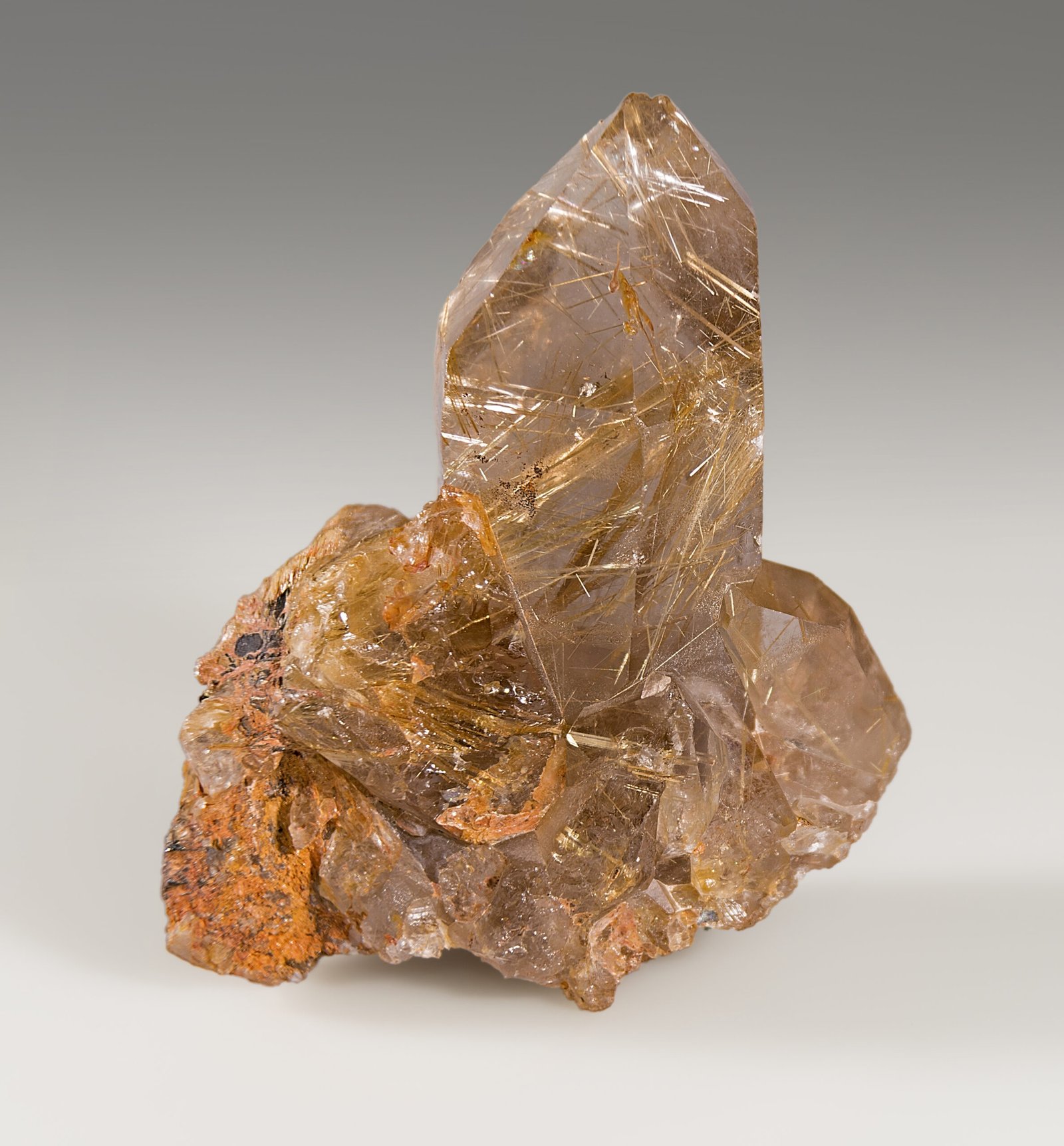
Quartz + rutile · Illumination & amplification
Rutilated quartz is not a mineral of its own — it is clear or smoky quartz containing needles of rutile, a titanium dioxide mineral (TiO₂). Those needles, usually golden but sometimes red, copper or black, grew inside the quartz as it crystallised, and are trapped there like fibres in glass. The French call them cheveux de Vénus — “hair of Venus” — and the old European name fléches d’amour, “arrows of love”, captures their look exactly. It is a hard, durable stone at 7 Mohs, and in the crystal tradition it combines quartz’s reputation for amplification with the needles’ symbolism of light and direction. The key thing to understand is simple: it is two minerals in one, and the golden threads are real crystals, not scratches or cracks.
Most stones are one mineral. Rutilated quartz is two, and you can see both at once: a clear or smoky quartz host, and inside it a scatter of fine golden needles, sometimes single and straight, sometimes bursting from a central point like a firework frozen in glass. Those needles are rutile — titanium dioxide — and they grew inside the quartz as it formed, becoming permanently sealed within it. It is one of the most visually striking of all quartzes, and one of the easiest to fall for.
This guide covers what rutilated quartz actually is, the difference between it and its black-needled cousin, the folklore of the “arrows of love”, and how to tell natural material from the imitations that copy the look.
What is rutilated quartz?
Rutilated quartz is quartz with inclusions of rutile. The host is ordinary quartz — silicon dioxide, SiO₂, Mohs hardness 7 — clear (rock crystal) or brown (smoky quartz). The needles are rutile, a titanium dioxide (TiO₂) mineral, which crystallises in long, slender prisms. As the quartz grew, rutile needles that had already formed were engulfed and preserved inside it — a genuine mineral inclusion, not a surface feature.
The needles are most often golden or reddish-gold, but they can also be copper-red, silvery or nearly black depending on the exact composition and any iron content. They may lie parallel, cross at angles, or radiate in starburst sprays. Because the whole thing is quartz on the outside, rutilated quartz is hard, durable and easy to care for — the rutile does not change that.
It is worth distinguishing from a close relative: tourmalinated quartz, which contains straight black needles of black tourmaline (schorl) rather than golden rutile. The two look superficially alike but are different inclusions, and the crystal tradition treats them differently — rutilated as illuminating, tourmalinated as grounding and protective.
Rutilated quartz meaning & history
The golden needles have inspired some of the loveliest names in gemmology. In French they are cheveux de Vénus — the hair of Venus — and older European lapidaries called the stone fléches d’amour, “arrows of love”, or “Cupid’s darts”. The needles were read as threads of captured light, or as arrows carrying love and inspiration, and the stone was worn accordingly.
In the modern crystal tradition, rutilated quartz inherits quartz’s reputation as an amplifier and combines it with the needles’ symbolism of light, clarity and direction. It is read as a stone that “illuminates” — bringing things to light and lifting the spirits.
Rutilated quartz healing properties
In the crystal tradition, rutilated quartz is valued as a stone of illumination, energy and amplification.
People typically turn to rutilated quartz for:
- Illumination. The signature association — bringing clarity, insight and light to a situation.
- Amplification. Inherited from quartz — traditionally said to strengthen intention and energy.
- Uplift. The golden needles are read as brightening mood and easing heaviness.
- Focus and direction. The “arrows” symbolism, associated with purpose and momentum.
These are traditional and symbolic uses, not medical claims. Rutilated quartz is sometimes marketed for the respiratory system, cell regeneration or the thyroid — associations, not mechanisms. There is no scientific evidence that any crystal treats, cures or prevents any illness, and none that rutilated quartz affects mood, energy or the body by any physical means. Enjoy it as one of the most beautiful natural composites there is; nothing here is intended to diagnose or treat any condition, and health concerns belong with a doctor.
Rutilated quartz, the chakras & zodiac
Clear quartz makes rutilated quartz a natural crown-chakra (Sahasrara) stone, while the golden needles give it a warm link to the solar plexus (Manipura), the seat of vitality and personal power. Its versatility — quartz works with any centre — means the tradition treats it as broadly clarifying and energising. For the wider framework, see our guide to the seven chakras and their crystals, and compare it with plain clear quartz.
By zodiac, rutilated quartz is most often associated with Gemini and Leo.
How to use rutilated quartz
- Hold it in meditation. At the crown, for clarity, or at the solar plexus for energy.
- Wear it as jewellery. Hard and durable at 7 Mohs, it takes daily wear well as a pendant or ring.
- Keep a specimen where the light catches it. The needles come alive in sunlight — a genuinely striking object.
- Use it as an “amplifier”. Traditionally paired with other stones to strengthen intention.
- Choose your needle colour. Gold for warmth and uplift, silver for cool clarity, black for a grounding edge.
How to cleanse & charge rutilated quartz
As a quartz, rutilated quartz is hard and among the easiest stones to care for.
- Water. Warm water and mild soap are perfectly safe.
- Sunlight or moonlight. Both are fine; the needles look wonderful in sun, and clear quartz is not prone to fading.
- Smoke. Sage, palo santo or incense.
- Selenite or sound. Contact-free and safe.
- Avoid sharp knocks and thermal shock. The main caution: fine rutile needles near the surface can, rarely, be a line of weakness, so avoid hard impacts and sudden temperature change.
- Ultrasonic cleaners. Generally tolerated by clean quartz, but better avoided if the stone has prominent surface-reaching needles or fractures.
Types & origins
- Golden rutilated quartz. The classic and most prized — clear quartz with bright gold needles. Brazil is the great source.
- Smoky rutilated quartz. Golden needles in a brown smoky-quartz host, giving strong contrast.
- Red / copper rutile. Reddish needles, often in denser sprays; a collector favourite.
- Silver rutile. Pale, silvery needles for a cooler look.
- Star or “sagenite” sprays. Rutile radiating from a central point, sometimes around a hematite or ilmenite core — spectacular specimens.
- Tourmalinated quartz. The black-needled cousin (tourmaline, not rutile) — related in look, different in mineral and meaning.
Is rutilated quartz rare or valuable?
Rutilated quartz is widely available and mostly affordable, though fine material can command real prices. Value is driven by the quality and arrangement of the needles: bright, well-defined golden needles in a clear, transparent host — especially in attractive parallel patterns or dramatic starbursts — are the most prized, while cloudy quartz with sparse or dull needles is inexpensive. Clarity of the quartz and richness of the rutile both matter. Because it is hard and durable, it makes excellent everyday jewellery, and top specimens are collected for their natural artistry.
Real vs fake — glass, synthetics & look-alikes
Rutilated quartz is not heavily faked, but a few imitations and confusions circulate.
- Glass with fibres or foil. Manufactured glass with gold-coloured fibres, wires or foil flakes is sold as rutilated quartz. Tell-tales are gas bubbles, a too-regular arrangement of the “needles”, and warmth in the hand — glass is a poor conductor and warms faster than quartz. Real rutile needles are irregular, three-dimensional and taper to points.
- Synthetic quartz with inclusions. Lab-grown quartz with engineered inclusions exists; it should be sold as synthetic. Uniformity that looks “too perfect” is a warning sign.
- Surface-treated or coated pieces. Some clear quartz is coated to add a golden sheen rather than genuine internal needles. Genuine rutile sits inside the stone; a coating sits on the outside and can wear.
- Tourmalinated confusion. Not a fake, but black-needled stone sold as “rutilated” is really tourmalinated quartz. Golden or reddish needles are rutile; straight black needles are tourmaline.
The workable rule: look for irregular, tapering needles set genuinely inside a cool, hard quartz body — bubbles, foil and warmth mean glass.
Genuine, correctly identified rutilated quartz
If you’d like a piece of your own, Minerals Kingdom offers authenticated natural rutilated quartz — with genuine internal rutile needles rather than glass or coated imitations.