Pink Tourmaline
A lithium-rich tourmaline that grows as long, striated pink prisms in granite pegmatites — the gem behind rubellite and watermelon tourmaline — and cherished in the crystal world as a gentle heart stone of compassion, self-love and emotional ease.
Lithium tourmaline · Compassion & the heart
In short Pink tourmaline is the pink to red colour range of the tourmaline group, a family of complex borosilicates. Most gem pink tourmaline is elbaite, a lithium-bearing species, and its colour comes chiefly from manganese. It crystallises in the trigonal system as long, vertically striated prisms with a rounded-triangular cross-section, mostly in granite pegmatites, and at 7–7.5 Mohs it is durable enough for everyday jewellery. Deep, saturated red stones are sold as rubellite, and pink-cored crystals with a green rind as watermelon tourmaline. Tourmaline is also a traditional October birthstone. The crystal tradition reads pink tourmaline as a heart stone of compassion, self-love, emotional healing and gentleness — symbolic uses, this guide explains, rather than medical ones.
Pink tourmaline is the soft-hearted sibling of a famously tough mineral family. Where its cousin black tourmaline is opaque, iron-rich and associated with protection, pink tourmaline is clear, glassy and lithium-rich, growing as bright pink pencils in the same kind of coarse granite that yields lepidolite and kunzite. Collectors prize its long, striated crystals; jewellers prize its colour and hardness; and crystal lovers reach for it as a gentle stone of love, kindness and emotional ease.
This guide covers what pink tourmaline actually is, where its colour comes from, how rubellite and watermelon tourmaline fit in, what the crystal tradition says about it, and how to tell natural material from the glass, dyed quartz and treated stones that turn up on the market.
What is pink tourmaline?
Tourmaline is not a single mineral but a group of more than thirty borosilicate species that share one crystal structure and swap different elements in and out of it. The common black variety, schorl, is iron-rich; brown dravite is magnesium-rich; and the brightly coloured gem tourmalines — pink, green, blue and multicoloured — are mostly elbaite, a sodium-lithium-aluminium tourmaline, with smaller amounts of liddicoatite and rossmanite. Pink tourmaline is therefore a colour variety, not a species of its own.
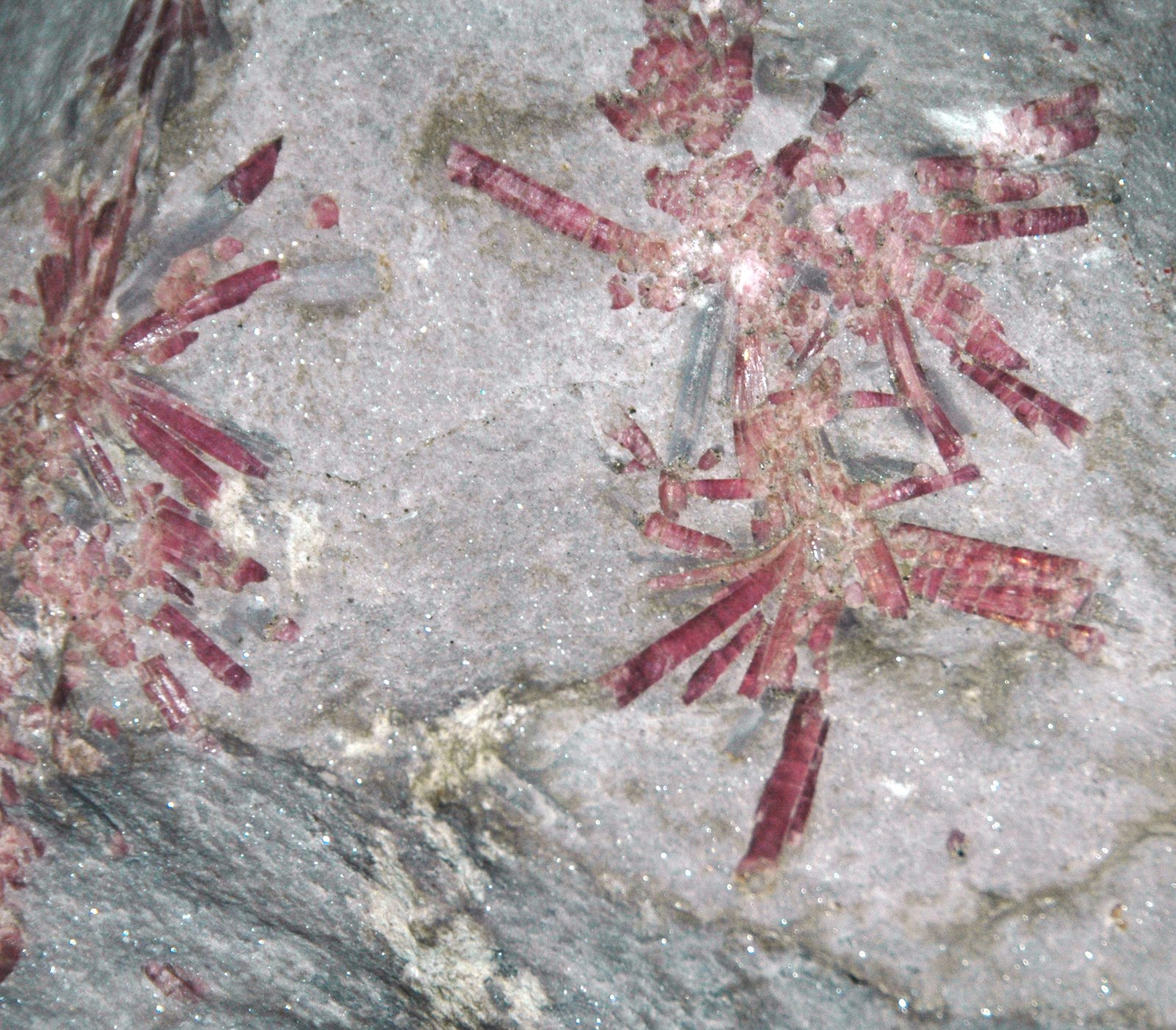
Tourmaline crystallises in the trigonal system (explained in our guide to the seven crystal systems). Its crystals are typically long prisms with deep lengthwise striations and a characteristic rounded-triangular cross-section, and a single crystal often shows different colours along its length or from core to rim. It has a hardness of 7–7.5 Mohs, no real cleavage and a glassy lustre, and it is strongly pleochroic: the colour looks deeper when you view a crystal down its length than from the side.
Two physical properties make tourmaline unusual. It is pyroelectric — warming or cooling a crystal builds up opposite electric charges at its two ends — and piezoelectric, generating a charge when squeezed. These are genuine, measurable effects of its asymmetric structure. Pink tourmaline forms mostly in lithium-rich granite pegmatites, the coarse, slow-cooling final stage of granite magma, where boron, lithium and manganese concentrate; the wider story of how such crystals grow is told in how crystals form.
Pink tourmaline meaning & history
The word tourmaline is usually traced to the Sinhalese turamali, a term used in Sri Lanka for mixed, colourful gem gravels. For centuries pink and red tourmaline was confused with other gems: red stones among old crown jewels and treasuries once called “rubies” have since proved to be rubellite tourmaline. Dutch traders in the 1700s noticed that warmed tourmaline crystals attracted ash and dust — the pyroelectric effect — and nicknamed them aschentrekkers, “ash pullers.”
Pink tourmaline’s most famous chapter came at the turn of the twentieth century, when mines in the pegmatites of San Diego County, California — around Pala and Mesa Grande — shipped large quantities of pink material to China, where the Empress Dowager Cixi’s court favoured it for carvings, snuff bottles and jewellery. In the modern crystal world it is read as a soft, nurturing stone of the heart: compassion, self-acceptance, gentleness and the healing of emotional hurt.
Colour, rubellite & watermelon tourmaline
The pink in tourmaline is generally attributed to manganese, with natural radiation in the earth over geological time thought to help develop the colour. The result ranges from barely-there blush through bubblegum and hot pink to deep raspberry and red. Three trade terms are worth knowing:
- Pink tourmaline. The general name for light to medium pink stones and crystals.
- Rubellite. Deep, saturated pink-red to red tourmaline. Gem dealers usually reserve the name for stones that keep a strong red in both daylight and warm indoor light, without turning brownish; rubellite commands higher prices than paler pinks.
- Watermelon tourmaline. Crystals that are pink at the core and green at the rim — sliced across, they look like a piece of watermelon. This zoning records a change in the chemistry of the fluid while the crystal was growing.
Pink tourmaline is often confused with other pink gems that share the same pegmatites or the same palette — kunzite, morganite and pink topaz among them. Tourmaline’s striated, triangular prisms and strong pleochroism are the classic clues.
Pink tourmaline healing properties
In the crystal tradition, pink tourmaline is valued as a stone of love, compassion and emotional gentleness.
People typically turn to pink tourmaline for:
- Self-love & self-acceptance. Its signature association — read as encouraging kindness toward yourself.
- Compassion & connection. Linked to warmth, empathy and openness in relationships.
- Emotional healing. Traditionally carried through grief, heartbreak or difficult change as a symbol of comfort.
- Calm & reassurance. Associated with a softer, steadier emotional state and a sense of feeling safe.
These are traditional and symbolic uses, not medical claims. There is no scientific evidence that any crystal treats, cures or prevents any illness, and pink tourmaline’s real pyroelectric and piezoelectric properties have no demonstrated effect on health, mood or emotions. Nothing here is intended to diagnose, treat or prevent any condition; if you are struggling emotionally or physically, please speak to a doctor or another qualified health professional.
Pink tourmaline, the chakras & zodiac
Pink tourmaline’s colour ties it to the heart chakra (Anahata), the centre of love, compassion and connection — where it sits alongside rose quartz, rhodochrosite and rhodonite. Watermelon tourmaline, pink and green in one stone, is read as an especially “complete” heart stone, since green is the heart chakra’s traditional colour too. For the wider framework, see our guide to the seven chakras and their crystals.
By zodiac, pink tourmaline is most often linked to Libra and Scorpio, the signs that span October — fitting for a stone that shares the October birthstone with opal.
How to use pink tourmaline
- Wear it as jewellery. At 7–7.5 Mohs it suits rings, pendants and earrings for everyday wear; a pendant keeps it close to the heart.
- Carry a tumbled stone or small crystal. A pocket piece for days when you want a reminder to be gentle with yourself.
- Hold it in heart-centred meditation. Often chosen for loving-kindness and self-compassion practice.
- Keep a crystal in matrix on display. Pink tourmaline pencils in white quartz or lilac lepidolite make striking, inexpensive specimens.
- Set it with a clear intention. Our guide to programming a crystal explains a simple, grounded way to do this.
How to cleanse & charge pink tourmaline
- Warm, soapy water is fine for most faceted and tumbled pink tourmaline — rinse and dry with a soft cloth.
- Avoid sudden temperature changes and strong heat, which can stress or crack the stone; tourmaline’s pyroelectric nature also means warm stones attract dust.
- Skip ultrasonic and steam cleaners, especially for included or fracture-filled stones.
- Keep long sunbathing short. Some pink stones may fade with prolonged strong light or heat; moonlight, sound, smoke or a selenite plate are gentle alternatives.
- Clean crystals in matrix dry. Specimens in lepidolite or feldspar are best dusted with a soft brush rather than soaked.
Our general guide to cleansing and charging crystals covers each method in more detail, including which stones tolerate water and which do not.
Types & origins
- Pink elbaite. The classic gem pink tourmaline, from pale blush to vivid hot pink.
- Rubellite. Deep pink-red to red tourmaline that holds its colour in different lighting.
- Watermelon tourmaline. Pink-cored, green-rimmed crystals, often sold as polished slices.
- Bicolour and parti-colour tourmaline. Crystals that change from pink to green, colourless or blue along their length.
- Pink tourmaline in lepidolite or quartz. Affordable matrix specimens, sometimes sold as “rubellite in lepidolite.”
Fine pink tourmaline comes from Brazil (especially Minas Gerais), Afghanistan (the Paprok area), Madagascar, Mozambique, Nigeria, Namibia and the United States, where the historic Pala and Himalaya mines of California and the pegmatites of Maine produced celebrated specimens. Value depends on the strength and evenness of the colour, clarity and size — rubellite and clean, saturated pinks sit at the top, while included or pale material is very affordable.
Real vs fake
- Pink glass. The commonest imitation. Glass often shows round bubbles, swirl marks and moulded edges, and it feels warmer to the touch than a real crystal.
- Dyed quartz. Crackled quartz dyed pink shows colour concentrated in the cracks; natural tourmaline’s colour runs through the stone.
- Look-alike gems. Pink topaz, kunzite, morganite and spinel can all be confused with pink tourmaline. They are real gems, but they should be sold under their own names.
- Treatments. Heating and irradiation are used to lighten or deepen pink tourmaline, and some stones are fracture-filled with resin. These are accepted practices when disclosed — ask before you buy.
- The crystal tell. Natural tourmaline crystals show deep lengthwise striations and a rounded triangular cross-section — something glass and dyed quartz never reproduce.
The workable rule: be wary of large, flawless, cheap “pink tourmaline,” and ask about treatments for any expensive stone. For the wider method, see our guide to spotting dyed and imitation stones.
Genuine, natural pink tourmaline
If you’d like a piece of your own, Minerals Kingdom offers authenticated natural pink tourmaline — with treatments disclosed and specimens honestly described.
Pink tourmaline pairs well with
Frequently asked questions
What is pink tourmaline good for?
Traditionally, pink tourmaline is used as a heart stone of self-love, compassion, emotional healing and calm. These are symbolic, traditional uses, not proven medical effects. No crystal treats illness, and pink tourmaline has no demonstrated effect on health or emotions.
What is the difference between pink tourmaline and rubellite?
Both are pink-to-red tourmaline, usually elbaite. Rubellite is the trade name for the deepest, most saturated pink-red to red stones that keep their colour in both daylight and indoor light; lighter stones are simply called pink tourmaline.
Is pink tourmaline the same as rose quartz?
No. Rose quartz is a variety of quartz (silicon dioxide), usually cloudy and massive, while pink tourmaline is a borosilicate that forms transparent, striated prismatic crystals. They share a colour and a heart-chakra association in crystal tradition, but they are different minerals.
Can pink tourmaline go in water?
Yes, briefly. Most pink tourmaline handles warm, soapy water well. Avoid hot water, sudden temperature changes, ultrasonic and steam cleaners, and soaking specimens that sit in softer matrix such as lepidolite.
Is pink tourmaline the October birthstone?
Yes. Tourmaline — pink tourmaline in particular — is one of the two modern October birthstones, alongside opal.
What crystals pair well with pink tourmaline?
Other heart stones suit it well — rose quartz for comfort, lepidolite as its natural pegmatite companion, and black tourmaline as a grounding counterpart. Together they make a coherent, balanced grouping.
Sources · Mindat.org, “Elbaite” and “Tourmaline Group” mineral data · Gemological Institute of America (GIA), tourmaline gem description and care guide · Smithsonian National Museum of Natural History, tourmaline collection notes.
Image credits · Hero and buy-box: pink rubellite tourmaline in lepidolite, Pala, California — Photo: James St. John / Wikimedia Commons (CC BY 2.0).