Rhodochrosite
A manganese carbonate that runs from banded rose-pink to a red so pure collectors chase single crystals across the world — and a stone soft enough to demand real care.
Manganese carbonate · The stone of the heart
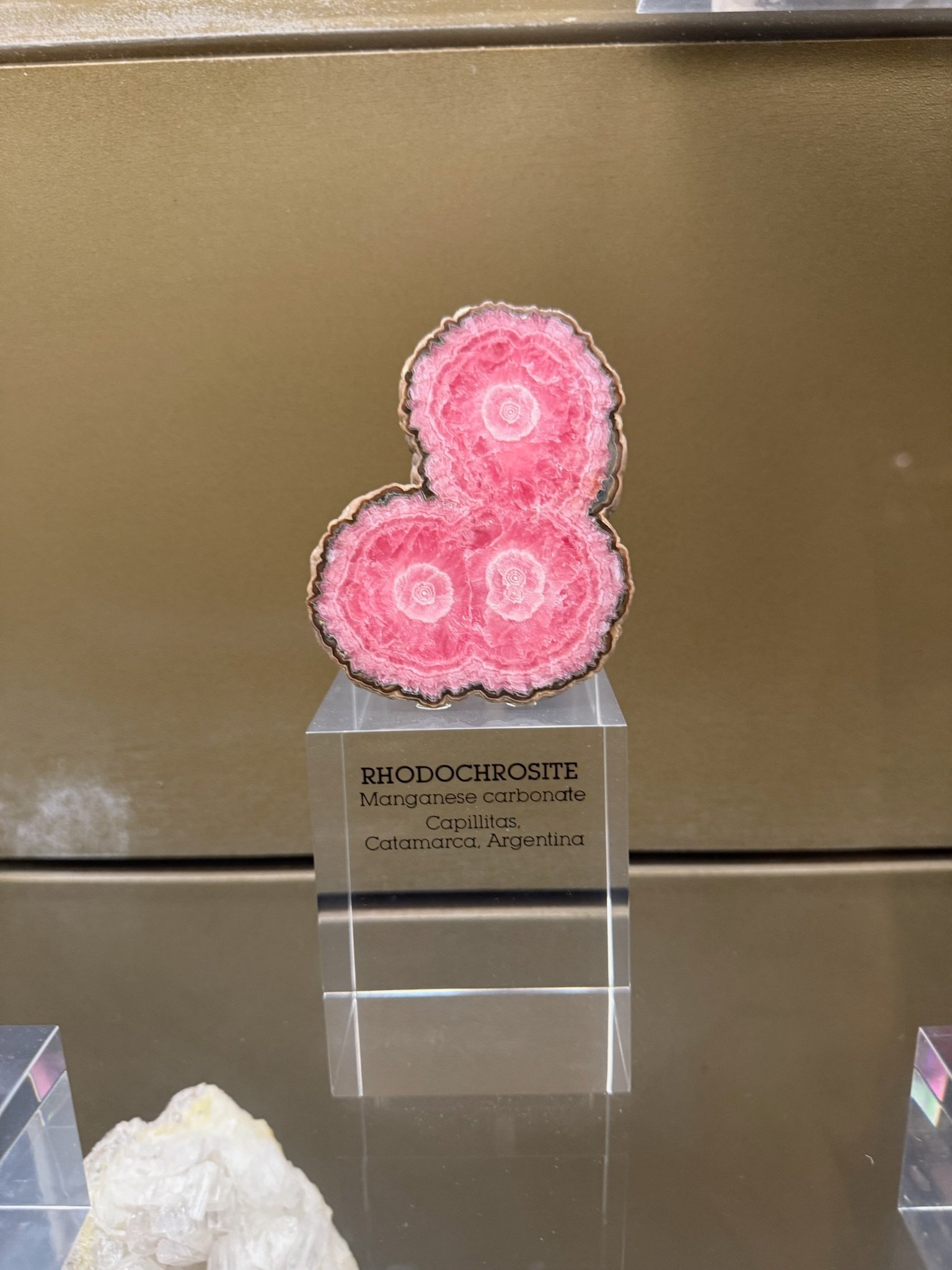
Rhodochrosite is manganese carbonate, MnCO₃, and the manganese is what makes it pink. Most of what you see is the banded variety — soft rose and white stripes, formed as layers lined old cave and mine cavities, and the classic Argentine material is nicknamed “Inca rose”. The rarest form is transparent gem-red crystals, chiefly from Colorado’s Sweet Home Mine, which are among the most prized specimens in mineralogy. In the crystal tradition it is above all a heart stone — self-love, compassion, emotional healing. The one thing every owner must know is that it is soft (3.5–4 Mohs), has perfect cleavage and reacts to acid, so it needs gentle handling. It is also routinely confused with rhodonite, which is a different and harder mineral.
Rhodochrosite is one of those stones that lives a double life. To most people it is the pretty pink banded material tumbled into palm stones and beads — soft, rosy, striped like agate. To mineral collectors it is something else entirely: the source of a handful of transparent scarlet crystals so fine that single specimens have become famous by name. Both are the same mineral, manganese carbonate, and both are worth understanding.
This guide covers what rhodochrosite actually is, where its two very different faces come from, why it needs more care than most popular stones, and how to tell it apart from rhodonite — the harder mineral it is constantly muddled with.
What is rhodochrosite?
Rhodochrosite is a carbonate mineral — manganese carbonate, MnCO₃ — and it belongs to the same structural family as calcite. Its rose colour comes directly from manganese; where iron, calcium or magnesium substitute into the structure, the pink pales towards brown or grey. Its name comes from the Greek for “rose-coloured”.
Two forms matter. The common one is botryoidal and banded: rhodochrosite that grew in rounded, layered crusts inside cavities, producing the familiar pink-and-white stripes. Much of this comes from old silver mines in Argentina, where it filled the spaces left in the rock. The rare one is crystalline: sharp, transparent rhombohedral crystals of intense red, of which the specimens from the Sweet Home Mine in Colorado — the “Alma King” among them — are the most celebrated.
The practical headline is its softness and fragility. At 3.5 to 4 on the Mohs scale it is easily scratched, it has perfect rhombohedral cleavage so it can split cleanly under a knock, and because it is a carbonate it reacts to acids — even weak ones will etch its polish. This is a beautiful stone that will not tolerate rough treatment.
Rhodochrosite meaning & history
The banded Argentine material carries the romantic name “Inca rose” (rosa del Inca), tied to the old silver workings of the Andes, some of which date back to Inca times. The stone became Argentina’s national mineral, and the folk story that it formed from the blood of Inca rulers is exactly that — a story, not geology.
As a distinct mineral rhodochrosite has a much shorter cultural history than stones like jade or amber, because fine specimens only reached the wider world through modern mining. In the twentieth-century crystal tradition it acquired a settled meaning very quickly: it became the stone of the heart, of self-love and emotional repair, and that is the role it plays today.
Rhodochrosite healing properties
In the crystal tradition, rhodochrosite is valued above all as a stone of self-love, compassion and emotional healing.
People typically turn to rhodochrosite for:
- Self-love. The signature use — kindness towards oneself, and the repair of self-worth.
- Emotional healing. Associated with soothing old wounds and buried grief.
- Compassion. A gentle heart-opening quality, warmth towards others.
- Comfort. Traditionally described as a consoling, reassuring stone in hard times.
These are traditional and symbolic uses, not medical claims. Rhodochrosite is sometimes marketed for the circulation, the heart organ or migraines, presumably because it is red and called a “heart” stone — which is association, not mechanism. There is no scientific evidence that any crystal treats, cures or prevents any illness, and none that rhodochrosite affects the body in any physical way. Enjoy it as a genuinely lovely mineral; nothing here is intended to diagnose or treat any condition, and emotional or physical health concerns belong with a qualified professional.
Rhodochrosite, the chakras & zodiac
Rhodochrosite belongs to the heart chakra (Anahata), the seat of love and compassion — where it sits alongside rose quartz as one of the two great pink heart stones. Where rose quartz is read as soft and universal, rhodochrosite is read as more active, more directed at self-worth and emotional courage. For the wider framework, see our guide to the seven chakras and their crystals.
By zodiac, it is most often associated with Scorpio and Leo — signs the tradition links to intensity of feeling and to the heart.
How to use rhodochrosite
- Hold it in meditation. At the heart, the traditional placement for self-love work.
- Keep a tumbled stone to carry. A pocket piece for reassurance — banded material is tougher than crystalline.
- Wear it as a pendant. Better than a ring: at 3.5–4 Mohs a ring-set stone takes knocks it will not survive.
- Place a specimen where you’ll see it. A banded slice is a genuinely calming object to have on a desk.
- Pair it with rose quartz. A classic heart-chakra combination.
- Protect it. Keep it away from harder stones, acids and impact.
How to cleanse & charge rhodochrosite
Because it is soft, cleavable and acid-sensitive, rhodochrosite needs gentler care than most popular stones.
- Avoid water where you can. As a carbonate it does not love prolonged wetting; a quick wipe with a soft dry or barely damp cloth is safer than soaking.
- Never use acids or vinegar. Even weak acid etches the surface. Keep it away from citrus, cleaning products and salt.
- Never use ultrasonic or steam cleaners. The vibration and heat will damage cleaved stones.
- Moonlight. A gentle overnight charge, entirely safe.
- Smoke. Sage, palo santo or incense.
- Selenite or sound. Rest it on a selenite plate or use a singing bowl — both contact-free.
- Keep it out of strong sun. Prolonged sunlight can fade the pink over time.
Types & origins
- Argentine banded (“Inca rose”). The classic tumbling and carving material — rose-and-white stalactitic bands from the old Andean silver mines. Attractive and affordable.
- Sweet Home Mine, Colorado. The source of the finest transparent red crystals, including named specimens. The peak of the mineral, and priced accordingly.
- Peruvian rhodochrosite. Pink botryoidal and crystalline material, widely available.
- N’Chwaning, South Africa. Superb red crystalline specimens from the Kalahari manganese field, prized by collectors.
- Gem-cut rhodochrosite. Rare, because the stone is soft and cleaves; faceted rhodochrosite is a collector’s gem, not an everyday one.
Is rhodochrosite rare or valuable?
The banded material is inexpensive and abundant — tumbled stones, beads and slices are among the more affordable pink crystals. The crystalline red material is another matter entirely: fine transparent rhombs from Sweet Home or N’Chwaning are rare, and top specimens sell for very large sums at mineral auctions. Value is driven by colour saturation (pure red over brownish or pale pink), transparency, crystal quality and locality. As a soft, cleavable carbonate it is bought for beauty and meaning, not as a durable everyday gem.
Real vs fake — and the rhodonite mix-up
There is less outright faking of rhodochrosite than of pricier stones, but two confusions are worth clearing up.
- Rhodochrosite vs rhodonite. This is the big one. Both are pink and their names both come from the Greek for rose, but they are different minerals. Rhodonite is a manganese silicate, harder (5.5–6.5 Mohs), tougher, and usually carries distinctive black veins of manganese oxide. Rhodochrosite is a manganese carbonate, softer (3.5–4), often banded pink-and-white, and reacts to acid. If it has black dendritic veining and resists a knife, it is rhodonite; if it is banded, soft and fizzes faintly with acid, it is rhodochrosite. We have a full profile of rhodonite for the comparison.
- Dyed and reconstituted material. Some cheap “rhodochrosite” is dyed howlite or magnesite, or reconstituted powder in resin. Genuine banded rhodochrosite has a soft, slightly translucent glow and irregular natural banding; dyed stone shows colour pooling in cracks and a flat, painted look.
- Glass and plastic beads. Uniform, bubble-flecked and warm to the touch, sold in cheap strands. Real rhodochrosite is cool, softer than glass, and banded rather than perfectly even.
The workable rule: check hardness and look for banding. Soft, banded and acid-sensitive means rhodochrosite; hard, black-veined and knife-resistant means rhodonite.
Genuine, correctly identified rhodochrosite
If you’d like a piece of your own, Minerals Kingdom offers authenticated natural rhodochrosite — properly named and not confused with rhodonite or dyed substitutes.