Rhodonite
The rose-pink stone veined with black — the crystal of forgiveness, emotional healing and picking yourself back up.
Manganese silicate · The rescue stone
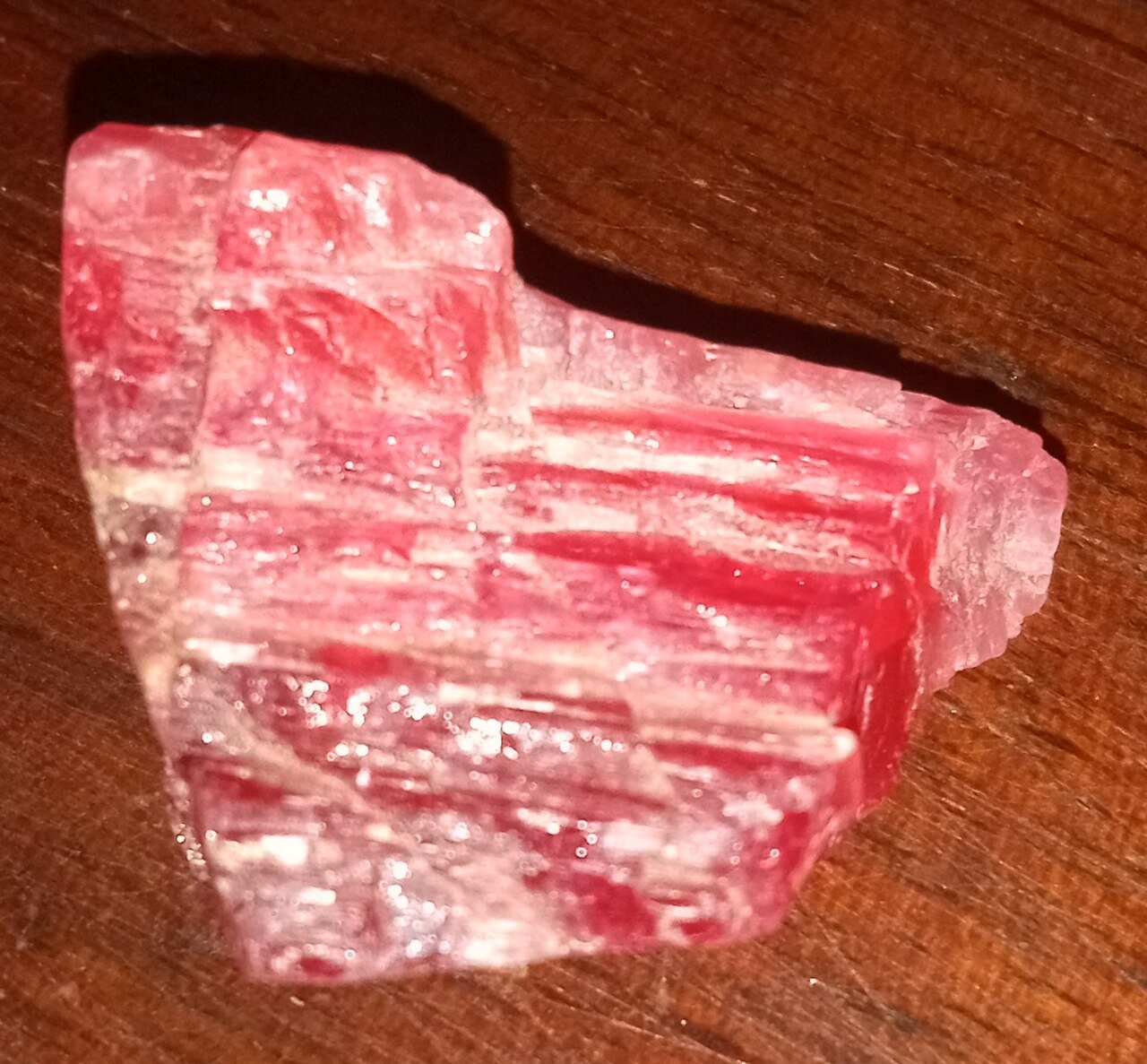
Rhodonite is a manganese silicate (MnSiO₃), rose-pink and almost always webbed with black manganese oxide. In the crystal tradition it’s the stone of emotional healing and forgiveness — a heart-chakra crystal for working through old hurt, resentment and grief, and for finding the courage to try again. Its black veins are read as the scars that healing leaves behind. It’s moderately hard (5.5–6.5 Mohs) and water-tolerant. Below — meaning, how to use it, how to keep it, and how to tell it from rhodochrosite.
Rhodonite is a stone that carries its own metaphor. A warm rose pink, run through with dark, branching veins of black — and the crystal tradition has never been able to resist reading those veins as the marks a healed wound leaves behind. Whether or not you find that meaningful, it is a genuinely beautiful mineral, and one of the very few pink stones that is not soft, fragile or dyed.
This guide covers what rhodonite actually is, where its reputation for forgiveness comes from, how people use it, how to care for it, and how to distinguish it from its usual look-alike.
What is rhodonite?
Rhodonite is a manganese silicate, MnSiO₃, in the pyroxenoid group. Manganese gives it its rose-pink colour; the name comes from the Greek rhodon, rose. The black veins that lace nearly every specimen are manganese oxides, formed as the surface weathered.
Gem-clear transparent rhodonite crystals exist and are extremely rare, prized by collectors and almost never cut. Almost everything on the market is massive rhodonite: an opaque, veined rock, tough and pleasant to polish.
It sits at 5.5 to 6.5 on the Mohs scale — hard enough for pendants and beads, soft enough that a ring worn daily will dull. Major sources are Russia (where the vast Malachite Room in the Hermitage is matched by rhodonite work of similar ambition), Australia and Peru.
Rhodonite meaning & history
Rhodonite was described in 1819 and became a Russian imperial stone in the nineteenth century. The Yekaterinburg lapidary works carved enormous vases, columns and sarcophagi from it; a rhodonite sarcophagus weighing several tonnes was made for the Empress Maria Alexandrovna. It was a stone of state, not of folk healing.
Its emotional meanings are, again, modern. In the twentieth-century crystal tradition it became the rescue stone: carried through heartbreak, betrayal and grief, and associated above all with forgiveness — both of others and of oneself. The pink is read as compassion, the black as the wound. It is an interpretation of appearance, and an unusually apt one.
Rhodonite healing properties
In the crystal tradition, rhodonite is valued as a stone of emotional healing, forgiveness and resilience.
People typically turn to rhodonite for:
- Forgiveness. The classic stone for releasing resentment.
- Heartbreak. Carried through grief, loss and betrayal.
- Self-compassion. Reached for by people who are hard on themselves.
- Resilience. Associated with getting back up and beginning again.
These are traditional and symbolic uses, not medical claims. Rhodonite is sometimes sold as a stone for depression, trauma or panic. There is no scientific evidence that any crystal treats mental or physical illness. Grief, depression and trauma respond to therapy, to people, and sometimes to medication — a stone is not a substitute for any of those. If you are struggling, please talk to a doctor or a therapist. Enjoy rhodonite as an object that means something to you; nothing here is intended to diagnose or cure any condition.
Rhodonite, the chakras & zodiac
Rhodonite is a heart chakra (Anahata) stone, but with a grounded edge that rose quartz lacks. Where rose quartz is read as soft, open love, rhodonite is read as love that has been through something — its black veins tie it to the root chakra as well, giving it a steadying, earthing quality.
By zodiac it’s most often associated with Taurus. It has no birthstone month, but it is a considered gift for someone going through a breakup, a bereavement or a hard year.
How to use rhodonite
Most uses revolve around emotional repair.
- Hold it during hard feelings. A tumble in the palm, while you sit with what hurts.
- Wear it over the heart. A rhodonite pendant for daily wear.
- Keep it by the bed. A quiet presence during a difficult stretch.
- Use it in meditation. Rested on the chest, for self-forgiveness practice.
- Give it to someone grieving. A small, honest gesture.
- Pair it with black tourmaline. Traditionally, for protection during emotional work.
How to cleanse & charge rhodonite
Rhodonite is reasonably robust but not indestructible.
- Water. A brief cool rinse is fine; dry it properly afterwards.
- Moonlight. A gentle overnight charge.
- Smoke. Sage, palo santo or incense.
- Selenite. Rest it on a selenite plate.
- Earth. Buried briefly in soil, for its grounding association.
Avoid prolonged sunlight, which can dull the pink, and acids, which attack manganese minerals. Skip salt water and ultrasonic cleaners. Cleanse it after emotionally heavy days.
Types & colours
- Massive rhodonite. The familiar opaque pink-and-black material, most of the market.
- Crystalline rhodonite. Rare transparent to translucent crystals, collector-grade.
- Fowlerite. A zinc-bearing variety from Franklin, New Jersey.
- Rhodonite in matrix. Pink veins running through darker host rock.
Is rhodonite rare or valuable?
Massive rhodonite is affordable. Tumbles cost very little; good cabochons and spheres are modestly priced. Value climbs steeply for two things: clean, evenly coloured material with elegant veining, and — in a different league entirely — transparent faceted crystals, which are among the rarer collector gems and can fetch serious sums.
Quality comes down to the pink (saturated, not brownish) and the veins (graphic, not muddy). Beware fine surface cracks in large pieces.
How to tell real rhodonite from fake
Outright fakes are uncommon, because rhodonite is cheap. The real confusion is with a genuinely different mineral.
- Vs rhodochrosite. The classic mix-up. Rhodochrosite is a manganese carbonate, softer (3.5–4), often banded in concentric pink and white stripes, and it fizzes in dilute acid. Rhodonite is a silicate, harder, and has irregular black veins rather than bands.
- Check the veins. Natural manganese oxide veins branch irregularly. A painted or resin-filled imitation shows repeating patterns.
- Hardness. Rhodonite scratches a copper coin easily but resists a steel knife more than rhodochrosite does.
- Weight and warmth. Resin imitations feel light and warm to the touch.
- Beware dyed howlite. Sold as almost anything pink; it is much softer and shows grey web veins, not black.
Genuine, ethically sourced rhodonite
If you’d like a piece of your own, Minerals Kingdom offers authenticated natural rhodonite — tumbles, cabochons and spheres.