
Kunzite
A pale pink lithium crystal barely over a century old in the gem trade — genuinely pleochroic, famously prone to fading in sunlight, and wrapped in a “natural lithium” claim we take apart honestly.
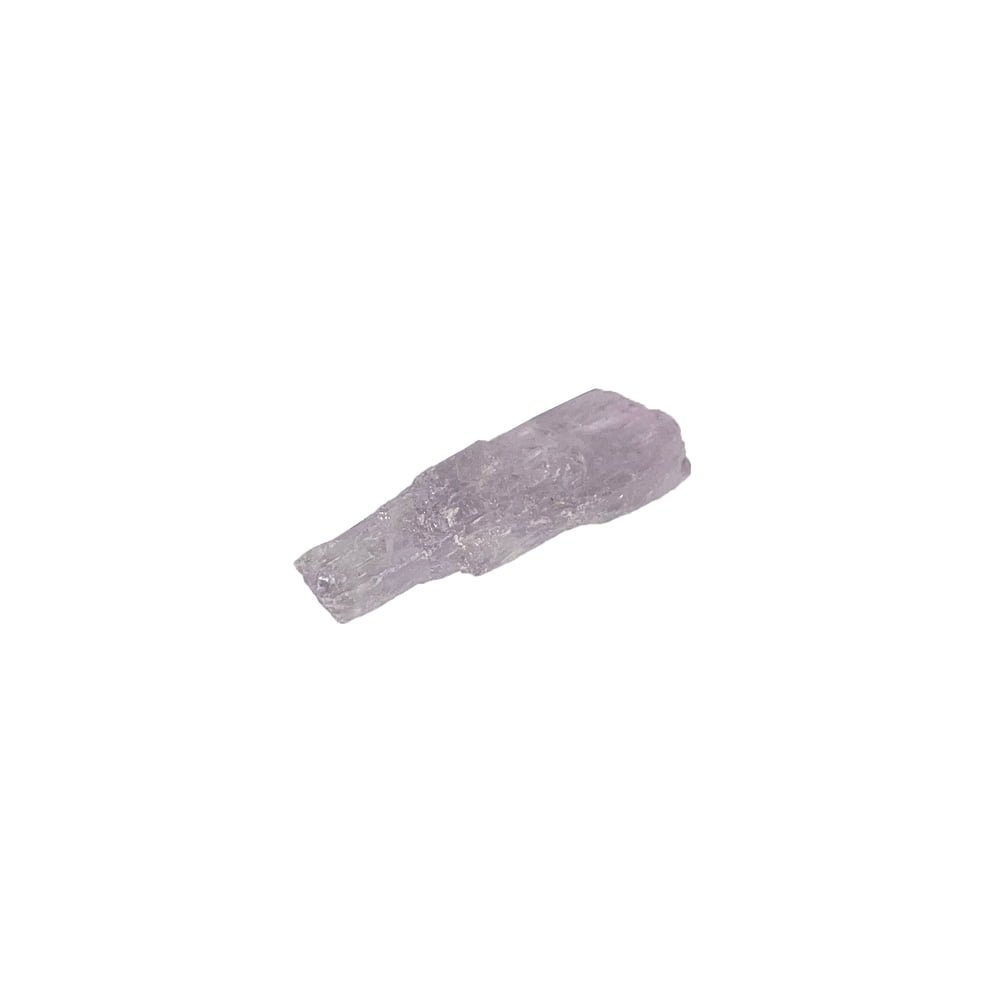
Spodumene · Heart-opening & calm
In short Kunzite is the pink-to-violet gem variety of spodumene, a lithium aluminium silicate first described in 1902–03 and named after gemologist George Frederick Kunz. It is genuinely pleochroic — its colour visibly shifts with viewing angle — and has perfect cleavage, making it brittle and, unusually among gems, prone to fading with prolonged light exposure. Because it contains lithium in its crystal structure, kunzite is often marketed as a “natural mood stabiliser” — a claim this guide takes apart plainly below, alongside the fading and cleavage that genuinely do matter for how you should wear and store it.
Kunzite is one of the youngest gems in the crystal cabinet — not in geological age, but in human knowledge of it. It was unknown to Western science until 1902, unlike stones with millennia of continuous folklore, and it arrived with two genuinely unusual properties: a colour that visibly changes as you tilt the stone, and a habit of quietly fading if you leave it on a sunny windowsill. It is also, by chemistry, a lithium mineral — a fact that has attracted more marketing enthusiasm than the evidence supports.
This guide covers what kunzite actually is, its short but well-documented modern history, an honest look at the lithium claim, and the two care points — fading and cleavage — that genuinely set it apart from almost every other stone on this site.
What is kunzite?
Kunzite is the pink-to-violet gem variety of spodumene, a lithium aluminium silicate (LiAlSi₂O₆) that forms in lithium-rich granite pegmatites. Its colour comes from trace manganese, and it is strongly pleochroic — a genuine optical property, not a marketing description, meaning the stone shows different colour intensity depending on the angle it is viewed from along its crystal axes, from nearly colourless to a rich pink-violet. Cutters must orient the rough carefully to bring out the best face.
Its Mohs hardness of 6.5 to 7 sounds durable, but spodumene has perfect cleavage in two directions, meaning it splits cleanly along specific planes under stress — a structural weakness that makes kunzite genuinely brittle and vulnerable to cracking from a sharp knock or sudden temperature change, regardless of its surface hardness.
Kunzite meaning & history
Kunzite has almost no ancient folklore, and it is worth saying so plainly: it was first described in 1902 or 1903, from crystals found in the pegmatites of Pala, San Diego County, California, and named by the mineralogist Charles Baskerville in honour of George Frederick Kunz, the influential gemologist and chief buyer for Tiffany & Co. who had studied and popularised it. Its arrival coincided with the Art Nouveau and Edwardian taste for soft, unusual coloured gems, and it became a fashionable “new” stone almost overnight — a rare case of a gem’s story beginning in dated, documented history rather than myth.
In the modern crystal tradition, kunzite’s gentle pink-to-violet range placed it quickly among the heart-centred stones, read as a gem of tenderness, emotional openness and calm — a reading reinforced, rightly or wrongly, by its lithium content.
The lithium claim — honestly
Because spodumene is a lithium mineral, kunzite is frequently marketed as delivering a gentle, “natural” version of the calming effect associated with pharmaceutical lithium, used clinically as a mood stabiliser. Here is the honest picture: kunzite genuinely contains lithium locked within its crystal lattice as spodumene, which is real chemistry. But holding, wearing or meditating with a kunzite crystal does not deliver any measurable or bioavailable lithium to the body — the lithium is bound within a hard silicate structure, not absorbed through skin contact, and the amounts involved bear no resemblance to a therapeutic dose. There is no scientific evidence that wearing kunzite affects mood, anxiety or brain chemistry by any physical mechanism. Enjoy the genuine, interesting fact that kunzite is a lithium mineral — just not as a stand-in for medical treatment.
Kunzite healing properties
In the crystal tradition, kunzite is valued as a stone of love, emotional healing and calm.
People typically turn to kunzite for:
- Emotional healing. The signature association — a gentle, heart-opening stone for tenderness and self-compassion.
- Calm. Traditionally read as soothing, partly on the strength of its lithium content (see above).
- Unconditional love. Associated with softening guardedness in relationships.
- Intuition. Violet-toned material is sometimes linked to the third eye as well as the heart.
These are traditional and symbolic uses, not medical claims. There is no scientific evidence that any crystal treats, cures or prevents any illness, and specifically no evidence that kunzite’s lithium content affects mood or has any pharmacological effect on the body. Nothing here is intended to diagnose, treat or prevent any condition; mental and emotional health concerns belong with a doctor or qualified therapist.
Kunzite, the chakras & zodiac
Kunzite’s soft pink places it primarily at the heart chakra (Anahata), the centre of love and compassion, with its violet tones sometimes extended to the third eye (Ajna) for intuition and insight. It shares its gentle pink heart-stone role with rose quartz, though its chemistry and history are entirely different. For the wider framework, see our guide to the seven chakras and their crystals.
By zodiac, kunzite is most often linked to Taurus and secondarily Scorpio.
How to use kunzite
- Wear it as jewellery — carefully. Pendants and earrings suit it better than everyday rings, since cleavage makes it vulnerable to knocks.
- Hold it in meditation. At the heart, for its traditional associations with emotional openness.
- Display it away from direct sun. Its colour is genuinely light-sensitive; a shaded shelf preserves it far better than a sunny windowsill.
- Choose protective settings. Bezel or half-bezel settings guard the edges of a stone that can chip.
- Handle it gently. Avoid dropping it onto hard surfaces or exposing it to sudden hot-to-cold temperature swings.
How to cleanse & charge kunzite
- Water, briefly. A quick rinse is fine; avoid soaking or hot water, which risk thermal shock on a cleavage-prone stone.
- Moonlight, not sunlight. This is the one stone on the site where sun-charging is actively discouraged — prolonged light exposure is the main cause of kunzite fading over time.
- Smoke. Sage, palo santo or incense — contact-free and low-risk.
- Selenite or sound. Safe, contact-free alternatives.
- Never use ultrasonic or steam cleaners. Both are a genuine hazard given kunzite’s perfect cleavage.
- Store it wrapped and separate. A soft pouch prevents both scratches from harder stones and accidental knocks.
Types & origins
- Pink kunzite. The classic, most widely available tone.
- Lilac / violet kunzite. Finer, more saturated material, generally more valuable.
- Hiddenite. The green variety of spodumene, named separately after William Earl Hiddenite — a mineralogical sibling of kunzite, not the same stone.
- Colourless spodumene (triphane). The undyed, uncoloured form of the same mineral.
- Afghan (Kunar / Nuristan) material. Often considered the finest source for large, clean crystals.
- Heat-treated kunzite. Gentle heating is sometimes used to even out or deepen colour — a disclosed, generally accepted treatment worth asking about.
Kunzite is moderately priced for its size: because spodumene forms large, relatively clean pegmatite crystals, it offers a genuinely big look — sizeable, eye-clean stones — for considerably less than a comparable sapphire or emerald. Colour saturation (violet-pink being the most prized), clarity and cutting orientation, given the pleochroism, are the main value drivers; buyers should also ask whether a stone’s colour has been kept out of strong light and whether it has been heat-treated.
Real vs fake
- Glass and synthetic imitations. Both are optically isotropic, meaning they do not show pleochroism — tilt a suspect stone under a light and watch for a genuine shift in colour intensity, which glass simply cannot reproduce.
- Morganite confusion. Morganite (pink beryl) is a different, genuine gemstone often informally confused with kunzite because of similar colour and price range — not a fake, but worth knowing which one you are actually buying.
- Dyed quartz. Occasionally sold as kunzite; quartz lacks kunzite’s cleavage planes and pleochroic colour shift.
- The cleavage tell. Genuine kunzite often shows fine, flat internal cleavage planes under magnification — a structural feature that is very difficult to fake convincingly.
The workable rule: tilt it and watch the colour change. True kunzite visibly shifts from paler to more saturated pink-violet depending on the angle; a stone that looks identical from every side is not showing genuine pleochroism.
Genuine, correctly identified kunzite
If you’d like a piece of your own, Minerals Kingdom offers authenticated natural kunzite — genuine lithium-bearing spodumene, not glass or dyed quartz.
Kunzite pairs well with
Frequently asked questions
What is kunzite good for?
Traditionally, kunzite is used for emotional healing, love and calm — a gentle heart-chakra stone. These are symbolic, traditional uses, not proven medical effects. No crystal treats illness, and kunzite’s lithium content has no pharmacological effect on the body.
Does kunzite really contain lithium, and will it affect my mood?
Yes, kunzite is chemically a lithium mineral (spodumene) — that part is true. But the lithium is locked within a hard silicate crystal structure and is not absorbed by wearing or holding the stone. There is no scientific evidence that kunzite jewellery delivers any dose of lithium or affects mood, unlike pharmaceutical lithium used in medicine.
Does kunzite fade in sunlight?
Yes, this is a genuine and well-documented property. Prolonged exposure to strong light, especially direct sun, can visibly lighten kunzite’s colour over time. Store and display it out of direct sunlight, and prefer moonlight over sun-charging.
Is kunzite durable enough for everyday jewellery?
It is hard enough (6.5–7 Mohs) to resist everyday scratching, but its perfect cleavage makes it genuinely brittle and prone to chipping or cracking from a sharp knock. Pendants and earrings suit it better than rings worn during manual activity.
What is the difference between kunzite and morganite?
Both are soft pink gems in a similar price range, but they are different minerals: kunzite is lithium-bearing spodumene, while morganite is pink beryl, the same family as emerald and aquamarine. They are often confused informally but are chemically distinct stones.
How can I tell if kunzite is real?
Tilt the stone under a light and look for pleochroism — a genuine shift in colour intensity depending on the viewing angle, which glass and most imitations cannot reproduce. Fine internal cleavage planes visible under magnification are another sign of the genuine mineral.