
Petrified Wood
A tree turned to stone. Petrified wood is fossil timber whose cells were slowly filled and replaced by silica over millions of years. In the crystal tradition it is a patient, grounding stone of stability, endurance and deep time.
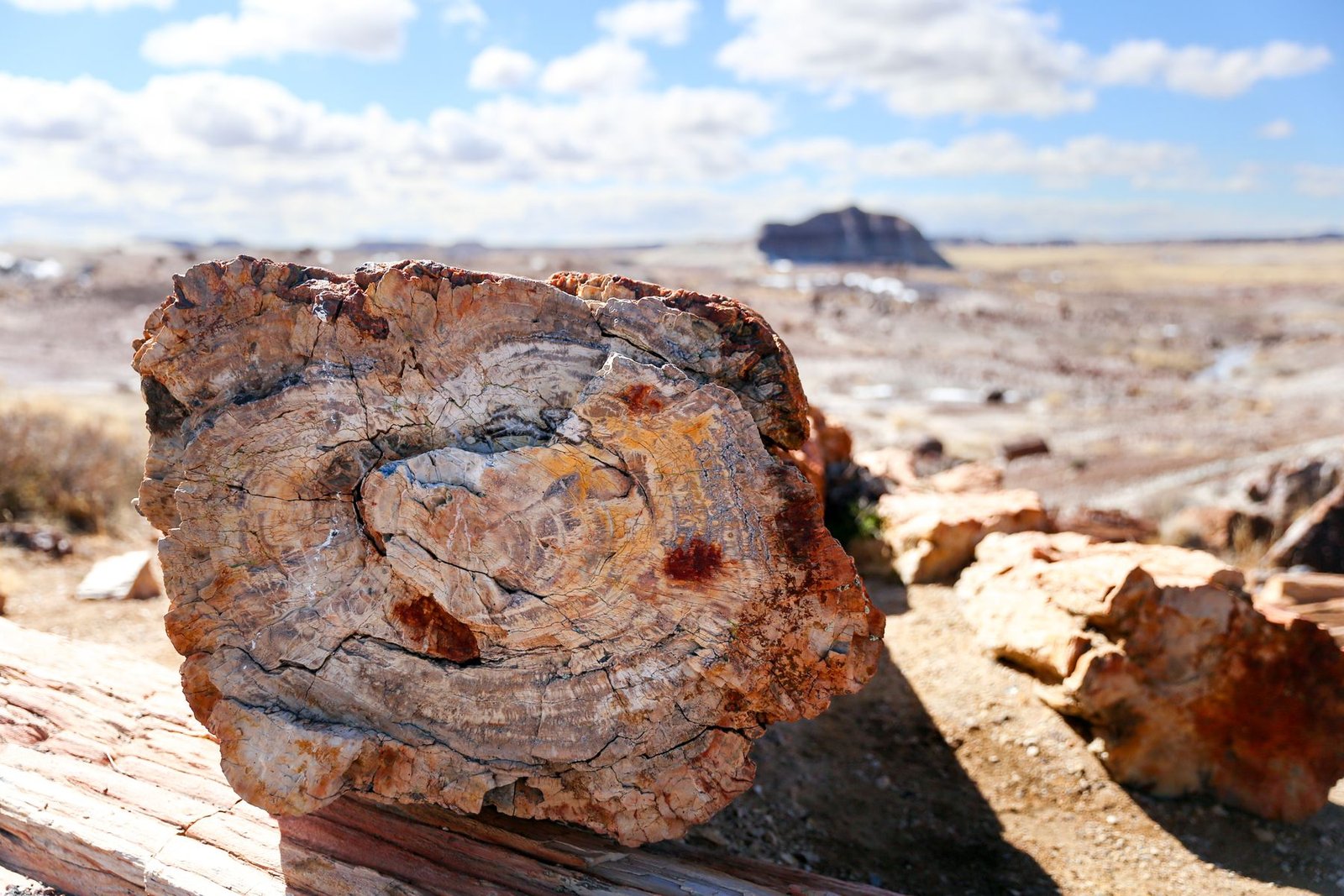
Silicified fossil wood · Grounding & patience
In short Petrified wood is not a single mineral but a fossil: ancient wood in which the original plant tissue has been permineralised and replaced, mainly by quartz and chalcedony (silicon dioxide), sometimes by opal or calcite. It forms when trees are buried quickly under sediment or volcanic ash and silica-rich groundwater seeps through them for thousands to millions of years. Its colours come from traces of iron and manganese oxides, and good pieces keep the growth rings, bark and even cell structure of the tree. When silicified it is hard (about Mohs 7) and takes a fine polish. The crystal tradition reads it as a stone of grounding, patience, stability and connection to the past. These are symbolic uses, as this guide explains, not medical ones.
Most crystals grew as crystals. Petrified wood began as a living tree: a conifer standing in a river valley more than two hundred million years ago, or a forest flattened by a volcanic eruption. Today you can hold a slice of it and count its growth rings, even though every ring is now made of stone. Few objects, apart perhaps from a fossil ammonite, make geological time feel so close.
This guide explains what petrified wood actually is, how a log turns into quartz, why it comes in such warm colours, what the crystal tradition says about it, and how to buy it responsibly. That last point matters, because some of the world’s most famous petrified forests are protected by law.
What is petrified wood?
Petrified wood (from the Greek petra, “rock”) is fossilised wood in which the organic material has been replaced by minerals while the original structure is preserved. In most specimens the replacing mineral is silica: microcrystalline quartz and chalcedony, the same family as agate and jasper. Less commonly, wood is replaced by opal (“opalised wood”), by calcite or by iron minerals such as pyrite. Because it is a fossil and a rock rather than one mineral species, it has no single chemical formula. A silicified piece behaves essentially like chalcedony.
Those mineral origins explain its physical properties. Silicified petrified wood has a hardness of roughly 6.5 to 7 on the Mohs scale, a density around 2.6, a waxy to glassy lustre when polished and a conchoidal to splintery fracture. It does not fizz in acid, unlike calcite-replaced wood. What makes it unmistakable is texture: growth rings, rays, knots, bark and sometimes insect borings, which can survive in such detail that palaeobotanists identify tree species from thin sections under the microscope.
It should not be confused with amber, which is fossilised tree resin, an organic substance that was never mineralised. Amber is soft and light enough to float in salt water; petrified wood is stone through and through.
How wood turns to stone
Wood normally rots within years. To fossilise, it has to escape oxygen and decay quickly. The usual recipe looks like this:
- Rapid burial. Trees are buried by river sediment, mudflows or volcanic ash, which cuts off oxygen and slows decay.
- Silica-rich groundwater. Volcanic ash in particular releases dissolved silica as it weathers. That water seeps through the buried wood.
- Permineralisation. Silica first fills the empty spaces in and between the plant cells, often as opal-like silica that later recrystallises into chalcedony and quartz.
- Replacement. As the cell walls slowly break down, minerals take their place, sometimes molecule by molecule, copying the anatomy of the wood.
- Uplift and erosion. Millions of years later, erosion exposes the stone logs at the surface, where they often break into neat segments along old stress lines.
Traces of other elements colour the result: iron oxides give reds, oranges and yellows; manganese and organic carbon give blacks and greys; rarer elements produce occasional blues or greens. For the wider picture of how minerals precipitate from solution, see our guide to how crystals form. Petrified wood shows a related process on a living template.
Petrified wood meaning & history
The most famous deposit is Petrified Forest National Park in Arizona, where colourful logs weather out of the Late Triassic Chinle Formation, roughly 210 to 225 million years old. Most of the logs belong to extinct conifers once grouped as Araucarioxylon arizonicum. The site was protected as a national monument in 1906, after collectors and industrial grinders had already carried away tons of wood, and became a national park in 1962. Petrified wood was named Arizona’s official state fossil in 1988. Other celebrated forests include the Lesvos Petrified Forest in Greece, buried by volcanic ash about 20 million years ago, and the Jurassic forest of Cerro Cuadrado in Patagonia, known for its fossilised araucaria cones.
People have collected and worked petrified wood for a very long time. Indigenous peoples of the American Southwest shaped it into tools and arrowheads and used it in building. Many cultures have explained stone logs through legend; in Navajo tradition, for instance, the logs are often described as the bones of a slain giant. In the modern crystal world, its meaning follows its story. Petrified wood is read as a stone of patience, endurance and transformation: something living that became permanent, slowly, without losing its shape.
Petrified wood healing properties
In the crystal tradition, petrified wood is valued as a grounding, steadying and long-view stone.
People typically turn to petrified wood for:
- Grounding & stability. Its signature association: a calm, earthy stone to feel rooted during change or uncertainty.
- Patience & perspective. A piece of wood that took millions of years to form is a natural reminder that slow growth counts.
- Ancestry & the past. Often kept in a personal or family space as a symbol of roots, heritage and continuity.
- Resilience & transformation. Read as a stone of steady endurance and of becoming something stronger over time.
These are traditional and symbolic uses, not medical claims. There is no scientific evidence that any crystal treats, cures or prevents any illness, and petrified wood has no proven effect on energy, mood, bones, stress or health. Nothing here is intended to diagnose, treat or prevent any condition, and no crystal is a substitute for medical care. Concerns about your physical or mental health belong with a doctor or other qualified professional.
Petrified wood, the chakras & zodiac
With its browns, reds and ochres, petrified wood is almost always assigned to the root chakra, the centre associated in the tradition with safety, belonging and being grounded. That puts it in good company with red jasper, smoky quartz and black tourmaline. For the wider framework, see our guide to the seven chakras and their crystals.
By zodiac, petrified wood has no fixed sign in older lore. Modern lists most often give it to Leo, and some also link it to the earth signs because of its grounding theme.
How to use petrified wood
- Keep a polished slice or log section in your home. Bookends, slabs and round “rounds” showing the rings make striking, durable décor.
- Hold a tumbled piece in meditation. Counting or tracing the visible rings is a simple, focusing grounding exercise.
- Place it near a family photo or keepsake. Its association with roots and ancestry makes it a natural choice for a memory corner.
- Use it at your desk during long projects. A quiet reminder of patience and steady progress.
- Wear it as a pendant or cabochon. Silicified wood is hard enough for most jewellery; opalised wood needs gentler handling.
How to cleanse & charge petrified wood
- Water is fine for silicified pieces. A rinse under lukewarm water and a soft cloth are enough; dry it well afterwards, especially pieces with open cracks or bark.
- Be gentler with opalised or calcite-replaced wood. Opal can crack if it dries out or heats quickly, and calcite reacts to acids. Keep these out of soaks and strong sun.
- Avoid harsh chemicals and ultrasonic cleaners, which can damage lacquered or stabilised slabs and open hidden fractures.
- Smoke, sound, moonlight or selenite are traditional dry methods that suit every type.
- Earth charging, briefly placing the stone on soil or a plant pot, is a popular choice for a stone so tied to trees and land.
Our general guide to cleansing and charging crystals covers each method in more detail.
Types & origins
- Arizona rainbow wood. Brightly coloured Triassic wood from private land around Petrified Forest National Park. Collecting inside the park is illegal.
- Madagascar petrified wood. The source of much of today’s polished décor: rounds, bookends and spheres with rich red, brown and yellow tones.
- Indonesian wood. Large, often grey-to-golden logs cut into tables and sculptures.
- Opalised wood. Wood replaced by opal, found notably in Australia and in Virgin Valley, Nevada; more fragile and sometimes showing play of colour.
- Palm wood (Palmoxylon). Fossil palm with a distinctive spotted pattern, the state stone of Louisiana and Texas.
- “Wood agate” and “wood jasper.” Trade names for petrified wood rich in translucent agate or opaque jasper.
Notable localities include Arizona, Washington, Wyoming and Oregon in the United States, Madagascar, Indonesia, Argentina, Egypt and the Greek island of Lesvos. Value depends on colour, preserved detail, polish and size. Small tumbled stones are very affordable, while large, richly coloured slabs with crisp rings command high prices. Always ask where a piece comes from: in many parks and protected areas, removing even a fragment is prohibited.
Real vs fake
- Look for real wood anatomy. Genuine pieces show irregular growth rings, rays, knots or bark that follow the logic of a tree, not a repeating printed pattern.
- Check the hardness. Silicified wood scratches glass and resists a steel knife. Plaster or resin imitations scratch easily and feel warm and light.
- Feel the weight. Stone wood is heavy for its size. Dried or driftwood sold as “fossil” is light and smells of wood when sanded.
- Watch for coatings. Many slabs are lacquered or resin-filled to stabilise cracks. That is acceptable if disclosed, but it changes care and value.
- Beware of unnatural colours. Vivid blues, greens or purples are rare in nature; dye collects in cracks and pores.
The workable rule: look for tree structure, stone hardness and an honest, legal origin. For the wider method, see our guide to spotting dyed and imitation stones.
Genuine, legally sourced petrified wood
If you’d like a piece of your own, Minerals Kingdom offers authenticated natural petrified wood, from tumbled stones to polished slices. Each piece is correctly labelled and honestly described, with any stabilisation disclosed.
Petrified wood pairs well with
Frequently asked questions
What is petrified wood good for?
Traditionally, petrified wood is used as a grounding stone of stability, patience and connection to one’s roots and the past. These are symbolic, traditional uses, not proven medical effects. No crystal treats illness, and petrified wood is not a substitute for medical care.
Is petrified wood a crystal or a fossil?
It is a fossil. The original wood has been replaced by minerals, usually microcrystalline quartz and chalcedony. So it is made of crystalline silica, but it is not a single mineral species with its own crystal form.
How old is petrified wood?
It depends on the deposit. The logs of Arizona’s Petrified Forest are about 210 to 225 million years old (Late Triassic), the Lesvos forest is about 20 million years old, and some petrified wood is older still. The petrification itself takes thousands to millions of years.
Can petrified wood go in water?
Silicified petrified wood is hard and water-safe for a rinse, though it should be dried well. Opalised or calcite-replaced wood and lacquered slabs are more delicate, so avoid soaking them and use dry methods such as smoke, sound or moonlight instead.
Is it legal to collect petrified wood?
Not everywhere. Removing petrified wood from protected areas such as Petrified Forest National Park is illegal. Some public lands in the United States allow small amounts for personal use, but rules vary. Buy from sellers who can state a legal, private-land or licensed origin.
What chakra is petrified wood?
Petrified wood is usually linked to the root chakra, the centre the tradition associates with grounding, safety and belonging, because of its earthy colours and its theme of roots and stability.
Image credits · Hero and buy-box: petrified wood close-up, Petrified Forest National Park — photo Daniel Erlandson / Pexels (Pexels License).
Sources · Mindat.org, “Petrified wood”; U.S. National Park Service, Petrified Forest National Park, “Petrified Wood” and park history; Encyclopædia Britannica, “Petrified wood”; Lesvos Island UNESCO Global Geopark, Petrified Forest of Lesvos; Arizona State Legislature, state symbols (state fossil, 1988).