Agate
A banded chalcedony grown layer by layer inside volcanic rock — the parent family behind dozens of named stones — and valued in the crystal world as a steady, grounding stone of balance, patience and quiet strength.
Banded chalcedony · Balance & grounding
In short Agate is a banded variety of chalcedony — compact, microcrystalline quartz with the formula SiO2, hardness 6.5–7 Mohs and the trigonal crystal structure of quartz, too fine to see without a microscope. It grows when silica-rich water fills gas cavities and cracks in volcanic rock, depositing thin layer after layer until the hollow is filled with concentric bands. Named after the Achates river in Sicily, it has been carved into seals, cameos and amulets for thousands of years. It is also the parent family of many stones covered separately on this site, from blue lace agate to onyx. The crystal tradition reads agate as a stabilising, grounding stone of balance, patience and self-confidence — symbolic uses, this guide explains, rather than medical ones.
Agate is the stone of patience made visible. Cut one open and you see its history written in rings — dozens, sometimes hundreds, of fine bands laid down one after another inside a hollow in ancient lava. Few stones are as varied, as durable or as widely loved, and few have been worked by human hands for so long.
This guide covers what agate actually is, how its famous banding forms, where its steadying reputation comes from, the many named varieties that belong to the agate family, and how to recognise the dyed material that fills so many shop trays.
What is agate?
Agate is a form of chalcedony, the compact, microcrystalline variety of quartz. Chemically it is simply silicon dioxide (SiO2), the same as clear quartz, but instead of growing as one large crystal it is built from countless tiny quartz fibres, often mixed with a related silica mineral called moganite. Those fibres belong to the trigonal crystal system of quartz — you can read more about how crystal structures are classified in our guide to the seven crystal systems.
What makes chalcedony an agate is its banding: concentric or parallel layers of slightly different colour and translucency. Agate is reasonably hard, at 6.5 to 7 on the Mohs scale, has no cleavage, breaks with a conchoidal fracture and takes a glassy to waxy polish. Its specific gravity sits around 2.6. That combination of toughness and beauty is why it has been used for tools, beads, seals and ornaments since prehistory.
Agate meaning & history
The name goes back to the Greek philosopher Theophrastus, who in his treatise On Stones (4th century BC) described a stone found along the Achates river in Sicily — today usually identified with the Dirillo. The river’s name passed to the stone, and from Latin achates it became “agate” in English.
Agate was one of the most widely worked stones of antiquity. It was cut into beads in ancient Mesopotamia and the Indus Valley, carved into seals and cameos by the Greeks and Romans, and turned into bowls and cups for Renaissance collectors. From the 16th century the town of Idar-Oberstein in Germany grew into Europe’s great agate-cutting centre, first using local stone and later importing huge quantities from Brazil and Uruguay.
Across these cultures agate gathered a reputation as a protective, strengthening stone — carried as an amulet by travellers and warriors and, in folk tradition, believed to bring courage and good fortune. In the modern crystal world it is read as a stone of balance, stability and patient, steady growth, its slow-built bands a natural emblem of resilience.
How the bands form
Most agates form inside gas bubbles (vesicles) and cracks in volcanic rock such as basalt and andesite. As the lava cools, those hollows are left empty. Over long periods, groundwater carrying dissolved silica seeps in and deposits it on the cavity walls, building up thin layers of chalcedony from the outside in. Trace impurities — chiefly iron and manganese oxides — tint successive bands red, orange, brown or black, while purer layers stay white or grey.
Exactly how such regular, rhythmic bands arise is still debated among geologists; several mechanisms, from repeated pulses of fluid to self-organising crystallisation within a silica gel, have been proposed. If the cavity never fills completely, the centre may be lined with sparkling quartz or amethyst crystals, producing a geode. Agates can also form in sedimentary rocks, and some — like those in petrified wood — replace organic material. For the bigger picture, see our guide to how crystals form.
Agate healing properties
In the crystal tradition, agate is valued as a stone of balance, grounding and steady strength.
People typically turn to agate for:
- Balance & harmony. Its even, layered bands are read as a symbol of emotional equilibrium and of bringing scattered energy back to centre.
- Grounding & stability. A dense, earthy stone traditionally carried to feel settled, secure and present.
- Patience & resilience. Built band by band over long ages, it is linked to perseverance and to growth that comes slowly but lasts.
- Confidence & protection. Its old role as a traveller’s and warrior’s amulet carries over into modern associations with courage and a sense of being shielded.
These are traditional and symbolic uses, not medical claims. There is no scientific evidence that any crystal treats, cures or prevents any illness, and agate has no proven effect on health, mood or energy. Crystals are not a substitute for medical care: nothing here is intended to diagnose, treat or prevent any condition, and health concerns belong with a qualified professional.
Agate, the chakras & zodiac
Because agate comes in so many colours, its chakra associations follow its colour. As a general family it is most often linked to the root chakra (Muladhara), the centre of grounding and security. Red and orange agates, close cousins of carnelian, are read with the root and sacral chakras; green agates with the heart; and blue agates — above all blue lace agate — with the throat. For the full framework, see our guide to the seven chakras and their crystals.
By zodiac, agate is most commonly associated with Gemini and Virgo, and in some modern birthstone lists it is given to Gemini as a traditional stone.
How to use agate
- Wear it as jewellery. At 6.5–7 Mohs, agate is tough enough for everyday beads, pendants and rings.
- Carry a tumbled stone. A classic worry or pocket stone, smooth and pleasant to hold.
- Display a slice or geode. Polished agate slices on a window catch the light beautifully, and geodes make striking desk or shelf pieces.
- Hold it in meditation. Tracing the bands with your eye or fingertip is a simple focusing practice.
- Use it as a coaster or bookend. Agate’s durability makes it one of the few crystals practical for everyday objects.
How to cleanse & charge agate
- Water is fine. Agate is hard and non-soluble; a rinse under lukewarm running water and a soft cloth are safe for natural stone.
- Go easy with dyed pieces. Long soaks, hot water or salt can leach or dull artificial colour, so keep dyed agate dry where possible.
- Sunlight in moderation. Natural agate tolerates light well, but some dyed colours may fade with long direct exposure.
- Smoke, sound, moonlight or selenite are gentle, contact-free alternatives for any piece.
- Avoid harsh chemicals and sudden heat, which can crack slices or damage polish.
Our general guide to cleansing and charging crystals covers each method in more detail.
Types & origins
- Fortification agate. The classic type, with angular concentric bands that resemble the walls of a fort.
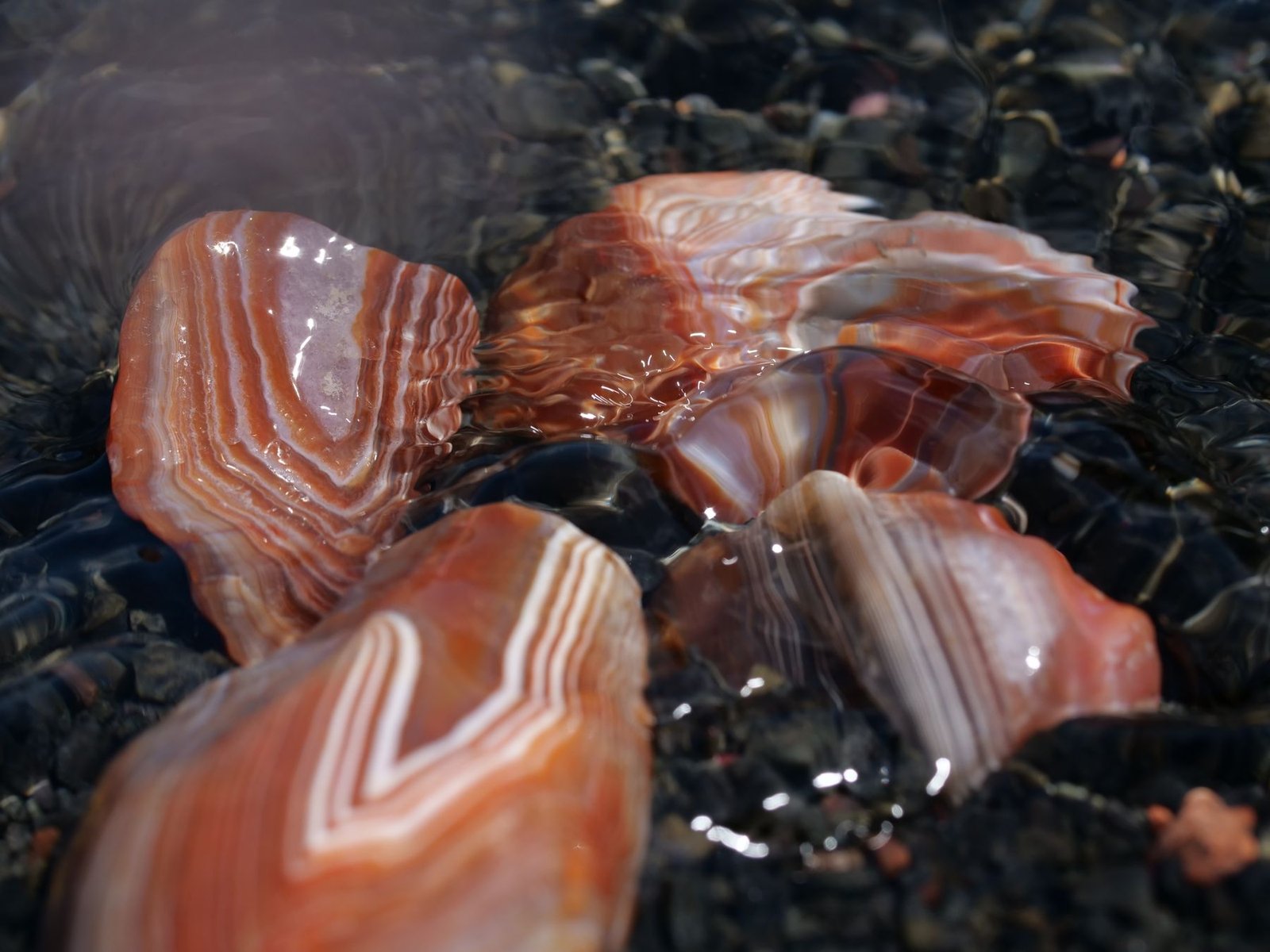
- Lake Superior agate. Red-orange, iron-rich banded agate from the Lake Superior region, named the official state gemstone of Minnesota in 1969.
- Botswana agate. Fine, tightly banded agate in soft greys, pinks and peach tones from southern Africa.
- Crazy lace agate. A swirling, multicoloured agate from northern Mexico.
- Fire agate. Brown chalcedony with thin iridescent layers of iron oxide, from Mexico and the south-western USA.
- Blue lace agate. Pale blue, finely banded agate — see our dedicated blue lace agate guide.
- Onyx & sardonyx. Agate with straight, parallel bands; most commercial black onyx is dyed agate.
- Moss & dendritic “agates.” Chalcedony with branching inclusions rather than true bands — technically not agate at all, as our moss agate guide explains.
The largest commercial sources are Rio Grande do Sul in Brazil and the Artigas region of Uruguay, which supply most of the world’s agate slices and geodes. Other important localities include Mexico, Botswana, India, the United States, Scotland and Germany. Agate is abundant and affordable; value comes from fine, sharp banding, strong natural colour and unusual patterns rather than rarity.
Real vs fake
- Dyed agate. The most common issue. Because agate is slightly porous, it readily absorbs dye; electric blue, hot pink, purple and bright green slices are almost always dyed. The technique has been practised at Idar-Oberstein since the 19th century.
- The colour tell. Natural agate shows soft, earthy tones; dye tends to pool in the more porous bands and cracks, giving a uniform, saturated colour that looks too vivid.
- Glass and resin. Moulded imitations may show bubbles, feel lighter and warmer, and lack the fine, irregular detail of real banding.
- Hardness. Real agate will not be scratched by a steel knife; many imitations will.
Dyed agate is still genuine agate — the issue is only honest labelling. The workable rule: enjoy dyed agate for its colour, but buy it as dyed and price it accordingly. For the wider method, see our guide to spotting dyed and imitation stones.
Genuine, natural-colour agate
If you’d like a piece of your own, Minerals Kingdom offers authenticated natural agate — with dyed material clearly identified as such and honestly described.
Agate pairs well with
Frequently asked questions
What is agate good for?
Traditionally, agate is used for balance, grounding, patience and confidence — a steady, stabilising stone. These are symbolic, traditional uses, not proven medical effects. No crystal treats illness, and agate is not a substitute for medical care.
Is agate a type of quartz?
Yes. Agate is a banded variety of chalcedony, which is microcrystalline quartz (SiO2). It has the same chemistry as clear quartz but is made of tiny fibrous crystals rather than one large crystal.
What is the difference between agate and jasper?
Both are microcrystalline quartz, but agate is translucent and typically banded, while jasper is opaque because it contains more impurities. Holding a thin edge to a light is the quickest way to tell them apart.
Can agate go in water?
Natural agate is hard and water-safe, so a quick rinse is fine. Dyed agate is better kept away from long soaks, hot water and salt, which can affect its artificial colour.
How can I tell if agate is dyed?
Look for unnaturally bright colours such as electric blue, hot pink or purple, and for dye that is concentrated along bands and cracks. Natural agate shows softer, earthy tones.
Is moss agate a real agate?
Not strictly. Moss agate is chalcedony with branching mineral inclusions but no concentric banding, so mineralogists class it as included chalcedony rather than true agate. The name is a long-standing trade convention.
Image credits · Hero and buy-box: banded Lake Superior agates in water — Photo: Giant Asparagus / Pexels (Pexels License).
Sources · Mindat: Agate · Minerals.net: Agate · Minnesota DNR: Lake Superior agate · Theophrastus, On Stones (c. 315 BC).