Black Onyx
The glossy, uniform-black stone in every jewellery counter — and one of the most honestly named gems there is, because almost all of it is dyed. We say so plainly, and explain why that’s fine.
Chalcedony · Grounding & protection
In short Black onyx is a variety of chalcedony, the same microcrystalline quartz family as agate, technically defined by its straight, parallel banding. Here is the fact almost nobody sells you upfront: uniform solid-black onyx is rare in nature, and the great majority of “black onyx” jewellery is naturally pale, greyish banded chalcedony that has been dyed black — a treatment carried out since ancient Rome. It is hard and durable at 6.5–7 Mohs, historically the classic material for carved cameos and seals, and in the crystal tradition a stone of grounding, protection and quiet strength. Dyed is not “fake” — it is simply worth knowing.
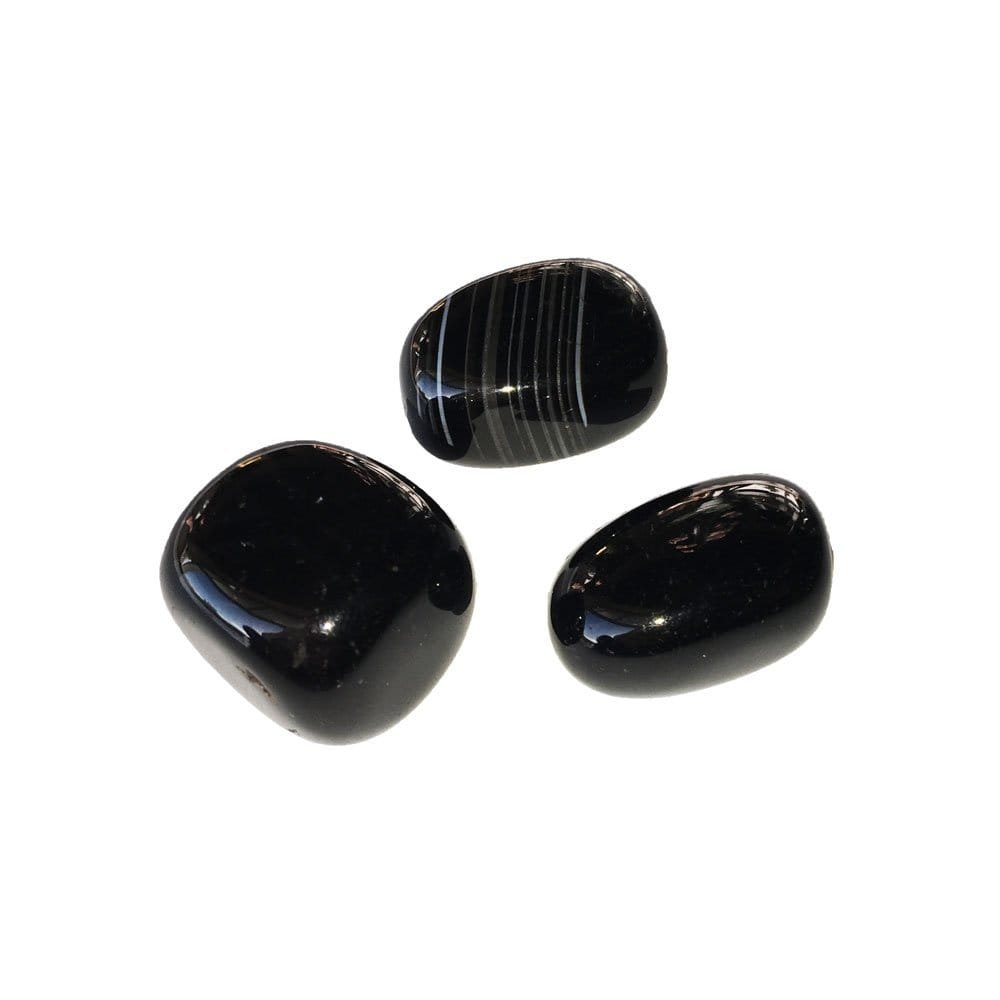
Black onyx is one of the most recognisable stones in any jewellery case — glossy, uniform, unmistakably black. It is also one of the most quietly misunderstood. Onyx is not its own mineral; it is a banded variety of chalcedony, the same cryptocrystalline quartz family that produces agate, and true onyx is defined by its parallel bands rather than agate’s curved ones. Left to nature, that banded material is rarely a flawless, solid black — which is precisely why almost every “black onyx” bead, cabochon or ring you have ever seen has been treated.
This guide covers what black onyx actually is, the centuries-old dyeing technique behind its colour, how it differs from the site’s other dark, protective stones, and how to buy it with clear expectations.
What is black onyx?
Onyx is a variety of chalcedony — a microcrystalline (fine-grained) form of quartz, silicon dioxide (SiO₂) — distinguished from its close cousin agate by straight, parallel colour bands rather than agate’s wavy or concentric ones. Its Mohs hardness is 6.5 to 7, tough and durable, which is exactly why it has been carved for millennia: the layered banding lets a skilled carver cut through a dark top layer into a paler one beneath, throwing a raised design into contrast — the technique behind classical cameos and intaglios.
Genuinely natural onyx is typically banded in greys, browns, whites and blacks, not a single flawless black. Solid, uniform black material of gem quality is uncommon in nature, so the trade has treated banded chalcedony to achieve it since antiquity. The method, essentially unchanged for two thousand years, soaks porous grey chalcedony in a sugar solution, then treats it with sulfuric acid, which carbonises the sugar trapped in the stone’s pores into carbon — turning it a deep, stable black.
Black onyx meaning & history
The name comes from the Greek onyx, meaning “claw” or “fingernail” — one myth holds that Cupid clipped the sleeping Venus’s nails, and the fragments, too precious to be lost, were turned to stone by the Fates. Whatever the etymology, onyx was one of the great working stones of the ancient world: Greek and Roman engravers prized its banding for cameos, intaglios and seal rings, and black onyx signet rings carried real legal weight as a mark of identity and authority.
Victorian mourning jewellery later adopted black onyx for its solemn, unbroken black, worn to signal grief and remembrance. In the modern crystal tradition, that same weighty, absorbing black has settled into a reading of grounding, protection and self-mastery — a stone associated with steadying resolve through difficulty.
Black onyx healing properties
In the crystal tradition, black onyx is valued as a stone of grounding, protection and inner strength.
People typically turn to black onyx for:
- Grounding. A heavy, stabilising root-chakra stone.
- Protection. Traditionally worn as a shield against negativity, in the company of other dark protective stones.
- Strength and self-discipline. Read as supportive through grief, transition or willpower-testing periods.
- Focus. Associated with steadying scattered attention and reinforcing resolve.
These are traditional and symbolic uses, not medical claims. There is no scientific evidence that any crystal treats, cures or prevents any illness, and nothing here is intended to diagnose, treat or prevent any condition. Enjoy black onyx as a genuinely ancient carving and jewellery material with real craft history; health and emotional concerns belong with a doctor or qualified therapist.
Black onyx, the chakras & zodiac
Black onyx’s deep, uniform black places it at the root chakra (Muladhara), the seat of grounding, security and physical stability — the same category as the site’s other dark stones, including black tourmaline, obsidian and hematite. For the wider framework, see our guide to the seven chakras and their crystals.
By zodiac, black onyx is most often linked to Leo and Capricorn, read as reinforcing discipline and quiet authority.
How to use black onyx
- Wear it as jewellery. Hard and durable at 6.5–7 Mohs, it takes rings, cufflinks and daily wear well.
- Hold it in meditation. At the root, for grounding and steadiness.
- Keep it as a pocket or worry stone. A traditional, tactile grounding companion.
- Choose a carved piece. A cameo or seal connects you to onyx’s long working history.
- Pair it with lighter stones. Its strong black anchors softer, paler crystals visually and symbolically.
How to cleanse & charge black onyx
- Water. Generally tolerant of a quick rinse, though prolonged soaking is best avoided on dyed material as a simple precaution.
- Avoid harsh chemicals and prolonged heat. Standard care for any dyed gemstone; the carbonised colour is stable but not indestructible.
- Sunlight or moonlight. A short charge in either is fine — its dark colour is not prone to fading.
- Smoke. Sage, palo santo or incense.
- Selenite or sound. Contact-free and safe.
- Soil. As a grounding stone, briefly resting it on the earth is a traditional, low-risk method.
Types & treatment
- Dyed black onyx. The vast majority of material sold — naturally pale, porous chalcedony carbonised black by the sugar-and-acid method, a technique unchanged since Roman times.
- Natural banded onyx. Genuinely untreated material, usually showing grey, brown, white and black bands rather than solid black — the traditional choice for cameo carving, since the contrast is the point.
- “Onyx marble” (Mexican onyx). A common decorative-stone confusion: this is banded calcite or travertine, a completely different, much softer mineral, sold as vases, lamps and tabletops under the “onyx” name despite having nothing to do with true chalcedony onyx.
- Look-alike black stones. Black tourmaline, obsidian and jet are genuinely different materials often visually confused with onyx — each has its own composition and story, covered in their own guides.
Is black onyx valuable?
Black onyx is one of the most affordable and widely available gem materials, which is part of why it appears in so much jewellery and carving. Value is driven mainly by workmanship — a fine antique cameo or seal commands far more than the raw material cost — rather than by rarity of the stone itself. Naturally banded, untreated material with attractive contrast is slightly more prized by carvers and collectors than plain dyed black, but neither is bought as an investment; onyx is chosen for its look, durability and symbolism rather than for scarcity.
Real vs fake
- Black glass. Cold, often shows gas bubbles under magnification, and lacks onyx’s slightly warmer, waxy chalcedony lustre.
- Dyed howlite or magnesite. Softer white stones dyed black to imitate onyx; both scratch far more easily than genuine chalcedony’s 6.5–7 hardness, so a simple scratch-resistance check (a steel pin should not mark real onyx) helps tell them apart. Genuine, undyed howlite has its own guide on this site.
- “Onyx marble.” Banded calcite or travertine sold as onyx for décor — much softer (around 3 Mohs, easily scratched by a coin) and a completely different mineral from true chalcedony onyx.
- Plastic. Light, warm to the touch quickly, and often shows mould seams.
The workable rule: trust the hardness, not the colour. A steel point should not scratch genuine onyx; if it does, you are likely holding dyed howlite, magnesite, or onyx marble rather than true chalcedony.
Genuine, correctly identified black onyx
If you’d like a piece of your own, Minerals Kingdom offers authenticated black onyx — true chalcedony, not onyx marble or a dyed substitute.
Black onyx pairs well with
Frequently asked questions
Is black onyx naturally black?
Rarely. Most natural onyx is pale and banded in greys, browns and whites. The uniform, glossy solid black seen in almost all jewellery is achieved by dyeing — a sugar-and-acid treatment used since ancient Rome — rather than found that way in the ground.
Is dyed black onyx “fake”?
No. Dyed onyx is genuine chalcedony that has been colour-treated, not an imitation material like glass or plastic. It is a long-standing, disclosed practice in the trade, similar to how many gemstones are routinely treated to reach their market colour.
What is the difference between black onyx and obsidian or black tourmaline?
All three are dark and used for similar grounding, protective purposes, but they are entirely different materials: onyx is a banded chalcedony (quartz family), obsidian is volcanic glass, and black tourmaline is a borosilicate mineral (schorl). Each has its own composition, formation story and guide on this site.
Is “onyx marble” the same as black onyx?
No, and this is a common and understandable mix-up. “Onyx marble,” often called Mexican onyx, is banded calcite or travertine — a much softer, entirely different mineral sold for vases, lamps and tabletops. True onyx is chalcedony, a form of quartz.
How do I cleanse and care for black onyx?
It tolerates water and daily wear well thanks to its 6.5–7 hardness. As a simple precaution on dyed material, avoid prolonged soaking, harsh chemicals and extended heat; sage smoke, sound and a short spell in sun or moonlight are all safe.
What is black onyx good for?
Traditionally, grounding, protection and inner strength — a heavy root-chakra stone associated with steadying resolve. These are symbolic, traditional uses, not proven medical effects. No crystal treats illness.