
Danburite
A hard, glass-clear calcium borosilicate named after a Connecticut town, prized by collectors for its striated prisms and chisel-shaped tips — and read in the crystal world as a gentle, luminous stone of serenity, the heart and the higher self.
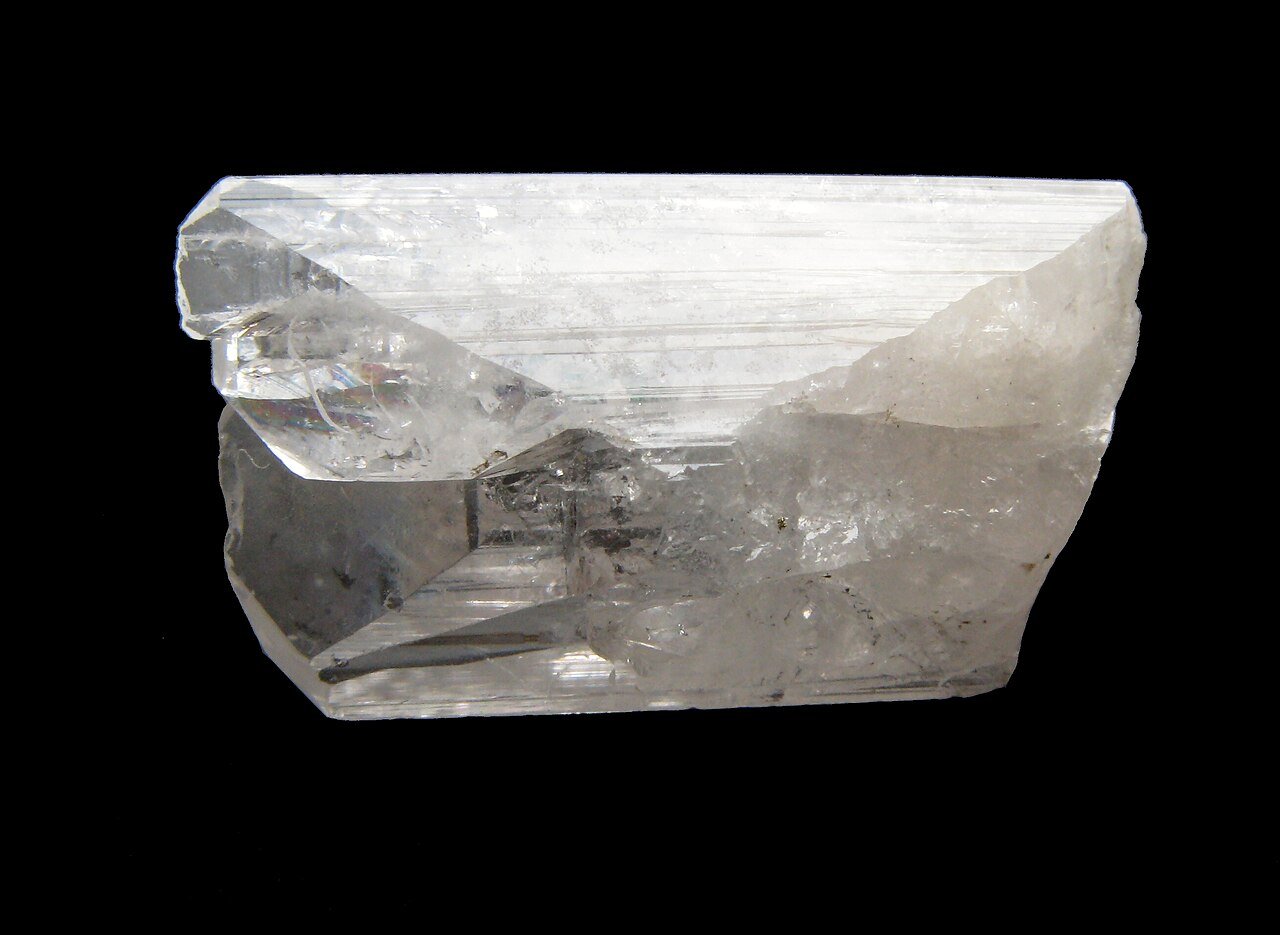
Calcium borosilicate · Serenity & light
In short Danburite is a calcium borosilicate with the formula CaB2(SiO4)2. It crystallises in the orthorhombic system, growing as long, glassy, lengthwise-striated prisms with a distinctive diamond-shaped cross-section and wedge- or chisel-shaped terminations very like topaz. At 7–7.5 on the Mohs scale with only poor cleavage, it is tough enough to facet, and fine colourless crystals show a lively brilliance. It was first described in 1839 from Danbury, Connecticut, though today most specimens come from Charcas in Mexico. The crystal tradition reads it as a crown-and-heart stone of serenity, gentleness, spiritual connection and new beginnings — symbolic uses, this guide explains, rather than medical ones.
Danburite is the kind of crystal that makes people look twice. At first glance it could pass for clear quartz — water-clear, glassy, gathered in bright clusters — but turn a crystal in your hand and the differences appear: fine grooves running its whole length, a squared-off, diamond-shaped profile, and a sloping, chisel-like tip where quartz would come to a six-sided point. Calm, bright and quietly unusual, it has become one of the crystal world’s favourite stones of peace and light.
This guide covers what danburite actually is, how a small New England town gave a worldwide mineral its name, how to tell it apart from quartz and topaz, what the crystal tradition says about it, and how to care for, use and authenticate a piece of your own.
What is danburite?
Danburite is a calcium borosilicate, CaB2(SiO4)2 — a silicate mineral built with boron, an element that is relatively rare in the earth’s crust. It crystallises in the orthorhombic system, the same symmetry as topaz, which is why the two minerals share such a similar wedge-shaped termination. Our guide to the seven crystal systems explains how that underlying symmetry dictates the outward shape of a crystal.
It forms where boron-bearing fluids meet calcium-rich rock: in metamorphosed carbonate rocks and skarns, in hydrothermal veins, in some granite pegmatites, and occasionally in evaporite deposits. Crystals are typically prismatic and striated lengthwise, with a vitreous to greasy lustre. Physically it is a robust mineral: 7 to 7.5 on the Mohs scale, a specific gravity of about 3.0, a refractive index around 1.63 and only poor, indistinct cleavage, with a conchoidal to uneven fracture. Many specimens also fluoresce sky-blue under ultraviolet light, a detail collectors enjoy.
Danburite meaning & history
Danburite was described in 1839 by the American mineralogist Charles Upham Shepard, who named it after Danbury, Connecticut, where the first crystals were found. The original locality has long since been built over, and the classic Connecticut material was mostly pale and modest; it was later finds — in Japan, Myanmar, Russia and above all Mexico — that revealed how clear, large and beautiful danburite can be.
Unlike jade, amber or lapis lazuli, danburite has no ancient folklore: it simply was not known before the nineteenth century. Its symbolic meaning is a modern one, built up within the contemporary crystal community over the past few decades. There, its clarity and brightness have earned it a reputation as a stone of serenity, gentleness and spiritual connection — often described as a calmer, softer companion to clear quartz, and associated with peace of heart, quiet joy and fresh starts.
Danburite, quartz or topaz?
Because colourless danburite looks so much like other clear minerals, telling them apart is the single most useful skill for anyone buying it. Three features do most of the work:
- Cross-section. Look down the length of a crystal. Clear quartz is six-sided (hexagonal); danburite is roughly diamond- or rhomb-shaped.
- Termination. Quartz ends in a six-faced pyramid that meets at a point. Danburite ends in a sloping, wedge- or chisel-shaped tip, much like topaz.
- Striations. Quartz shows horizontal grooves across its prism faces; danburite’s striations run lengthwise, along the crystal.
Separating danburite from topaz is harder, since they share a symmetry and a similar tip. The clearest difference is cleavage: topaz has a perfect basal cleavage and can split cleanly across the crystal, whereas danburite does not. Topaz is also noticeably denser (about 3.5 against 3.0) and slightly harder, which a gemmologist can measure in seconds. For faceted stones, refractive index and specific gravity are the reliable tests.
Danburite healing properties
In the crystal tradition, danburite is valued as a stone of serenity, heart-centred calm and spiritual connection.
People typically turn to danburite for:
- Serenity & peace. Its signature association — a clear, soft-feeling stone chosen for quiet, unhurried calm.
- Spiritual connection. Read as a crown stone of meditation, reflection and a sense of the “higher self.”
- Gentleness & the heart. Linked, especially in its pink form, to compassion, kindness and emotional ease.
- Fresh starts. Traditionally kept close during transitions, to mark letting go of the old and welcoming change.
These are traditional and symbolic uses, not medical claims. There is no scientific evidence that any crystal treats, cures or prevents any illness, and danburite has no proven effect on health, mood or energy. Nothing here is intended to diagnose, treat or prevent any condition; health and life concerns belong with the appropriate qualified professional.
Danburite, the chakras & zodiac
Clear, colourless danburite is linked above all to the crown chakra (Sahasrara), the centre associated with awareness and spiritual connection — the usual home for water-clear stones such as selenite and clear quartz. Pink danburite and the stone’s gentle reputation also tie it to the heart chakra (Anahata). It sits comfortably beside other airy, high-vibration stones such as celestite and apophyllite. For the wider framework, see our guide to the seven chakras and their crystals.
By zodiac, danburite is most often associated with Leo, and some writers also link it to Aquarius and Libra. As with all such correspondences, these are modern conventions rather than fixed rules.
How to use danburite
- Hold a point in meditation. Its clarity makes it a popular focus for quiet, crown-centred practice.
- Keep a cluster on a bedside table or altar. A calm, luminous presence for evening wind-down rituals.
- Wear it as jewellery. At 7–7.5 Mohs, faceted danburite and polished points wear well in pendants and rings.
- Set an intention with it. Many people “program” a clear stone for a fresh start — see our guide on how to program a crystal.
- Pair it with a heart stone. Danburite alongside rose quartz or pink tourmaline makes a soft, heart-centred grouping.
How to cleanse & charge danburite
- Water is fine, briefly. Danburite is hard and non-porous, so a short rinse in lukewarm water and a soft cloth are safe.
- Skip salt and harsh chemicals, which can dull polished faces and lodge in the striations of raw crystals.
- Avoid sudden temperature changes — no hot water straight after cold — which can stress included or fractured crystals.
- Moonlight, smoke, sound or selenite are gentle, dry, contact-free alternatives.
- Limit long, strong sunlight for pink and yellow pieces, as pale colours in some minerals can fade over time.
Our general guide to cleansing and charging crystals covers each method in more detail, including which stones tolerate water and which do not.
Types & origins
- Colourless danburite. The classic form — water-clear to milky-white prisms and clusters, most famously from Mexico.
- Pink danburite. Pale blush-pink crystals, also chiefly from Charcas, Mexico; much sought after for heart-centred work.
- Yellow & golden danburite. Pale yellow to honey-brown gem material, notably from Myanmar and Madagascar.
- Faceted danburite. A collector’s gem: bright, durable and still relatively affordable.
- Coated “aura” danburite. Crystals treated with a thin metallic film for an iridescent sheen — attractive, but not a natural colour.
The world’s main source is the Charcas district of San Luis Potosí, Mexico, where mines have produced large clear and pink clusters for decades. Other important localities include Mogok in Myanmar, Madagascar, Dalnegorsk in Russia, Obira in Japan and Tanzania. Value depends on clarity, crystal sharpness, colour and size; fine, undamaged terminations and an even pink colour command the highest prices.
Real vs fake
- Quartz sold as danburite. The most common mix-up. Check the cross-section and the tip: six sides and a pyramid point mean quartz.
- Glass imitations. Moulded glass points may show bubbles, swirl marks, rounded edges and no natural striations.
- Undisclosed coatings. Iridescent “aura” finishes are a treatment; an honest seller will say so.
- Topaz confusion. Colourless topaz is sometimes mislabelled; density and cleavage separate the two.
The workable rule: look for lengthwise striations, a diamond-shaped profile and a chisel tip, and buy from a seller who labels treatments. For the wider method, see our guide to spotting dyed and imitation stones.
Genuine, correctly identified danburite
If you’d like a piece of your own, Minerals Kingdom offers authenticated natural danburite — correctly identified rather than quartz sold under its name, with any treatment clearly disclosed.
Danburite pairs well with
Frequently asked questions
What is danburite good for?
Traditionally, danburite is used for serenity, spiritual connection, gentleness and fresh starts — a calm, crown-and-heart stone. These are symbolic, traditional uses, not proven medical effects. No crystal treats illness, and danburite has no demonstrated effect on health or mood.
How can I tell danburite from clear quartz?
Look at the crystal’s profile and tip. Quartz is six-sided and ends in a pointed pyramid with horizontal striations; danburite has a diamond-shaped cross-section, a sloping chisel-shaped tip and striations that run lengthwise along the crystal.
Is danburite rare?
Danburite is uncommon rather than truly rare. Mexico produces it in quantity, so clear tumbled pieces and small points are affordable; large, sharp, undamaged clusters, fine pink crystals and clean faceted gems are scarcer and priced accordingly.
Can danburite go in water?
Yes, briefly. Danburite is hard (7–7.5 Mohs) and non-porous, so a quick rinse in lukewarm water is safe. Avoid salt, harsh chemicals and sudden temperature changes, and keep coated “aura” pieces out of water, as the film can wear.
What is pink danburite?
Pink danburite is a naturally pale-pink variety, found mainly in Charcas, Mexico. It is the same mineral as colourless danburite and is especially popular for heart-centred use in the crystal tradition. Vivid or uneven pinks may indicate a treatment, so ask the seller.
What crystals pair well with danburite?
Other clear and airy stones suit it well — clear quartz for focus, selenite for calm and cleansing, and celestite for peace and rest. For a heart-centred grouping, add rose quartz or pink tourmaline.
Sources · Mindat.org, “Danburite” mineral data; Gemological Institute of America (GIA), gem encyclopedia notes on danburite; C. U. Shepard, original description, American Journal of Science (1839).
Image credits · Hero and buy-box: danburite crystal from San Luis Potosí, Mexico — photo Ra’ike, via Wikimedia Commons (CC BY-SA 3.0 DE).