Ruby
The red gem variety of corundum and one of the four great precious stones — the hardest coloured gem after diamond, coloured by a trace of chromium, and read in the crystal world as a stone of passion, courage and vitality.
Corundum · Passion & life-force
In short Ruby is the red gem variety of corundum, crystalline aluminium oxide (Al2O3), coloured by a trace of chromium; every other colour of the same mineral is called sapphire. At 9 on the Mohs scale it is the hardest natural gem after diamond, which is why it has been worn and treasured for millennia. Sanskrit crowned it ratnaraj, “the king of gems.” In the crystal tradition it is a root and heart stone of passion, courage and vitality. Ruby is durable and non-toxic, so the honesty here is not about safety but about treatments: most rubies on the market are heat-treated, and some are glass-filled, so buying well matters more than usual.
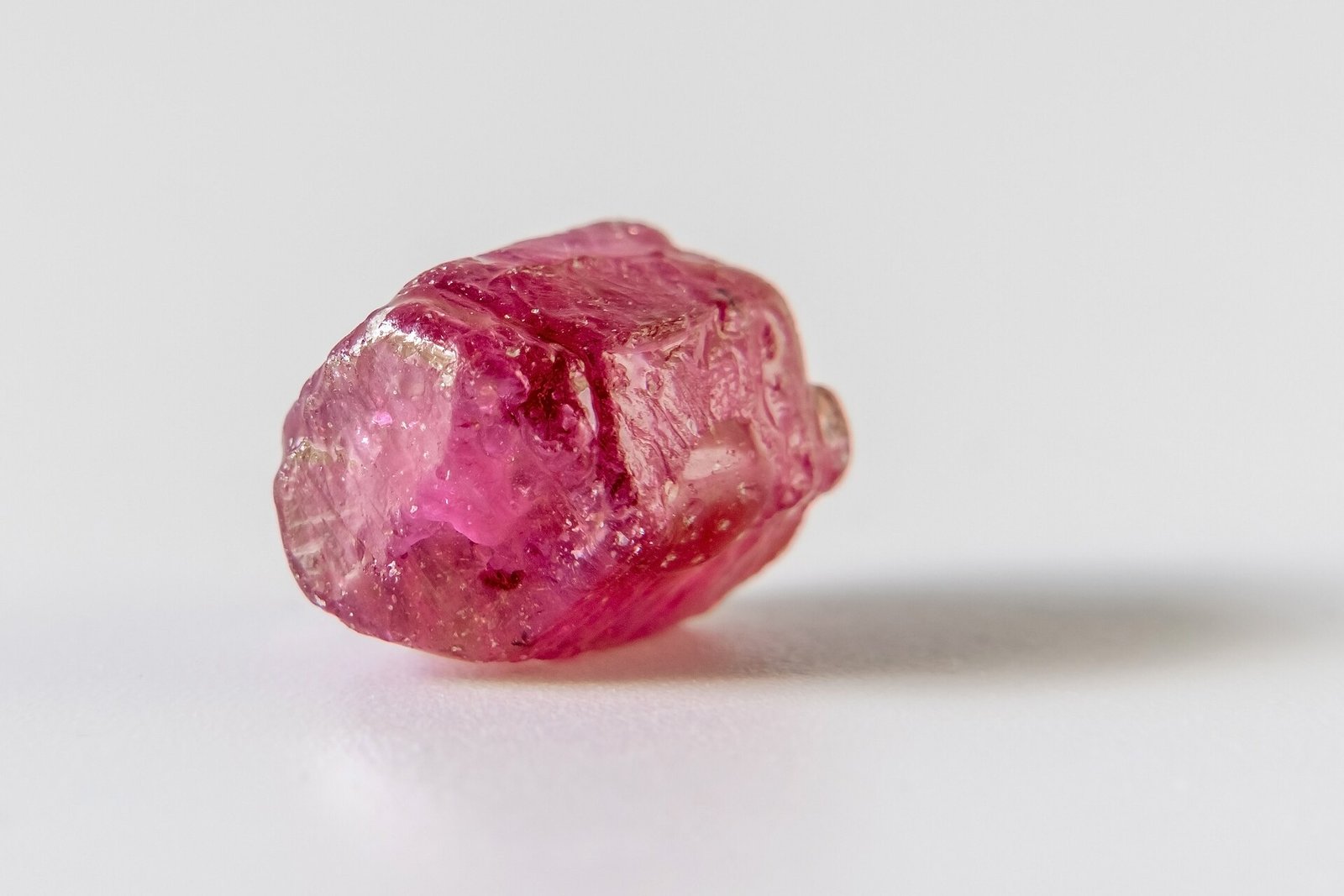
Ruby is the stone that made red precious. For most of recorded history it was the most valuable gem on earth, worth more than diamond, and even now a fine untreated Burmese ruby can outprice almost anything of the same size. It is a hard, glassy, chromium-red crystal — the same mineral as sapphire — and it carries a reputation for fire, courage and vitality that fits its colour exactly.
This guide covers what ruby actually is, why it ruled the gem world for so long, an honest look at the treatments almost every ruby has undergone, and the surprising role it played in the invention of the laser.
What is ruby?
Ruby is corundum — crystalline aluminium oxide, Al2O3 — in its red form. Pure corundum is colourless; when a few atoms of aluminium are replaced by chromium, the crystal turns red, and if that red is strong enough the stone is called a ruby. The very same chromium that colours ruby also makes emerald green in a different host mineral, which is why both gems share a certain glowing intensity.
Corundum crystallises in the trigonal system, usually as tapering barrel or tabletop-shaped hexagonal crystals. At 9 on the Mohs scale it is exceptionally hard — scratched only by diamond and moissanite — and it has no cleavage, so it wears superbly. Many rubies contain fine needles of the mineral rutile, called “silk”; when these are dense and correctly oriented they scatter light into a six-rayed star ruby. Ruby also tends to fluoresce red under ultraviolet light, the chromium glowing as it does in a ruby laser.
Ruby meaning & history
Few stones carry as much history as ruby. In Sanskrit it was ratnaraj, the king of precious stones, and Hindu tradition held that offering fine rubies to the god Krishna could earn rebirth as an emperor. Burmese warriors are said to have embedded rubies beneath their skin for invulnerability in battle, trusting the stone’s red fire to protect the life-blood it resembled. Across medieval Europe ruby stood for passion, protection and royal power, glowing in crowns and reliquaries; several famous “rubies” in the crown jewels later turned out to be red spinel, a testament to how completely the colour commanded desire.
That long association with blood, heart and courage is exactly what the modern crystal world inherited. Where softer, more recently popularised stones carry little folklore, ruby arrives already steeped in symbolism — the stone of the life-force, of ardent love and of the nerve to act. It remains the birthstone for July and a traditional gift for the fortieth wedding anniversary.
The treatment question — honestly
Ruby is safe to own, wear and handle — it is chemically inert and non-toxic. The honesty a good ruby guide owes you is about treatment, because the great majority of rubies on the market have been altered to improve their colour or clarity.
- Heat treatment is near-universal. Most rubies are heated to high temperatures to deepen the red and dissolve the rutile “silk.” This is a stable, permanent, widely accepted enhancement — but it should still be disclosed.
- Glass filling is more serious. Heavily fractured, low-grade ruby is often impregnated with lead glass to hide the cracks. These “composite rubies” look convincing but are fragile, can be damaged by everyday chemicals, and are worth a fraction of solid stones.
- Dyeing and diffusion are used on the cheapest material to fake colour that isn’t really there.
- Untreated rubies exist and command a premium. A natural, unheated ruby with a reputable laboratory report is one of the most valuable gems by weight in the world.
None of this makes ruby “fake” — a heat-treated ruby is still a real ruby. It simply means you should buy from sellers who disclose treatments, and treat a suspiciously cheap “natural ruby” with caution.
The first laser was a ruby
Ruby has a genuine claim to fame in the history of physics. It was the first gem to be synthesised commercially — by the flame-fusion process Auguste Verneuil perfected around 1902 — and in 1960 a synthetic ruby rod became the heart of the first working laser, built by Theodore Maiman. The same chromium atoms that make the crystal red can be pumped with light and made to release it again in a single coherent burst. It is a quiet reminder that the “energy” the crystal tradition reads into ruby has, in a very literal and different sense, a basis in how the mineral behaves.
Ruby healing properties
In the crystal tradition, ruby is valued as a stone of passion, courage and vitality.
People typically turn to ruby for:
- Life-force and energy. A root and heart stone, read as reviving drive, stamina and enthusiasm.
- Courage and confidence. Traditionally carried for nerve, leadership and the will to act.
- Passionate love. Associated with warmth, devotion and the heart’s fire rather than gentle tenderness.
- Motivation. Linked to overcoming inertia and committing fully to a goal.
These are traditional and symbolic uses, not medical claims. There is no scientific evidence that any crystal treats, cures or prevents any illness, and ruby has no proven effect on energy, the heart or health. Nothing here is intended to diagnose, treat or prevent any condition; concerns about circulation, energy or wellbeing belong with a doctor.
Ruby, the chakras & zodiac
Ruby’s deep red places it at the root chakra (Muladhara), the centre of grounding, survival and vitality, while its links to passionate love also connect it to the heart chakra (Anahata). It shares that warm, energising territory with garnet, carnelian and red jasper, though its extreme hardness and gem quality set it apart from those more common stones. For the wider framework, see our guide to the seven chakras and their crystals.
By zodiac, ruby is most often linked to Leo and Scorpio, read as signs of warmth, intensity and strong will.
How to use ruby
- Wear it as jewellery. At Mohs 9 with no cleavage, ruby is one of the most hard-wearing gems there is — ideal for rings worn daily.
- Keep a tumbled ruby or ruby-in-matrix on you. A popular pocket stone for its traditional links to courage and energy.
- Hold it in meditation. At the base of the spine or over the heart, for its root and heart associations.
- Place it in a workspace. A common choice for a motivating, get-things-done corner of a desk.
- Choose ruby-in-zoisite or ruby-in-fuchsite if you want an affordable, sculptural specimen rather than a faceted gem.
How to cleanse & charge ruby
- Water is fine for solid, untreated or heat-only stones. Ruby is hard and non-porous, so a brief rinse does no harm.
- Avoid water on glass-filled “composite” rubies. The lead glass in fracture-filled stones can be attacked by water, heat and household chemicals, so keep those dry.
- Smoke, sound, moonlight or selenite all suit ruby and carry no risk to any type of stone.
- Moonlight over strong sun. A moon charge is a safe default; while ruby’s colour is generally stable, there is no need to bake it in the sun.
- Never use ultrasonic or steam cleaners on filled ruby, which can shatter the glass and ruin the stone.
Our general guide to cleansing and charging crystals covers each method in more detail, including which stones tolerate water and which do not.
Types & origins
- Burmese ruby. The historic benchmark — intense, slightly bluish “pigeon’s blood” red from Mogok and Mong Hsu in Myanmar, the most prized of all.
- Star ruby. Cabochon-cut stones whose rutile silk produces a floating six-rayed star (asterism).
- Mozambique ruby. The major modern source, producing large quantities of fine red gem material.
- Ruby-in-zoisite (anyolite). Opaque green zoisite studded with red ruby crystals — a popular carving and specimen stone.
- Ruby-in-fuchsite. Red ruby set in shimmering green chromium mica, another affordable decorative form.
Fine ruby comes chiefly from Myanmar (Burma), Mozambique, Sri Lanka, Thailand and Madagascar, with historic material from India and Afghanistan. Value is driven above all by colour — a vivid, pure red is worth the most — along with clarity, cut, size and, decisively, whether the stone is treated. Untreated, top-colour rubies rank among the most expensive gemstones on earth per carat, while opaque ruby matrix and small treated stones are affordable and widely available.
Real vs fake
- Synthetic ruby. Lab-grown ruby is chemically identical to natural ruby but far cheaper; it is often flawlessly clean and may show curved growth lines instead of natural inclusions. It is real corundum, but should be sold and priced as synthetic.
- Glass and “composite” imitations. Red glass, and lead-glass-filled composite ruby, mimic the look at low cost; trapped gas bubbles and a warm, light feel are giveaways.
- Garnet and red spinel. Both are natural red stones once confused with ruby; a jeweller’s test distinguishes them, and garnet is notably softer.
- Dyed or coated stones. Pale corundum with a red coating, or dyed cracked material, fakes colour that will wear or wash away.
- The hardness tell. Genuine ruby scratches glass and virtually everything else easily; a “ruby” that scratches readily is something softer.
The workable rule: ask about treatment and, for anything expensive, insist on a laboratory report. For the wider method, see our guide to spotting dyed and imitation stones.
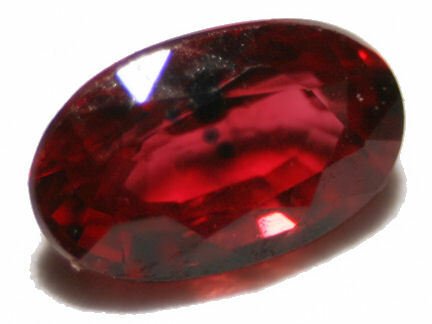
Genuine, correctly identified ruby
If you’d like a piece of your own, Minerals Kingdom offers authenticated natural ruby and ruby-in-matrix — genuine corundum, correctly labelled and honestly described, with treatments disclosed.
Ruby pairs well with
Frequently asked questions
What is ruby good for?
Traditionally, ruby is used for passion, courage, vitality and motivation — a root and heart stone. These are symbolic, traditional uses, not proven medical effects. No crystal treats illness, and ruby has no demonstrated effect on the body.
Is ruby the same as sapphire?
Chemically, yes. Both are the mineral corundum (aluminium oxide). Red corundum is called ruby; corundum of every other colour — blue, yellow, pink, colourless — is called sapphire. The difference is simply the trace element colouring the crystal.
Are most rubies treated?
Yes. The great majority of rubies are heat-treated to improve colour and clarity, which is stable and widely accepted. Some low-grade rubies are filled with lead glass to hide fractures; these “composite” stones are fragile and much less valuable. Reputable sellers disclose all treatments.
Can ruby go in water?
A solid, untreated or heat-only ruby is hard and non-porous, so a brief rinse is fine. Avoid water, heat and household chemicals on glass-filled composite rubies, which can be damaged. When in doubt, cleanse with smoke, sound, moonlight or selenite instead.
What is the difference between ruby and garnet?
They are different minerals. Ruby is corundum, extremely hard (Mohs 9) and usually more expensive; garnet is a softer silicate (around Mohs 7) with its own deep-red beauty. Garnet was often confused with ruby historically, but a simple gemmological test tells them apart.
What crystals pair well with ruby?
Other warm, energising stones suit it well — garnet for grounded vitality, carnelian for creative drive, and rose quartz to balance ruby’s fire with gentle, loving warmth.
Image credits · Hero: ruby crystal — photo W.carter, Wikimedia Commons (CC BY 4.0). Below: faceted ruby — photo Humanfeather / Michelle Jo, Wikimedia Commons (CC BY 3.0).