Moss Agate
A milky chalcedony threaded with green, moss-like mineral filaments — not a true banded agate at all — and cherished in the crystal world as the “gardener’s stone” of growth, abundance and new beginnings.
Chalcedony · Growth & abundance
In short Moss agate is a translucent variety of chalcedony — microcrystalline quartz — filled with green dendritic inclusions of iron or manganese oxides that look uncannily like moss or fern fronds. Despite the name it is not a true agate, because it has no concentric banding, and despite appearances the “moss” is mineral, not organic. Found from Montana to India, it has long been carried as an amulet by gardeners and farmers, and the crystal tradition reads it as a heart-centred stone of growth, abundance, stability and fresh starts — symbolic uses, this guide explains, rather than medical ones.
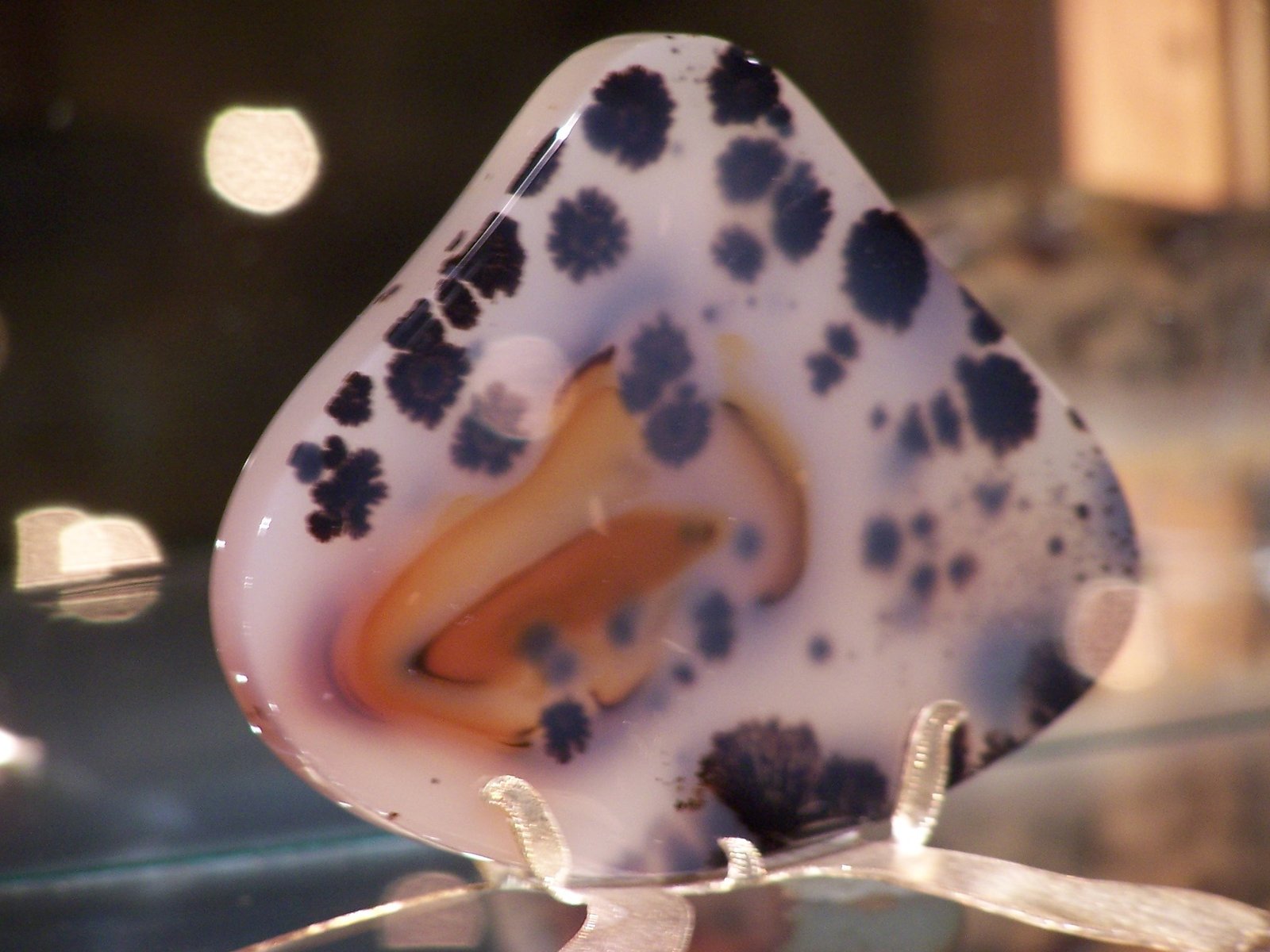
Moss agate is one of those stones that looks alive. Hold a polished slice to the light and you seem to see a tiny landscape inside it — ferns, lichen, a forest floor in miniature, all suspended in milky quartz. It is that likeness to living green that has made moss agate the classic “gardener’s stone,” a favourite of anyone drawn to growth, nature and new beginnings.
This guide covers what moss agate actually is, why it isn’t really an agate at all, where its earthy reputation comes from, and how to tell natural stone from the dyed material that sometimes borrows its name.
What is moss agate?
Moss agate is a form of chalcedony — a compact, microcrystalline variety of quartz (silicon dioxide, SiO2). Its body is a clear to milky-white quartz, and running through it are branching green filaments that resemble moss, fern or trees. Like other chalcedonies it is reasonably hard, around 6.5 to 7 on the Mohs scale, and takes a smooth polish, which makes it durable enough for everyday jewellery.
Here is the twist in its name: moss agate is not a true agate. A true agate is defined by its concentric banding, and moss agate has none — its pattern comes from scattered inclusions rather than layered growth. For that reason mineralogists often class it simply as included chalcedony. It has also long been called “Mocha stone,” after the Yemeni port of Mocha that once shipped it to Europe.
Moss agate meaning & history
Moss agate’s reputation is rooted, quite literally, in the earth. Because its inclusions look like growing plants, it has for centuries been associated with agriculture, fertile soil and the harvest. In folk tradition farmers and gardeners carried it as a talisman for healthy crops and a good growing season, hanging it in fields or on tools, and it earned the enduring nickname the “gardener’s stone.”
From that agricultural root the symbolism widened into the meanings the crystal world gives it today: growth of every kind — personal, financial, creative — along with abundance, stableness and new beginnings. It is often described as a stone that helps you feel connected to nature and quietly optimistic, a gentle emblem of things taking root and flourishing.
The “moss” explained
The green “plants” inside moss agate are not plants at all — they are dendrites, branching mineral growths of manganese and iron oxides that crystallised inside the quartz. The word comes from the Greek for “tree,” and the resemblance is pure physics: these oxides crystallise in the same fractal, branching pattern that also shapes frost on a window and lightning in the sky. In moss agate the greens and blues usually come from iron-bearing minerals, while manganese oxides give the black, tree-like dendritic agate its inky ferns. Nothing organic is involved, which is why moss agate contains no fossils and no living matter — just quartz and a beautiful accident of mineral chemistry. Understanding how those inclusions form is part of the wider story of quartz growth explored in our guide to the seven crystal systems.
Moss agate healing properties
In the crystal tradition, moss agate is valued as a stone of growth, abundance and connection to nature.
People typically turn to moss agate for:
- Growth & new beginnings. The classic stone for a fresh start, a new project or a season of change.
- Abundance. Traditionally carried to encourage prosperity and steady increase, from gardens to goals.
- Grounding in nature. Read as a calming, earth-connected stone that eases a sense of overwhelm.
- Stability & patience. Associated with slow, steady progress and quiet persistence.
These are traditional and symbolic uses, not medical claims. There is no scientific evidence that any crystal treats, cures or prevents any illness, and moss agate has no proven effect on health, wealth or wellbeing. Nothing here is intended to diagnose, treat or prevent any condition; health and life concerns belong with the appropriate qualified professional.
Moss agate, the chakras & zodiac
Moss agate’s green colour ties it firmly to the heart chakra (Anahata), the centre of love, growth and connection — the natural home for a stone so associated with living, flourishing things. It shares that green, heart-centred territory with green aventurine and jade, two other stones of growth and quiet good fortune. For the wider framework, see our guide to the seven chakras and their crystals.
By zodiac, moss agate is most often linked to Virgo, the earthy, practical sign of the harvest, and sometimes to Gemini.
How to use moss agate
- Wear it as jewellery. Durable at hardness 7, moss agate suits everyday rings, beads and pendants, and its landscapes look striking as cabochons.
- Keep one in the garden or by plants. A fitting home for the “gardener’s stone,” and a quiet reminder of growth.
- Carry a tumbled stone. A popular pocket piece for a new job, move or project — anything you want to take root.
- Hold it in meditation outdoors. Often chosen for grounding, nature-connected practice.
- Place one on your desk. As a calm, steadying focus during periods of change.
How to cleanse & charge moss agate
- Cool running water. A brief rinse is perfectly safe — moss agate is a hard chalcedony. Skip salt water and harsh chemicals.
- Moonlight or sunlight. A gentle moon charge is classic; brief morning sun is generally fine for this stable stone, though long, intense sun is best avoided.
- Smoke. Pass it through sage, palo santo or incense smoke.
- Earth. Fittingly, some people rest moss agate briefly on soil or bury it overnight to “reset” it.
- Selenite or sound. Safe, contact-free alternatives for a quick, dry cleanse.
Our general guide to cleansing and charging crystals covers each method in more detail.
Types & origins
- Green moss agate. The classic milky stone with green, moss-like dendrites — the most familiar type.
- Montana moss agate. Prized American material from the Yellowstone River gravels, often with red (iron) and black (manganese) inclusions in clear quartz.
- Dendritic agate. Very clear chalcedony with striking black, tree-like manganese dendrites — closely related and often grouped with moss agate.
- Blue and multicolour moss agate. Softer bluish or mixed inclusions, popular for jewellery.
- Tree agate. An opaque white cousin with green veining, sometimes sold under the same umbrella.
Fine moss agate comes chiefly from India and the United States (the famous Montana material), with more from Brazil, Uruguay and central Europe. It is an inexpensive to moderately priced stone, chosen for the beauty and depth of its “landscapes” rather than for rarity — value is driven by clear quartz, vivid dendrites and a well-composed pattern.
Real vs fake
- Dyed chalcedony. Plain grey agate is sometimes dyed a vivid, uniform green and sold as “moss agate”; genuine moss is irregular and three-dimensional, not an even wash of colour.
- Glass imitations. Moulded green glass with swirled “moss” lacks real crystal feel, warms quickly in the hand and may show bubbles.
- Mislabelled banded agate. True banded agate is sometimes sold as moss agate; real moss agate shows scattered dendrites, not concentric rings.
- The pattern tell. Genuine moss agate has natural, branching inclusions of differing depth; a flat, repetitive or suspiciously uniform “moss” deserves a second look.
The workable rule: trust natural, irregular, three-dimensional dendrites. If the green is flat and even, suspect dye or glass — for the wider method, see our guide to spotting dyed and imitation stones.
Genuine, undyed moss agate
If you’d like a piece of your own, Minerals Kingdom offers authenticated natural moss agate — genuine dendritic chalcedony with its true, undyed “landscapes,” honestly described.
Moss agate pairs well with
Frequently asked questions
What is moss agate good for?
Traditionally, moss agate is used for growth, abundance, new beginnings and connection to nature — a heart-centred “gardener’s stone.” These are symbolic, traditional uses, not proven medical effects. No crystal treats illness, and moss agate has no demonstrated effect on health or wealth.
Is moss agate a real agate?
Not strictly. A true agate is defined by concentric banding, which moss agate lacks. It is really an included chalcedony — the same quartz family — whose “moss” is scattered mineral dendrites rather than layered bands.
Is the moss inside real plant material?
No. The green “moss” is mineral, not organic — dendritic growths of manganese and iron oxides that happen to branch like plants. Moss agate contains no fossils and no living matter, just quartz and these mineral inclusions.
Can moss agate go in water?
Yes. Moss agate is a chalcedony with a hardness of about 7 and tolerates a brief rinse in cool water. Avoid prolonged soaking, salt water and harsh chemicals, and dry it gently afterwards.
How can I tell if moss agate is dyed?
Natural moss agate has irregular, three-dimensional green dendrites of varying depth. Dyed stone tends to show a flat, uniform, unnaturally vivid green, sometimes pooling in cracks. If the colour looks too even, suspect dye.
What crystals pair well with moss agate?
Other growth and grounding stones suit it well — green aventurine for luck and opportunity, jade for prosperity, and red jasper for patient, rooted stamina. Together they make a coherent green-and-earth grouping.
Image credits · Hero and buy-box: Montana moss agate — specimen and photo Brooks Britt (Bhbritt54), public domain, via Wikimedia Commons.