Jade
Two unrelated minerals, one commercial name — and a market in which the adjective in front of the word “jade” is usually the warning.
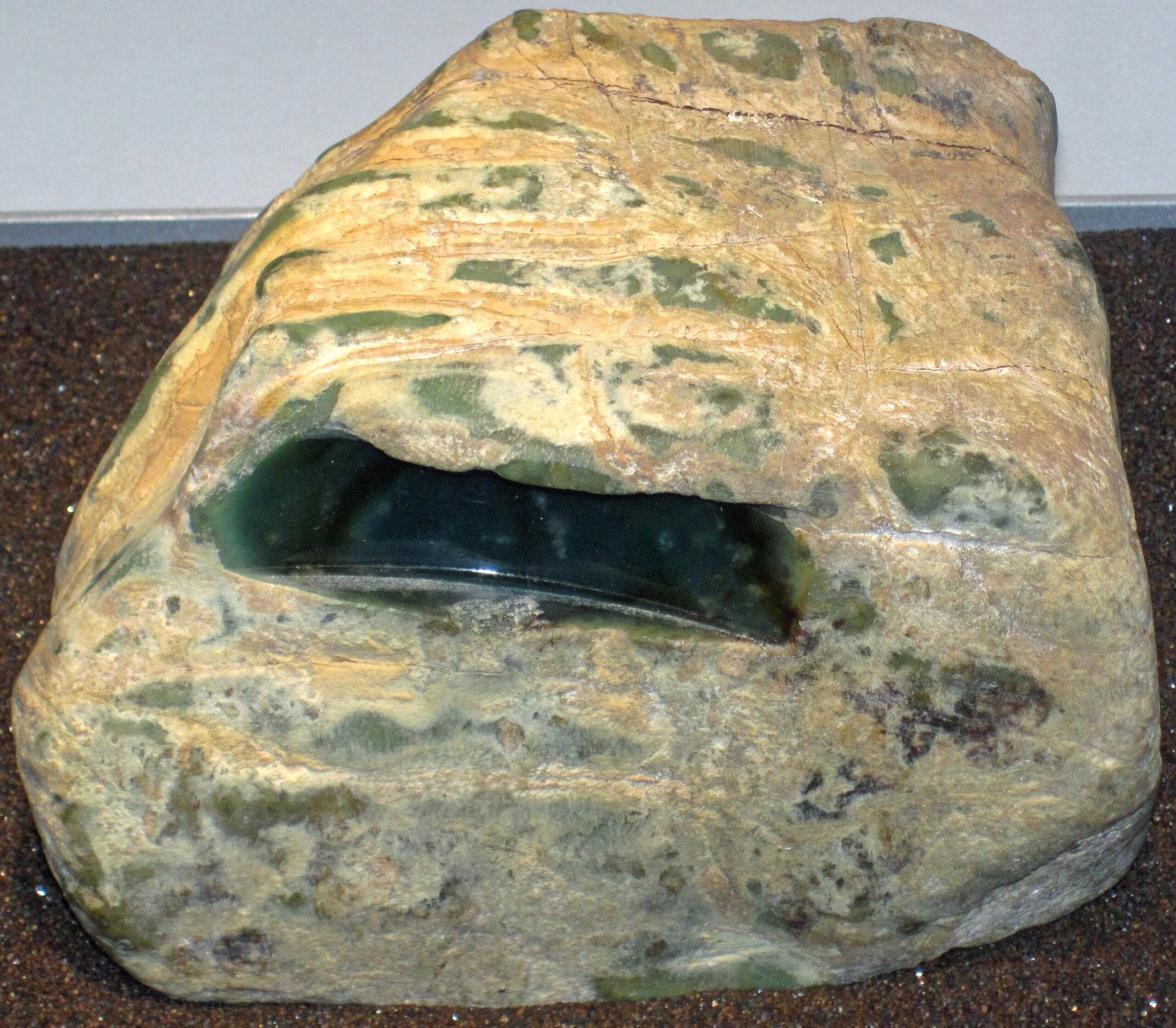
Jadeite · The stone of harmony
“Jade” is a commercial term covering two completely different minerals: jadeite, a pyroxene, and nephrite, an amphibole. They are mineralogically unrelated and were only told apart in 1863, by the French mineralogist Alexis Damour. Both are genuine jade. Jadeite is harder; nephrite is tougher — and those are not the same property. In the crystal tradition jade is the stone of harmony, luck and protection, a heart crystal. Buying it is where things get complicated: learn the A/B/C grades and the list of stones sold under borrowed names, and you will avoid almost every trap.
Almost every gemstone name refers to one mineral. Jade refers to two — and they have nothing to do with each other chemically. One is a pyroxene, the other an amphibole. They happen to look alike, they happen to behave alike under a carver’s tools, and for several thousand years nobody had any reason to separate them. When the separation finally came, in 1863, it did not make one of them fake. It made “jade” a category rather than a mineral.
That single fact explains most of the confusion in the jade market, and a good deal of the dishonesty in it too. This guide covers what the two minerals actually are, the grading system every buyer should know, the long list of stones sold under a borrowed name, and how jade is used in the crystal tradition.
What is jade? The two minerals
Jade is a name applied to two distinct materials.
Jadeite is a sodium aluminium silicate, NaAlSi₂O₆, and belongs to the pyroxene group. It forms only in subduction zones, where rock is squeezed at very high pressure and comparatively low temperature — which is why gem-quality deposits are rare and isolated. Its Mohs hardness is 6.5 to 7, and its texture is granular to interlocking-granular.
Nephrite is a calcium magnesium iron silicate of the amphibole group — a compact, felted mass of the tremolite–actinolite series. Its Mohs hardness is 6 to 6.5, a little lower than jadeite’s.
They are not varieties of one another. They share no structural relationship. They were treated as one substance until 1863, when the French mineralogist Alexis Damour analysed material from both traditions and demonstrated that the “jade” of Chinese antiquity and the “jade” arriving from Burma were chemically different minerals. Chinese connoisseurs had long distinguished the two by feel and appearance; Damour supplied the chemistry.
Hardness is not toughness
This is the detail most often garbled, and it is worth getting right.
Hardness is resistance to scratching. Toughness is resistance to breaking, chipping and fracture. They are independent properties — diamond is the hardest natural material and will still shatter if struck on a cleavage plane.
Jadeite is the harder of the two. But nephrite is the tougher, and by a considerable margin: it is routinely described as among the toughest of all natural mineral materials. The reason is structural. Nephrite is built from densely interlocked fibrous crystals in a felted, matted arrangement, so a crack cannot travel cleanly through it — the energy of an impact is dispersed across a large, irregular surface instead of running along a single fracture front. Jadeite’s interlocking granular texture is also very tough, just less so.
Practically: nephrite tolerates knocks that would chip most gems, which is exactly why Neolithic cultures on three continents made axe heads and adzes out of it. A stone you can drop is a different proposition from a stone you can scratch.
Jade meaning & history
Jade has one of the longest continuous human histories of any material, and it belongs to several traditions at once.
In China, nephrite — the character 玉 (yù) — has been worked for well over five thousand years, long before jadeite arrived. It was not a decorative stone but a moral one. Confucian writing associates jade with the virtues of the junzi, the person of character: its warmth read as benevolence, its firmness as intelligence, its unyielding edge as justice, its ring when struck as music. The saying that a gentleman does not part with his jade is a statement about integrity, not jewellery. Jadeite reached China from Burma only towards the end of the eighteenth century, where it became known as fei cui and quickly acquired its own prestige.
In Aotearoa New Zealand, nephrite is pounamu, and it is a taonga — a treasure — of Māori. This is living cultural heritage belonging to specific peoples, not a marketing category. Pounamu occurs in Te Waipounamu, the South Island, whose name means the waters of greenstone. Carved forms such as hei-tiki are held with deep significance, often passed down across generations, and pieces carry their own whakapapa. Under the Ngāi Tahu (Pounamu Vesting) Act 1997, the Crown vested ownership of naturally occurring pounamu within the tribal takiwā in Ngāi Tahu, who are its kaitiaki, its guardians. If you buy pounamu, buy it from Māori sources with proper provenance; Ngāi Tahu operate an authentication and traceability system for exactly this reason.
In Mesoamerica, the jade was jadeite, sourced chiefly from the Motagua Valley in Guatemala. The Olmec and later the Maya valued it above gold, using it for masks, ear flares and funerary offerings — including the celebrated blue-green material now traded as “Olmec blue”.
In the modern crystal tradition, drawing chiefly on the Chinese associations, jade is read as a stone of harmony, luck, prosperity and protection.
Jade healing properties
In the crystal tradition, jade is valued above all as a stone of balance and steady good fortune rather than dramatic change.
People typically turn to jade for:
- Harmony. The classic use — smoothing friction at home, at work, in a household.
- Luck and prosperity. Long associated with steady, accumulating good fortune rather than windfalls.
- Protection. Traditionally worn as an amulet, particularly for travellers and children.
- Heart-centred calm. A green heart-chakra stone, read as encouraging generosity and even temper.
- Longevity and continuity. The stone of things that last, and of things handed on.
These are traditional and symbolic uses, not medical claims. Jade is widely sold for the kidneys — its Spanish name piedra de ijada, “stone of the side”, comes from a sixteenth-century belief that it cured kidney complaints, and the word nephrite preserves the same idea. There is no scientific evidence that any crystal treats illness, and none that jade affects the kidneys, the immune system or anything else. Jade rollers and gua sha tools are pleasant and may feel soothing; the effect is massage and cool temperature, not the mineral. Nor will any stone bring you luck or money. Enjoy jade as one of the great materials of human craft; nothing here is intended to diagnose or cure any condition, and health concerns belong with a doctor.
Jade, the chakras & zodiac
Green jade belongs to the heart chakra (Anahata), which is the seat of compassion, balance and connection in the chakra system. The tradition reads it as the quietest of the heart stones — less about opening than about steadying. Lavender jade is sometimes assigned to the crown, and white jade to general clearing, though these attributions are modern and much less settled.
By zodiac, jade is most often associated with Taurus and Libra, both Venus-ruled signs, and sometimes with Virgo. If you want to place it in a fuller system, our guide to the seven chakras and their crystals sets out where the green stones sit.
How to use jade
Most traditional uses treat jade as something you keep and carry rather than something you deploy.
- Wear it every day. The classic use — a bangle or pendant worn continuously rather than for occasions.
- Keep a piece at home. Traditionally placed for harmony in shared living space.
- Carry it as a travel amulet. One of the oldest and most persistent uses.
- Hold it in meditation. At the heart; jade warms in the hand and holds that warmth.
- Give it as an heirloom. Jade’s real cultural weight is in what gets passed on.
- Handle bangles carefully. Tough, but not unbreakable — a jadeite bangle dropped on tile will very often crack.
How to cleanse & charge jade
Untreated jade is one of the easiest stones to care for. Treated jade is not — see the grades below.
- Water. Warm water and mild soap are perfectly safe for natural jade.
- Moonlight. A gentle overnight charge.
- Smoke. Sage, palo santo or incense.
- Selenite. Rest it on a plate.
- Sound. Nephrite famously rings when struck — that resonance is itself part of the tradition.
Avoid steam and ultrasonic cleaners, harsh chemicals, and prolonged strong sunlight. If your piece is Type B or B+C, treat it as fragile: the polymer inside it degrades with heat, ultraviolet light, household solvents and simple time, and it can yellow, craze or lose its polish. Nothing you do will reverse that.
Types, grades & origins
Two things are being described whenever jade is sold: what mineral it is, and what has been done to it. Both matter.
The material
- Imperial jade. The most valuable jade there is — jadeite of a vivid, saturated emerald green with high translucency, coloured by traces of chromium, the same element that colours emerald. Historically it comes from the jadeite belt of Kachin State in northern Myanmar. Very little material meets the standard.
- Burmese jadeite. Myanmar has long supplied the great majority of gem-quality jadeite. This trade has been associated with serious human rights concerns and with the financing of armed conflict, documented over many years by Global Witness and others, and Burmese jadeite has been subject to import restrictions and sanctions at various points — the US Tom Lantos Block Burmese JADE Act dates from 2008. The legal and political picture has shifted repeatedly and remains complex and evolving, so we will not state a current status here: if you are buying, check the rules that apply in your own jurisdiction at the time of purchase, and ask sellers for real provenance rather than a country name.
- Guatemalan jadeite. From the Motagua Valley — the Mesoamerican source, including “Olmec blue”.
- Chinese nephrite. Hetian (Khotan) material from Xinjiang, including the prized creamy “mutton fat” white.
- Pounamu. New Zealand nephrite, a taonga of Māori — see above.
- Lavender, white, black and “moss-in-snow” jadeite. Colour varieties, some of them very collectable.
- Maw sit sit. A chromium-rich green rock from Myanmar, related to jadeite deposits but a distinct material with its own name.
The A/B/C grades — the single most useful thing to know
This system applies to jadeite, and it describes treatment, not quality. A poor-colour Type A stone is still Type A. Get this right and you have avoided most of the trouble in the jade market.
- Type A. Natural, untreated jadeite. Traditional surface waxing is accepted and does not disqualify a stone; nothing else has been done to it. Only Type A jadeite holds value over time.
- Type B. Bleached and polymer-impregnated. The stone is treated with strong acid to strip out brown and grey iron staining, which leaves it porous and weakened, then impregnated with a polymer resin to fill the voids and restore apparent clarity. The colour that remains is natural; the structure is not. Type B jadeite is physically weaker than Type A and it degrades over time — the resin yellows, crazes and breaks down under heat and ultraviolet light. It is worth a small fraction of comparable Type A.
- Type C. Dyed. Colour has been added. Dyes typically fade, and in many cases the material has been bleached and impregnated as well.
- Type B+C. Both — bleached, impregnated and dyed. Common in cheap green bangles.
Two points that matter. First, selling Type B and Type C jade is entirely legal in most markets provided the treatment is disclosed; treated jade is a legitimate product at a legitimate price. The fraud is non-disclosure — selling a treated stone as natural, at natural prices. Second, and less comfortably: you cannot reliably tell the grades apart by eye. Some Type B shows a slightly glassy over-bright look or a faint acid-etched surface network under magnification, and dye can sometimes be seen pooling in fractures, but good treatment defeats casual inspection. Confident identification needs a laboratory — typically infrared spectroscopy to detect polymer. For any jadeite bought at a serious price, insist on a certificate from an independent gemmological laboratory, and note that a certificate saying “jadeite” says nothing at all about treatment. It must state Type A.
Is jade rare or valuable?
Jade covers an extraordinary price range — from a few pounds to the highest prices ever paid for any coloured stone.
Nephrite is generally affordable. It is far more widely distributed than jadeite, and fine carving rather than the material usually carries the value. Pounamu is priced for its cultural and artistic significance, not its scarcity as a mineral.
Jadeite spans everything. Ordinary opaque green jadeite is inexpensive. Fine Type A jadeite is expensive. Imperial jade is among the most valuable gem materials on earth, and top jadeite necklaces have sold at auction for tens of millions of dollars.
Value in jadeite is driven by colour (pure, vivid, evenly distributed green with no grey), translucency (the great multiplier — semi-transparent material is worth many times opaque material of the same colour), texture (fine and even, giving a smooth lustrous polish) and, decisively, being untreated. Jade is also sold by the piece rather than by carat weight, which makes comparison harder than for faceted gems.
How to tell real jade from fake
There are two separate problems here, and they need separate answers. The first is treated jade sold as natural. The second is other minerals sold as jade. Neither is rare.
The tell-tale: an adjective in front of “jade”
Here is the most useful heuristic in the whole trade. Genuine jade is sold as jade, jadeite or nephrite. When a name attaches a place or a qualifier to the front — “Indian jade”, “Korean jade”, “Malaysia jade”, “Transvaal jade”, “new jade”, “African jade”, “mountain jade”, “olive jade” — it is almost always not jade at all. These are trade misnomers, and gemmological bodies regard them as an abuse of terminology precisely because they exist to borrow jade’s prestige.
- Serpentine — sold as “new jade”, “Korean jade” or “olive jade”. The commonest substitute by far. It is a genuinely attractive stone in its own right, but it is much softer (roughly 2.5–5.5 on Mohs, depending on the variety) and it is too soft to scratch glass, where jade will scratch it. Serpentine also feels slightly greasy and is noticeably lighter in the hand than jadeite.
- Aventurine — sold as “Indian jade”. A green quartzite. The giveaway is aventurescence: tiny glittering flecks of included fuchsite mica catching the light. Real jade never sparkles like that. We have a full profile of green aventurine, which is well worth having for itself.
- Dyed quartzite — sold as “Malaysia jade”. Pale quartzite stained a vivid, slightly unconvincing green. Dye concentrates along grain boundaries, visible with a loupe.
- Prehnite — rarely mis-sold deliberately, but genuinely easy to confuse with pale nephrite: soft translucent green with a similar glow. It has its own profile here.
- Hydrogrossular garnet — sold as “Transvaal jade”. A dense green garnet from southern Africa, often with dark spots.
- Glass. The crudest substitute. Look for round internal bubbles, mould seams, a uniformity of colour that real jade never quite has, and a stone that warms instantly in the hand rather than staying cool.
- Dyed marble, chalcedony and plastic also circulate, particularly in tourist markets and cheap bangles.
What you can check yourself
- Heft. Jadeite is dense — specific gravity around 3.3–3.4, nephrite around 2.9–3.0. Serpentine (~2.6) and quartzite (~2.65) feel distinctly light for their size. Hold two pieces and the difference is obvious.
- Coolness. Real jade feels cold and stays cold for a moment against the skin. Plastic and glass warm up almost at once.
- The tap test. Two pieces of nephrite struck together give a clear resonant chime; a jadeite bangle suspended and tapped rings rather than clunks. A dull thud suggests a filled, cracked or substitute stone. This is a hint, not a proof.
- Texture under a loupe. Nephrite shows a fibrous, felted structure and an oily lustre when polished; jadeite shows a granular, slightly dimpled “orange peel” surface and a more vitreous lustre. Glass shows neither.
- The scratch test on glass. Both jades will scratch window glass; serpentine will not. Do this on a scrap of glass, never on the stone.
- Price. A large, richly green, translucent bangle for a modest sum is not Type A jadeite. It is the single most reliable indicator on this list.
- Get a certificate. For anything expensive, an independent laboratory report stating Type A is the only real assurance. Nothing you can do at home replaces it.
Genuine, correctly identified jade
If you’d like a piece of your own, Minerals Kingdom offers authenticated natural jade — with the mineral properly named rather than hidden behind a trade term.