Spinel
A hard, brilliant magnesium-aluminium oxide that grows in near-perfect octahedra — the gem behind several of history’s most famous “rubies” — and read in the crystal world as a stone of renewal, vitality and fresh hope.
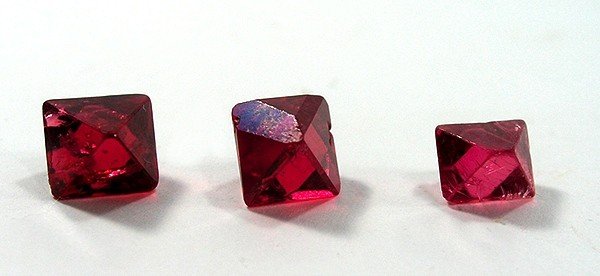
Spinel · Renewal & vitality
In short Spinel is a magnesium aluminium oxide (MgAl2O4) that crystallises in the cubic system, typically as sharp, glassy octahedra. At 8 on the Mohs scale, with no real cleavage, it is one of the toughest gems available, and it comes in an unusually wide palette — red and pink from chromium, blues from iron and, very rarely, cobalt. For centuries red spinel was simply called ruby, and some of the most celebrated “rubies” in royal collections are in fact spinel. Unlike much ruby and sapphire, gem spinel is usually sold untreated. The crystal tradition reads it as a stone of renewal, vitality, hope and stamina — symbolic uses, this guide explains, rather than medical ones.
Spinel is the great understudy of the gem world. For most of history it shared a name, a reputation and a place in royal crowns with ruby, until mineralogists realised the two red stones were entirely different minerals. Rather than fade, spinel has slowly earned a following of its own: a hard, brightly lustrous gem that grows into near-perfect geometric octahedra, comes in almost every colour, and rarely needs any treatment to look its best.
This guide covers what spinel actually is, how it came to be mistaken for ruby in some of the world’s most famous jewels, what the crystal tradition says about it, and how to tell natural spinel from the synthetic material that has been used to imitate other gems for more than a century.
What is spinel?
Spinel is a magnesium aluminium oxide with the formula MgAl2O4. The name also covers a wider spinel group of oxide minerals that share the same atomic arrangement — magnetite and chromite are members — but in the gem and crystal world “spinel” means the magnesium-aluminium species. It typically forms in marble, where limestone has been baked and recrystallised by heat and pressure, and in certain igneous and metamorphic rocks; because it is hard and chemically resistant, it also survives weathering and collects in gem gravels alongside sapphire and ruby.
Spinel crystallises in the cubic (isometric) system, most often as sharp octahedra — two four-sided pyramids joined base to base — and it gives its name to a classic form of crystal twinning, the “spinel twin,” in which two octahedra grow as mirror images of each other. Cubic symmetry has a practical consequence: spinel is singly refractive, so unlike ruby or sapphire it shows the same colour from every direction. Its high symmetry is a textbook example of the patterns explained in our guide to the seven crystal systems.
At 8 on the Mohs scale, spinel is harder than quartz and as hard as topaz, and it has no easy cleavage, so it wears very well in rings and everyday jewellery. Its colour comes from trace elements: chromium gives red and hot pink (often with a red fluorescence under ultraviolet light), iron gives lavender, grey and steely blues, and a trace of cobalt produces the rare, intensely saturated “cobalt spinel.”
Spinel meaning & history
The origin of the name is not settled. It is usually traced to the Latin spina, “thorn,” for the sharp points of its octahedral crystals, though some writers link it to the Greek word for “spark,” for the stone’s brilliance. In the medieval trade, fine red and pink spinel from the mines of Badakhshan (today on the border of Afghanistan and Tajikistan) was known as “balas ruby,” a name taken from the region, and it was traded across Central Asia and into Europe as a royal stone.
In 2016 spinel was added as a birthstone for August, alongside peridot, by the American Gem Trade Association and Jewelers of America — a sign of how far its reputation has come. In the modern crystal world, its symbolism grew from that history of reinvention: a gem that stepped out of ruby’s shadow and was valued for itself. It is read as a stone of renewal, revitalisation and hope, of fresh energy after a difficult stretch, and of the stamina to keep going.
The “ruby” that wasn’t
Before modern gemmology, gems were mostly sorted by colour, so any fine red stone could be called a ruby. Only in the late eighteenth century did mineralogists, using crystal form and physical properties, establish that spinel and corundum are different minerals. By then, red spinels had already become some of the most prized jewels of royal houses.
The best-known example is the Black Prince’s Ruby, the large red stone set at the front of the Imperial State Crown in the British Crown Jewels. According to the Royal Collection, it is in fact a red spinel, with a recorded history going back to the fourteenth century. The Timur Ruby, another historic “ruby” in the Royal Collection, is likewise a spinel. Spinel and ruby can look strikingly similar, but they differ in chemistry, crystal system and optics — ruby is doubly refractive corundum at Mohs 9, spinel singly refractive at Mohs 8 — and a gemmologist separates them easily with standard instruments.
Spinel healing properties
In the crystal tradition, spinel is valued as a stone of renewal, vitality and encouragement.
People typically turn to spinel for:
- Renewal & fresh starts. Its signature association — a stone for turning a page, recovering momentum and beginning again with hope.
- Vitality & stamina. Red spinel especially is read as a stone of energy and endurance for long, demanding projects.
- Encouragement & confidence. Linked to optimism, self-belief and the courage to step out of someone else’s shadow.
- Colour-specific meanings. Pink spinel is tied to warmth and affection, blue and violet spinel to calm and clear expression, black spinel to grounding and protection.
These are traditional and symbolic uses, not medical claims. There is no scientific evidence that any crystal treats, cures or prevents any illness, and spinel has no proven effect on energy, mood or health. Crystals are not a substitute for medical care; nothing here is intended to diagnose, treat or prevent any condition, and health concerns belong with a qualified professional.
Spinel, the chakras & zodiac
Because spinel comes in so many colours, its chakra links follow the stone in your hand. Red spinel is placed at the root chakra (Muladhara), the centre of grounding and vitality, sharing that warm territory with ruby and garnet. Pink spinel is read as a heart chakra (Anahata) stone, close in spirit to pink tourmaline, while blue and violet spinel are linked to the throat and third eye, alongside sapphire. For the wider framework, see our guide to the seven chakras and their crystals.
By zodiac, spinel is most often linked to Aries and Sagittarius, read as fire signs that suit a stone of renewed energy and forward momentum.
How to use spinel
- Wear it as jewellery. Hard, tough and singly refractive, spinel is an excellent everyday ring or pendant stone, and far more affordable than ruby of similar colour.
- Keep a rough octahedron on you. Small natural spinel crystals are inexpensive and make a striking pocket or desk piece.
- Hold it in meditation. Red at the base of the spine, pink over the heart, blue at the throat — according to its colour associations.
- Choose spinel in marble if you prefer a display specimen: sharp crystals sitting in white matrix show exactly how the mineral forms.
- Use it as a “fresh start” stone. Many people choose spinel to mark a new job, a move or a recovery period, as a symbolic reminder of renewal.
How to cleanse & charge spinel
- Water is fine. Spinel is hard, non-porous and chemically stable, so a rinse in lukewarm water with a drop of mild soap is safe for solid stones.
- Take care with matrix pieces. Spinel set in marble sits in a soft, acid-sensitive host rock — avoid soaks, salt and anything acidic.
- Smoke, sound, moonlight or selenite all suit spinel and carry no risk to any form of the stone.
- Sunlight is generally safe for spinel’s colour, though a moonlight charge remains the gentlest default for any crystal.
- Ultrasonic cleaning is usually safe for untreated, inclusion-free faceted spinel, but skip it for included stones and matrix specimens.
Our general guide to cleansing and charging crystals covers each method in more detail, including which stones tolerate water and which do not.
Types & origins
- Red spinel. The classic historic “ruby” colour, coloured by chromium; the finest, most vivid reds are the most valued.
- Pink and “Jedi” spinel. Hot pink to neon pink-red material, much of it from Mahenge in Tanzania and Mogok in Myanmar.
- Lavender, grey and blue spinel. Iron-coloured stones in soft, cool tones, increasingly popular in modern jewellery.
- Cobalt spinel. A rare, intensely saturated blue coloured by cobalt, notably from Vietnam and Sri Lanka.
- Black spinel. Opaque, iron-rich material, faceted as an affordable, hard-wearing black gem.
Gem spinel comes chiefly from Myanmar (Mogok), Sri Lanka, Tanzania, Vietnam (Luc Yen), Tajikistan (the historic Badakhshan mines) and Madagascar. Value is driven by colour first — vivid red, neon pink and cobalt blue command the highest prices — then clarity, cut and size. Small rough octahedra and pale or greyish faceted stones remain affordable, while top-colour stones in larger sizes are genuinely rare.
Real vs fake
- Synthetic spinel. Flame-fusion synthetic spinel has been made for over a century and is used to imitate many gems, including aquamarine, blue topaz and sapphire; it is often flawless and may show unusual colours with no natural counterpart.
- Glass imitations. Red or pink glass mimics spinel cheaply but is softer, feels warm in the hand and may contain round gas bubbles.
- Mislabelled red stones. Garnet, ruby and spinel are still confused; a gemmologist’s refractometer or polariscope tells them apart in minutes.
- Treatment is uncommon. Most natural spinel is sold untreated; heated or filled stones exist but are the exception, and should be disclosed.
- The hardness tell. Real spinel scratches glass and quartz easily; a “spinel” that scratches readily is something softer.
The workable rule: buy from sellers who state natural versus synthetic, and get a laboratory report for any expensive stone. For the wider method, see our guide to spotting dyed and imitation stones.
Genuine, correctly identified spinel
If you’d like a piece of your own, Minerals Kingdom offers authenticated natural spinel — correctly labelled as natural rather than synthetic, and honestly described.
Spinel pairs well with
Frequently asked questions
What is spinel good for?
Traditionally, spinel is used for renewal, vitality, stamina and encouragement, with meanings that shift with its colour. These are symbolic, traditional uses, not proven medical effects. No crystal treats illness, and spinel has no demonstrated effect on health or energy.
Is spinel the same as ruby?
No. Ruby is red corundum (aluminium oxide, Mohs 9, doubly refractive); spinel is magnesium aluminium oxide (Mohs 8, singly refractive). For centuries they were confused because both can be a vivid red, which is why famous jewels such as the Black Prince’s Ruby turned out to be spinel.
Is spinel a valuable gemstone?
Fine spinel in vivid red, neon pink or cobalt blue is rare and can be expensive, though usually well below ruby or sapphire of similar quality. Paler colours, black spinel and small rough crystals are affordable and widely available.
Is spinel usually treated?
Most natural gem spinel is sold untreated, which sets it apart from ruby and sapphire, where heating is routine. Synthetic spinel, however, is common and should always be sold as synthetic.
Can spinel go in water?
Yes. Solid spinel is hard and non-porous, so lukewarm water and mild soap are fine. Keep spinel-in-marble specimens dry and away from acids, as the marble host rock is soft and acid-sensitive.
What crystals pair well with spinel?
Other hard, colourful gems suit it well — ruby for passion, garnet for grounded vitality and sapphire for calm focus. Together they make a coherent grouping of durable stones with shared gem-gravel origins.
Sources · Gemological Institute of America (GIA), spinel description; Mindat.org, spinel mineral data; Royal Collection Trust, Imperial State Crown and the Timur Ruby; American Gem Trade Association, August birthstone (2016).
Image credits · Hero and buy-box: red spinel octahedra — specimen photo Rob Lavinsky / iRocks.com, via Wikimedia Commons (CC BY-SA 3.0).