
Pearl
The classic gem grown inside a living animal — layer upon layer of shimmering nacre built by an oyster or mussel around an irritant — and read in the crystal world as a soft, lunar stone of calm, sincerity and emotional balance.
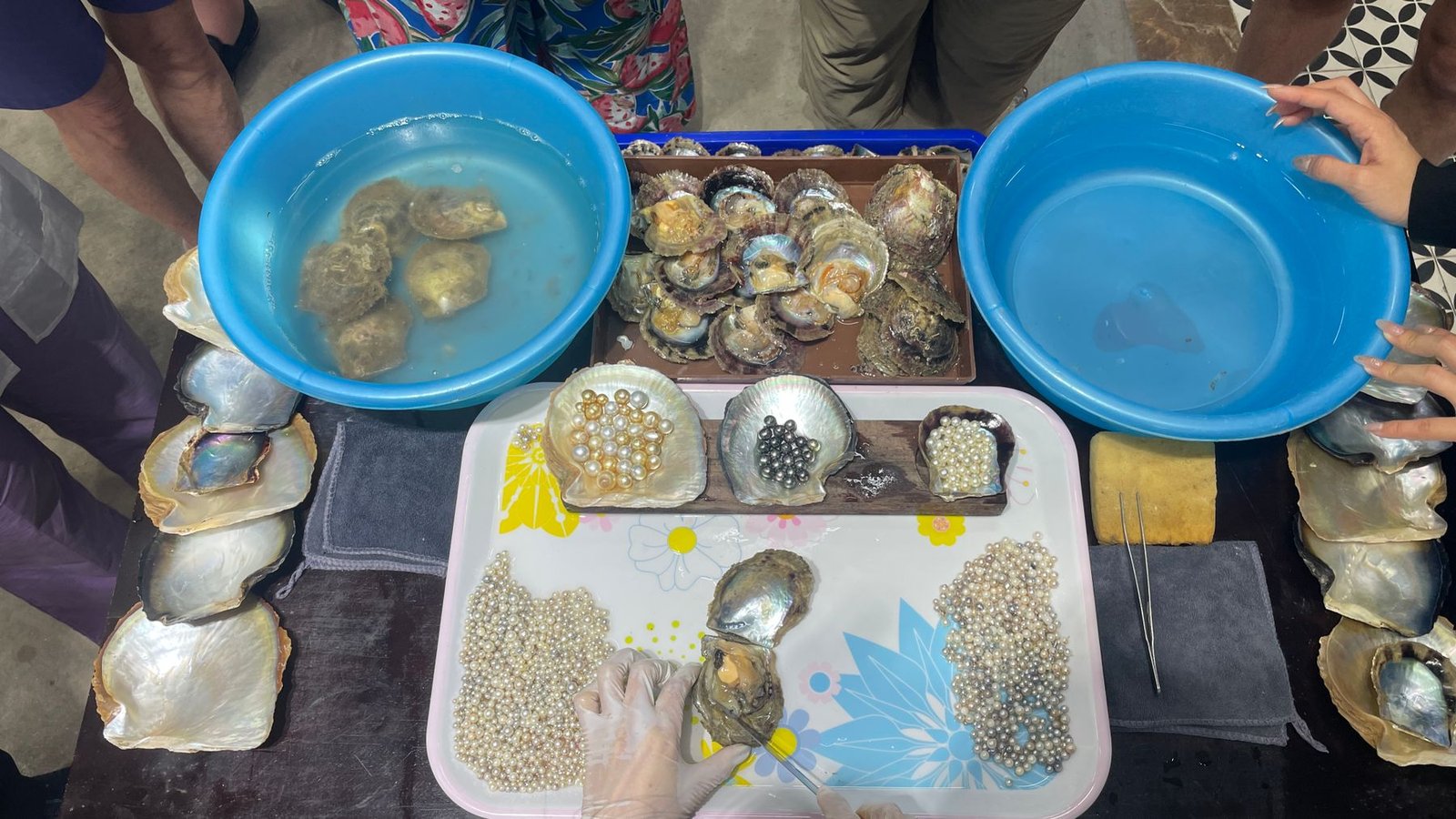 Organic gem · Calm & sincerity
In short A pearl is an organic gem, not a mineral crystal dug from the ground. It forms inside a mollusc — usually an oyster or freshwater mussel — which coats an irritant or implanted nucleus with concentric layers of nacre: microscopic platelets of aragonite (calcium carbonate, CaCO3) bound by an organic protein called conchiolin. That layered structure creates the soft inner glow gemmologists call orient. Pearls are soft (2.5–4.5 Mohs) and sensitive to acids, and today almost all pearls on the market are cultured rather than natural. The crystal tradition reads pearl as a lunar stone of calm, sincerity, purity and emotional balance — symbolic uses, this guide explains, rather than medical ones.
Almost every other stone in this encyclopedia was made by geology — heat, pressure, water and time. The pearl was made by an animal. Quietly, over months or years, a mollusc wraps an unwelcome intruder in thousands of translucent layers until it becomes one of the most coveted objects in human history. It needs no cutting and no polishing to shine, which is perhaps why so many cultures have seen it as a symbol of purity, patience and hidden beauty.
This guide covers what a pearl actually is, how natural and cultured pearls differ, the long history behind its lunar reputation, how to care for such a delicate gem, and the simple tests that separate real pearls from glass and plastic imitations.
What is a pearl?
A pearl is a biogenic gem — a hard, rounded concretion produced inside the soft tissue of a living shelled mollusc. When an irritant such as a parasite or a fragment of tissue enters the animal, specialised cells from the mantle form a pearl sac around it and begin secreting nacre, the same iridescent material that lines the inside of the shell and is known as mother-of-pearl.
Nacre is a natural composite. Under the microscope it looks like a brick wall: tiny hexagonal tablets of aragonite, a crystalline form of calcium carbonate, stacked in thin layers and cemented by conchiolin, a horn-like protein. Each tablet is thinner than the wavelength of visible light, so light entering the pearl is reflected and diffracted from layer after layer. The result is the pearl’s characteristic lustre and the subtle rainbow shimmer, or orient, that no other gem quite matches. Because a pearl is built from aragonite rather than grown as a single crystal, it has no crystal system of its own — a nice contrast with the minerals described in our guide to how crystals form.
Physically, pearls are soft — around 2.5 to 4.5 on the Mohs scale — with a specific gravity of roughly 2.6 to 2.85. They are tough rather than hard: a pearl resists cracking surprisingly well, but its surface scratches easily and dissolves in acids, including vinegar, lemon juice and even acidic perspiration.
Pearl meaning & history
Pearls are among the oldest gems used by humans. Pearl ornaments have been found in archaeological sites around the Persian Gulf dating back several thousand years, and for centuries the Gulf, the Red Sea and the Gulf of Mannar between India and Sri Lanka supplied the world’s finest natural pearls. Roman writers treated them as the ultimate luxury; the naturalist Pliny the Elder recorded the famous story of Cleopatra dissolving a priceless pearl in vinegar to win a wager — a tale best read as legend, though it does reflect a real chemical truth about how acids attack nacre.
Because pearls come from the sea and glow softly like the moon, many traditions linked them with water, the moon and the feminine. In parts of Asia they were associated with wisdom and with dragons guarding precious knowledge; in European symbolism they came to stand for purity, modesty and fidelity, which is why pearls became classic bridal jewellery. Today the pearl is the traditional June birthstone (shared with moonstone and alexandrite) and the gift associated with a 30th wedding anniversary.
In the modern crystal world, pearl’s meaning grows directly from how it forms: a grain of irritation patiently transformed into something beautiful. It is read as a stone of calm, sincerity, patience and turning difficulty into wisdom.
Natural vs cultured pearls
This is the single most important thing to understand before buying. A natural pearl forms entirely by chance, without human help. Natural pearls are now extremely rare: overfishing and pollution exhausted most historic beds in the early twentieth century, and fine natural pearls today sell mainly at auction.
A cultured pearl forms in exactly the same way — the mollusc still produces all the nacre — but a pearl farmer starts the process by inserting a nucleus or a piece of mantle tissue. Pioneered in Japan at the end of the nineteenth century, most famously by Kokichi Mikimoto, along with researchers such as Tokichi Nishikawa and Tatsuhei Mise, pearl culturing transformed pearls from a gem for royalty into something many people can own. Cultured pearls are real pearls; they are not imitations. They are simply not natural, and an honest seller always says which is which.
Within cultured pearls there are two main methods. Bead-nucleated pearls (Akoya, South Sea, Tahitian) grow around a polished shell bead, so their value depends heavily on nacre thickness. Tissue-nucleated pearls, typical of Chinese freshwater pearls, are almost solid nacre. Laboratories distinguish natural from cultured pearls with X-ray imaging, which reveals the internal growth structure or the bead inside.
Pearl healing properties
In the crystal tradition, pearl is valued as a gentle stone of calm, sincerity and emotional balance.
People typically turn to pearl for:
- Calm & emotional steadiness. Its soft lustre and watery origin are read as soothing, linked to a quieter, more settled mood.
- Sincerity & integrity. Long a symbol of purity and honesty, pearl is associated with truthfulness and loyalty in relationships.
- Patience & transformation. Made from an irritant slowly turned into beauty, it is carried as a reminder that difficulty can become wisdom.
- Lunar & feminine symbolism. Traditionally tied to the moon, the tides and cycles, and often chosen for milestones such as weddings and births.
These are traditional and symbolic uses, not medical claims. There is no scientific evidence that any crystal or gem treats, cures or prevents any illness, and pearl has no proven effect on health, mood or relationships. Nothing here is intended to diagnose, treat or prevent any condition; health and life concerns belong with the appropriate qualified professional.
Pearl, the chakras & zodiac
Pearl’s white, moon-like glow links it most often to the crown chakra (Sahasrara), the centre associated with clarity and spiritual connection, and its watery, lunar symbolism to the sacral chakra (Svadhisthana), linked with emotion and creativity. It shares this soft, luminous territory with moonstone and selenite. For the wider framework, see our guide to the seven chakras and their crystals.
By zodiac, pearl is most often linked to Cancer — the moon-ruled water sign — and to Gemini, whose birth month of June it shares as a birthstone.
How to use pearl
- Wear it as jewellery. Pearls are meant to be worn: skin contact and gentle use help keep nacre from drying out, and a single pearl pendant or studs make an easy everyday piece.
- Keep a loose pearl or mother-of-pearl piece as a touchstone. A quiet reminder of patience and calm on a desk or bedside table.
- Hold it in meditation. Often chosen for moon rituals, gratitude practice or reflection on a difficult situation.
- Mark a milestone. Pearls have a long tradition as wedding, birth and anniversary gifts — symbolic heirlooms rather than talismans.
- Pair it with other lunar stones. Combined with moonstone or selenite on an altar for a soft, luminous grouping.
How to cleanse & care for pearl
- Last on, first off. Put pearls on after perfume, hairspray, make-up and lotions, and take them off first — these products can dull or etch the nacre.
- Wipe after wearing. A soft, slightly damp cloth removes perspiration, which is mildly acidic. Let them dry flat before storing.
- Never use salt, vinegar, lemon or chemical cleaners, and avoid ultrasonic and steam cleaners entirely.
- Don’t soak strung pearls. Water weakens and stretches the silk thread; good strands are knotted between pearls and restrung every few years.
- Smoke, sound, moonlight or selenite are ideal symbolic cleansing methods — dry, contact-free and safe for such a delicate gem. Avoid long sunbathing, which can dry and fade pearls.
- Store separately in a soft pouch, away from harder gems that can scratch them, and never seal them airtight for years.
Our general guide to cleansing and charging crystals covers each method in more detail, including which stones tolerate water and which do not.
Types & origins
- Akoya pearls. The classic round white-to-cream pearl with a sharp, mirror-like lustre, cultured in the Pinctada fucata oyster, mainly in Japan and China.
- South Sea pearls. Large, silky white to golden pearls from the big Pinctada maxima oyster, farmed in Australia, Indonesia and the Philippines.
- Tahitian pearls. Naturally dark pearls — grey, green, aubergine and “peacock” — from the black-lipped Pinctada margaritifera, cultured mainly in French Polynesia.
- Freshwater pearls. Grown in mussels, overwhelmingly in China; mostly solid nacre, in many shapes and soft pastel colours, and the most affordable type.
- Keshi & baroque pearls. Irregular, often all-nacre pearls prized for their unique shapes and intense lustre.
Pearl value is judged on seven classic factors: size, shape, colour, lustre, surface quality, nacre quality and matching within a strand. Round, highly lustrous, clean pearls with thick nacre command the highest prices; baroque and freshwater pearls offer real pearls at gentler prices.
Real vs fake
- The tooth test. Gently rub a pearl against the edge of your front teeth: real pearls, natural or cultured, feel slightly gritty because of their nacre layers; glass and plastic imitations feel smooth.
- Look at the drill hole. Under a loupe, real pearls show a crisp hole and sometimes visible layers; imitations often show chipped or flaking coating around the hole.
- Weight and temperature. Plastic imitations feel noticeably light and warm quickly; real pearls feel cool at first and pleasantly heavy.
- Perfect uniformity is suspicious. Real pearls show small variations in shape, surface and colour; a strand of absolutely identical beads may be glass or shell-based imitation.
- Treatments. Many cultured pearls are bleached, polished, dyed or irradiated to alter colour. These are common but should always be disclosed.
The workable rule: ask whether pearls are natural, cultured or imitation, and which treatments they have had — an honest seller will tell you. For the wider method, see our guide to spotting dyed and imitation stones.
Genuine, honestly described pearls
If you’d like a piece of your own, Minerals Kingdom offers authentic pearls and mother-of-pearl — clearly labelled as natural or cultured, with any treatment disclosed.
Pearl pairs well with
Frequently asked questions
What does a pearl symbolise?
Traditionally, pearls symbolise purity, sincerity, wisdom and calm, and are linked with the moon and the sea. Because a pearl grows from an irritant slowly coated in nacre, it is also read as a symbol of patience and of turning hardship into beauty. These are symbolic meanings, not proven effects.
Is a pearl a crystal?
Not in the strict sense. A pearl is an organic gem produced by a living mollusc. It is, however, built from crystalline aragonite platelets bound by protein, so it sits at the meeting point between biology and mineralogy.
Are cultured pearls real pearls?
Yes. Cultured pearls are grown by real oysters or mussels, which secrete all of the nacre; farmers only start the process by inserting a nucleus or piece of tissue. They are different from natural pearls, which form by chance, and from imitations made of glass, shell powder or plastic.
Can pearls get wet?
A brief wipe with a damp cloth is fine, but avoid soaking strung pearls, swimming in chlorinated or salt water with them, and any acidic or chemical cleaner. Water weakens the silk thread, and acids can etch nacre. Dry methods like moonlight, sound or selenite are safer for symbolic cleansing.
What is the birthstone for June?
June has three birthstones: pearl, moonstone and alexandrite. Pearl is the most traditional, and it is also the classic gift for a 30th wedding anniversary.
What crystals pair well with pearl?
Other soft, luminous stones suit it well — moonstone for its lunar symbolism, selenite for gentle dry cleansing, and rose quartz for warmth and compassion. Together they make a coherent, calming grouping.
Sources · Gemological Institute of America (GIA), “Pearl” gem encyclopedia and pearl description system; Mindat.org, “Aragonite” mineral data; Pliny the Elder, Natural History, Book IX; CIBJO Pearl Book (nomenclature of natural, cultured and imitation pearls).
Image credits · Hero and buy-box: pearl oysters and harvested pearls at a pearl farm — photo Clifford Coulter, via Pexels (Pexels license).