
Dumortierite
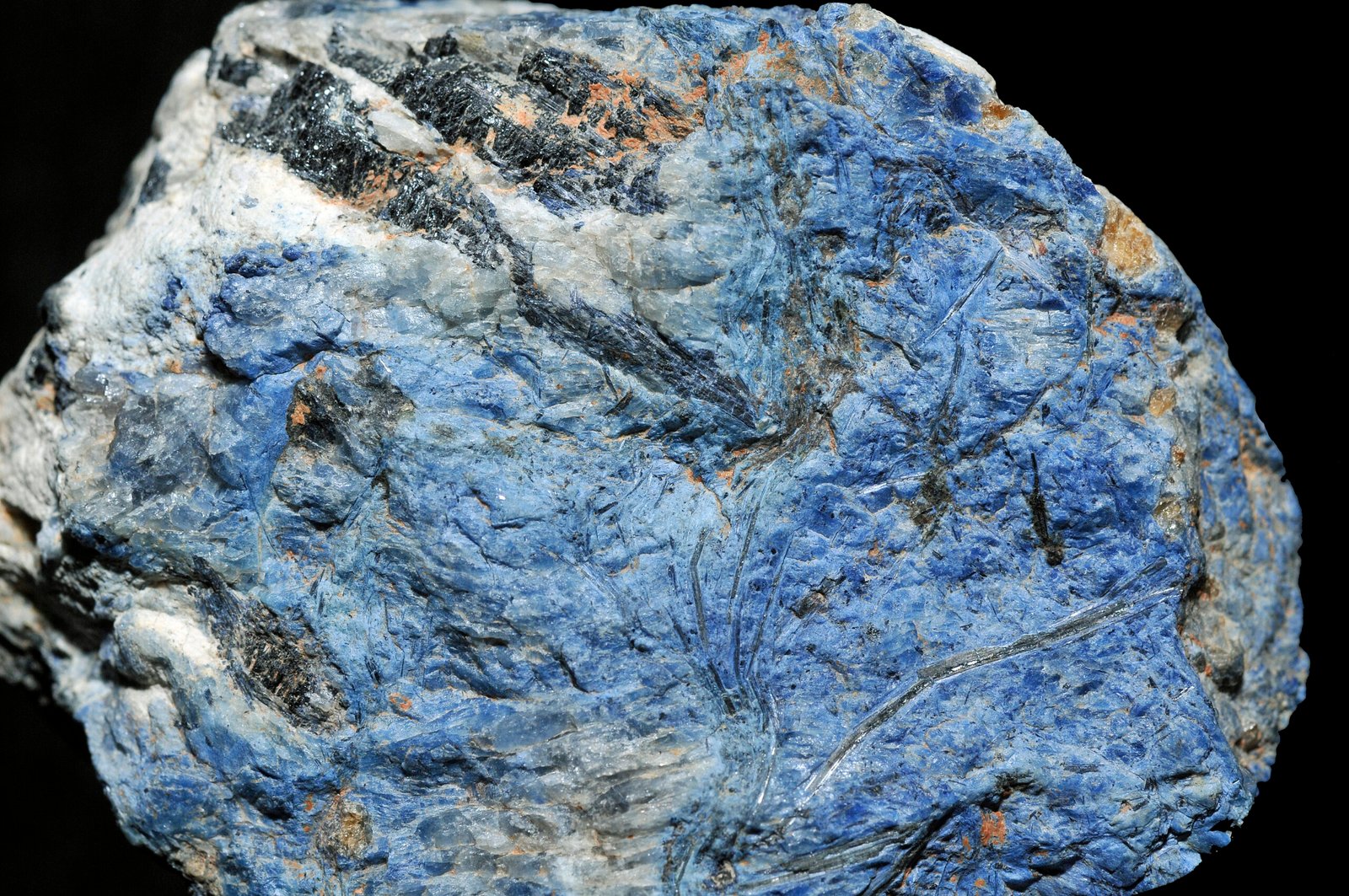
A deep-blue aluminium borosilicate that grows in dense, felt-like fibres — often woven right through quartz — and read in the crystal world as the stone of patience, order and calm, disciplined thinking.
Aluminium borosilicate · Patience & clarity
In short Dumortierite is a deep-blue to violet-blue aluminium borosilicate, a hard, fibrous mineral (Al7BO3(SiO4)3O3) that usually grows as dense, felt-like masses rather than showy crystals. Its blue comes from a trace of iron and titanium, and it is often found permeating quartz to make the gem material sold as “dumortierite quartz” or “blue denim” stone. At 7 and above on the Mohs scale it is tough and takes a fine polish. The crystal tradition reads it as a throat-and-third-eye stone of patience, mental discipline, focus and calm communication — symbolic uses, this guide explains, rather than medical ones.
Dumortierite is a stone that hides in plain sight. It rarely forms the sparkling crystals collectors chase; instead it gathers as a dense, deep-blue felt of fibres, or seeps invisibly into quartz until a whole boulder turns the colour of well-worn denim. Quiet, tough and unshowy, it has become the crystal world’s emblem of patience — the stone you reach for when you need to slow down, think straight and see a long job through.
This guide covers what dumortierite actually is, where its name and its reputation for patience come from, how it colours quartz into a popular gem material, and how to tell the genuine stone from the sodalite, lapis and dyed look-alikes it is so often confused with.
What is dumortierite?
Dumortierite is an aluminium borosilicate — a nesosilicate with the formula Al7BO3(SiO4)3O3, meaning it contains the relatively unusual element boron alongside aluminium and silica. It crystallises in the orthorhombic system, but almost never as clean, isolated crystals: far more often it forms fibrous, columnar or felt-like masses that look woven or matted. That fibrous habit, and its underlying orthorhombic symmetry, place it among the many patterns explored in our guide to the seven crystal systems.
It is a genuinely hard mineral, sitting at about 7 on the Mohs scale and reaching 8.5 in some material — as hard as, or harder than, quartz. That toughness, combined with a rich blue colour, is what makes it valued for beads, cabochons and carvings despite its lack of gem-quality faceted crystals.
Dumortierite meaning & history
Dumortierite is a relative newcomer by name. It was first described in 1881, from Chaponost near Lyon in France, and named after the French palaeontologist Eugène Dumortier. Without an ancient pedigree of myth to draw on, its symbolism has grown up in the modern crystal-and-wellbeing world around a single, consistent idea: patience.
It is frequently called the “stone of patience,” and by extension a stone of order, stamina and level-headed persistence. Where fiery stones are read as sparks of drive, dumortierite is treated as the slow, steady blue that helps you organise your thoughts, stick with a difficult task and keep your composure when things drag on. That reputation for calm, disciplined thinking is the thread running through everything the tradition says about it.
The blue & “dumortierite quartz”
Dumortierite’s signature blue comes from a charge-transfer effect between trace iron and titanium sitting in its structure — the same broad mechanism that colours several other blue minerals. Depending on the exact chemistry it ranges from pale sky-blue through vivid cobalt to violet, and more rarely into pink and brown.
Its most familiar form on the market, though, is not massive dumortierite at all but “dumortierite quartz” — ordinary quartz shot through with countless fine dumortierite fibres until the whole stone reads blue. Sold as “blue quartz” or “blue denim stone,” it is cut into beads, tumbles and cabochons, and its mottled, cloudy blue is often mistaken for sodalite or even lapis lazuli. Knowing that much of the “dumortierite” you meet is really quartz coloured by dumortierite explains why its hardness and feel can vary from piece to piece.
Dumortierite healing properties
In the crystal tradition, dumortierite is valued as a stone of patience, mental clarity and disciplined focus.
People typically turn to dumortierite for:
- Patience & persistence. Its signature association — a steadying stone for long, slow or repetitive tasks that test your resolve.
- Focus & orderly thinking. Read as helping arrange scattered thoughts, aiding study, planning and clear-headed problem-solving.
- Calm communication. A throat-chakra stone, linked to speaking with composure and expressing yourself precisely.
- Intuition & insight. Connected to the third eye, and to a cool, level-headed kind of judgement rather than fiery impulse.
These are traditional and symbolic uses, not medical claims. There is no scientific evidence that any crystal treats, cures or prevents any illness, and dumortierite has no proven effect on the mind, mood or memory. Nothing here is intended to diagnose, treat or prevent any condition; concerns about focus, stress or wellbeing belong with a suitably qualified professional.
Dumortierite, the chakras & zodiac
Dumortierite’s blue places it at the throat chakra (Vishuddha), the centre of communication and honest expression, while its deeper violet-blue tones and its links to insight carry it up to the third-eye chakra (Ajna) of intuition and clear seeing. It shares that cool blue territory with sodalite, lapis lazuli and the affordable violet-blue iolite. For the wider framework, see our guide to the seven chakras and their crystals.
By zodiac, dumortierite is most often linked to Leo, where its steadying, patient character is read as a useful counterweight to the sign’s fire.
How to use dumortierite
- Wear it as jewellery. Hard and durable, dumortierite and blue-denim quartz suit rings, beads and pendants for everyday wear.
- Keep a tumbled stone on you. A popular pocket piece for its traditional links to patience and a steady head.
- Hold it in meditation. At the throat or brow, for its throat and third-eye associations.
- Place one on your desk. A common choice for study, writing, revision or any long task that needs concentration.
- Choose a polished massive piece or blue quartz if you want a sculptural, affordable stone rather than a faceted gem.
How to cleanse & charge dumortierite
- Water is fine for solid stones. Dumortierite is hard and non-porous, so a brief rinse in cool water does no harm.
- Skip salt water and long soaks, especially on porous quartz-hosted pieces, where seams could trap moisture.
- Smoke, sound, moonlight or selenite all suit it and carry no risk to any type of stone.
- Moonlight over strong sun. A moon charge is a safe default; brief sun is fine, but prolonged intense sun is best avoided.
- Rest it on the earth if you like an earthy reset for a stone so associated with grounded patience.
Our general guide to cleansing and charging crystals covers each method in more detail, including which stones tolerate water and which do not.
Types & origins
- Massive blue dumortierite. Dense, felt-like fibrous material in deep to violet blue — the classic form, cut into cabochons and carvings.
- Dumortierite quartz (“blue quartz”). Quartz permeated by dumortierite fibres, sold as “blue denim” stone for beads and tumbles.
- Violet-blue dumortierite. Richer purplish material, prized where the colour is even and saturated.
- Pink & brown dumortierite. Less familiar iron-poor or altered material, collected for interest.
- Gem crystals. Rare, small, transparent crystals — a collector’s curiosity rather than a commercial gem.
Fine dumortierite comes chiefly from Madagascar, Brazil and Nevada in the United States, with historic material from France and further stones from Sri Lanka, Namibia and Canada. It is an inexpensive to moderately priced stone, chosen for the depth and evenness of its blue rather than for rarity — the most valued material is a rich, uniform cobalt-to-violet with few dull or greyish patches.
Real vs fake
- Dyed stones. Pale quartz, howlite or magnesite dyed a flat, even blue is sometimes passed off as dumortierite; genuine colour is uneven and fibrous, not a uniform wash.
- Mislabelled blue minerals. Sodalite, lapis and lazulite are all confused with dumortierite; each differs in structure, and lapis carries golden pyrite flecks dumortierite lacks.
- Glass and composites. Blue glass and reconstituted material mimic the look but warm quickly in the hand and may show bubbles.
- The hardness tell. Real dumortierite scratches glass easily; a “dumortierite” that is soft or scratches readily is something else, probably dyed.
The workable rule: look for uneven, fibrous blue and test the hardness. For the wider method, see our guide to spotting dyed and imitation stones.
Genuine, correctly identified dumortierite
If you’d like a piece of your own, Minerals Kingdom offers authenticated natural dumortierite and blue-quartz — correctly labelled and honestly described, with any treatments disclosed.
Dumortierite pairs well with
Frequently asked questions
What is dumortierite good for?
Traditionally, dumortierite is used for patience, focus, orderly thinking and calm communication — a throat-and-third-eye stone. These are symbolic, traditional uses, not proven medical effects. No crystal treats illness, and dumortierite has no demonstrated effect on the mind or memory.
Is dumortierite the same as sodalite or lapis lazuli?
No. All three are blue, but they are different minerals. Dumortierite is a hard aluminium borosilicate; sodalite and lapis are softer and chemically distinct, and lapis carries golden pyrite flecks. They are frequently confused, which is why hardness and texture help tell them apart.
What is dumortierite quartz or “blue quartz”?
It is ordinary quartz permeated by countless fine dumortierite fibres, which turn the whole stone blue. Sold as “blue quartz” or “blue denim” stone, it is a common, affordable form used for beads, tumbles and cabochons.
Can dumortierite go in water?
A solid dumortierite is hard and non-porous, so a brief rinse in cool water is fine. Avoid salt water and long soaks, especially on quartz-hosted pieces with seams. When in doubt, cleanse with smoke, sound, moonlight or selenite instead.
Is dumortierite rare or expensive?
Massive dumortierite and blue quartz are affordable and widely available. Truly transparent gem crystals are rare and collectible, but most material is priced modestly, with the best colour — a rich, even cobalt-to-violet — commanding a small premium.
What crystals pair well with dumortierite?
Other blue stones of clarity and communication suit it well — sodalite for logic and order, lapis lazuli for wisdom, and iolite for affordable clear sight. Together they make a coherent throat-and-third-eye grouping.
Image credits · Hero and buy-box: blue dumortierite (Madagascar) — photo Géry Parent, via Wikimedia Commons (CC BY-SA 3.0).