Vanadinite
Barrel-shaped crystals in a startling traffic-cone red — a genuinely soft lead mineral, prized by collectors and read in the crystal world as a stone of raw energy. Handled honestly, including the part where it contains lead.
Vanadate · Energy & drive
In short Vanadinite is a lead vanadate mineral with the formula Pb5(VO4)3Cl, and — perhaps surprisingly — a member of the apatite group, the same structural family as the mineral in your teeth. It forms glassy, barrel-shaped hexagonal crystals in vivid red and orange, most famously from Mibladen and Midelt in Morocco, and is a minor ore of the metal vanadium. In the crystal tradition it is a root and sacral stone of energy, endurance and motivation. Because it genuinely contains lead, this guide treats safe handling as seriously as symbolism — no elixirs, wash your hands, and keep it away from children and pets.
Vanadinite is one of the most photogenic minerals a collector can own: clusters of small, perfectly hexagonal barrels in a red so bright it looks artificial, scattered across pale rock like beads of enamel. It is also a heavy, soft, lead-bearing mineral — a stone to admire and handle sensibly rather than to wear against the skin all day.
This guide covers what vanadinite actually is, how a Norse goddess ended up lending it a name, an honest look at the lead question, and the care a soft toxic-element mineral genuinely requires.
What is vanadinite?
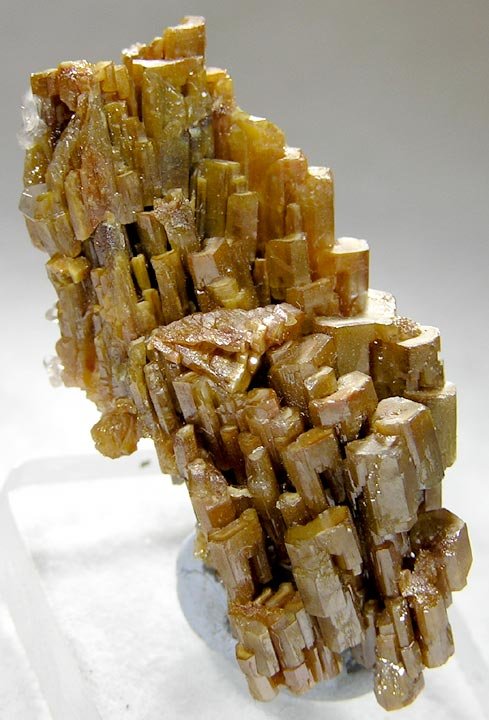
Vanadinite is a lead vanadate, formula Pb5(VO4)3Cl, and a member of the apatite group — the same broad structural family as apatite and pyromorphite, with vanadium and lead taking the places occupied by phosphorus and calcium in ordinary apatite. That relationship explains its neat hexagonal crystals, which typically grow as short, stubby barrels or prisms perched on a matrix of pale rock.
It is a soft, heavy mineral, only about 3 to 4 on the Mohs scale, so it scratches very easily — a fingernail is close and a coin will mark it. Its high lead content makes it noticeably dense for its size, and it carries a bright, almost greasy lustre. Colours run from the celebrated blood-red and orange of Moroccan crystals through brown to yellow, with the reddest, most translucent material the most prized. Vanadinite is also a genuine industrial mineral: it is a minor ore of vanadium, the metal used to toughen steel.
Vanadinite meaning & history
Vanadinite has an unusually charming naming story. The element vanadium, which gives the mineral its identity, was named after Vanadis — another name for Freyja, the Norse goddess of beauty — because its compounds form such beautiful colours. The mineral itself was described in the first half of the nineteenth century as chemists worked out the new element, and it has been an ore of both vanadium and lead ever since.
Like charoite, vanadinite is a modern entrant to the crystal world rather than an ancient talisman, and it carries almost no classical folklore. Its metaphysical reputation is built on the sheer intensity of its colour: a fiery red-orange that the crystal community naturally attached to the lower chakras, to physical vitality and to the idea of igniting stalled energy. The best-known specimens — dense red barrels on cream-coloured barite from Mibladen, Morocco — did more than anything to make the stone popular with collectors and, later, with crystal enthusiasts.
The lead question — honestly
Here is the fact most sellers skate over: vanadinite is a lead mineral. Lead is toxic, and it is right there in the formula. That does not mean a specimen on a shelf is dangerous — simply owning and occasionally handling a solid vanadinite crystal poses very little risk — but it does mean a few sensible rules are worth following, much as they do for a copper mineral such as azurite.
- Never make elixirs or “gem water.” Do not soak vanadinite in water you intend to drink, or leave it in a water bottle. This is the single most important rule.
- Wash your hands after handling. Especially before eating, and especially if the specimen is dusty or crumbly.
- Keep it away from children and pets, who may put things in their mouths.
- Don’t sand, grind or inhale dust from it, and store it where it won’t shed powder onto food surfaces.
Follow those and vanadinite is a perfectly reasonable collector’s stone. Ignore them — by drinking its “elixir,” for instance — and you are needlessly handling a source of lead. Enjoy it as the striking specimen it is, and let its energy be symbolic rather than something you swallow.
Vanadinite healing properties
In the crystal tradition, vanadinite is valued as a stone of energy, endurance and motivation.
People typically turn to vanadinite for:
- Physical energy. A root-and-sacral stone, read as reviving stamina and drive when motivation flags.
- Focus and follow-through. Associated with channelling scattered effort into steady, purposeful action.
- Beating procrastination. Traditionally used to help start and finish demanding tasks.
- Grounded confidence. Linked to feeling capable, present and rooted in the body.
These are traditional and symbolic uses, not medical claims. There is no scientific evidence that any crystal treats, cures or prevents any illness, and vanadinite has no proven effect on energy or health. Remember too that it is a lead mineral: never take it internally in any form. Nothing here is intended to diagnose, treat or prevent any condition; fatigue and other health concerns belong with a doctor.
Vanadinite, the chakras & zodiac
Vanadinite’s fiery colour places it at the root chakra (Muladhara), the centre of grounding and survival energy, extending up to the sacral chakra (Svadhisthana) of drive and creativity. It shares that warm, energising role with carnelian, red jasper and tiger’s eye, though its lead chemistry sets it firmly apart from those quartz-family stones. For the wider framework, see our guide to the seven chakras and their crystals.
By zodiac, vanadinite is most often linked to Virgo and Aries, read as signs of practical drive and initiative.
How to use vanadinite
- Keep it as a display specimen. Its softness and lead content make it far better suited to a shelf or desk than to daily wear.
- Hold it briefly in meditation. At the base of the spine, for its traditional links to energy and grounding, then wash your hands afterwards.
- Place it in a workspace. A popular choice for a motivating, get-things-done corner of a desk.
- Prefer sealed or bezelled settings if you ever have it made into jewellery, and avoid wearing it directly against damp skin.
- Store it apart from harder stones, which will scratch its soft surface almost instantly.
How to cleanse & charge vanadinite
- Prefer dry methods. Smoke from sage or palo santo, moonlight, sound or selenite are all ideal and never touch the stone with water.
- Avoid water cleansing. Vanadinite is soft, and soaking a lead mineral is best avoided; if it needs dusting, a dry, soft brush is enough.
- Moonlight over sun. A gentle overnight moon charge is safe; strong sun adds nothing and can heat a specimen.
- Handle gently. Its fragile barrels chip easily, so cleanse it in place rather than tumbling it around.
- Never use ultrasonic or steam cleaners, which would damage a soft mineral and disperse fine particles.
Types & origins
- Moroccan red vanadinite. The classic — vivid red barrels on cream barite from Mibladen and Midelt, the material most collectors picture.
- Arizona vanadinite. Historic American specimens, often deeper red-brown, from the old lead districts.
- Endlichite. A yellow-green, arsenic-bearing variety of vanadinite, prized for its unusual colour.
- Brown and yellow material. Less saturated crystals, more affordable and common on matrix.
- Micro-clusters. Sparkling carpets of tiny barrels, popular as inexpensive display pieces.
Fine vanadinite comes chiefly from Morocco, with notable specimens also from Arizona in the United States, Namibia and Mexico. It is inexpensive to moderately priced, chosen for the intensity of its colour and the perfection of its crystals rather than for durability or rarity. Value is driven by colour saturation — bright, translucent red being the most prized — along with crystal size, lustre and how attractively the barrels sit on their matrix. Because it is soft and lead-bearing, vanadinite is very much a collector’s and display stone rather than an everyday gem.
Real vs fake
- Enhanced colour. Vanadinite is cheap enough that outright fakes are rare, but dull specimens are occasionally oiled or coated to boost the red; a suspiciously glossy, sticky surface is a warning sign.
- Confusion with wulfenite and crocoite. Other bright orange-red minerals are sometimes mislabelled vanadinite; true vanadinite forms stubby hexagonal barrels, not the thin plates of wulfenite or the long needles of crocoite.
- The heft tell. Its high lead content makes vanadinite feel noticeably heavy for its size — lighter, plasticky “red crystals” are imitations.
- The softness tell. At Mohs 3 to 4 it scratches easily; a bright red “crystal” that resists a fingernail or coin is probably something harder and unrelated.
The workable rule: trust the shape and the weight. Genuine vanadinite is a dense, soft cluster of small hexagonal barrels in fiery red — if a stone is light, hard or oddly uniform, treat the label with caution.
Genuine, correctly identified vanadinite
If you’d like a piece of your own, Minerals Kingdom offers authenticated natural vanadinite — genuine lead-vanadate crystals, correctly labelled and honestly described.
Vanadinite pairs well with
Frequently asked questions
What is vanadinite good for?
Traditionally, vanadinite is used for physical energy, endurance and motivation — a root and sacral stone. These are symbolic, traditional uses, not proven medical effects. No crystal treats illness, and vanadinite has no demonstrated effect on the body.
Is vanadinite dangerous — does it contain lead?
Yes, vanadinite is a lead mineral. Simply owning and occasionally handling a solid specimen is low-risk, but you should never make elixirs from it, always wash your hands after handling, and keep it away from children and pets. Never take it internally in any form.
Can vanadinite go in water?
It is best not to. Vanadinite is soft and lead-bearing, so soaking it is unwise — and never soak it in water you plan to drink. Use dry cleansing methods such as smoke, moonlight, sound or selenite instead.
Where does vanadinite come from?
The finest material is Moroccan, from Mibladen and Midelt, with excellent specimens also from Arizona in the United States, as well as Namibia and Mexico. Moroccan red barrels on pale barite are the classic collector’s form.
Is vanadinite safe to wear as jewellery?
It is better kept as a display specimen. If you do wear it, choose a sealed or bezelled setting, avoid prolonged contact with damp skin, and wash your hands after handling. Its softness also means it scratches and chips very easily.
What crystals pair well with vanadinite?
Other warm, energising stones suit it well — carnelian for creative drive, red jasper for grounding stamina and tiger’s eye for focus. Together they form a coherent root-and-sacral, get-things-done grouping.