Bloodstone
Dark green chalcedony spotted with red — the “martyr’s stone” of medieval legend, and a March birthstone with one of the oldest names in the book.
Green chalcedony · The stone of courage
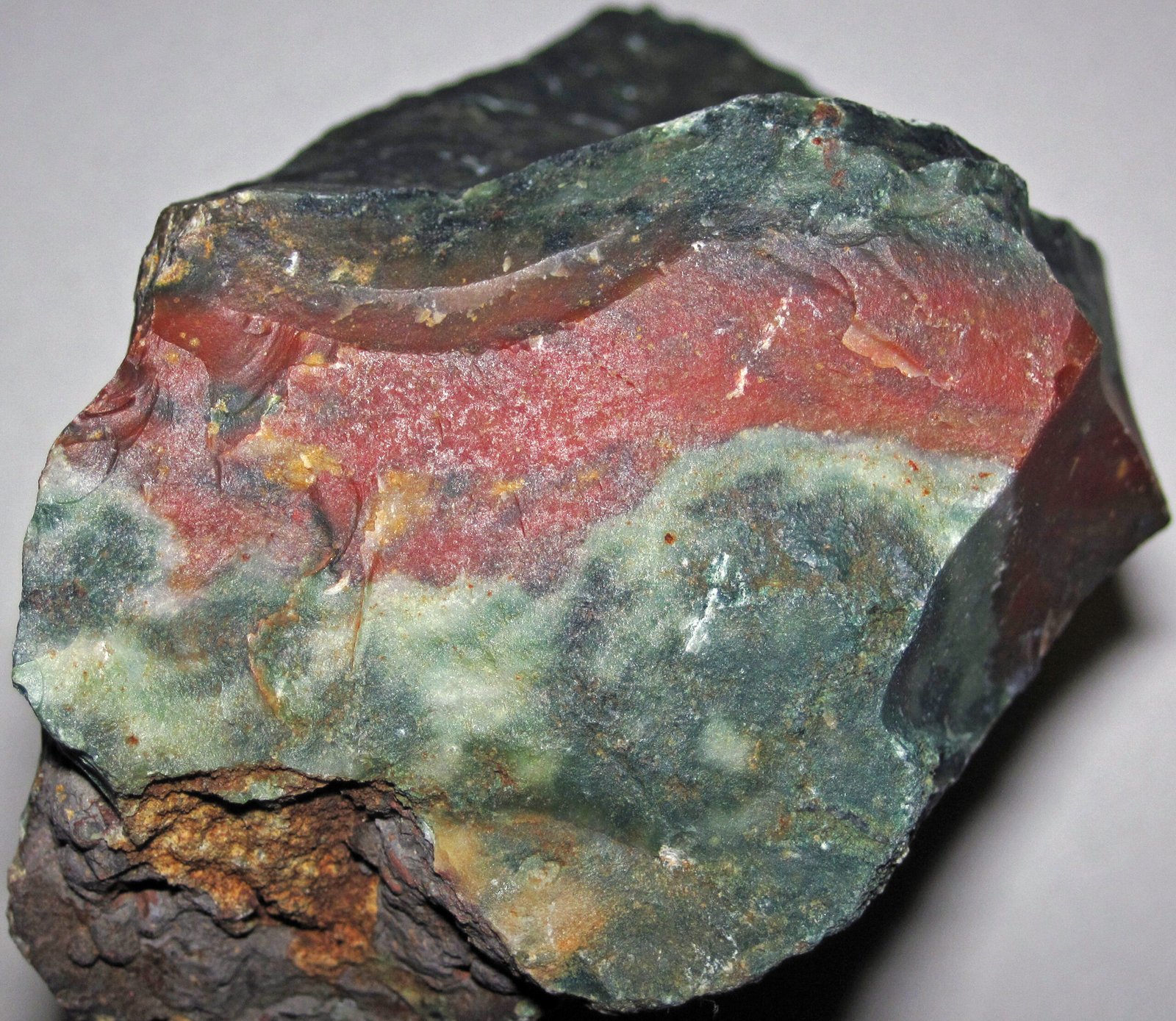
Bloodstone — also called heliotrope — is a dark green chalcedony (a form of quartz) scattered with red spots of iron oxide that look like droplets of blood. That appearance gave it its name and, in the Christian Middle Ages, a powerful legend: the red spots were said to be the blood of Christ fallen on green jasper at the Crucifixion, making it the “martyr’s stone”. It is durable at 6.5–7 Mohs, one of the traditional March birthstones, and in the crystal tradition a stone of courage, vitality and grounding. It is easy to care for, hard to fake convincingly, and mostly confused with plain dark jasper or with dyed material pretending to have finer spots.
Few stones carry their story so plainly on the surface. Bloodstone is dark green, and across that green run flecks and spatters of deep red — and for two thousand years people have looked at those flecks and seen blood. The Greeks called it heliotrope; medieval Christians called it the martyr’s stone and built a Crucifixion legend around it. Underneath the folklore it is a perfectly ordinary and very durable member of the quartz family, but few stones wear their meaning as visibly.
This guide covers what bloodstone actually is, where the red spots come from, the legend that shaped its reputation, its place as a March birthstone, and how to tell good material from plain jasper and dyed imitations.
What is bloodstone?
Bloodstone is a variety of chalcedony — cryptocrystalline quartz, the same broad family as agate, carnelian and chrysoprase — and it is often classed more specifically as a green jasper, the opaque, iron-rich end of that family. Its Mohs hardness is 6.5 to 7, so it is genuinely tough and everyday-durable.
Its dark green body colour comes from densely packed green mineral inclusions — chlorite and amphibole. The famous red spots are iron oxide (chiefly hematite), scattered through the green in droplets, streaks and patches. When the inclusions are yellow to orange rather than red, the material is sometimes called plasma or, in its spotted form, still grouped with bloodstone. The classic and most prized look is deep, even green carrying a scatter of bright, well-defined red.
The old name heliotrope — from the Greek for “sun-turning” — reflects an ancient belief that the stone, placed in water, could turn the reflection of the sun red. It is a poetic name for what is, mineralogically, a spotted green quartz.
Bloodstone meaning & history
Bloodstone is one of the oldest named gemstones. It was used in the ancient world for seals, signet rings and amulets, and Babylonian and later Roman engravers prized it. Pliny the Elder recorded the heliotrope name and its supposed powers.
Its most enduring story is Christian. In the medieval imagination the red spots were the blood of Christ, fallen at the foot of the Cross onto green jasper below — which is why it became known as the martyr’s stone and appeared in devotional carvings of the Crucifixion. The legend has no bearing on the stone’s geology, of course, but it fixed bloodstone’s association with sacrifice, courage and endurance for centuries.
Soldiers and travellers carried it as a protective amulet, and it acquired a long folk reputation as a stone that could staunch bleeding — a belief clearly rooted in its appearance rather than in any real effect. In the modern crystal tradition it is read as a stone of courage, strength and grounding, and it remains a traditional March birthstone, sharing the month with aquamarine.
Bloodstone healing properties
In the crystal tradition, bloodstone is valued as a stone of courage, vitality and grounding.
People typically turn to bloodstone for:
- Courage. The signature use — steadiness under pressure and the nerve to act.
- Vitality. Long associated with energy, stamina and physical drive.
- Grounding. A root-chakra stone, read as steadying and anchoring.
- Protection. One of the classic amulet stones for travellers and for facing difficulty.
These are traditional and symbolic uses, not medical claims. Bloodstone has a long folk reputation for the blood — staunching bleeding, “purifying” the blood, helping circulation — which comes entirely from its red-spotted appearance and not from any physical property. There is no scientific evidence that any crystal treats, cures or prevents any illness, and none that bloodstone affects the blood or the body in any way. Enjoy it as a durable and storied stone; nothing here is intended to diagnose or treat any condition, and health concerns belong with a doctor.
Bloodstone, the chakras & zodiac
Bloodstone belongs to the root chakra (Muladhara), the base of the chakra system and the seat of grounding, security and physical vitality — where its red flecks place it alongside stones like red jasper and hematite. Its green body also gives it a secondary link to the heart, read in the tradition as courage that comes from a steady centre. For the wider framework, see our guide to the seven chakras and their crystals.
By zodiac, bloodstone is most often associated with Aries — the sign of courage and drive — and with Pisces, and it remains a traditional March birthstone.
How to use bloodstone
- Carry it for courage. The oldest use — a pocket stone or amulet before something demanding.
- Wear it as jewellery. Durable enough for daily wear as a ring, pendant or signet, as it was historically.
- Hold it in meditation. At the root, for grounding and steadiness.
- Keep it at a workspace. Traditionally used for stamina and focus during hard effort.
- Give it in March. A birthstone with an unusually rich history attached.
How to cleanse & charge bloodstone
Bloodstone is hard, opaque and one of the easier stones to care for.
- Water. Warm water and mild soap are perfectly safe — as a quartz it handles water well.
- Sunlight or moonlight. Both are fine; bloodstone is not prone to fading the way some coloured stones are.
- Smoke. Sage, palo santo or incense.
- Selenite or sound. Contact-free and safe.
- Salt or soil. Its toughness means traditional grounding methods, such as resting it briefly on the earth, carry little risk — though a rinse afterwards is wise.
- Avoid ultrasonic and steam cleaners. Sensible caution for any jasper, which can hold internal fractures.
Types & origins
- Indian bloodstone. India is the major source, supplying most of the classic dark green material with bright red spots.
- Australian and Brazilian material. Additional modern sources for cabochons, beads and carvings.
- Plasma. A related deep green chalcedony with yellow or white spots rather than red — a close cousin.
- “Fancy” or multicolour bloodstone. Material with orange, yellow and red flecks together; genuine, though the classic red-on-green is most prized.
- Seftonite and trade names. Various regional and marketing names cover essentially the same spotted green chalcedony.
Is bloodstone rare or valuable?
Bloodstone is affordable and widely available, which suits its long history as a working amulet and signet stone rather than a luxury gem. Value is driven by the quality of the contrast: a deep, even green carrying a good scatter of bright, well-distributed red spots is the most prized, while muddy green with sparse or brownish flecks is inexpensive. Well-carved antique intaglios and signets can carry value for their workmanship. Because it is hard and opaque, it makes durable everyday jewellery.
Real vs fake — jasper, dye & imitations
Bloodstone is not heavily faked, but a few substitutions and confusions circulate.
- Plain dark jasper. The commonest “not quite” — green or greenish jasper with little or no genuine red spotting, sold as bloodstone. Real bloodstone needs the red flecks; a stone that is simply dark green is just jasper.
- Dyed material. Some cheap stone is dyed to deepen the green or brighten the red. Dye tends to look flat and to pool along cracks; natural bloodstone has irregular, three-dimensional spots that sit within the body of the stone rather than on the surface.
- Glass and resin imitations. Moulded imitations show bubbles, seams, a too-regular pattern and warmth in the hand. Real bloodstone is cool, hard and irregular.
- Reconstituted stone. Ground chalcedony bound in resin, sometimes with added colour; look for an unnaturally even texture and a slightly plastic feel.
The workable rule: look for genuine three-dimensional red flecks in a hard, cool, deep green body. No red, and it is jasper; surface-only colour, and it is dyed.
Genuine, correctly identified bloodstone
If you’d like a piece of your own, Minerals Kingdom offers authenticated natural bloodstone — genuine spotted green chalcedony rather than plain jasper or dyed material.