Chrysoprase
The apple-green chalcedony coloured by nickel, not chromium — a joy stone with one real quirk: it can fade if you treat it carelessly.
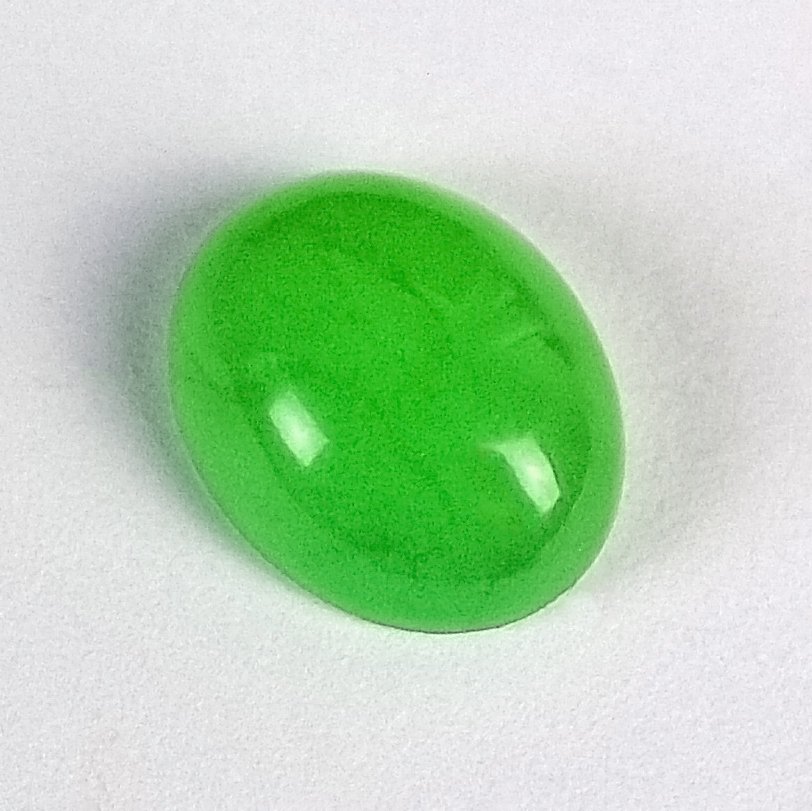
Green chalcedony · The stone of joy
Chrysoprase is a green chalcedony — a cryptocrystalline form of quartz — and, unusually, its colour comes from nickel rather than the chromium or iron that colours most green stones. It is the most valuable of the chalcedonies, prized for a clean apple-green glow, and Australia’s Queensland deposits made it famous enough to be sold, misleadingly, as “Australian jade”. In the crystal tradition it is a stone of joy, optimism and the heart. It is durable at 6.5–7 Mohs, but it has one genuine weakness worth knowing: some chrysoprase fades in strong sunlight or heat, because the nickel colouring can be disturbed by drying out. Keep it out of the sun and it stays green for life.
Green stones usually owe their colour to chromium or iron. Chrysoprase is the exception: it is coloured by nickel, and that single fact separates it from almost every other green gem and explains both its distinctive apple hue and its one real vulnerability. It is a quartz — specifically a chalcedony, the same microcrystalline family as agate and carnelian — but it is the most sought-after member of that family, and one of the few green stones that can pass, at a glance, for fine jade.
This guide covers what chrysoprase is, where its green comes from, why some pieces fade and how to stop that happening, and how to tell it from the jade and dyed material it is confused with.
What is chrysoprase?
Chrysoprase is a variety of chalcedony — a cryptocrystalline quartz, meaning it is built from crystals far too small to see, which gives it a smooth, waxy, translucent body rather than visible facets. Its Mohs hardness is 6.5 to 7, the same as other quartz, so it is genuinely hard-wearing.
What makes it chrysoprase rather than plain chalcedony is nickel. Traces of nickel-bearing minerals, absorbed as the chalcedony formed in weathered nickel-rich rock, colour it the characteristic apple to mint green. The name comes from the Greek chrysos (gold) and prason (leek) — a golden-green leek colour. Related nickel- and chromium-coloured green chalcedonies include prase and chrome chalcedony (mtorolite), but chrysoprase is the classic.
The nickel colouring is also the source of its one quirk. In some material the colour is tied to water held in the stone’s microscopic pores, so prolonged heat or strong sunlight can cause it to dry out and fade towards grey or pale green. This is not universal, and gentle care prevents it entirely, but it is real and worth knowing before you leave a piece on a sunny windowsill.
Chrysoprase meaning & history
Chrysoprase was prized in antiquity — the Greeks and Romans used it for seals, cameos and jewellery, and it appears among the stones of the ancient world’s most valued green materials. It enjoyed a great vogue in the eighteenth century, when Frederick the Great of Prussia decorated rooms and objects with Silesian chrysoprase from the deposits of what is now Poland.
Because it looks so like fine green jade, it has long been sold under borrowed names — most persistently “Australian jade” after the major Queensland deposits were developed in the twentieth century. It is not jade, and the name is a trade misnomer, but the resemblance is genuine. In the modern crystal tradition chrysoprase is read, above all, as a stone of joy and optimism.
Chrysoprase healing properties
In the crystal tradition, chrysoprase is valued as a stone of joy, optimism and emotional openness.
People typically turn to chrysoprase for:
- Joy. The signature association — lightness, good humour, a sunnier outlook.
- Optimism. Read as encouraging hope and easing anxious, pessimistic thinking.
- Heart-opening. A green heart-chakra stone, associated with acceptance and warmth.
- Emotional balance. Traditionally described as calming after upset and encouraging forgiveness.
These are traditional and symbolic uses, not medical claims. Chrysoprase is sometimes marketed for fertility, skin conditions or the immune system — associations, not mechanisms. There is no scientific evidence that any crystal treats, cures or prevents any illness, and none that chrysoprase affects mood or the body by any physical means. Enjoy it as one of the loveliest of the chalcedonies; nothing here is intended to diagnose or treat any condition, and health concerns belong with a doctor.
Chrysoprase, the chakras & zodiac
Chrysoprase belongs to the heart chakra (Anahata), among the green stones associated with love, balance and acceptance — read as the most cheerful and lighthearted of them. Its role in the tradition is less about deep emotional repair, as with rhodochrosite, and more about everyday brightness. For the wider framework, see our guide to the seven chakras and their crystals.
By zodiac, chrysoprase is most often associated with Libra and Cancer, and sometimes with Taurus — the Venus-touched, heart-centred signs.
How to use chrysoprase
- Wear it as jewellery. Durable enough for daily wear as a pendant, ring or beads.
- Carry a tumbled stone. A pocket piece for a lift in mood.
- Hold it in meditation. At the heart, for openness and optimism.
- Keep it near a workspace. Traditionally used to lighten tension and encourage good humour.
- Keep it out of the sun. The single most useful care habit — see below.
How to cleanse & charge chrysoprase
Chrysoprase is hard and easy to care for, with one specific exception around light and heat.
- Water. Warm water and mild soap are perfectly safe — as a quartz it tolerates water well.
- Keep it out of prolonged strong sunlight and heat. This is the one real rule: some chrysoprase fades if it dries out, so do not store or charge it on a sunny sill.
- Moonlight. A gentle overnight charge — the ideal method for this stone, since it avoids the sun entirely.
- Smoke. Sage, palo santo or incense.
- Selenite or sound. Contact-free and safe.
- Avoid ultrasonic and steam cleaners. Better to hand-clean chalcedony gently.
Types & origins
- Australian chrysoprase. From Queensland and Western Australia — the major modern source and the material behind the “Australian jade” misnomer. Often a fine, even apple green.
- Polish (Silesian) chrysoprase. The historic European source, famous through Frederick the Great; the classic old deposits.
- Tanzanian and Brazilian material. Additional modern sources supplying beads and cabochons.
- Lemon chrysoprase. A yellow-green trade name that is usually magnesite coloured by nickel, not true chrysoprase — pretty, but a different material.
- Prase and chrome chalcedony. Related green chalcedonies coloured differently; close cousins rather than the same stone.
Is chrysoprase rare or valuable?
Chrysoprase is the most valuable of the chalcedonies, though it remains affordable compared with faceted gems. Value is driven almost entirely by colour: a clean, saturated, even apple green with good translucency and no grey or brown clouding commands the highest prices, while paler or patchy material is inexpensive. Fine translucent Australian chrysoprase is the benchmark. Because it is hard and holds a good polish, it makes durable everyday jewellery — provided the sunlight caveat is respected.
Real vs fake — jade, dye & substitutes
The confusions around chrysoprase run in two directions: it is sold as something more expensive (jade), and other things are sold as it.
- “Australian jade” is chrysoprase, not jade. If a green stone is labelled Australian jade, it is almost certainly chrysoprase — a fine stone in its own right, but not jade, and it should be priced and named as chrysoprase. We cover the wider pattern in our profile of jade.
- Dyed chalcedony and agate. Cheap grey or white chalcedony dyed bright green is sold as chrysoprase. Dye tends to look flat and slightly unnatural, pools in cracks and along banding, and lacks the soft internal glow of the real stone. Even colour with a waxy translucency points to genuine chrysoprase.
- Dyed quartzite and “Malaysia jade”. Some green quartzite substitutes overlap with the jade-imitation market; these are coarser and more granular than smooth chalcedony.
- Glass. Bubbles, mould seams, a colour that is too uniform, and warmth in the hand all point to glass rather than chalcedony.
- “Lemon chrysoprase”. Usually nickel-bearing magnesite, softer and more opaque than true chrysoprase — genuine as a material, but not the same stone despite the name.
The workable rule: look for an even, waxy, translucent apple green with no dye pooling, and treat any “Australian jade” label as chrysoprase.
Genuine, correctly identified chrysoprase
If you’d like a piece of your own, Minerals Kingdom offers authenticated natural chrysoprase — named as chrysoprase rather than hidden behind a jade trade term.