
Ametrine
A single quartz crystal split between amethyst purple and citrine gold — mined almost entirely from one Bolivian deposit, and read in the crystal world as a stone of balance between opposites.
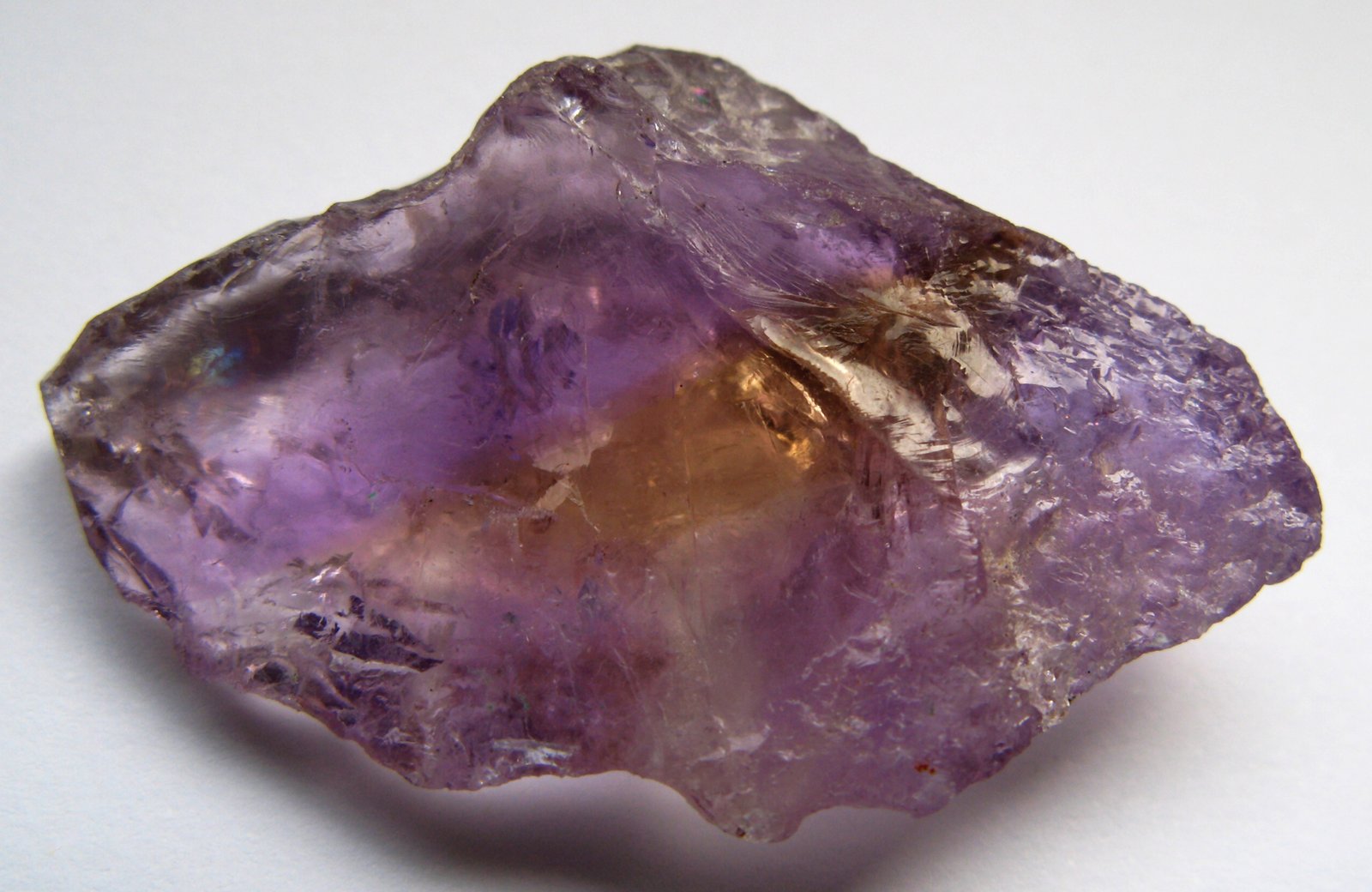
Quartz · Balance & clarity
In short Ametrine is a natural variety of quartz in which zones of purple amethyst and golden citrine meet in a single crystal — its name a portmanteau of the two. The colours come entirely from iron in different oxidation states: gentle heat oxidised the yellow zones while the purple stayed unchanged. Almost all natural ametrine comes from one source, the Anahí mine in Bolivia, which is why it is also traded as “bolivianite.” In the crystal tradition it is read as a stone of balance, clarity and the reconciling of opposites — symbolic uses, this guide explains, rather than medical ones.
Ametrine is one of the most quietly remarkable stones in the quartz family: a crystal that seems unable to decide whether it is amethyst or citrine, and settles for being both at once. That half-purple, half-gold banding looks almost designed, and it has made ametrine a favourite of gem cutters, who set the two colours side by side in a single faceted stone.
This guide covers what ametrine actually is, the neat piece of chemistry that gives it two colours, where its story comes from, and how to tell natural Bolivian material from the synthetic and treated stone that shares the shelf with it.
What is ametrine?
Ametrine is a variety of quartz — silicon dioxide, SiO2, the same mineral as clear rock crystal, amethyst and citrine. What makes it special is that it combines amethyst and citrine zones in one crystal, giving a stone that is part violet and part golden-yellow. Like all quartz it sits at 7 on the Mohs scale, hard enough for everyday jewellery and easy to care for, and it grows as the familiar six-sided prisms of the quartz group.
Its trade name “trystine” or “bolivianite” points to its origin: the vast majority of natural ametrine comes from a single deposit, the Anahí mine in eastern Bolivia. That one-source scarcity, combined with its unusual two-tone colour, is what gives good ametrine its appeal — although, as we’ll see, plenty of the ametrine on the market is grown or treated rather than dug from that mine.
Ametrine meaning & history
Ametrine is a modern gemstone with a romantic origin story. Legend holds that it was introduced to Europe in the seventeenth century, when a Spanish conquistador received the Anahí mine as a dowry on marrying a princess of the native Ayoreo people, and sent the striking bicoloured stones back as gifts to the Spanish queen. Whatever the truth of the tale, the mine still bears the princess’s name, and ametrine reached the wider gem market only in the late twentieth century.
Because it is such a recent arrival, ametrine carries little ancient folklore of its own. Its symbolism was assembled from its two halves: the calm, spiritual reputation of amethyst and the sunny, confident reputation of citrine. The crystal tradition reads their meeting as a natural emblem of balance — of head and heart, action and reflection, the everyday and the spiritual held in one stone.
Why ametrine has two colours
The two-tone effect is a genuinely elegant piece of natural chemistry. Both amethyst and citrine owe their colour to tiny amounts of iron built into the quartz; the difference is the iron’s oxidation state. Where the crystal was gently heated during its growth, the iron was oxidised and the quartz turned golden; where it stayed cooler, the iron remained unchanged and the quartz stayed violet. A temperature gradient across the growing crystal froze both states into one stone. It is the same mineral throughout — only the colour centres differ, which is exactly why heating an amethyst can turn it to citrine, and why the boundary between ametrine’s two zones can look so sharp.
Ametrine healing properties
In the crystal tradition, ametrine is valued as a stone of balance, clarity and harmony.
People typically turn to ametrine for:
- Balance. Read as uniting opposites — calm and drive, thought and feeling — in a single stone.
- Clarity and decisions. Associated with clear thinking and weighing choices without being pulled to extremes.
- Confidence with calm. Blending citrine’s sunny optimism with amethyst’s steadying quiet.
- Focus in meditation. Linked to the higher chakras through its amethyst half.
These are traditional and symbolic uses, not medical claims. There is no scientific evidence that any crystal treats, cures or prevents any illness, and ametrine has no proven effect on mood, focus or health. Nothing here is intended to diagnose, treat or prevent any condition; concerns about wellbeing belong with a doctor or qualified professional.
Ametrine, the chakras & zodiac
Ametrine’s two colours give it a foot in two camps. Its golden citrine half is tied to the solar plexus (Manipura), the centre of will and confidence, while its violet amethyst half reaches to the third eye and crown, the centres of intuition and spiritual awareness. That span is exactly why the tradition treats it as a bridging, balancing stone. It sits naturally alongside clear quartz in any quartz grouping; for the wider framework, see our guide to the seven chakras and their crystals.
By zodiac, ametrine is most often linked to Libra — fittingly, the sign of the scales and of balance.
How to use ametrine
- Wear it as jewellery. A durable quartz at hardness 7, ametrine suits daily rings and pendants and shows its two colours beautifully when faceted.
- Hold it in meditation. A popular focus when you want calm and clarity at the same time rather than one or the other.
- Keep one on your desk. Chosen as a steadying, balancing presence for decisions and focused work.
- Carry a tumbled stone. A small piece as a tactile reminder to stay even-keeled through a busy day.
- Store it away from strong sun. Prolonged sunlight can slowly pale the purple amethyst zone.
How to cleanse & charge ametrine
- Cool running water. A brief rinse is perfectly safe — ametrine is a hard quartz. Skip salt water and harsh chemicals.
- Moonlight. The classic, colour-safe charge; leave it out overnight under a full moon.
- Smoke. Pass it through sage, palo santo or incense smoke.
- Selenite or sound. Rest it on a selenite plate, or use a singing bowl, for a dry reset.
- Avoid prolonged sunlight. Like amethyst, ametrine’s violet can fade in strong, sustained sun.
Our general guide to cleansing and charging crystals covers each method in more detail.
Types & origins
- Natural Bolivian ametrine. Stone from the Anahí mine, with a genuine, often gradual boundary between violet and gold — the benchmark material.
- Faceted bicolour cuts. Emerald and other step cuts chosen to display both colours side by side in one stone.
- Tumbled and cabochon ametrine. Everyday pieces showing softer, blended zoning.
- Synthetic ametrine. Lab-grown quartz, chemically identical, produced hydrothermally and then irradiated — real quartz, but not natural.
- Heat-treated stone. Some material is amethyst partially heated to mimic natural zoning.
Natural ametrine comes almost exclusively from the Anahí mine in Bolivia, with minor deposits reported in Brazil and India. Value is driven by strong, evenly divided colour and clean crystal, and because the source is effectively single, good natural material is priced as a genuine collector’s quartz. Understanding how one crystal can hold two colours is really a lesson in quartz growth, a theme explored in our guide to the seven crystal systems.
Real vs fake
- Synthetic quartz. The main “fake” is lab-grown ametrine — chemically identical and hard to spot by eye; only a gem laboratory can confirm origin with certainty.
- Impossible colours. Green-and-gold or blue-and-gold “ametrine” does not occur naturally; these are synthetic or treated.
- Suspiciously sharp, cheap zoning. Very cheap stones with a knife-edge colour split are often synthetic or heat-treated rather than mined.
- Dyed or assembled imitations. Rarely, glass or dyed stone is passed off as ametrine; it lacks quartz’s cool feel and natural internal character.
The workable rule: natural ametrine is real quartz with honest colour and honest zoning. If you need certainty of Bolivian origin, buy from a seller who is clear about source and treatment — for the wider method, see our guide to spotting dyed and imitation stones.
Genuine, correctly identified ametrine
If you’d like a piece of your own, Minerals Kingdom offers authenticated natural ametrine — genuine bicolour quartz, with origin and any treatment honestly described.
Ametrine pairs well with
Frequently asked questions
What is ametrine good for?
Traditionally, ametrine is used for balance, clarity and reconciling opposites — a stone that unites amethyst’s calm with citrine’s confidence. These are symbolic, traditional uses, not proven medical effects. No crystal treats illness, and ametrine has no demonstrated effect on health.
Is ametrine a real stone or a fake?
Natural ametrine is entirely real — a genuine quartz variety from Bolivia. However, a lot of ametrine on the market is synthetic (lab-grown) or heat-treated amethyst. All are real quartz; the question is whether the colour is natural, so buy from an honest seller.
Why does ametrine have two colours?
Both colours come from iron in the quartz, in different oxidation states. Zones that were gently heated during growth turned golden (citrine), while cooler zones stayed violet (amethyst). A temperature gradient across the crystal locked both into one stone.
Can ametrine go in water?
Yes. Ametrine is a quartz with a hardness of 7 and tolerates a brief rinse in cool water. Avoid prolonged soaking, salt water and harsh chemicals, and keep it out of strong sunlight, which can slowly fade the purple zone.
Where does ametrine come from?
Almost all natural ametrine comes from a single source, the Anahí mine in eastern Bolivia — which is why it is also called bolivianite. Minor deposits are reported in Brazil and India, but Bolivia is effectively the world’s supply.
What crystals pair well with ametrine?
Its own two halves suit it best — amethyst for calm and clarity, citrine for confidence — with clear quartz to amplify and balance the pairing. Together they make a coherent quartz-family grouping.
Image credits · Hero and buy-box: natural ametrine from Bolivia — photo Ra’ike, Wikimedia Commons (CC BY-SA 3.0).