Shungite
A near-black carbon rock from Karelia, two billion years old, that contains natural fullerenes — and carries the boldest health claims on the shelf. We take them apart honestly.
Carbon rock · Grounding & protection
Shungite is not a mineral but a carbon-rich rock, found almost entirely in Karelia, north-west Russia, and named after the village of Shunga. It is extraordinarily old — roughly two billion years, from the Paleoproterozoic — and it is genuinely scientifically interesting, because it contains fullerenes, the football-shaped carbon molecules whose discovery won a Nobel Prize, here occurring in nature. It comes in two grades: rare, shiny “elite” (noble) shungite, around 98% carbon, and common matte black shungite with much less. In the crystal tradition it is a root-chakra stone of grounding and protection. It is also sold with sweeping claims about blocking EMF and 5G radiation and purifying water — and here we do what the site always does: we tell you plainly what the evidence does and does not support.
Shungite is one of the strangest things sold in a crystal shop. It is not a crystal, not a mineral, but a black rock made mostly of carbon — a substance closer to coal or graphite in makeup than to quartz. It is astonishingly old, it comes from essentially one place on Earth, and it genuinely contains molecules that scientists were thrilled to discover. It is also wrapped in some of the most confident health claims you will ever read on a stone’s label. All three of those things are worth taking seriously, and taking apart.
This guide covers what shungite actually is, why it is scientifically notable, and — with the honesty this site insists on — exactly how much of the EMF-blocking and water-purifying story stands up.
What is shungite?
Shungite is a carbon-rich rock, not a single mineral, which is why it has no crystal structure and no fixed formula. It formed around two billion years ago in ancient Karelian sediments, most likely from organic-rich deposits later altered by heat and pressure. Its Mohs hardness is only about 3.5 to 4, and it is opaque black, often with a metallic sheen. Crucially, some shungite conducts electricity — unusual for a rock, and a consequence of its carbon content.
Its scientific fame rests on fullerenes. Fullerenes are hollow, cage-like molecules of pure carbon — the most famous being C₆₀, the “buckyball” — whose discovery earned the 1996 Nobel Prize in Chemistry. Shungite was found to contain naturally occurring fullerenes, which is genuinely remarkable, since natural fullerenes are rare. It is important to be precise, though: they are present in very small quantities, and their presence does not, by itself, grant the rock any of the powers marketing attaches to it.
Shungite meaning & history
Shungite’s documented history is Russian and relatively recent. The area’s mineral-rich springs were used as a spa — Russia’s first, “Marcial Waters”, was established by Peter the Great in the early eighteenth century, and soldiers were reportedly issued the stone to purify drinking water on campaign. Whether the water benefit was real filtration or simply clean spring water is not clearly established, but the tradition of shungite-and-water is centuries old in Karelia.
In the modern crystal tradition, its deep black colour and carbon nature place it firmly among the grounding and protective stones, in the same family of meaning as black tourmaline and obsidian.
The EMF and water claims — honestly
Shungite is marketed harder than almost any stone, so this section matters. Two big claims dominate: that it shields you from electromagnetic fields (EMF), Wi-Fi and 5G, and that it purifies water. Here is the honest picture.
On EMF and 5G. Because carbon-rich shungite conducts electricity, it can, in principle, interact with electromagnetic fields — and this is the grain of truth the marketing is built on. But a small stone or sticker placed on or near a phone does not meaningfully shield a person from radiofrequency fields, and there is no credible scientific evidence that shungite protects health from EMF, Wi-Fi or 5G. Just as importantly, the underlying premise is shaky: mainstream scientific and public-health bodies find no established health harm from the low-level radiofrequency exposure of everyday phones and Wi-Fi in the first place. So shungite is being sold as protection against a danger that is itself unproven, by a mechanism that does not work as described. Enjoy the stone — but do not buy it to “block 5G”.
On water purification. This claim is on firmer, though still limited, ground. There is genuine laboratory research suggesting shungite and shungite-derived carbon can adsorb certain organic contaminants and bacteria from water, behaving somewhat like other forms of activated carbon. That is real and interesting. But it is a long way from “shungite water heals the body”: the studies are preliminary, the effect depends heavily on the material and conditions, home use is unstandardised, and raw shungite can also shed fine black particles into the water. It is not a substitute for a certified water filter, and shungite water has no proven health benefit beyond, at best, some filtration.
The honest summary: shungite is a fascinating carbon rock with a real, narrow scientific basis — natural fullerenes, conductivity, some adsorption capacity — that has been inflated into health claims the evidence does not support.
Shungite healing properties
In the crystal tradition, shungite is valued as a stone of grounding, protection and purification.
People typically turn to shungite for:
- Grounding. The signature use — a heavy, dark, anchoring root-chakra stone.
- Protection. Read as shielding and steadying, in the same tradition as black tourmaline.
- Purification. Associated symbolically with clearing and cleansing.
- Steadiness. Traditionally described as calming and stabilising.
These are traditional and symbolic uses, not medical claims — and shungite attracts more overreach than most. There is no scientific evidence that any crystal treats, cures or prevents any illness, that shungite protects health from EMF, Wi-Fi or 5G, or that “shungite water” has any medical benefit. The water-adsorption research is preliminary and does not make shungite a safe water filter. Enjoy shungite as a genuinely unusual rock with an interesting scientific story; nothing here is intended to diagnose, treat or prevent any condition, and health concerns belong with a doctor.
Shungite, the chakras & zodiac
Shungite belongs firmly to the root chakra (Muladhara), the base of the chakra system and the seat of grounding, security and physical stability — the natural home for a heavy black stone. It sits alongside black tourmaline, obsidian and hematite among the dark grounding stones. For the wider framework, see our guide to the seven chakras and their crystals.
By zodiac, shungite — a modern addition to the tradition — is most often linked to Capricorn and Scorpio.
How to use shungite
- Hold it in meditation. At the root, for grounding — its weight and darkness suit the intention.
- Keep a piece as a desk or pocket stone. A traditional grounding companion; note that unpolished shungite can leave black marks on hands and fabric.
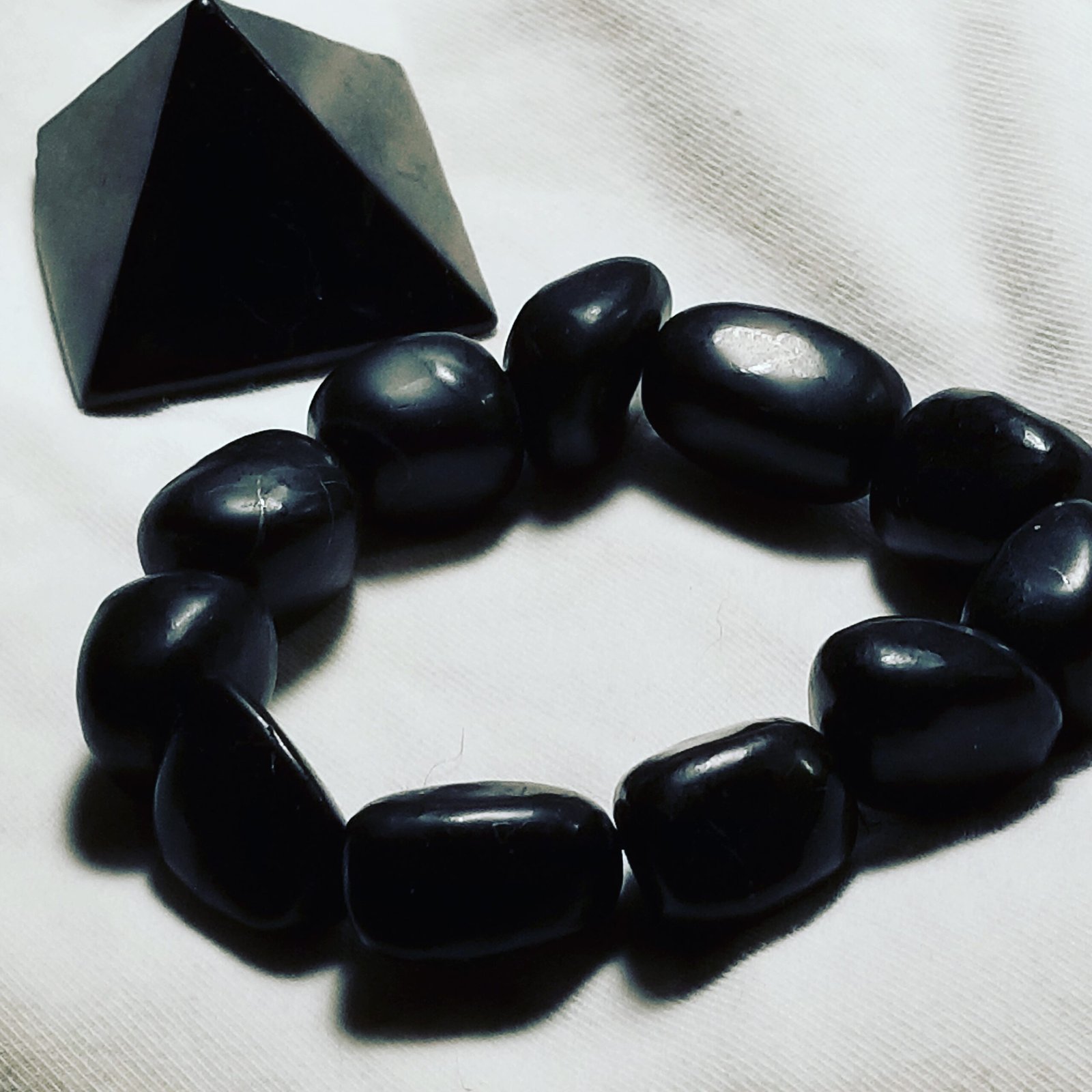
- Use it decoratively. Polished spheres, pyramids and pendants are handsome objects in their own right.
- Wear polished pieces. Polished shungite jewellery avoids the sooty residue of raw stone.
- Be realistic about it. Enjoy it as a grounding stone and a curiosity — not as EMF armour.
How to cleanse & charge shungite
Shungite is soft and can shed carbon, so care is a little different from most stones.
- Water. Tolerates water, but raw shungite may cloud it with fine black particles; rinse and dry gently, and expect some residue from unpolished pieces.
- Sunlight. A short charge in sun or moonlight is fine; being black and stable, it is not prone to fading.
- Smoke. Sage, palo santo or incense.
- Selenite or sound. Contact-free and safe.
- Soil. As a grounding stone, resting it briefly on the earth is a traditional and low-risk method.
- Handle raw pieces with care. Unpolished shungite is sooty; keep it off pale surfaces and wash your hands after handling.
Types & value
- Elite (noble / Type I) shungite. Rare, shiny, silvery-black, around 98% carbon. It is brittle, does not carve well, and is sold as small natural nuggets at a premium.
- Regular (black) shungite. The common matte grade, lower in carbon (often around 30–60%), which carves and polishes into spheres, pyramids, pendants and plates. Most shungite objects are this.
- Petrovsky and other intermediate grades. Trade names for material between the two.
Shungite is generally affordable, with elite grade commanding more for its rarity and higher carbon content. Value is driven by grade, carbon content and, for carved pieces, workmanship. It is bought as a grounding stone and a scientific curiosity rather than as a precious gem.
Real vs fake
Because almost all real shungite comes from one region, fakes and misrepresentations are common.
- Black glass, resin and painted stone. Cheap “shungite” spheres and pyramids are often moulded black glass or resin. Real shungite is a rock, not glassy; look for a slightly matte or metallic surface rather than a glassy shine, and beware bubbles and mould seams.
- The conductivity test. Genuine carbon-rich shungite conducts electricity — a simple battery-and-bulb or multimeter circuit will show a current pass through it, where glass, resin and most other black stones will not. This is the single most reliable home check.
- The residue point. Raw regular shungite typically leaves a faint black mark when rubbed on paper (like graphite); pure glass does not.
- Fake “elite” shungite. Shiny black stones sold as elite grade may be other minerals such as hematite or anthracite. Elite shungite is light for its size, brittle and irregular, not heavy and metallic like hematite.
- Provenance. Real shungite is Karelian. A seller who cannot say the material is from Russia’s Shunga / Zazhoginskoye region is a reason for caution.
The workable rule: test it for conductivity and check its origin. If a current will not pass and the seller cannot place it in Karelia, be sceptical.
Genuine, Karelian shungite
If you’d like a piece of your own, Minerals Kingdom offers authenticated natural shungite — genuine Karelian carbon rock, not black glass or resin.