
Iolite
The gem that changes colour as you turn it — blue-violet one way, near-colourless the next — and the stone tangled up with a genuine Viking navigation puzzle.
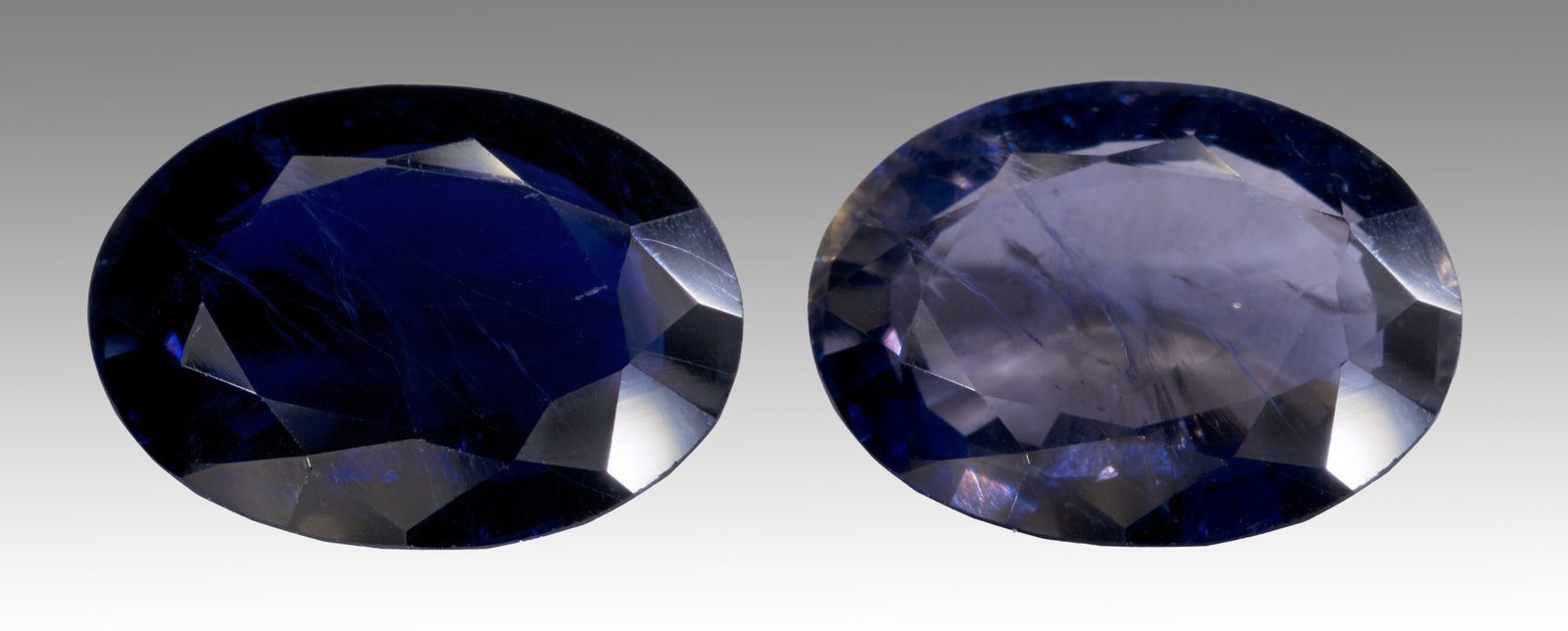
Gem cordierite · The stone of vision
Iolite is the gem-quality form of the mineral cordierite, a magnesium-iron aluminosilicate. Its defining feature is strong pleochroism: turn the same stone and it shifts from a rich violet-blue to a washed-out grey or pale yellow, because it absorbs light differently along different crystal directions. That property is genuine physics, and it is central to the stone’s most famous story — the idea that Viking navigators used a “sunstone” to find the hidden sun through cloud, an idea for which iolite is a leading candidate but not a proven answer. It is durable at 7–7.5 Mohs, in the crystal tradition a third-eye stone of vision and intuition, and often sold under the older, romantic name “water sapphire” — which it is not.
Most blue gems are blue from every angle. Iolite is not. Hold a cut iolite and rotate it, and it visibly changes — deep violet-blue one way, pale straw or almost colourless another, a smoky grey-blue in between. This is not a trick of the light or an inclusion effect; it is a fundamental optical property of the mineral called pleochroism, and iolite shows it more dramatically than almost any other gem. That single quality is what makes iolite worth understanding, and it sits at the heart of one of the best stories in gemmology.
This guide covers what iolite really is, the physics of its colour-change, the Viking-navigation legend and how solidly it holds up, and how to tell iolite from the sapphire and tanzanite it is sometimes confused with.
What is iolite?
Iolite is the transparent, gem-quality variety of cordierite, a magnesium iron aluminosilicate. The name iolite comes from the Greek ios (violet) and lithos (stone); mineralogists call the same material cordierite, after the French geologist Pierre Louis Antoine Cordier, who described it. Its Mohs hardness is 7 to 7.5, hard enough for jewellery, though it has distinct cleavage that calls for a little care in wear and setting.
Its blue-violet colour comes from iron in the structure. What makes iolite special is not the colour itself but how that colour behaves with direction — which is where pleochroism comes in.
Pleochroism & the Viking “sunstone”
Pleochroism is the property by which a crystal absorbs light differently along its different axes, so it shows different colours depending on the direction you view it from. Iolite is strongly trichroic: along one axis it is a strong violet-blue, along another a pale, almost colourless yellow, and along a third a smoky grey-blue. This is why cutting iolite is skilled work — the cutter must orient the stone so that the best blue faces up, and a poorly oriented stone looks washed out.
That directional behaviour connects iolite to a real and unresolved historical question. Medieval Norse sagas refer to a “sunstone” (sólarsteinn) used to locate the sun in overcast or twilight skies for navigation. Certain crystals can reveal the direction of polarised skylight, which does indicate where the hidden sun is, and iolite — strongly pleochroic and available in Scandinavia — has long been proposed as a candidate. It is a wonderful idea, and the site’s usual rule applies: we should say honestly how well it is evidenced.
The honest position is that this is plausible but unproven. Modern experiments have shown that polarising crystals really can locate the sun through cloud, and a calcite crystal was famously recovered from an Elizabethan shipwreck in a navigational context — but that crystal was calcite (Iceland spar), not iolite, and no iolite sunstone has ever been excavated from a Viking site. The link between iolite and the sagas is an attractive hypothesis, repeated far more confidently than the evidence warrants. What is certain is the physics: iolite genuinely does behave the way a sunstone would need to.
Iolite meaning & history
Under the trade name “water sapphire”, iolite was known to European jewellers for centuries as an affordable blue stone. That name is a misnomer — it is not a sapphire, and not related to corundum — but it stuck, and iolite has long lived in the shadow of the more famous blue gems. Its associations with navigation and with “seeing the way” feed directly into how the crystal tradition reads it: a stone of vision, intuition and inner guidance.
Iolite healing properties
In the crystal tradition, iolite is valued as a stone of vision, intuition and clear inner sight.
People typically turn to iolite for:
- Intuition. The signature association — trusting inner guidance and perception.
- Vision. Read, appropriately for a navigator’s stone, as helping to “find the way” through confusion.
- Focus. Traditionally described as clearing mental fog and aiding concentration.
- Self-knowledge. Associated with honest inner reflection.
These are traditional and symbolic uses, not medical claims. Iolite is sometimes marketed for the eyes, for headaches or for detoxification — associations, not mechanisms. There is no scientific evidence that any crystal treats, cures or prevents any illness, and none that iolite affects perception, mood or the body by any physical means. Enjoy it as one of the most optically fascinating of the affordable gems; nothing here is intended to diagnose or treat any condition, and health concerns belong with a doctor.
Iolite, the chakras & zodiac
Iolite belongs to the third-eye chakra (Ajna), the seat of intuition, insight and inner vision in the chakra system — a natural home for a violet-blue stone associated with “seeing the way”. Some read its deeper blue as touching the throat chakra too, for clear expression. For the wider framework, see our guide to the seven chakras and their crystals, and compare it with labradorite, the other great optical-effect stone of intuition.
By zodiac, iolite is most often associated with Sagittarius — the traveller and seeker — and with Libra and Taurus.
How to use iolite
- Turn it in the light. The defining experience — watch the colour shift as you rotate it, which is genuinely absorbing.
- Wear it as jewellery. A well-cut iolite makes a fine, affordable blue stone for pendants and earrings.
- Hold it in meditation. At the third eye, for intuition and clarity.
- Keep it for decisions. Traditionally used when trying to “find the way” through a confusing choice.
- Favour protected settings. Because iolite has cleavage, pendants and earrings survive better than exposed rings.
How to cleanse & charge iolite
Iolite is hard but cleavable, so ordinary care with a little caution about impact is the rule.
- Water. Warm water and mild soap are safe.
- Avoid ultrasonic and steam cleaners. Iolite’s cleavage makes vibration and thermal shock a real risk — this is the main caution.
- Moonlight. A gentle overnight charge, entirely safe.
- Smoke. Sage, palo santo or incense.
- Selenite or sound. Contact-free and safe.
- Avoid sharp knocks. Store it apart from harder stones and don’t wear a ring-set iolite for rough work.
Is iolite rare or valuable?
Iolite is affordable and good value — one of the reasons it has long been a stand-in for pricier blue gems. Most material comes from India, Sri Lanka, Madagascar and Brazil. Value is driven by colour (a deep, saturated violet-blue with good transparency is best), by clarity, and above all by cut orientation, since a stone cut in the wrong direction looks grey and lifeless no matter how good the rough was. Clean, richly coloured, well-oriented stones are the ones to want. It is bought for its beauty and its remarkable colour-change rather than as an investment.
Real vs fake — sapphire, tanzanite & glass
Iolite is more often confused with other blue gems than deliberately faked, but a few points help.
- Sapphire. Iolite’s old name “water sapphire” causes confusion, but sapphire (corundum) is far harder (9 Mohs), denser and not strongly pleochroic in the same violet-to-colourless way. Sapphire also usually costs far more.
- Tanzanite. Tanzanite is also pleochroic and violet-blue, but softer (6.5–7), rarer and much more expensive, and its pleochroism runs more towards blue-purple-burgundy. A cheap “tanzanite” that turns straw-yellow on rotation is very likely iolite.
- The rotation test. Iolite’s strong, distinctive shift from violet-blue to pale yellow to grey as you turn it is its best identifier — few substitutes reproduce that exact trichroic behaviour.
- Glass and synthetic spinel. Uniformly blue from every angle, often with bubbles, and showing no pleochroism at all. If the colour never changes as you turn it, it is not iolite.
The workable rule: rotate it and watch. Genuine iolite changes colour dramatically with direction; a stone that stays one flat blue is something else.
Genuine, correctly identified iolite
If you’d like a piece of your own, Minerals Kingdom offers authenticated natural iolite — named as iolite (cordierite) rather than as “water sapphire”.