Unakite
The mottled pink-and-green “stone” that is not a mineral at all but a whole rock — an altered granite of epidote, feldspar and quartz, named after a mountain range and honestly explained here.
Altered granite · Heart & growth
In short Unakite is unusual on this site because it is not a single mineral but an entire rock — a hydrothermally altered granite made of three ingredients at once: green epidote, salmon-pink orthoclase feldspar and clear or smoky quartz. That combination gives it its unmistakable speckled pink-and-green look. It was first described in 1874 and named after the Unaka Range of the Great Smoky Mountains where it was found. Hard and durable enough for everyday jewellery, it is, in the crystal tradition, a gentle heart-chakra stone of patience, gradual growth and emotional balance — its pink-and-green pairing read as uniting love with renewal.
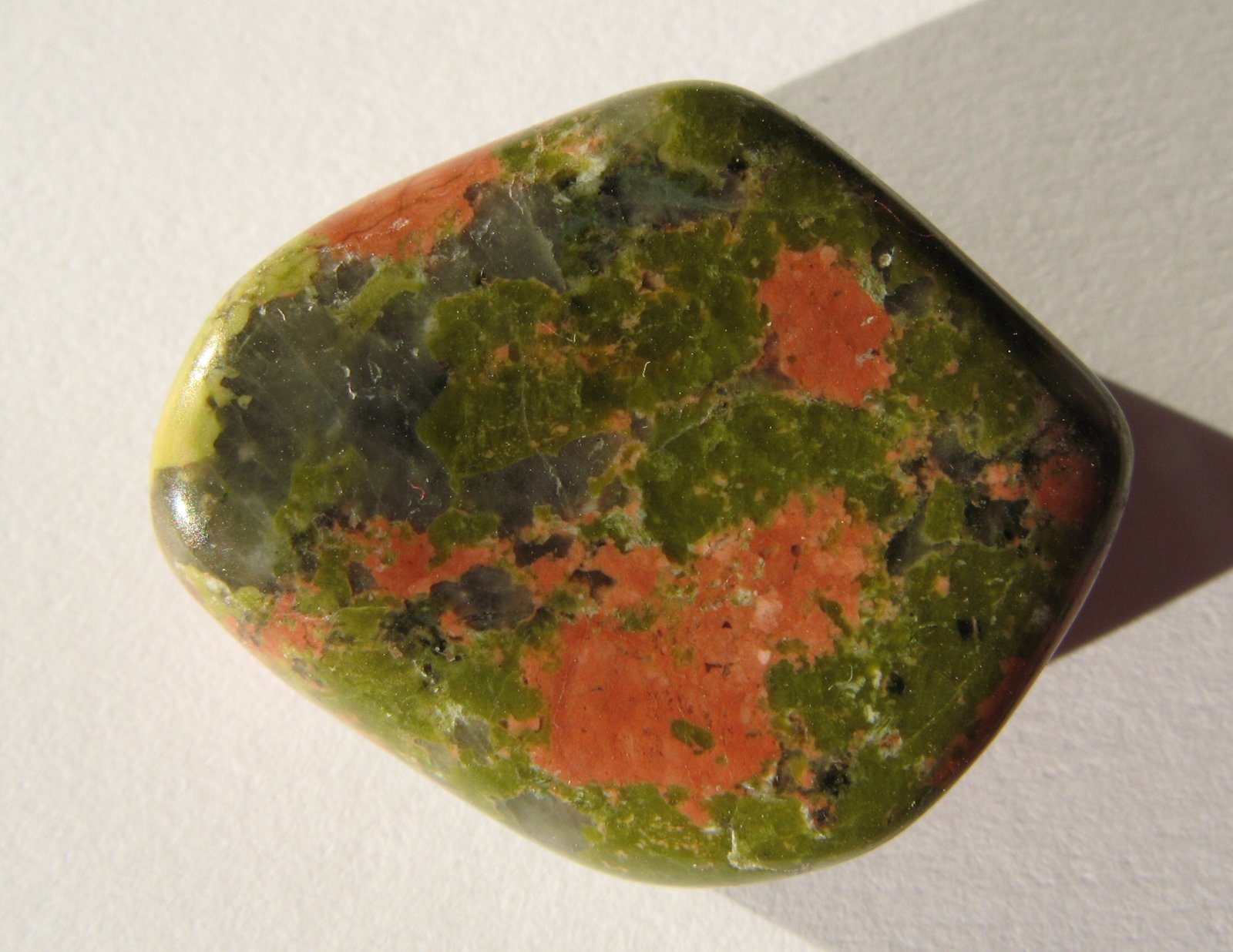
Unakite is one of the most recognisable stones in any tumbled-stone bowl — a soft mosaic of pistachio-green and salmon-pink that looks almost too neatly patterned to be natural. It is also, quietly, one of the most misunderstood, because unlike almost every other stone in this encyclopedia it is not a mineral species at all. It is a rock: a naturally occurring mixture of several minerals that formed together, and its charm comes precisely from that mixture.
This guide covers what unakite actually is, the mountain range that gave it its name, why “a rock, not a crystal” genuinely matters, and how to use and care for a durable, water-friendly heart stone.
What is unakite?
Unakite is a coarse-grained altered granite — geologists call it an altered granitoid — made chiefly of three minerals visible to the naked eye: green epidote, pink orthoclase (potassium) feldspar and colourless-to-smoky quartz. It forms when an ordinary granite is reworked by hot, mineral-rich fluids deep in the crust, a process called hydrothermal alteration, which grows the green epidote among the pre-existing pink feldspar and quartz. The result is the speckled two-tone rock we polish and sell.
Because it is an aggregate of several minerals rather than one, its properties are averages rather than fixed values: hardness runs about 6 to 7 on the Mohs scale depending on which mineral you test, and unlike a single crystal it has no cleavage and no crystal faces of its own. That mixed structure makes it tough, even-textured and excellent for tumbling, carving and cabochons.
Unakite meaning & history
Unakite has no ancient folklore, and it is worth saying so plainly: it was first defined and described in 1874 by the geologist Frank H. Bradley, who named it after the Unaka Range on the border of North Carolina and Tennessee, in the Great Smoky Mountains, where he collected his samples. It is, in other words, a stone whose story begins in documented nineteenth-century geology rather than in myth.
Its meaning in the modern crystal tradition was built almost entirely from its colours. Green has long been read as the shade of the heart, growth and nature; pink as the shade of gentle love and compassion. A stone that fuses the two was quickly adopted as an emblem of patient, heart-centred growth — the slow, steady kind rather than the dramatic breakthrough — and that reading remains its signature today.
A rock, not a crystal
It is genuinely useful to know that unakite is a rock, not a mineral. A mineral such as quartz or amethyst has a single, definite chemical composition and an orderly crystal structure; a rock such as unakite (or granite, or marble) is a mixture of two or more minerals grown together. This is why unakite never forms points or geodes of its own, why its pattern differs from piece to piece, and why any claim about a precise “crystal system” or single chemical formula for unakite is mistaken. None of this makes it less genuine or less pleasant to work with — it simply means it belongs to a different category of Earth material, closer to a beautiful building stone than to a faceted gem.
Unakite healing properties
In the crystal tradition, unakite is valued as a gentle stone of patience, balance and emotional recovery.
People typically turn to unakite for:
- Patience and gradual growth. The signature association — steady, unhurried progress rather than sudden change.
- Emotional balance. Its pink-and-green pairing is read as uniting love with renewal and grounding.
- Letting go. Traditionally used as a stone for gently releasing old habits or grief.
- Support during pregnancy. A long-standing folk association with nurturing and new beginnings (symbolic only — see the note below).
These are traditional and symbolic uses, not medical claims. There is no scientific evidence that any crystal treats, cures or prevents any illness, and unakite is no exception — its folk link to pregnancy is symbolic and not a substitute for medical care. Nothing here is intended to diagnose, treat or prevent any condition; health and emotional concerns belong with a doctor or qualified professional.
Unakite, the chakras & zodiac
Unakite’s green-and-pink colouring places it firmly at the heart chakra (Anahata), the centre of love, compassion and balance — the same family as the site’s other pink and green heart stones, including rose quartz, green aventurine and rhodonite. For the wider framework, see our guide to the seven chakras and their crystals.
By zodiac, unakite is most often linked to Scorpio, read as a steadying, transformative stone for a sign associated with deep emotional change.
How to use unakite
- Wear it as jewellery. Durable and free of cleavage, it takes beads, cabochons and daily wear well.
- Hold it in meditation. At the heart, for its traditional associations with balance and patience.
- Keep it as a pocket or worry stone. A smooth, tactile companion for grounding.
- Choose a carved piece. Its even texture suits eggs, spheres and small animal carvings.
- Place it in a calm space. A traditional choice for a bedroom or a quiet corner rather than a busy desk.
How to cleanse & charge unakite
- Water. Tolerant of rinsing thanks to its quartz-and-feldspar hardness; a quick wash and soft-cloth dry is fine.
- Sunlight or moonlight. A short charge in either suits it; its colours are stable and not prone to fading.
- Smoke. Sage, palo santo or incense — contact-free and simple.
- Selenite or sound. Safe, contact-free alternatives.
- Soil. As a grounding heart stone, briefly resting it on the earth is a traditional, low-risk method.
Types & origins
- Classic American unakite. From the Unaka and Blue Ridge mountains of North Carolina, Virginia and Tennessee — the original and namesake material.
- African unakite. South Africa and Zimbabwe supply much of the modern tumbled-stone trade.
- Chinese and Brazilian material. Widely available and often used for beads and carvings.
- “Epidote in feldspar” varieties. The exact green-to-pink ratio varies by deposit; some pieces are mostly green, others mostly pink.
- River-tumbled pebbles. Naturally rounded unakite is found in some Appalachian streams as well as being commercially tumbled.
Unakite is inexpensive and abundant, valued for its look and durability rather than any rarity. Value is driven mainly by attractive, even patterning — a good balance of clear pink and green with few dull grey patches — and by the quality of the polish or carving, rather than by scarcity of the stone itself. It is bought as a decorative and symbolic material, never as an investment gem.
Real vs fake
- Dyed howlite or magnesite. Softer white stones dyed pink and green can imitate unakite’s colours but lack its natural mottled mineral texture and its hardness.
- Reconstituted or “resin” stones. Crushed mineral powder set in resin is sometimes sold as unakite; it often feels warmer and lighter and shows an unnaturally uniform pattern.
- Glass and ceramic. Rare, but bright, glassy “unakite” beads with bubbles or a painted-on pattern are not the real rock.
- The natural-texture tell. Genuine unakite shows a slightly grainy, three-mineral texture — you can often make out separate green, pink and glassy grains — rather than a smooth, printed-looking colour.
The workable rule: look for real grain. Authentic unakite reads as a speckled mixture of distinct minerals under a loupe or good light; a perfectly even, printed-looking pink-and-green surface suggests dye, resin or an imitation.
Genuine, correctly identified unakite
If you’d like a piece of your own, Minerals Kingdom offers authenticated natural unakite — genuine epidote-and-feldspar rock, not dyed howlite or a resin imitation.
Unakite pairs well with
Frequently asked questions
What is unakite good for?
Traditionally, unakite is used for patience, emotional balance and gentle, gradual growth — a soft heart-chakra stone. These are symbolic, traditional uses, not proven medical effects. No crystal treats illness.
Is unakite a crystal or a rock?
A rock. Unakite is an altered granite made of three minerals grown together — green epidote, pink feldspar and quartz — rather than a single mineral species. That is why it never forms crystal points and why its pattern varies from piece to piece.
What are the pink and green parts of unakite?
The green is epidote, the pink is orthoclase (potassium) feldspar, and the clear or greyish grains are quartz. The green epidote grew through an existing pink granite during hydrothermal alteration, producing unakite’s speckled two-tone look.
Can unakite go in water?
Yes. With a hardness of about 6–7 and no cleavage, unakite tolerates rinsing and short water contact well. A quick wash and a soft-cloth dry are fine; prolonged soaking is unnecessary but not damaging.
Where does unakite come from?
It was first described in the Unaka Range of the Great Smoky Mountains in the United States, which gave it its name. Today most tumbled unakite comes from South Africa, Zimbabwe, China and Brazil, with classic American material still prized by collectors.
How can I tell if unakite is real?
Look for a genuine three-mineral grain: distinct green, pink and glassy grains visible under good light or a loupe. A perfectly even, printed-looking pink-and-green surface suggests dyed howlite, resin or another imitation rather than the real rock.