
Moldavite
The mossy-green glass thrown from a meteorite impact — the most counterfeited stone on the market, and the one most worth learning to read.
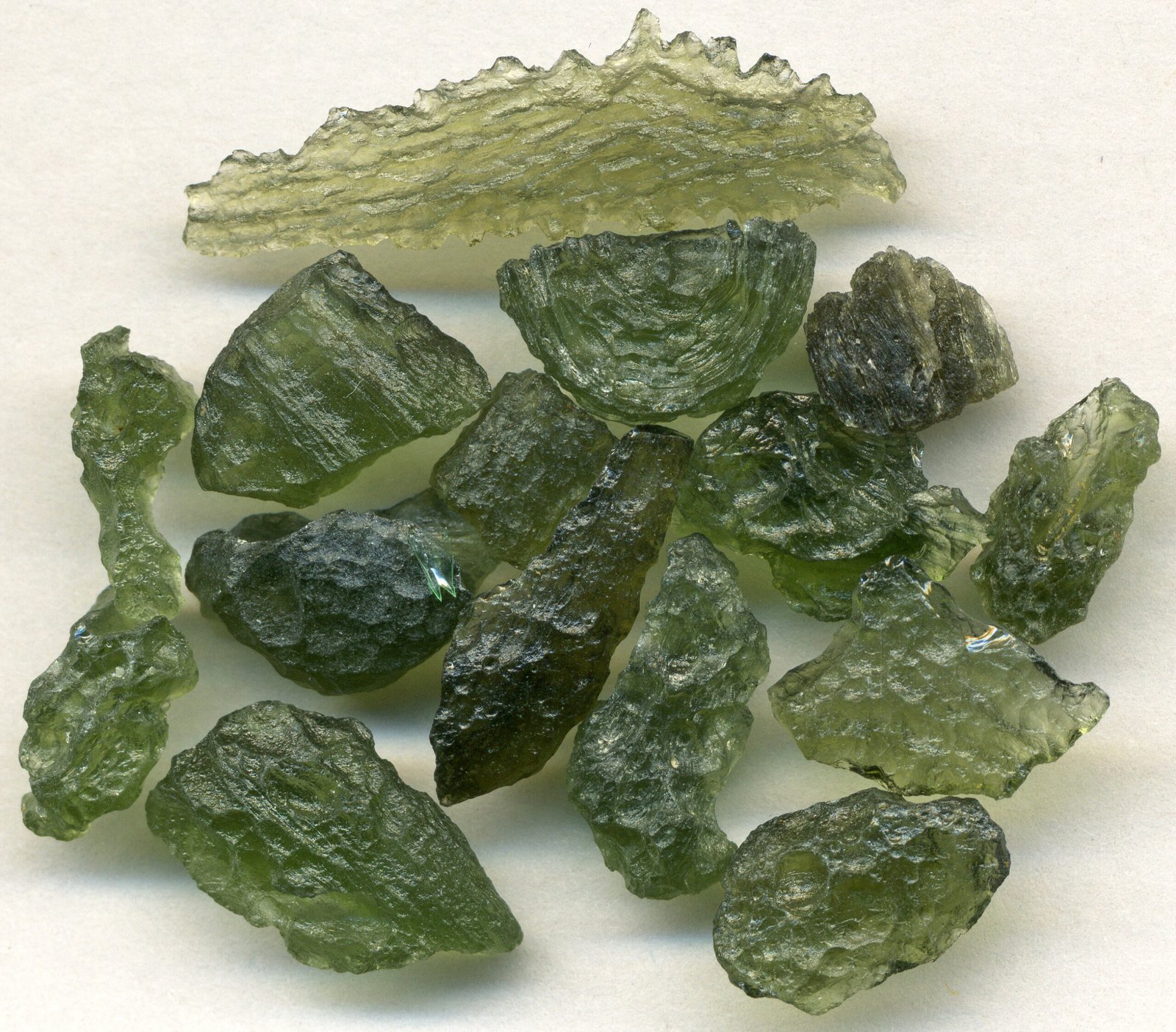
Vltavín · Tektite
Moldavite is a tektite: terrestrial rock that was melted and flung into the air by a meteorite impact, then fell back to earth as glass. It is not a meteorite and not “a stone from space” — the meteorite was the hammer, not the material. It formed roughly 14–15 million years ago in the impact that made the Ries crater in southern Germany, and is found in a strewn field concentrated in the Czech Republic. In the crystal tradition it is the stone of transformation and a heart-chakra crystal. Prices have risen steeply, and the market is now saturated with moulded green bottle glass — so the longest section below is the one on telling real from fake.
Moldavite is a strange, wrinkled fragment of green glass that looks less like a gem than like something dredged from a riverbed — which, in a sense, it is. It has one of the most remarkable origin stories of any material sold as a healing stone, and one of the worst counterfeiting problems. Both of those things are worth taking seriously, and this guide tries to do so without either mystifying the stone or sneering at the people who love it.
Below: what moldavite actually is (the nuance matters and is constantly muddled online), how it formed, what the tradition says about it, how to use and keep it, and — at length — how to tell genuine material from the bottle glass that now floods the market.
What is moldavite?
Moldavite is a tektite. Tektites are natural glasses formed when a large meteorite strikes the earth: the impact melts and vaporises the terrestrial rock at ground zero, throws the molten material high into the atmosphere, and it cools and solidifies as it falls back down, sometimes hundreds of kilometres away.
This is the point that gets lost constantly. Moldavite is not a meteorite. It is not extraterrestrial material and it is not “a stone from space”. Every atom in it came out of the ground in Bavaria. The meteorite supplied the energy; the earth supplied the substance. If you want genuinely extraterrestrial material in a stone, that is a pallasite meteorite or a lunar meteorite — not moldavite. What moldavite is is a piece of our own planet that was briefly liquefied by a cosmic collision, which is arguably a better story anyway.
Chemically it is essentially silica glass — SiO₂ with some alumina and minor iron, magnesium, calcium, potassium and sodium. Being a glass, it is amorphous: it has no crystal lattice, no cleavage, no birefringence, and mineralogists class it as a mineraloid rather than a true mineral. Its Czech name is vltavín. It is a close cousin, structurally, of obsidian — both are natural glasses — though obsidian is volcanic and moldavite is not.
Reported hardness runs from about 5.5 to 7 on the Mohs scale, specific gravity from about 2.32 to 2.38, and refractive index from about 1.48 to 1.54. Those last two numbers matter later.
How moldavite formed
The scientific consensus is that moldavite formed during the impact that created the Nördlinger Ries crater in Bavaria, southern Germany, about 14.7 million years ago — the mid-Miocene. Radiometric dating of the crater itself gives an age of roughly 14.8 million years, and moldavite specimens are conventionally labelled 14.5–14.8 Ma. So “around 14 to 15 million years old” is the honest way to put it.
The melt came from a sand-rich surface layer at the impact site, which is why moldavite is so silica-rich and so remarkably low in water. Modelling of the oblique impact suggests the material was thrown as far as 450 km downrange of the crater — which is how German rock ended up scattered across what is now the Czech Republic.
That scattering is called a strewn field. Moldavite’s covers southern Bohemia, western Moravia, the Cheb Basin in north-west Bohemia, plus small sub-fields in Lusatia (Germany), the Waldviertel (Austria) and Lower Silesia (Poland). By far the most productive localities are the South Bohemian ones, in the České Budějovice and Třeboň basins.
The name comes from the river. Zippe coined “moldavite” in 1836 after the Vltava — Moldau in German — the Bohemian river near whose valley the first described pieces were found. Nothing to do with Moldova.
One more thing follows from all this, and it turns out to be the key to spotting fakes. Moldavite did not simply fall and sit on the surface. It was buried in sediment for millions of years, where groundwater carrying dissolved CO₂ and humic acids slowly ate into it. That long chemical etching is what produced moldavite’s extraordinary wrinkled, pitted, worm-tracked surface — a texture no piece of fresh glass has.
Moldavite meaning & tradition
Moldavite has been in human hands for a very long time. Worked moldavite flakes from the Czech lands and Austria date to the Aurignacian, tens of thousands of years ago — people knapped it into tools, as they did obsidian and flint. Whether they attached meaning to its colour we cannot know.
Its modern reputation is genuinely modern. Moldavite entered the crystal tradition in the later twentieth century and was quickly cast as the stone of transformation — of accelerated change, of shaking loose what has become stuck, of the push rather than the comfort. Where rose quartz soothes, moldavite is described as the stone that moves things.
It is read as a heart chakra stone, on the strength of its green, and often paired with the idea of opening the heart to change rather than to romance. Because of its impact origin it also picked up a strong association with the cosmos and with “star” symbolism — a case where the folklore ran somewhat ahead of the geology, since the material itself is terrestrial.
Moldavite healing properties
In the crystal tradition, moldavite is above all the stone of transformation and rapid change.
People typically turn to moldavite for:
- Transformation. The classic association — periods of deliberate change and reinvention.
- Heart opening. A green stone read as clearing what the heart has closed around.
- Breaking stagnation. Used symbolically when something has felt stuck for a long time.
- Meditation and expansion. Valued as a focus for contemplative practice.
- Perspective. Its origin story invites a longer view of one’s own troubles.
These are traditional and symbolic uses, not medical claims. No crystal treats illness, and nothing here is intended to diagnose, treat or cure any condition.
Moldavite needs one correction more than most stones. Online it is widely credited with causing a “moldavite flush” — a dramatic upheaval said to follow acquiring it: relationships ending, jobs lost, a life rearranged. That belief is real and sincerely held within the community, and it is worth describing accurately. But there is no evidence that a stone causes life events, and the mechanism behind the stories is not mysterious. People generally buy moldavite because they want change, at a moment when they are already turning something over — a job they have outgrown, a relationship they have been questioning for months. When the change arrives, the stone gets the credit. That is confirmation bias plus a selection effect: the people who acquire it are precisely the people about to change something, and the stories that get retold are the dramatic ones, not the thousands of uneventful ones.
Naming that plainly is not a criticism of anyone who finds the stone meaningful. It matters chiefly because the reverse framing does harm: if you are going through a genuinely hard time — a bereavement, a breakup, redundancy, illness — that is not a rock’s doing, and it deserves the real explanations and the real support that any difficult stretch deserves. Please talk to people you trust, or to a qualified professional.
Moldavite, the chakras & zodiac
Moldavite is placed at the heart chakra (Anahata) in most crystal systems, on account of its green colour, and is frequently described as bridging the heart to the higher centres — an idea you will find set out more fully in our guide to the seven chakras and their crystals.
It is not a birthstone and has no traditional astrological assignment of any antiquity; modern sources most often link it to Aquarius and Scorpio, signs associated with change. Treat that as a recent convention rather than an old tradition.
How to use moldavite
Most uses are quiet ones. It is a small, brittle, expensive piece of glass, so practicality is part of the advice.
- Start small and briefly. Whatever you make of the “flush”, the sensible practice is the one long recommended in the tradition: short sessions, a small piece, no drama required.
- Hold it in meditation. The most common use by far — a focus, held at the heart.
- Wear it as a pendant. Better than a ring: at 5.5–7 Mohs and brittle, moldavite chips easily on a hand.
- Keep it somewhere you will see it. Many people prefer it on a shelf or desk to carrying it loose.
- Pair it with something steadying. Black tourmaline or labradorite are the usual grounding companions.
- Do not carry it loose in a pocket. Keys and coins will scratch and chip it, and the etched surface is the very thing that proves it genuine.
How to cleanse & charge moldavite
Chemically it is inert glass. Physically it is fragile, and its value lives in an intact surface sculpture.
- Water. A brief rinse in cool water is harmless. Use no brush or abrasive on the etched surface.
- Moonlight. A gentle overnight charge, and the traditional favourite for this stone.
- Smoke. Sage, palo santo or incense — no contact, no risk.
- Sound. A singing bowl or bell, ideal for something this brittle.
- Selenite. Rest it on a plate; keep it from knocking against harder pieces.
Avoid salt (it scratches), ultrasonic and steam cleaners, and any hard storage where it can rattle against other stones. Wrap it in cloth. Being a glass, moldavite has no cleavage but very little tolerance for a sharp knock — a chipped edge on a faceted stone is common and permanent.
How to tell real moldavite from fake
This is the part that matters. Moldavite prices have climbed steeply over the past decade, driven largely by its popularity on social media, and the market has responded exactly as markets do. A very large proportion of the moldavite sold online today is counterfeit — almost always moulded green bottle glass, sometimes acid-etched to mimic the real surface. Some estimates put the fake share of online listings above half. Learning four or five checks will save you far more than it costs you.
1. The surface sculpture — the single best clue. Genuine moldavite spent millions of years buried in sediment, being etched by CO₂- and humic-acid-bearing groundwater. The result is a chaotic, wrinkled, pitted, worm-tracked texture of ridges, channels and pinholes that never repeats. It is irregular at every scale. Moulded glass, by contrast, is smooth and glossy, or bears a texture that repeats — because it came from a mould, and moulds get reused. Look for a mould seam: a faint raised line running around the piece where the two halves of the mould met. If you find one, you are holding a bottle. Also be suspicious of two “different” pieces with identical bumps in identical places: that is one mould, not two stones.
Note the honest limitation here: fakers do acid-etch glass, typically with hydrofluoric acid, and a good etch can look convincing in a photograph. Artificial etching tends to be more uniform and shallower than the real thing, and it lacks the deep, tunnelling channels of genuine long-term dissolution — but this is the check that most rewards handling a known-genuine piece at least once.
2. Lechatelierite inclusions. Genuine moldavite frequently contains lechatelierite — pure silica glass formed at temperatures far higher than any bottle furnace reaches — appearing under a loupe as fine, worm-like or thread-like whitish inclusions. Alongside them you will often see schlieren: swirling flow lines frozen into the glass. Neither can be manufactured in bottle glass; lechatelierite in particular simply cannot be faked. The caveat is that not every genuine piece shows it — it is common in South Bohemian material but not universal — so its presence is strong proof, while its absence proves nothing.
3. Bubbles: shape and distribution. This is the one most people can check with a cheap loupe. Genuine moldavite contains bubbles that are elongated, irregular, unevenly distributed and often stretched along the flow lines — because the melt was moving and deforming as it cooled. Manufactured glass contains bubbles that are round, uniform and evenly scattered, because it cooled quietly in a mould. A field of neat little spheres is a bottle.
4. Colour. Genuine moldavite is a mossy, olive, forest green — often slightly brownish, and rarely uniform; Moravian material tends more strongly brown than Bohemian. Many fakes are a bright, even emerald or apple green, clear and cheerful in a way real moldavite almost never is. If the colour looks like a wine bottle held up to the light, it very likely is one.
5. Price and quantity. Real moldavite is scarce and is sold by the gram. Very cheap material, large flawless pieces at low prices, or endless identical stock in a shop that sells everything, should all prompt questions. Beads and bulk “moldavite chip” strands are a particular red flag.
6. Cut stones need extra care. Faceting removes the etched surface — the best clue — so a polished or faceted moldavite must be judged on inclusions, bubbles and colour alone. Buy cut moldavite only from a seller you have reason to trust, or with a report from a real laboratory.
The only certainty is a laboratory test. Refractive index, specific gravity and chemical analysis distinguish moldavite from bottle glass unambiguously: moldavite’s RI sits around 1.48–1.54 and its SG around 2.32–2.38, and its composition is distinctive and very low in water. A gemmological lab can settle the question in minutes. Everything above is field guidance, not proof.
And one point worth stating flatly: a “certificate of authenticity” from an unknown seller is worth nothing. Anyone can print one, and the ones bundled with cheap online moldavite routinely are. A certificate has value only when it is issued by an independent, identifiable gemmological laboratory that you can look up and contact — not by the shop selling you the stone.
Is moldavite rare or valuable?
Genuine moldavite is scarce and expensive by the gram, and it has become markedly more so. The rise is driven by demand from the crystal market rather than by any gemmological quality — this is glass, after all, and not a hard or brilliant one.
Supply is also constrained by law. Under Czech mining legislation moldavite is a reserved mineral: natural accumulations belong to the state, and extraction requires official authorisation. Several localities are additionally protected, and the famous Besednice site is a protected area where collecting is not permitted. Illegal digging has been a persistent problem in South Bohemia and is treated as a criminal matter. Collecting on private farmland with the owner’s permission is possible; digging in protected sites or public forest is not. If you visit, ask locally before you dig.
Value within genuine material tracks size, surface quality and translucency. Deeply and finely sculptured pieces from Besednice — the classic “hedgehog” texture — command the strongest premiums, as do larger, more transparent stones. Most commercially sold moldavite is raw fragments, which is the norm and the form in which the diagnostic surface survives. Faceted moldavite does exist and is genuinely attractive, but it sacrifices the sculpture, so it demands more trust in the seller.
Genuine, authenticated Czech moldavite
If you’d like a piece of your own, Minerals Kingdom offers authenticated natural moldavite — raw fragments with their surface sculpture intact, and finished jewellery.