Amber
Not a stone but fossilised tree resin — tens of millions of years old, warm to the touch, and the material that gave electricity its name.
Fossil resin · Warmth & vitality
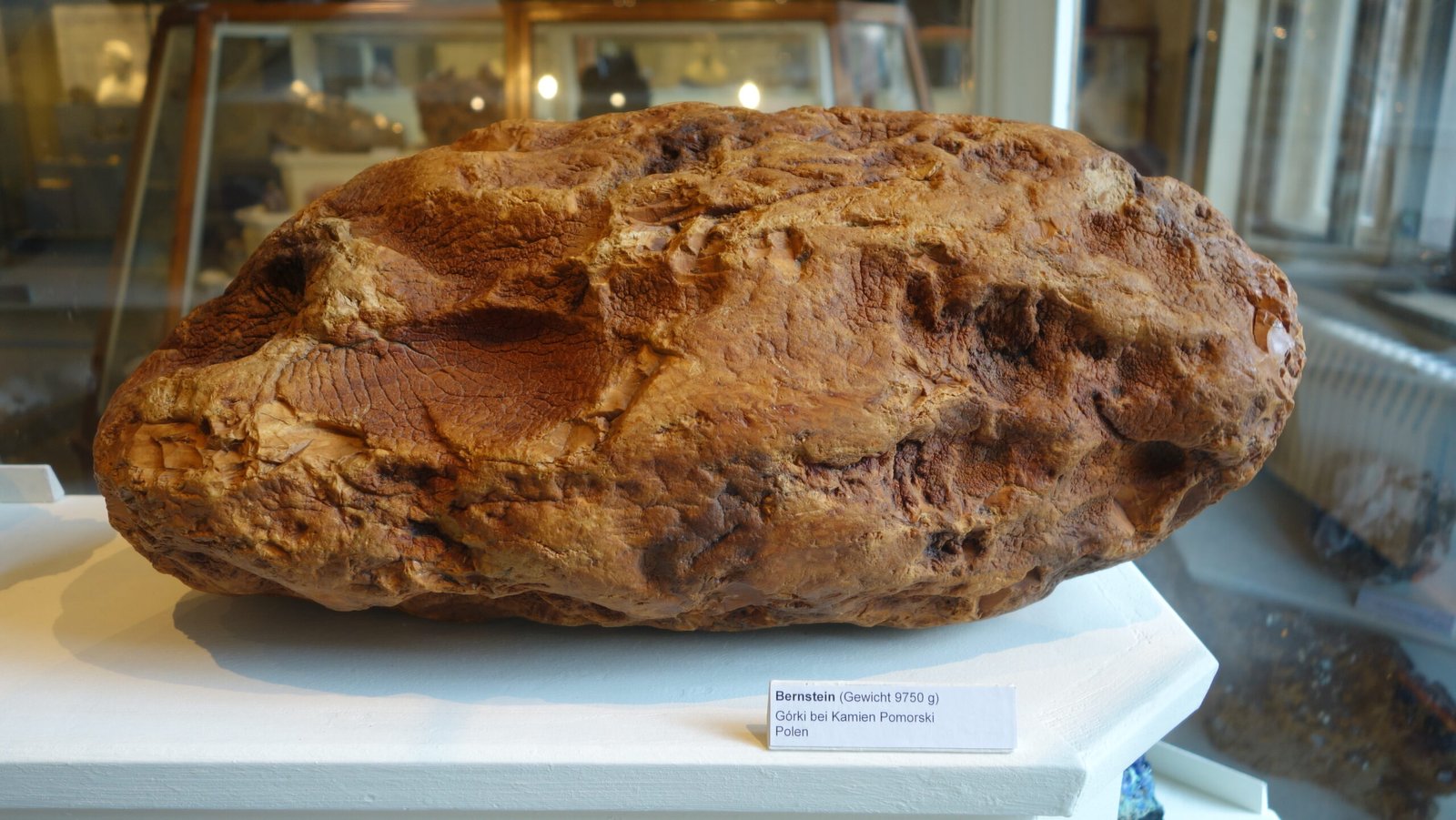
Amber is not a mineral at all. It is fossilised tree resin — organic material, tens of millions of years old, amorphous and very soft at only 2 to 2.5 on the Mohs scale. Baltic amber, the classic material, is roughly 44 million years old and contains succinic acid. Amber is warm to the touch, builds a static charge when rubbed — the Greek word for it, ēlektron, is the root of the word electricity — and it famously preserves trapped insects. In the crystal tradition it is a stone of warmth, vitality and protection. The two things every buyer needs are the saltwater float test and an awareness of copal and plastic sold in its place. One safety point matters more than any of that: amber teething necklaces are a genuine strangulation and choking hazard, and we say so plainly below.
Amber is the other great outsider on this site. Like opal, it is not a crystal — but it is not even a mineral. It is the hardened, fossilised resin of ancient trees, an organic substance that oozed from wounded conifers and broadleaf trees millions of years ago, was buried, and slowly polymerised into the golden material we prize today. It has no crystal lattice, no chemical formula you can write cleanly, and a hardness so low you can scratch it with a copper coin. It is, in every sense, a fossil you can wear.
This guide covers what amber really is, why it feels warm when every stone feels cold, the insects sealed inside it, the long muddle between amber and copal, and the plastic imitations that flood the market — plus a safety note about teething jewellery that we will not soften.
What is amber?
Amber is fossilised tree resin — not sap, which is a different fluid entirely. Resin is the sticky, aromatic substance a tree exudes to seal a wound and defend against insects and fungi. Over millions of years, buried under sediment and subjected to heat and pressure, that resin loses its volatile components and polymerises, hardening into a stable, glassy solid. Material that has not completed this process is copal — younger, softer, immature resin — and the line between the two is a matter of age and degree.
Because it is organic and amorphous, amber is classed as a mineraloid rather than a mineral. Its Mohs hardness is only 2 to 2.5, which makes it one of the softest materials ever used as a gem — a fingernail is close, and everyday grit will mark it. Its specific gravity is very low, around 1.05 to 1.10, which is the basis of the single most useful authenticity test there is (see below). It is warm to the touch because it is a poor conductor of heat, so it does not pull warmth from your skin the way quartz or jade does.
Baltic amber, the most famous variety, is known mineralogically as succinite and contains a few per cent of succinic acid. It formed in the Eocene, around 44 million years ago, in vast forests that once covered the region of the modern Baltic Sea.
Amber meaning & history
Amber has been collected and worked for far longer than most gemstones — Palaeolithic amber beads are among the oldest surviving ornaments made by humans. Along the prehistoric Amber Road, it travelled south from the Baltic to the Mediterranean, valued as highly as gold.
Its most consequential property was noticed by the Greeks: rub a piece of amber on wool and it attracts feathers and dust. Their word for amber, ēlektron, became the seventeenth-century Latin electricus and, in time, the English words electric and electricity. The entire vocabulary of the electrical age descends from a lump of fossil resin.
Across cultures amber carried associations with the sun, with light captured and held, and with protection — a warm, glowing amulet against harm. Those readings feed directly into how the crystal tradition uses it today.
Amber healing properties
In the crystal tradition, amber is valued as a stone of warmth, vitality and protection — a solar, life-affirming material.
People typically turn to amber for:
- Warmth and vitality. The classic association — energy, brightness, a lift in low spirits.
- Protection. One of the oldest amulet materials, traditionally worn to guard the wearer.
- Grounding light. Read as a gentle solar-plexus stone, steadying rather than stimulating.
- Clearing. Traditionally described as drawing off heaviness and lightening mood.
These are traditional and symbolic uses, not medical claims. Amber is widely sold as teething jewellery for babies, on the theory that succinic acid absorbed through the skin relieves pain. There is no scientific evidence for this, the amounts involved are negligible, and — far more importantly — amber necklaces are a real strangulation and choking hazard. Paediatric bodies and safety regulators have issued repeated warnings and recorded infant deaths. Please do not put an amber necklace on a baby. More broadly, no crystal treats, cures or prevents any illness, and nothing here is intended to diagnose or treat any condition; health concerns belong with a doctor.
Amber, the chakras & zodiac
Amber’s warm golden colour places it at the solar plexus chakra (Manipura), the traditional seat of personal power and vitality, and sometimes at the sacral chakra (Svadhisthana) for its creative, life-giving associations. Cognac and cherry material is read as more grounding, pale honey amber as lighter and more uplifting. For the wider framework, see our guide to the seven chakras and their crystals.
By zodiac, amber is most often linked to Leo, the sun-ruled sign, and sometimes to Taurus. It shares its solar, golden character with citrine, another warm stone often used for the same intentions.
How to use amber
- Wear it as jewellery. The oldest use — a warm pendant or beads worn against the skin.
- Keep a piece in the light. Amber glows; a specimen on a sunny sill (briefly) is genuinely cheering.
- Hold it in meditation. At the solar plexus, for warmth and steadiness.
- Choose it for its inclusions. A piece with a trapped insect is a 40-million-year-old snapshot — a remarkable object to hold.
- Handle it gently. At 2–2.5 Mohs it scratches easily; keep it away from keys, harder stones and abrasives.
- Never on a baby. See the safety note above.
How to cleanse & charge amber
Amber is soft and chemically sensitive, so gentleness is the whole rule.
- Water. A quick wipe with a soft damp cloth. Do not soak it, and never use hot water.
- Avoid all chemicals. Perfume, hairspray, alcohol, solvents and household cleaners all attack amber and dull its surface. Put jewellery on last, after scent.
- Never use ultrasonic or steam cleaners. They will damage it.
- Moonlight. A gentle overnight charge, with no risk.
- Smoke. Sage, palo santo or incense — pass it through, keep it away from the heat.
- Selenite or sound. Contact-free and completely safe.
- Keep it out of prolonged heat and strong sun. Amber can darken, craze and dry out over time.
Types & origins
- Baltic amber (succinite). The classic, from the coasts of the Baltic Sea — Poland, Lithuania, Kaliningrad. Honey to cognac, containing succinic acid, and the benchmark material.
- Dominican amber. From the Dominican Republic, younger and often exceptionally clear, famous for insect inclusions and for the rare, prized blue amber that fluoresces under ultraviolet light.
- Burmese amber (burmite). Very old amber from Myanmar, of great scientific interest for its inclusions — though its trade raises serious ethical and provenance concerns that a buyer should weigh.
- Green amber. Usually natural amber that has been heat- and pressure-treated to develop a green colour; the treatment should be disclosed.
- Copal. Young, immature resin — genuine and attractive, but not true amber, and frequently sold as if it were.
Is amber rare or valuable?
Most amber is affordable, which is part of its charm. Value rises with clarity, colour and inclusions: clear cherry and cognac material commands more than cloudy amber, natural blue Dominican amber is genuinely rare and expensive, and a specimen containing a well-preserved insect or an unusual creature can be worth a great deal to collectors and palaeontologists alike. Because it is soft and easily imitated, amber is bought to be enjoyed rather than as an investment for a non-specialist.
Real vs fake — copal, plastic & pressed amber
Amber is one of the most imitated gem materials, and the substitutes range from honest to fraudulent.
- The saltwater float test. The most useful test you can do at home. Dissolve about two tablespoons of salt in a cup of water. Real amber floats in saturated saltwater; most plastics and glass sink. Rinse the piece afterwards, and note this works on loose beads, not mounted jewellery.
- Plastic imitations. Bakelite, celluloid, casein and modern resins are all sold as amber. They usually feel colder, sink in saltwater, and smell of chemicals or nothing when a hot needle is touched to an inconspicuous spot — whereas real amber smells of pine resin and incense.
- Copal. Young resin, genuinely natural but not fossilised. It is softer, dissolves or goes tacky with a drop of acetone (real amber resists it briefly), and its insect inclusions are often suspiciously fresh and complete.
- Pressed amber (ambroid). Small fragments of real amber heated and compressed into a solid block. It is real amber, but reconstituted, and should be sold as pressed — under magnification it often shows elongated, swirled flow-lines and clusters of tiny bubbles.
- Glass. Cold, hard, sinks, and cannot be scratched by a coin. Rare now, but it exists.
- Fake inclusions. Modern insects set into plastic or copal are a common giveaway of a fake — a real 40-million-year-old inclusion is usually partial, darkened and surrounded by tiny stress fractures.
The workable rule: float it, warm a hidden spot, and rub it. Real amber floats in brine, smells of pine when heated, and builds a static charge that lifts a scrap of paper.
Genuine, correctly identified amber
If you’d like a piece of your own, Minerals Kingdom offers authenticated natural amber — with the material properly described rather than confused with copal or resin.