
Kyanite
The bladed blue crystal of alignment — the stone said never to need cleansing, and the only common mineral with two hardnesses.
Aluminium silicate · The alignment stone
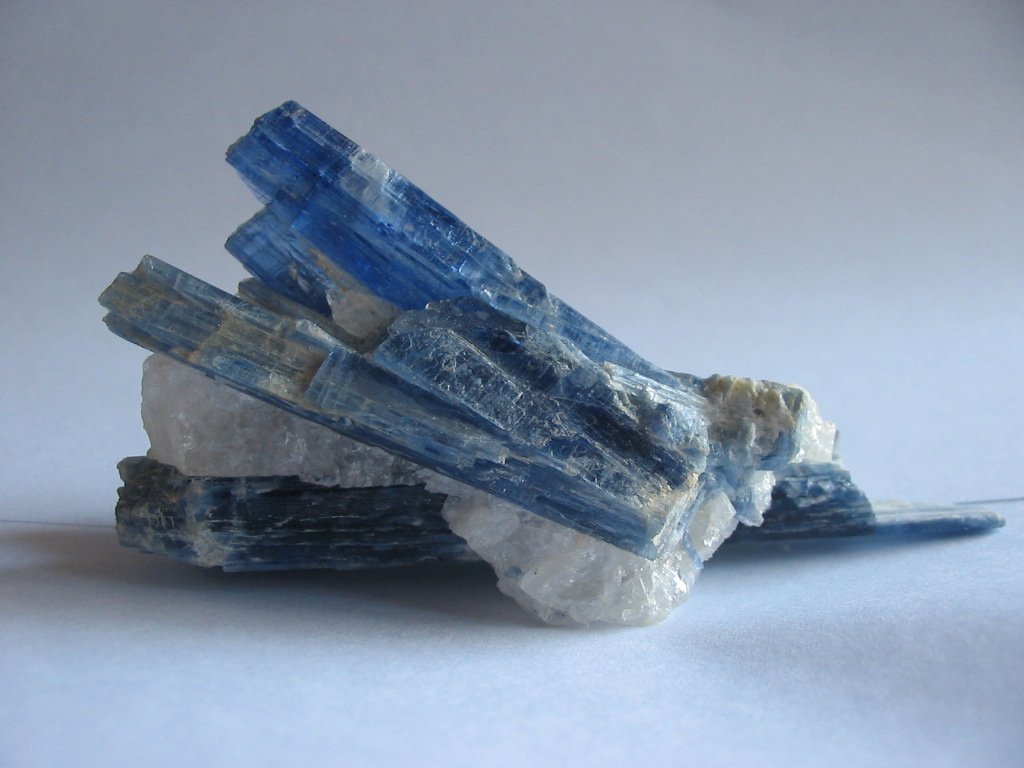
Kyanite is an aluminium silicate (Al₂SiO₅) that grows in long, flat blades of streaked blue. It has a genuinely strange property: it is softer along the blade than across it — roughly 4.5 lengthways, up to 7 crossways. In the crystal tradition it’s the stone of alignment and clear communication, and one of the very few said to never need cleansing. It’s brittle, cleaves easily, and dislikes water. Below — meaning, how to use it, how to handle a fragile crystal, and why the “self-cleansing” claim is worth examining.
Kyanite does not look like other crystals. It grows in flat, splintered blades, striated along their length, in a blue that shifts from ink to pale sky within a single crystal. Run a fingernail down the blade and it will mark; drag it across and it will not. That one oddity — a mineral with two different hardnesses depending on direction — is the reason it was called disthene in French, “two strengths.”
This guide covers what kyanite actually is, where its reputation for alignment comes from, how people use it, how to look after a crystal that splits if you look at it wrong, and what to make of the claim that it never needs cleansing.
What is kyanite?
Kyanite is aluminium silicate, Al₂SiO₅ — chemically identical to andalusite and sillimanite, but with the atoms packed differently. It forms in metamorphic rocks under high pressure, which is why geologists use its presence as a pressure indicator: find kyanite, and you know the rock has been deep.
Its famous property is anisotropic hardness. Along the blade it is about 4.5 on the Mohs scale — softer than glass. Across the blade, up to 7. The Greek kyanos, dark blue, gave it its English name; the older French name disthène named the anomaly instead.
It also has perfect cleavage. It splits cleanly along its length under a modest knock. Fine material comes from Brazil, Nepal and Zimbabwe.
Kyanite meaning & history
Kyanite was described in 1789 and has, like most metamorphic minerals, no ancient folklore at all. Its industrial career is longer than its spiritual one: it is used to make refractory ceramics, spark plugs and furnace linings, because it withstands enormous heat.
In the modern crystal tradition, the blades themselves suggested the meaning. A crystal that grows in straight, parallel lines became a stone of alignment — of the chakras, of the spine, of intention with action. And its bright blue placed it at the throat and the third eye, for clear speech and clear seeing.
Kyanite carries one further claim that sets it apart: that it never accumulates negative energy and therefore never needs cleansing. This idea appears to originate in Katrina Raphaell’s crystal books of the 1980s and has been repeated ever since. It is a claim about a category that cannot be measured, so it can be neither confirmed nor refuted — which is a different thing from being true.
Kyanite healing properties
In the crystal tradition, kyanite is valued as a stone of alignment, communication and clarity.
People typically turn to kyanite for:
- Alignment. The classic stone for balancing the chakras.
- Clear communication. A throat-chakra stone for honest, direct speech.
- Meditation. Said to quiet mental chatter quickly.
- Dream recall. Placed near the bed by some practitioners.
These are traditional and symbolic uses, not medical claims. Kyanite is sometimes sold for the throat, the spine or the nervous system. There is no scientific evidence that any crystal treats illness or affects the body. Chakras are a metaphysical framework, not an anatomical one. Enjoy kyanite as a striking mineral and a focus for reflection; nothing here is intended to diagnose or cure any condition.
Kyanite, the chakras & zodiac
Blue kyanite works at the throat chakra (Vishuddha) and the third eye (Ajna) — expression and perception. Its other colours are read differently: black kyanite at the root, green at the heart, orange at the sacral. The blades are frequently laid along the body in “alignment” layouts, one per centre.
By zodiac it’s linked to Aries, Taurus and Libra. It is not a birthstone.
How to use kyanite
Most uses revolve around clarity and alignment.
- Lay blades along the body. The classic chakra-alignment layout.
- Hold it in meditation. Flat against the palm, not gripped.
- Keep it on the desk. Where its blue and its blades can be seen.
- Wear it carefully. A kyanite pendant is possible, but the stone is brittle.
- Use it to cleanse other stones. The tradition’s most distinctive use.
- Never put it in a pocket with keys. It will split.
How to cleanse & charge kyanite
The tradition says it does not need cleansing. The mineral says: please do not soak me.
- Smoke. Sage, palo santo or incense — safe and dry.
- Moonlight. A gentle overnight charge.
- Selenite. Rest it on a plate, if you like.
- Dry brush. A soft brush along the blade, never across it.
- Nothing at all. Which is what the tradition itself recommends.
Avoid water and long soaks: kyanite blades are bladed and micaceous, and water works into the cleavage planes. Avoid ultrasonic cleaners absolutely — they will shatter it. Handle it flat, never edge-on, and store it apart from harder stones.
Types & colours
- Blue kyanite. The classic, streaked and translucent.
- Black kyanite. Fan-shaped sprays, sometimes called “witch’s broom”.
- Green kyanite. Coloured by vanadium; scarce.
- Orange kyanite. Manganese-bearing, from Tanzania. Genuinely rare.
Is kyanite rare or valuable?
Rough blue kyanite blades are inexpensive. Prices climb for large, clean, evenly coloured blades, for orange and green material, and — very steeply — for the rare gem-quality faceted kyanite, which is difficult to cut precisely because of its two hardnesses and its cleavage. Few cutters will attempt it.
Quality comes down to colour saturation, translucency and intact edges. A blade with a fresh split is worth much less than one that has survived intact.
How to tell real kyanite from fake
Kyanite is cheap enough that outright fakes are rare. Confusion is the real risk.
- Test the two hardnesses. The definitive test. A steel pin marks the blade lengthways but not crossways. No other common mineral does this.
- Look for striations. Fine parallel lines run along the length of every blade.
- Vs blue tourmaline or sapphire. Both are far harder and do not form flat blades.
- Vs dyed quartzite. Uniform colour, no bladed habit, no cleavage.
- Beware “self-cleansing” as a sales pitch. It is a tradition, not a property, and it is sometimes used to justify a premium.
Genuine, ethically sourced kyanite
If you’d like a piece of your own, Minerals Kingdom offers authenticated natural kyanite — blades, fans and pendants.