Howlite
The white, grey-veined stone of stillness — the calm-mind crystal, and the most impersonated mineral on earth.
Borate · The stillness stone
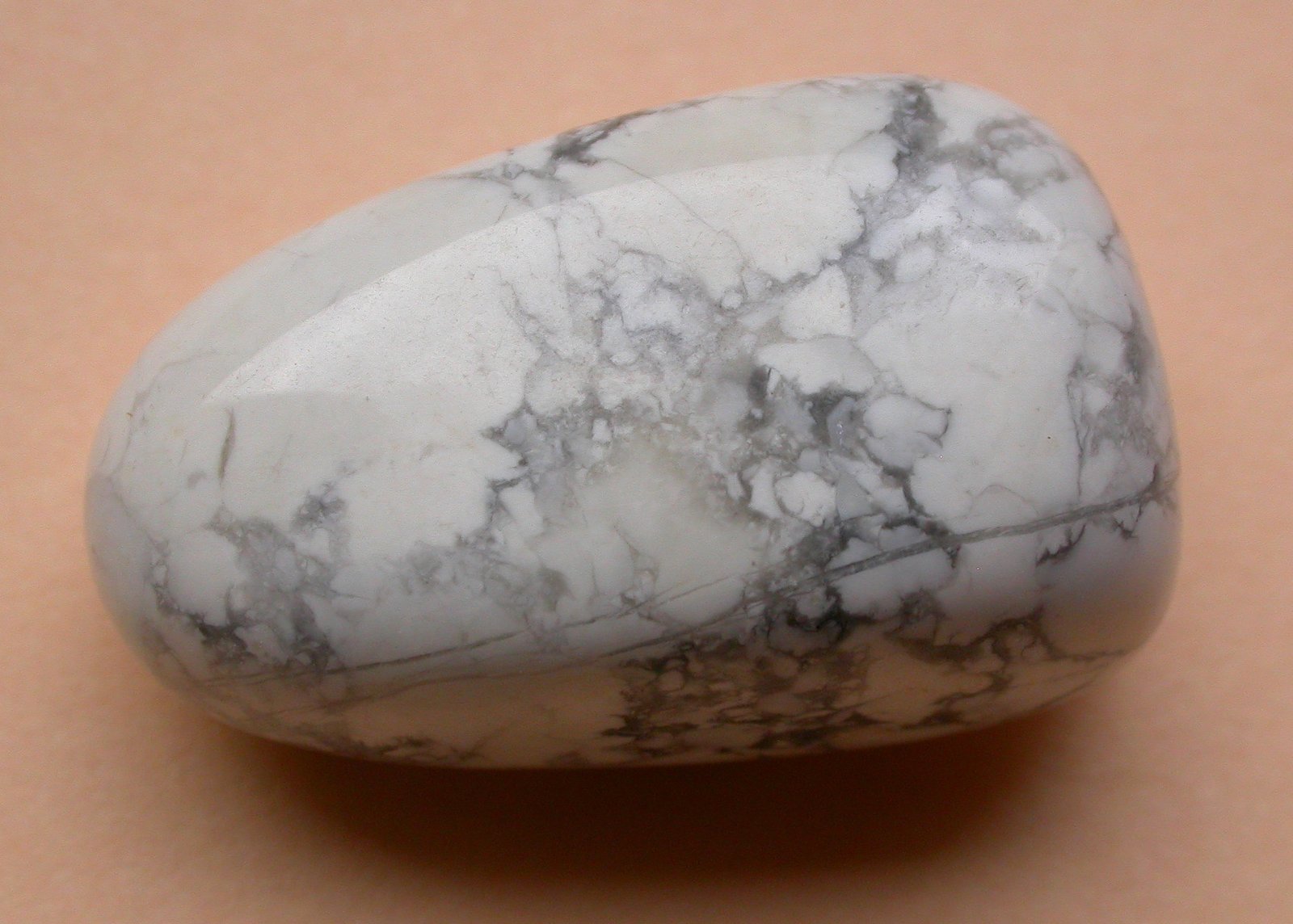
Howlite is a calcium borosilicate, chalk-white and threaded with grey veins that look like ink in marble. In the crystal tradition it’s a stone of stillness and quiet mind — reached for at bedtime and in meditation. It is very soft (3.5 Mohs) and porous, which is precisely why it has become the crystal world’s great impostor: dyed blue and sold as turquoise, dyed almost every colour and sold as almost everything. Below — meaning, how to use it, how to keep it, and how to recognise it wearing someone else’s name.
Howlite has an odd double life. In its own right it is a quiet, undemanding stone: white as a beach pebble, veined in grey, cool in the hand, sold cheaply and reached for at bedtime. And under other names it is everywhere — the “turquoise” on a market stall, the “lapis” in a cheap bracelet, the “red coral” that has never seen the sea. Learn to recognise howlite and you will start seeing it in the strangest places.
This guide covers what howlite actually is, where its calm reputation comes from, how people use it, how to care for a very soft stone, and how to spot it wearing a disguise.
What is howlite?
Howlite is a calcium borosilicate hydroxide. It forms in nodules that look startlingly like cauliflower heads, in the borate deposits of dry lake beds. The grey veins are the host rock, trapped as the nodule grew.
It was discovered near Windsor, Nova Scotia, in 1868 by the Canadian chemist and geologist Henry How, who first called it “silico-boro-calcite”. It was later renamed for him. Most commercial howlite today comes from California.
Two facts govern everything else. It is very soft — 3.5 on the Mohs scale, softer than a copper coin. And it is porous, drinking up dye like a sugar cube. Those two properties made it a bead-maker’s dream and a buyer’s problem.
Howlite meaning & history
Howlite has no ancient tradition — it was only named in the nineteenth century, and it was almost immediately put to work as an imitation. There is no lore, no Roman talisman, no legend. Its meaning is entirely a product of the twentieth-century crystal revival, and it was assigned, once again, from appearance: white is calm, so howlite is calm.
The tradition made it a stone of stillness, patience and sleep — the crystal you put under the pillow when your thoughts will not stop. It is also read as a stone that absorbs anger, one’s own and other people’s, which is a nice image for a mineral that absorbs dye so readily.
Howlite healing properties
In the crystal tradition, howlite is valued as a stone of calm, patience and quiet mind.
People typically turn to howlite for:
- Sleep. The classic under-the-pillow stone for a racing mind.
- Patience. Carried by people prone to irritation.
- Calm. Said to soothe anger, one’s own and others’.
- Meditation. A crown-chakra stone for stillness.
These are traditional and symbolic uses, not medical claims. Howlite is often sold for insomnia and anxiety. There is no scientific evidence that any crystal affects sleep or treats illness. Persistent insomnia has real, treatable causes and is worth discussing with a doctor. Enjoy howlite as a calming ritual and a pretty object; nothing here is intended to diagnose or cure any condition.
Howlite, the chakras & zodiac
Howlite is linked to the crown chakra (Sahasrara), the seat of stillness and awareness — which is why it is placed at the head, or under the pillow, rather than worn. Its white, unassertive colour is read as clarity without stimulation.
By zodiac it’s most often associated with Gemini, whose restless mind it is said to settle. It has no birthstone month.
How to use howlite
Most uses revolve around quiet.
- Put it under your pillow. The classic use, and the one it is bought for.
- Hold it when angry. A cool, smooth stone to grip while the feeling passes.
- Keep it on the nightstand. Where you can see it before sleep.
- Use it in meditation. Rested at the crown or held loosely.
- Wear it as beads. A howlite bracelet — but expect it to scuff.
- Keep it away from bathrooms. Damp and porous stone do not mix.
How to cleanse & charge howlite
Howlite is soft and porous. Treat it as you would chalk.
- Smoke. Sage, palo santo or incense — the safest option.
- Moonlight. A gentle overnight charge.
- Selenite. Rest it on a selenite plate.
- Sound. A singing bowl, for beads.
- Dry cloth. Wipe it; do not scrub it.
Avoid water — a soak will dull the polish and, on dyed pieces, will bleed colour. Avoid salt water absolutely, and skip ultrasonic cleaners. Keep it out of direct sun, which yellows white stones. Cleanse it after restless nights.
Types & the dye problem
Howlite comes in one natural colour: white with grey veins. Everything else is dye.
- “Turquenite” or “white turquoise”. Blue-dyed howlite, sold as turquoise. Extremely common.
- “Blue howlite”. The same thing, more honestly named.
- Dyed red, green, purple, black. Sold as coral, jade, sugilite, onyx.
- Magnesite. A different mineral with the same porous, veined look, dyed the same way.
Dyeing is not the crime. Selling dyed howlite as turquoise, at turquoise prices, is. Under EU consumer law that silence is a misleading commercial practice — and it is the single most common deception in the crystal trade.
Is howlite rare or valuable?
Howlite is abundant and very cheap. Tumbles cost pennies. Nothing about it is scarce, and no honest seller will price it otherwise.
This is worth stating plainly, because howlite’s low value is the whole reason it is dyed. Turquoise from a good deposit costs many times more. When a “turquoise” bracelet costs five euros, arithmetic has already answered your question.
How to tell real howlite (and howlite pretending to be something else)
Two different questions. Both are easy.
- Is it howlite? White, grey-veined, and it scratches with a fingernail or a coin. At 3.5 Mohs it is softer than almost anything else you own.
- Is your “turquoise” actually howlite? Look at the veins. Howlite’s are fine, grey and web-like; real turquoise matrix is browner, blacker, and follows different lines. Turquoise is also harder (5–6).
- Look in the cracks. Dye pools in fissures. Colour that is darker inside a crack than on the surface is dye.
- Acetone on a cotton bud. On a discreet spot. A blue trace on the cotton settles it.
- Check the price. The most reliable test in the entire crystal trade.
Genuine, undyed howlite
If you’d like a piece of your own, Minerals Kingdom offers natural howlite, sold under its own name — tumbles, beads and palm stones.