Blue Lace Agate
The soft, banded sky-blue stone of gentle speech — a quiet throat-chakra crystal for calm words and easier conversations.
Chalcedony · The gentle communicator
Blue lace agate is a banded variety of chalcedony — microcrystalline quartz — laid down in delicate ribbons of pale blue and white. In the crystal tradition it’s the gentlest of the throat-chakra stones, reached for when speech feels difficult: for calm words, soft honesty and quiet confidence. It’s durable (6.5–7 Mohs) and water-safe, though its colour prefers shade. The finest material comes almost entirely from a single Namibian deposit. Below — meaning, how to use it, how to keep it, and how to spot dyed agate sold under its name.
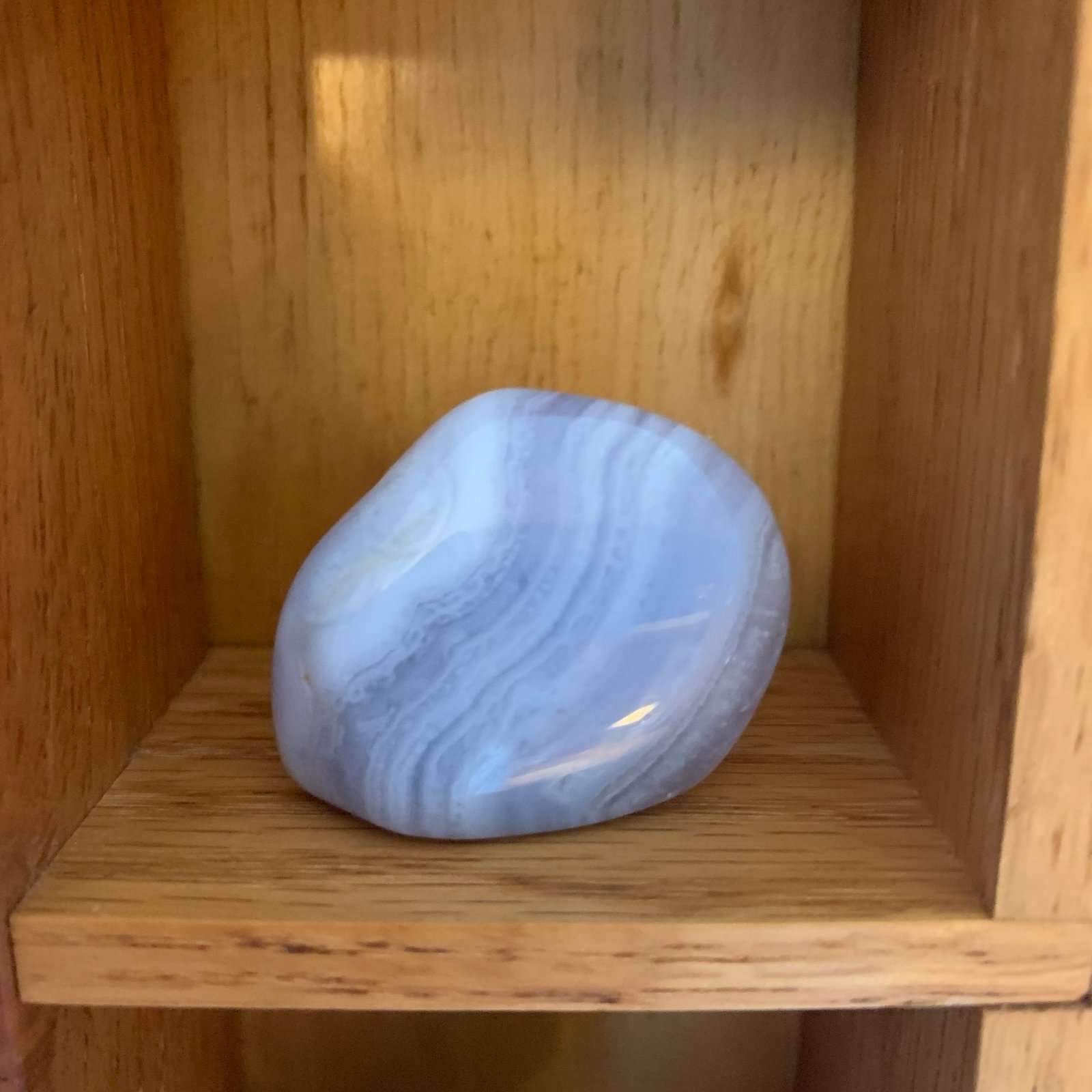
Some crystals announce themselves. Blue lace agate does not. Its blue is barely there — a pale, powdery sky threaded with white bands that look genuinely like lace, drawn in fine parallel lines by mineral-rich water seeping through a cavity, layer after layer, over an unimaginable stretch of time. It is a stone people reach for when they need to say something difficult and want to say it kindly.
This guide covers what blue lace agate actually is, where its reputation for gentle speech comes from, how people use it, how to care for it, and how to tell the real thing from the dyed agate that floods the market.
What is blue lace agate?
Blue lace agate is a variety of agate, which is itself a banded form of chalcedony — quartz so finely crystalline that the individual crystals are invisible. Its pale blue comes from trace elements and from the way light scatters through the microscopic fibres; the white bands are simply layers of differing density.
The bands record its formation. Silica-rich water filled a gas bubble in volcanic rock and deposited layer upon layer against the cavity wall, each with a slightly different chemistry. The lace is a stratigraphy, not a decoration.
It is hard and tough, 6.5 to 7 on the Mohs scale, and it takes a fine polish. The world’s finest material — and by a wide margin most of what you will ever see — comes from a single locality in Namibia, near Ysterputz. This is worth knowing: the supply is genuinely finite.
Blue lace agate meaning & history
Agate has been carved and worn since antiquity — the name comes from the Achates river in Sicily, where Theophrastus described it in the third century BC. But blue lace agate itself is a modern stone. It was only identified as a distinct material in the twentieth century, when the Namibian deposit was worked.
That matters, and it’s rarely said. Blue lace agate has no ancient lore. Its associations — gentleness, soft speech, calm — were assigned in the twentieth-century crystal-healing revival, largely on the basis of how it looks. A pale, cool, softly banded blue stone looks gentle, so gentleness became its meaning. That is an honest account of where the tradition comes from, and it takes nothing away from the pleasure of holding one.
Blue lace agate healing properties
In the crystal tradition, blue lace agate is valued as a stone of calm, gentle expression and soothing.
People typically turn to blue lace agate for:
- Gentle communication. The classic stone for saying hard things kindly.
- Calm. A soothing presence for anxiety and racing thoughts.
- Confidence in speech. Carried before presentations or difficult calls.
- Emotional cooling. Reached for after arguments, to settle.
These are traditional and symbolic uses, not medical claims. Blue lace agate is sometimes marketed for the throat, the thyroid or for stammering — there is no scientific evidence that any crystal treats illness or affects speech. If speaking causes you real distress, a speech therapist or a doctor can help in ways a stone cannot. Enjoy blue lace agate as a calming ritual and a beautiful object; nothing here is intended to diagnose or cure any condition.
Blue lace agate, the chakras & zodiac
Blue lace agate belongs to the throat chakra (Vishuddha), the centre of expression. Where lapis lazuli is associated with declaring truth and aquamarine with courage, blue lace agate is the softest of the three — the one for the conversation you have been avoiding, not the speech you have to give.
By zodiac it’s most often linked to Pisces and Gemini. It’s not a birthstone, but it is a thoughtful gift for anyone who finds speaking up hard.
How to use blue lace agate
Most uses revolve around calm, gentleness and easier speech.
- Hold it before a difficult conversation. The classic use, and the simplest.
- Wear it at the throat. A blue lace agate pendant sits over the throat chakra.
- Keep a tumble in your pocket. A cool, smooth anchor to reach for when tense.
- Place it by the bedside. A quiet presence for a restless mind.
- Use it in meditation. Rested at the throat, for stillness.
- Give it after a falling-out. A small gesture toward repair.
How to cleanse & charge blue lace agate
As a quartz, blue lace agate is easy to care for — with one caveat about light.
- Water. A brief rinse under cool running water is perfectly safe.
- Moonlight. A gentle overnight charge suits its cool colour.
- Smoke. Sage, palo santo or incense.
- Selenite. Rest it on a selenite plate.
- Sound. A singing bowl for beads and small pieces.
Avoid prolonged direct sunlight. The pale blue of some agates fades with sustained UV exposure, and this one has little colour to spare. Avoid ultrasonic cleaners on fractured pieces. Cleanse it after tense days or heavy conversations.
Types & patterns
The lace itself is what collectors judge:
- Fine lace. Tight, closely spaced bands — the most prized pattern.
- Eye or fortification. Concentric rings where the cavity was rounded.
- Blue chalcedony. Unbanded pale blue material, sold separately and often confused with it.
- Druzy pockets. Small vugs lined with sparkling quartz crystals.
Is blue lace agate rare or valuable?
It is affordable but not abundant. Tumbles and small slices cost very little. What drives price is pattern: tight, high-contrast lacing on a well-cut cabochon commands a real premium, and large clean slabs are increasingly hard to find.
The single-deposit story is the honest one here. Because most fine material comes from one Namibian source, quality material has become steadily scarcer and pricier over the last two decades. This is not marketing: it is a mine with a finite amount of rock in it.
How to tell real blue lace agate from fake
The common deception is not glass. It is dyed grey agate, sold as the real thing.
- Look at the blue. Natural blue lace agate is pale, dusty and slightly grey. A vivid, saturated blue is dye.
- Check the bands. Dye concentrates in the more porous layers, producing unnaturally sharp colour contrast between bands.
- Look at fractures. Dye pools in cracks. A colour that is deeper in the fissures than on the surface is a giveaway.
- Acetone on a cotton bud. On a discreet spot, a blue trace on the cotton means dye.
- Hardness. It is quartz: it scratches glass. A stone scratched by a knife is not agate.
Dyed agate is not illegal, and many sellers disclose it honestly. The problem is silence, not the dye.
Genuine, ethically sourced blue lace agate
If you’d like a piece of your own, Minerals Kingdom offers authenticated natural blue lace agate — tumbles, cabochons and pendants.